USP <800> Readiness and Planning Nick Hopkins, PharmD Discuss - - PDF document

usp 800 readiness and planning
SMART_READER_LITE
LIVE PREVIEW

USP <800> Readiness and Planning Nick Hopkins, PharmD Discuss - - PDF document

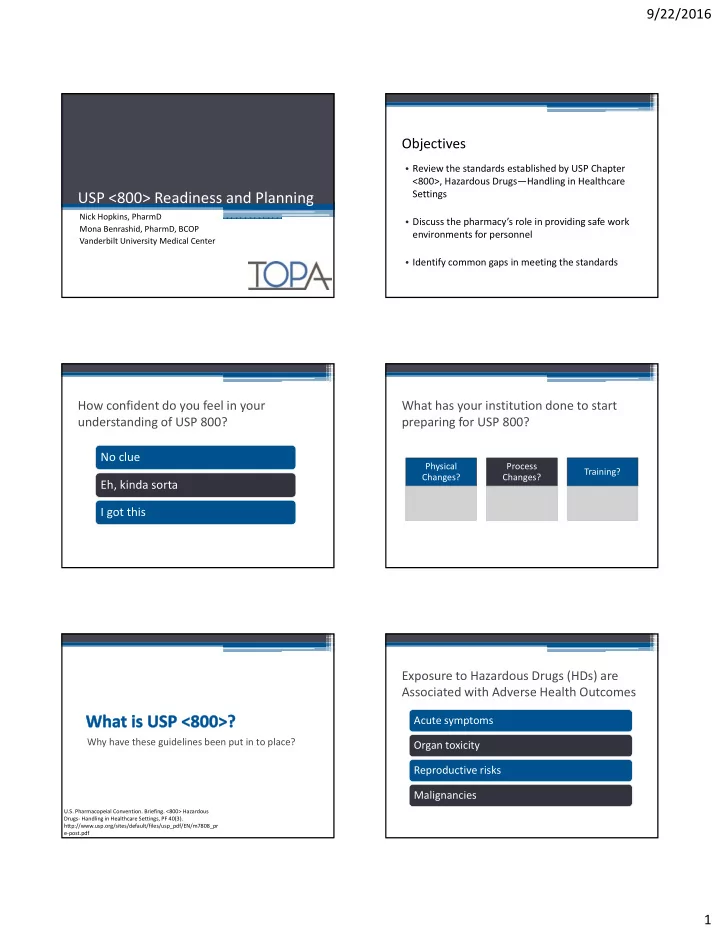
9/22/2016 Objectives Review the standards established by USP Chapter <800>, Hazardous DrugsHandling in Healthcare Settings USP <800> Readiness and Planning Nick Hopkins, PharmD Discuss the pharmacys role in providing safe


slide-1
SLIDE 1

9/22/2016 1

USP <800> Readiness and Planning

Nick Hopkins, PharmD Mona Benrashid, PharmD, BCOP Vanderbilt University Medical Center

Objectives

  • Review the standards established by USP Chapter

<800>, Hazardous Drugs—Handling in Healthcare Settings

  • Discuss the pharmacy’s role in providing safe work

environments for personnel

  • Identify common gaps in meeting the standards

How confident do you feel in your understanding of USP 800?

No clue Eh, kinda sorta I got this

What has your institution done to start preparing for USP 800?

Physical Changes? Process Changes? Training?

Why have these guidelines been put in to place?

U.S. Pharmacopeial Convention. Briefing. <800> Hazardous Drugs‐ Handling in Healthcare Settings, PF 40(3). http://www.usp.org/sites/default/files/usp_pdf/EN/m7808_pr e‐post.pdf

Exposure to Hazardous Drugs (HDs) are Associated with Adverse Health Outcomes

Acute symptoms Organ toxicity Reproductive risks Malignancies

slide-2
SLIDE 2

9/22/2016 2

1999 Investigation of Pregnancy Loss Associated with Exposure to Antineoplastic Drugs

Outcomes Definitions Miscarriage Failed pregnancy in first 20 weeks Stillbirth Failed pregnancy after 20 weeks’ gestation Elective abortion Per respondent report Live birth Either single or multiple live births *7,094 pregnancies of pharmacy and nursing staff

Exposed mother: Increased risk for miscarriages by 40‐50% Increased risk for low birth weight by 17‐fold Increased risk for congenital malformations by 5‐fold Exposed father: Patterns of increased risk were similar, though not statistically significant

Valanis B; Vollmer WM; Steele P. Occupational Exposure to Antineoplastic Agents: Self‐Reported Miscarriages and Stillbirths Among Nurses and Pharmacists. J of Occupational and Enviornmental Medicine. 1999; 41(8)632‐8

To Whom Does <800> Apply?

  • All healthcare personnel who handle HD preparations

and all entities that store, prepare, transport, or administer HDs

▫ Hospitals ▫ Physician practices ▫ Retail pharmacies ▫ Home infusion facilities ▫ Veterinarian practices ▫ Government health clinics ▫ Prisons/jails ▫ Emergent care clinics

Enforceable by Boards of Pharmacy, The Joint Commission, CMS, and all

  • ther regulatory boards.

USP <800> Overview

  • Hazardous drug list
  • Designated expert
  • Education and training
  • Documentation and standard
  • perating procedures (SOPs)
  • Facilities design
  • Environmental design
  • Environmental quality and

control

  • Personal Protective Equipment

(PPE)

  • Procurement/receiving
  • Compounding
  • Labeling and packaging
  • Transport
  • Disposal
  • Administration
  • Deactivation, decontamination,

cleaning and disinfecting

  • Medical surveillance

Important USP Terminology

Must

  • “Be commanded or requested to”

Should

  • “To express a request in a polite manner”

Antineoplastic

  • Inhibiting or preventing the growth and spread of

neoplasms or malignant cells

  • Refer to Table 1 of NIOSH Hazardous List

High‐Level Oversight Requirements

  • Hazardous drug list

▫ NIOSH ▫ Annual review

 Should be reviewed whenever a new agent or dosage form is used

▫ Assessment of risk (reviewed annually)

  • Designated expert

▫ Development and implementation procedures ▫ Oversight of compliance ▫ Oversight of monitoring the facility and maintenance of reports, testing/sampling, and action on results

  • Policies and SOPs
  • Education and Training

Facilities Design

  • Receiving and Unpacking

▫ MUST be unpacked in an area that is neutral/normal pressure ▫ MUST not be unpacked from external shipping containers in sterile compounding areas or in positive pressure areas

slide-3
SLIDE 3

9/22/2016 3 Facilities Design

  • Storage

▫ Prevent spillage or breakage in case the container falls ▫ Do NOT store on floor ▫ Precautions for natural disasters ▫ Antineoplastic HDs that require manipulation other than counting/repackaging final dosage forms:

 Store separate from non‐HDs  Negative‐pressure room, externally ventilated  Refrigerated antineoplastic HDs: dedicated refrigerator in a negative‐pressure area

Facilities Design

  • Compounding

▫ Sterile and nonsterile HDs MUST be compounded within a containment primary engineering control (C‐ PEC) located in a containment secondary engineering control (C‐SEC)

 C‐SEC (room) MUST

 Be externally vented  Be physically separated  Have an appropriate air exchange  Have a negative pressure between 0.01 and 0.03 inches of water column

Facilities Design

  • Nonsterile compounding required to be performed

in a C‐PEC unless handling only final dose forms that do not produce particles, aerosols or gases

  • Sterile compounding requirements:

▫ All <797> requirements ▫ MUST not use LAFW and MUST not compound non‐ HDs in hazardous C‐PEC unless the prep is placed in wrapper and labeled (as hazardous) to require PPE

Personal Protective Equipment (PPE)

When Required What’s Required

Sterile AND Non‐sterile compounding Gown (to be changed every 2‐3 hrs, or as stated by manufacturer) Head/hair cover Two pairs shoe covers Two pairs chemo gloves (changed at least every 30 min) Administration of antineoplastics Two pairs chemo gloves ***Other PPE as defined by standards other than USP Handling ALL HDs (receiving, unpacking, checking, etc.) Chemo gloves Risk of spills or splashes when working

  • utside of a C‐PEC (e.g. surgery, cleaning

spills) Goggles and/or face shield ‐Cleaning large spills ‐Deactivating, decontaminating and cleaning underneath the work surface of the C‐PEC ‐There is known or suspected airborne exposure to powders or vapors Full‐face piece, chemical cartridge‐type respirator or powdered air‐ purifying respirator (PAPR) (N‐95 NOT sufficient)

Compounding/Dispensing

  • Chemo mats SHOULD be used
  • Not only STERILE compounding

▫ Dedicated equipment (counting trays, spatulas, mortals & pestles) MUST be used ▫ Equipment SHOULD be decontaminated after every use ▫ Tablets and capsules MUST not be placed in automated counting or packaging machines

Labeling and Packaging

  • MUST have SOPs in place that address prevention of

accidental exposures or spills

▫ Closed System Transfer Devices (CSTDs) listed as an example of an exposure‐reducing strategy (SHOULD??)

  • MUST be clearly labeled at all times
  • MUST have SOPs in place that describe appropriate

shipping containers and insulating materials

slide-4
SLIDE 4

9/22/2016 4 Transport and Disposal

MUST be labeled, stored and handled in accordance with federal, state and local regulations Containers MUST minimize risk of breakage/leakage Pneumatic tubes MUST not be used to transport any liquid HDs or any antineoplastic HDs Personnel who perform custodial waste removal and cleaning MUST be trained to protect themselves and the environment to prevent contamination

Administration – Beyond the Walls of the Pharmacy

  • HDs MUST be administered safely using protective

medical devices and techniques.

▫ Examples of protective medical devices include:

 Needleless and closed systems

▫ Examples of protective techniques include:

 Spiking or priming IV tubing with non‐HD solution in a C‐ PEC  Crushing tablets in a plastic pouch

  • “Appropriate” PPE MUST be worn
  • CSTDs MUST be used for administration of

antineoplastic HDs when dosage form allows

Deactivation and Decontamination

Step Purpose Example Agents Deactivation Render compound inert or inactive Listed on labeling or other agents which may incorporate EPA‐registered

  • xidizers (e.g., peroxide formulations,

bleach, etc.) Decontamination Remove HD residue and transfer to absorbent, disposable materials Validated for HD decontamination including alcohol, water, peroxide, and bleach Cleaning Remove organic or inorganic material Germicidal detergent Disinfection (for sterile manipulation) Destroy microorganisms EPA‐registered disinfectant and/or sterile alcohol

Deactivation and Decontamination

  • Deactivation

▫ No one proven method to deactivate all compounds ▫ Ultimate goal is complete surface decontamination

  • Decontamination

▫ Work surface of C‐PEC MUST be decontaminated between compounding of different HDs ▫ C‐PEC MUST be decontaminated at least daily, any time a spill

  • ccurs, before and after certification, any time voluntary

interruption occurs, and if the ventilation tool is moved ▫ Under the work tray of C‐PEC MUST be decontaminated and cleaned at least monthly.

 Environmental wipe sampling SHOULD be performed at least every 6 months

Medical Surveillance

Purpose is to minimize adverse health effects by utilizing assessment and documentation of symptom complaints, physical findings, and lab values, looking for deviation from expected norms Potentially valuable early detection tool Is a SHOULD Lists guidance for development of a program and actions for follow up (both

  • n the level of the employee and the entity)

Summary

  • USP <800> sets guidelines to protect patients,

personnel and the environment from hazardous drug contamination

  • Proper planning prevents poor performance!
  • Anticipate guidelines to go into effect July 1, 2018
slide-5
SLIDE 5

9/22/2016 5

How confident do you feel in your understanding of USP 800?

No clue Eh, kinda sorta I got this

USP <800> Readiness and Planning

Nick Hopkins, PharmD Mona Benrashid, PharmD, BCOP Vanderbilt University Medical Center