Users Guide for Integrated Stormwater and Wastewater Planning - - PDF document

user s guide for integrated stormwater and wastewater
SMART_READER_LITE
LIVE PREVIEW

Users Guide for Integrated Stormwater and Wastewater Planning - - PDF document

2/16/2018 Users Guide for Integrated Stormwater and Wastewater Planning Tuesday, February 20, 2018 1:00 2:30 pm ET How to Participate Today Audio Modes Listen using Mic & Speakers Or, select Use Telephone and dial the


slide-1
SLIDE 1

2/16/2018 1

User’s Guide for Integrated Stormwater and Wastewater Planning

Tuesday, February 20, 2018 1:00‐2:30 pm ET

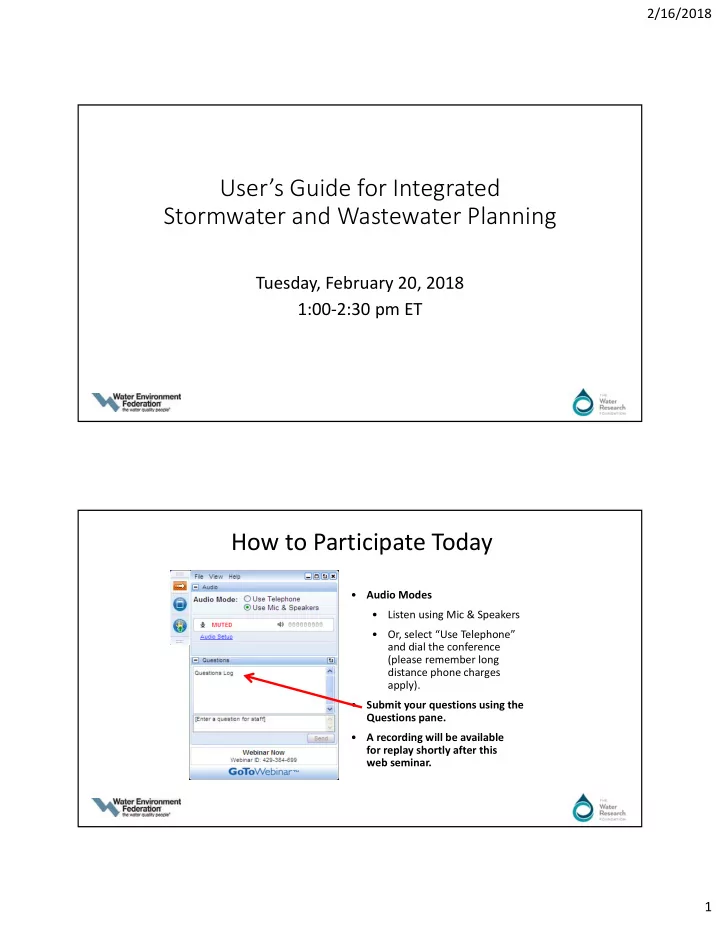
How to Participate Today

  • Audio Modes
  • Listen using Mic & Speakers
  • Or, select “Use Telephone”

and dial the conference (please remember long distance phone charges apply).

  • Submit your questions using the

Questions pane.

  • A recording will be available

for replay shortly after this web seminar.

slide-2
SLIDE 2

2/16/2018 2

Today’s Speakers

Adrienne Nemura, P.E. Geosyntec Consultants Phil Hubbard, P.E. Hampton Roads Sanitation District (VA) Jeff Rexhausen University of Cincinnati Economics Center Adam Blandford University of Cincinnati Economics Center

Agenda

1:00 Welcome and Introductions 1:10 Overview and Summary of SIWM9R14 Findings and Tool Adrienne Nemura, P.E., Geosyntec Consultants 1:25 Case Study Development for HRSD Phil Hubbard, P.E., HRSD 1:45 Summary of Community Insight Survey Adam Blandford & Jeff Rexhausen, University of Cincinnati Economics Center 2:10 Panel Discussion 2:20 Questions and Answers 2:30 Adjourn

slide-3
SLIDE 3

2/16/2018 3

WRF SIWM9R14 Project: Toolbox for Completing an Alternatives Analysis as Part of an Integrated Planning Approach to Water Quality Compliance

Adrienne Nemura, P.E. February 20, 2018 Webcast

Integrated planning relies on diverse tools to facilitate sustainable & comprehensive approaches

  • Social
  • Technical
  • Scientific
  • Stakeholder
  • Economic
slide-4
SLIDE 4

2/16/2018 4

QUALITY ASSURANCE PROJECT PLAN 69 COMMUNITIES COMMUNITY INSIGHT SURVEY

7

slide-5
SLIDE 5

2/16/2018 5

Community Priorities Barriers

  • Concerns of additional obligations
  • Increased enforcement risks
  • Uncertainty about outcomes
  • Lack of knowledge by state regulators
  • Lack of state flexibility or support
  • Lack of EPA flexibility
slide-6
SLIDE 6

2/16/2018 6

Peoria, IL Did Did Not Not Pu Pursue

  • Fear of additional reporting

requirements & regulatory

  • versight
  • Need for state experience & trust

100% Green

  • Wastewater collection & stormwater
  • $200‐$250M combined sewer
  • verflow plan

Fairfax County, VA

  • Wastewater collection & treatment

and stormwater

  • Busy board

Considering Considering IP IP (in (internally lly)

  • Cost benefits of integrating planning & operations
  • Merging stormwater and wastewater
  • Ability to better re‐prioritize and explain expected
  • utcomes

234 square miles 340,000 connections

slide-7
SLIDE 7

2/16/2018 7

Capital Region Water, PA

  • Wastewater collection & treatment, stormwater, and drinking water
  • 80% combined sewers, partial consent decree
  • Assuming MS4 permit
  • Total maximum daily loads (TMDLs)

Undertaking IP

  • Establish priorities and affordable schedules
  • Challenges coordinating across communities
  • Regulatory expectations unclear
  • Reduce CSO
  • Improve water quality
  • Green neighborhoods

Hampton Roads Sanitation District (HRSD), VA

  • 9 WWTPs (~250 MGD)
  • 17 cities & counties
  • Sustainable Water Initiative for Tomorrow (SWIFT)

Undertaking IP

  • Improve water quality, address economic growth, be sustainable
  • Slow or reverse land subsidence
  • Improve public education on wastewater recycling
  • Identify appropriate affordability metrics

Goals: Goals: Re Recycle to to Ze Zero Disch Discharge

slide-8
SLIDE 8

2/16/2018 8

City City of

  • f Ox

Oxna nard, CA CA

  • Wastewater collection & treatment,

stormwater, drinking water, recycled water

  • Groundwater Recovery Enhancement and

Treatment (GREAT) program

Completed IP

  • Uniform planning approach for departments
  • Improved council discussions regarding budgets
  • Requires increased staff time

Sea Seawater In Intru trusion to to Gr Grou

  • undwater Re

Recharge

Lim Lima, OH OH

  • Wastewater collection & treatment (also have stormwater and drinking water)
  • Consent decree allows IP
  • Avoid diversion of funding to future obligations & maintain affordable rates

Completed IP

  • City concerned about rate increases on low and fixed incomes
  • Lack of EPA knowledge and flexibility for proposals and longer schedules
slide-9
SLIDE 9

2/16/2018 9

Springfield Water & Sewer Commission (MA)

  • Wastewater collection &

treatment and drinking water

  • Reallocate CSO funding to repair

and rehabilitation

  • Fiscal sustainability

Completed IP & Accepted

  • Cleaning helped reduce sanitary sewer overflows
  • Experienced communication & interpretation issues with individual

regulators at multiple government levels

Data Gaps

  • Element 1: Issues to be addressed in the plan
  • Lack of direction may hinder some communities
  • Element 3: Stakeholder engagement
  • Lack of community support
  • Regulator knowledge
slide-10
SLIDE 10

2/16/2018 10

Advice

  • Begin with case studies
  • Understand it takes time and money (but it is worth it)
  • Engage regulatory agencies early on and have a plan
  • Understand ultimate goal(s)
  • Develop the necessary data
  • Be open to engaging a broad group of stakeholders and have a solid

plan for engagement

  • Understand funding sources and limits

Acknowledgements

  • Jeff Rexhausen,

Economics Center at the University of Cincinnati

  • Patricia McGovern,

McGovern, McDonald Engineers

  • Fred Andes & Erika Powers,

Barnes & Thornburg

  • WE&RF Project Advisory Committee
  • WE&RF Foundation Staff
  • Stakeholder Advisory Committee

Adrienne Nemura, P.E. anemura@Geosyntec.com 734.476.0357

slide-11
SLIDE 11

2/16/2018 11

EPA Consent Decree Integrated Plan/Regional Wet Weather Management Plan February , 20 2018

Hampton Roads Sanitation District

  • Serves Southeast Virginia
  • 430 miles of force mains
  • 81 PS
  • 50 miles gravity pipe
  • 9 major treatment plants
slide-12
SLIDE 12

2/16/2018 12

Regional System

  • 450,000 connections
  • 5,800 miles gravity sewer
  • ~ 4000 miles private sewers
  • 1,580 public sewer pump stations
  • ~ 1500 private sewer pump stations
  • 1,120 miles of force main
  • 3,100 sq. mile service area
  • 1.6 million population
  • 9 Wastewater Treatment Plants
  • 250 MGD Permitted Capacity

Enforcement Happens…. Despite Great Performance!!!

  • EPA declared their intention to institute an enforcement action in

September 2005

  • Region comes together and develops a State Consent Order covering

HRSD and 13 Localities in 2005, 2006 & Signed on September 26, 2007

  • EPA and HRSD negotiate a Federal Consent Decree similar to the State

Order in 2008 & 2009

  • Federal Decree entered with court in February 23, 2010

24

slide-13
SLIDE 13

2/16/2018 13

Objective of the Consent Decree

  • “HRSD, working in consultation

with the Localities, to fulfill the

  • bjectives of the Clean Water

Act with a goal of eliminating Sanitary Sewer Overflows (SSOs)”

  • Localities and HRSD agreed in Memorandum of Agreement to

Regionalized Approach

  • HRSD will be responsible for capacity in the regional sanitary sewer

system (Localities’ systems and HRSD system)

Regionalized Approach

26

slide-14
SLIDE 14

2/16/2018 14

Major Change in Compliance Orders

  • Special Order by Consent (SOC) modified in December 2014 focuses on

Localities’ Management, Operations and Maintenance (MOM) issues

  • Eliminates HRSD from SOC
  • Adds Norfolk to SOC and terminates prior Order
  • Consent Decree Modification No. 4 references SWIFT and its

relationship with the RWWMP. Requires that the approved RWWMP be a material modification to the CD subject to public comment and Court approval

  • HRSD continues to implement requirements of Federal Consent

Decree, which was originally entered with the court on February 23, 2010, as modified

  • All Consent Decree required submittals have been on time

Overall Regulatory Status

28

slide-15
SLIDE 15

2/16/2018 15

  • Requires addressing specific features with condition defects identified in

Consent Decree Condition Assessment Program (CAP)

  • EPA/DEQ approved the plan in May 2015
  • Addresses more than $183M of required improvements in gravity mains,

force mains, pump stations, and associated system components

  • Implementation Plan has three phases through May 2025
  • Sixteen projects complete with value more than $42M

Rehabilitation Action Plan

29

  • Consent Decree includes requirement to complete 45 CIP projects totaling

approximately $399M.

  • 42 projects will be completed by February 23, 2018 , two projects by

December 2018 and one project by June 30, 2018

  • Of the 45 projects, thirty‐six (36) are completed and nine (9) are in

construction

  • All projects completed by February 23, 2018.

Interim System Improvements

30

slide-16
SLIDE 16

2/16/2018 16

  • MOM Program approved by EPA/DEQ in 2011
  • The MOM Program was updated in July 2015 to reflect:
  • Organizational updates
  • Current programs and updated status of initiatives
  • Performance measures are continuing to be tracked to evaluate the

effectiveness of the programs

  • Program update scheduled for 2018

Management, Operations, and Maintenance (MOM) Program

31

  • Integrated Plan/RWWMP submitted to EPA/DEQ on September 28,

2017

Regional Wet Weather Management Plan (RWWMP)

32

slide-17
SLIDE 17

2/16/2018 17

  • Added reference to SWIFT
  • May reference the Integrated Plan as necessary to explain the sequencing
  • r schedules in the RWWMP
  • Schedule in the RWWMP shall accommodate expenditures on and revenues

from SWIFT provided that HRSD demonstrates that greater human health

  • r environmental benefits will be gained through SWIFT before completion
  • f the RWWMP and HRSD provides a schedule for both SWIFT and

RWWMP that is as expeditious as possible as determined through an acceptable Financial Capability Assessment and good engineering practice

  • Identify and list high priority projects to be implemented concurrently with

SWIFT

Amendment 4

33

EPA’s Approach to Integrated Planning

“…we proceed as one EPA to assure that we work with states and communities to get the most effective as well as cost‐effective approaches for meeting our shared objective

  • f clean water that protects public health and the

environment”

“A comprehensive and integrated planning approach … offers the greatest opportunity for identifying cost effective and protective solutions and implementing the most important projects first”

slide-18
SLIDE 18

2/16/2018 18

  • Restoration of the Chesapeake Bay
  • Harmful Algal Blooms
  • Localized bacteria impairments
  • Urban stormwater retrofits (cost and complexity)
  • Depletion of groundwater resources
  • Including protection from saltwater contamination
  • Adaptation to sea level rise
  • Recurrent flooding
  • Wet weather sewer overflows
  • Compliance with Federal enforcement action

Water Issues Challenging Virginia and Hampton Roads

17

Sea Level Rise Threats to Hampton Roads are Significant

36

slide-19
SLIDE 19

2/16/2018 19

Recurrent Flooding is a Real and Current Problem

37

Overpumping Has Led to Major Declines in the Potomac Aquifer

38

slide-20
SLIDE 20

2/16/2018 20

SWIFT – Sustainable Water Initiative for Tomorrow

  • Treat water to meet drinking

water standards and replenish the aquifer with clean water to:

  • Provide regulatory stability for

wastewater treatment

  • Reduce nutrient discharges to the

Bay

  • Reduce the rate of land subsidence
  • Provide a sustainable supply of

groundwater

  • Protect the groundwater from

saltwater contamination

Advanced Water Treatment

Hampton Roads’ Localities Stormwater Nutrient & Sediment Reductions

  • Required in Virginia’s Watershed Implementation Plan

(WIP)

  • Localities expected to spend $2.0B (proposed IP reduces

to $500M)

  • SWIFT will essentially eliminate HRSD’s dry weather

discharges

  • Virginia has required laws, regulations and infrastructure

to facilitate trading

  • Draft agreements provided to Localities
  • Term credits used to meet TMDL schedule
  • Permanent credits offset once SWIFT is in place
slide-21
SLIDE 21

2/16/2018 21

HRSD Bay TMDL Allocations HRSD Post SWIFT Loads (2030) Available for other needs Stormwater Reduction Needs* Nitrogen James 3,400,000 500,000 2,900,000 63,039 York 275,927 25,000 250,927 19,114 Phosphorus James 300,009 50,000 250,009 13,088 York 18,395 2,000 16,395 3,887 Sediment James 14,000,000 700,000 13,300,000 5,269,142 York 1,400,000 98,000 1,302,000 1,413,762

Potential to Offset Stormwater Reductions

23

* DEQ Regulated Stormwater w/o federal lands

  • Modeled SSO Load Reduction (50%)
  • Modeled Location (30%)
  • Proximity to public beaches(VDH)
  • Proximity to public surface drinking water sources
  • Proximity to open shellfish grounds
  • Proximity to high priority waters
  • Drains to bacteriologically impaired water
  • Reduces I/I to SWIFT plant proximate to open shellfish grounds
  • I/I Reduction (20%)

High Priority Project Selection Criteria and Weightings

42

slide-22
SLIDE 22

2/16/2018 22

Potential High Priority Project Impact

Load reduction as compared to RHM baseline simulation

  • Volume Eliminated

10.84MG

  • 47% Reduction to

modeled baseline

47% Reduction

High Priority Project Areas

44

slide-23
SLIDE 23

2/16/2018 23

45

Overall RWWMP Costs

slide-24
SLIDE 24

2/16/2018 24

  • Overall = $1.82B
  • Wet Weather Capacity Improvements = $963.7M
  • I/I Reduction Program = $852.3M
  • Scheduled 176 Projects
  • 532 Elements grouped and sequenced w/ hydraulic considerations
  • Implementation Timeframe
  • 2020‐2030 High Priority (6 Projects)
  • 2030‐2053 Remaining RWWMP Projects

Regional Wet Weather Management Plan

47

Program Cash Flow by Spending Type

slide-25
SLIDE 25

2/16/2018 25

Affordability Review

WW = 1.70 SW+WW = 2.10

High Burden Preliminary Impact

Wastewater Only

Peak Residential Indicator Year: 2049

Wastewater + Stormwater

slide-26
SLIDE 26

2/16/2018 26

$1,302 Peak CPH WW+SW @ Regional MHI: 2.10% @ Lowest Quintile: 9.18%

Income Quintiles

51

Quintile Average Income Upper Limit Peak RI, Integrated Plan/RWWMP Lowest $14,183 $26,219 9.2% Second $36,722 $47,510 3.5% Third $59,118 $72,168 2.2% Fourth $89,292 $109,998 1.5% Highest $176,797 N/A 0.7% Top 5 Percent $185,056 N/A 0.7% Quintile brackets from ACS 5‐Year 2015; MSA: Virginia Beach‐Norfolk‐Newport News, VA‐NC Metro Area (part); Virginia

  • Much broader impact at

implementation peak

Census Tract Household Utility Cost Burden

2017 CPH Wastewater + Stormwater

  • Costs are already high burden

for some

Peak CPH Wastewater + Stormwater

52

slide-27
SLIDE 27

2/16/2018 27

  • Applying iterative decision‐making in the face of multiple

uncertainties and adjusting the course of solutions in the future to adapt to changing conditions

Adaptive Management Approach

53

  • Sea level rise and recurrent flooding
  • Magnitude and spatial patterns of growth
  • Future of numerous major DoD facilities
  • Long term trend in I/I
  • Regional economic vitality and household income and employment

levels

  • Regional environmental and public health priorities

Uncertainties

54

slide-28
SLIDE 28

2/16/2018 28

  • HRSD and Localities have entered into nutrient trading agreements to

apply SWIFT reductions to stormwater requirements

  • Prioritize the projects that provide the highest benefit to human

health and the environment

  • Allows for appropriate sequencing of projects/programs
  • Provides for adaptive management strategies to adjust programs

based on results and changing circumstances

Adaptive Management

55

Phase Activities Cost, $M Schedule

1 Planning, Condition Assessment, Prompt Repairs, Interim System Improvements, Rehab Action Plan $700 2008 ‐ 2025 2 SWIFT and High Priority Projects $1,308 2020 ‐ 2030 3 Re‐Evaluation and Development of Final Remedial Measures Plan for Priority Capacity Related SSOs $2 2028 ‐ 2030 4 Implementation of Final Remedial Measures Plan TBD TBD

Regional Adaptive Plan

56

slide-29
SLIDE 29

2/16/2018 29

SWIFT (~$1.1B)

Sequence Places the Greatest Water Quality Benefits First

Plan Approval 2019 2030 TBD Final Measures Plan Implementation ($ TBD) Pathogen Tracking Program ($10M) 2028 High Priority RWWMP Projects (~$200 M) Program Re‐Evaluation and Preparation

  • f Final Remedial Measures Plan

Future generations will inherit clean waterways and be able to keep them clean.

slide-30
SLIDE 30

2/16/2018 30

Community Experience with Integrated Planning

February 20, 2018 Jeff Rexhausen, retired Adam Blandford, Economics Center, University of Cincinnati

part of a larger project to create an Integrated Planning Toolbox

Funded by: Project Manager: Adrienne Nemura

2016 Survey of Community Insights On Integrated Planning

slide-31
SLIDE 31

2/16/2018 31

Context for the Survey

  • EPA’s integrated planning initiative: more questions than answers
  • Community Insight Survey: largest and most comprehensive to date
  • Open‐end and closed‐end questions
  • Produced a range of insights

Survey Respondent Characteristics

  • General Governments: 44
  • Special Districts: 25

Size (population served) large (500,000 +) 30% medium (100,000 ‐ 499,000) 30% small (25,000 ‐ 99,000) 25% very small (< 25,000) 15% Status Completed plan 26% Currently undertaking 17% Currently considering 26% Decided not to 14% Never considered 16%

91% 80% 73% 18% 96% 28% 28% 12% Wastewater Stormwater Drinking water Other Part of General Government Special District

slide-32
SLIDE 32

2/16/2018 32

Affordability is a Major Concern

  • 41% ‐ Primary CWA challenge (WQ 2nd)
  • 70% ‐ Top driver for integrated planning (fin mgt 2nd)

Top Community Priorities

  • Financial Capability and Affordability
  • Affordability for all & especially low income groups
  • Environmental and Public Health Benefits
  • Maximize water quality benefits
  • Utilization of Resources
  • Setting priorities; cost effective resource allocation
slide-33
SLIDE 33

2/16/2018 33

Drivers and Expected Benefits

  • Finding: there is an appetite for IP because of challenges, but …

Barriers to Integrated Planning

Top 4 are regulatory / enforcement concerns Internal issues are mostly less important

slide-34
SLIDE 34

2/16/2018 34

Sources of Information on Integrated Planning

  • How frequently consulted and how useful

Insights from Those Who Have Considered or Undertaken Integrated Planning

  • Where have you experienced problems or

frustrations?

  • What could have made a difference for

you?

  • What tools do you wish you had? What

improvements or tools are most needed?

  • Bureaucracy – EPA (esp. regions) and DOJ,

community; less of an issue with state regulators

  • Cooperation, partnership, flexibility from

regulators

  • Cited: templates, examples, case studies,

technical tools

  • A liaison dedicated to coordinating

regulatory and permit issues with enforcement people

slide-35
SLIDE 35

2/16/2018 35

Advice from Respondents

  • Advice to Others
  • “Be creative. This is an opportunity to create a site‐specific program that is reasonable,

affordable, and sustainable.”

  • Advice to EPA
  • Change culture; codify; improve guidelines
  • “Communities that choose the integrated planning process also need to be supported in

this effort.”

  • Final Thoughts
  • More communication about IP & its effectiveness, especially, document how communities
  • btained regulatory relief
  • “Good communities and state level officials who are working together do not need to have

this at the Federal level … if they can work things out at the state level.”

Findings Relevant to Potential Legislative Proposals 1

Integrated Plans

  • The most significant barriers to integrated planning involved regulatory and enforcement

concerns

  • Need for information sharing is strongly affirmed in the survey – desire for more useful

information from EPA

  • Concept of a municipal ombudsman seems important
  • Responses called for regulatory flexibility and “a liaison dedicated to coordinating regulatory

and permit issues”

  • Advice to EPA that “Communities … need to be supported in this effort”
slide-36
SLIDE 36

2/16/2018 36

Findings Relevant to Potential Legislative Proposals 2

Financial Capability Guidance

  • Importance of affordability issues was repeatedly identified in response to various

questions

  • Some of the highest priorities for communities were affordability for low income groups

and more adequately assessing financial capability than is possible with current Guidance

  • Sizes of community programs are leading many to look at schedule lengths well beyond

the 20‐year period cited in the Guidance, as well as consent decree extensions that are quite substantial

Schedule / Consent Decree Extension

  • Targeted length
  • Consent Decree Extension
slide-37
SLIDE 37

2/16/2018 37

Other Notes on Potential Legislative Proposals

  • Neither the Integrated Planning Approach nor the 2014 FCA Framework contains a clear

statement about affordability

  • FCA Framework’s emphases on sustainability, flexibility, and a continuum of financial

capability are not followed by regulators

  • In a 2016 survey, 85% + said regulators showed:
  • Unwilling to balance CWA with other environmental issues
  • Unwilling to consider other community needs
  • Insistence on spending even when costs outweigh benefits
  • Lack of consideration of impacts on vulnerable households
  • Lack of consideration of impacts on businesses

Connections to Other Efforts

  • Commissioned to conduct independent study to create definition and framework for

community affordability

  • Facilitated forums
  • Stakeholder discussions
  • Consult national organizations
  • Identified the need for
  • More permitting and less enforcement
  • More case studies
  • Less stovepiping
  • Movement towards “One Water” concept
slide-38
SLIDE 38

2/16/2018 38

  • Report should be available to subscribers soon

(and for purchase by others)

  • Toolbox, case studies later
  • Subscribers can also ID issues for WRF’s future research agenda

WR WRF ‐ User’s Guide for Integrated Wastewater and Stormwater Planning Thank Thank Yo You!

  • Jeff Rexhausen, retired, and
  • Adam Blandford, Research Associate

Economics Center, University of Cincinnati

slide-39
SLIDE 39

2/16/2018 39

Panel Discussion

Wha What ar are the the mai main sim simila larities rities and and di differ erences ences betw between een EP EPA’s “In “Integrated Pl Planning anning Fr Fram amework” k” and and “In “Integ egrated Wa Water Re Resources Ma Manag nagemen ment (IW (IWRM)” as as we we oft

  • ften

hear hear fr from the the wa water sect sector? Can Can the the implem plemen entation tion of

  • f EP

EPA’s In Integrated Pl Planni anning ng Fr Fram amework sh show an any ta tangible co cost st sa savin ving / fina financia ial bene benefits fits fo for utilities utilities and and municip cipalities lities?

Questions for Our Speakers?

  • Submit your questions

using the Questions Pane.

slide-40
SLIDE 40

2/16/2018 40

Thank You