Use of Text Mining Technique in Doing Trend Analysis of the Internet - - PDF document

use of text mining technique in doing trend analysis of
SMART_READER_LITE
LIVE PREVIEW

Use of Text Mining Technique in Doing Trend Analysis of the Internet - - PDF document

Transactions of the Korean Nuclear Society Virtual Spring Meeting July 9-10, 2020 Use of Text Mining Technique in Doing Trend Analysis of the Internet Articles for Nuclear Energy So Yun Jeong, Jae Wook Kim, Young Seo Kim, Han Young Joo, and Joo


slide-1
SLIDE 1

Transactions of the Korean Nuclear Society Virtual Spring Meeting July 9-10, 2020

Use of Text Mining Technique in Doing Trend Analysis

  • f the Internet Articles for Nuclear Energy

So Yun Jeong, Jae Wook Kim, Young Seo Kim, Han Young Joo, and Joo Hyun Moon* Dankook Univ., 119, Dandae-ro, dongnam-gu, cheonan-si, Rep. of Korea, 31116

*Corresponding author: jhmoon86@dankook.ac.kr

1. Introduction Because use of nuclear energy is highly influenced by the public acceptance, it is necessary to identify the people’s perception in establishing the policy for the use

  • f nuclear energy [1]. However, there is actually no way

to check if the public’s first perceptions are kept without changes or how they vary as time goes on. Since the public’s perceptions are subject to change by the mass media, such as SNS (Social Networking Service), newspapers and news, the trend analysis of those media could be a useful method to predict the people’s perception of nuclear energy [2]. This study analyzed the internet articles posted on ‘NAVER’, a Korean internet portal site, to figure out the trend of those articles on nuclear energy for the past four years from January 1, 2016 to December 31, 2019. For this, we used a big data analysis program ‘R’ and performed text mining technique.

  • 2. Methods and Results

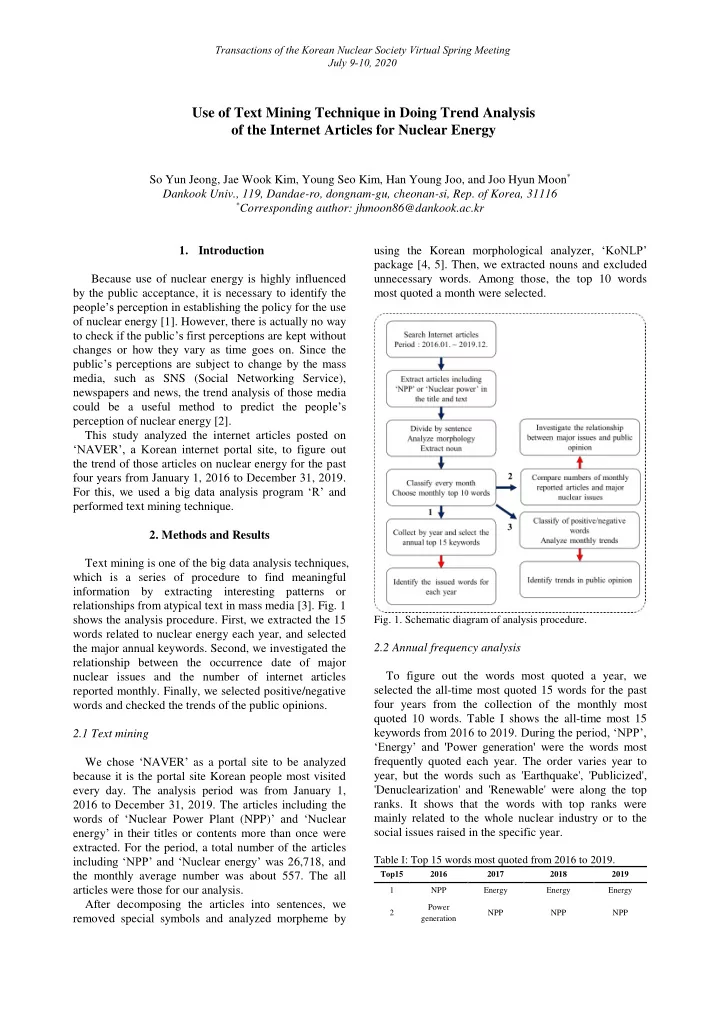
Text mining is one of the big data analysis techniques, which is a series of procedure to find meaningful information by extracting interesting patterns or relationships from atypical text in mass media [3]. Fig. 1 shows the analysis procedure. First, we extracted the 15 words related to nuclear energy each year, and selected the major annual keywords. Second, we investigated the relationship between the occurrence date of major nuclear issues and the number of internet articles reported monthly. Finally, we selected positive/negative words and checked the trends of the public opinions. 2.1 Text mining We chose ‘NAVER’ as a portal site to be analyzed because it is the portal site Korean people most visited every day. The analysis period was from January 1, 2016 to December 31, 2019. The articles including the words of ‘Nuclear Power Plant (NPP)’ and ‘Nuclear energy’ in their titles or contents more than once were

  • extracted. For the period, a total number of the articles

including ‘NPP’ and ‘Nuclear energy’ was 26,718, and the monthly average number was about 557. The all articles were those for our analysis. After decomposing the articles into sentences, we removed special symbols and analyzed morpheme by using the Korean morphological analyzer, ‘KoNLP’ package [4, 5]. Then, we extracted nouns and excluded unnecessary words. Among those, the top 10 words most quoted a month were selected.

  • Fig. 1. Schematic diagram of analysis procedure.

2.2 Annual frequency analysis To figure out the words most quoted a year, we selected the all-time most quoted 15 words for the past four years from the collection of the monthly most quoted 10 words. Table I shows the all-time most 15 keywords from 2016 to 2019. During the period, ‘NPP’, ‘Energy’ and 'Power generation' were the words most frequently quoted each year. The order varies year to year, but the words such as 'Earthquake', 'Publicized', 'Denuclearization' and 'Renewable' were along the top

  • ranks. It shows that the words with top ranks were

mainly related to the whole nuclear industry or to the social issues raised in the specific year.

Table Ⅰ: Top 15 words most quoted from 2016 to 2019.

Top15 2016 2017 2018 2019 1 NPP Energy Energy Energy 2 Power generation NPP NPP NPP

slide-2
SLIDE 2

Transactions of the Korean Nuclear Society Virtual Spring Meeting July 9-10, 2020

3 Energy Power generation Problem Economy 4 Technology Policy Power generation Power generation 5 Development Problem Business Policy 6 Business Construction Industry Technology 7 Occurrence Business Policy Industry 8 Earthquake Publicized U.S Problem 9 Safety Technology North Korea Nuclear 10 Region Safety Denuclearization Safety 11 Scale Nuclear Economy Renewable 12 Problem Electricity Technology Corporation 13 Industry Discontinue Corporation Business 14 Research Nation Nuclear U.S 15 Nuclear City UAE Research

2.3 Review of the relevance to the nuclear issues

  • Fig. 2 shows the trends in the number of the articles

reported a month for the past four years and the

  • ccurrence date of the major nuclear issues. This figure

showed that sudden increase in the number of the articles about the issue right after occurrence of a specific nuclear issue. Specifically, in September 2016, NPP safety was the biggest social issue because of the earthquake in

  • Gyeongju. The number of the articles on nuclear energy

in 2017 was larger than those in the other years. That was mainly because the new government launched in 2017 made clear ‘energy transition policy’. In June 2017, the new president said that plans for new power reactors will be cancelled and the operating periods of existing units will not be extended beyond their design license at the ceremony of the permanent shutdown of the Kori unit 1. In October 2017, when the public deliberation about resumption of the construction of Shinkori units 5 and 6 was ongoing, the number of the articles was surged. Since 2018, on average, 520 articles were released, though there was no hot issue like those events.

  • Fig. 2. Number of the articles including ‘Nuclear energy’ and

‘NPP’ released each month.

2.4 Trend analysis of the nuances of the nuclear energy related-articles Each word composing a sentence has various emotional meanings depending on their context [6]. To understand the real intentions, the articles wanted to deliver, we analyzed the nuances of the words extracted

  • previously. After excluding the unnecessary words such

as the country name, we classified the remaining words into the 3 groups, positive, negative or neutral, for the nuclear energy as shown in Table Ⅱ.

Table Ⅱ: Classification for the nuances of the words. Classification Words Positive Technology, Economy, Export, Development, Advance, Resumption, Construction, Safety Negative Problem, Earthquake, Denuclearization, Disuse, Contamination, Nuclear test, Restriction, Nuclear armament, Discontinuity Neutral Policy, Radioactivity

  • Fig. 3 shows the difference between the numbers of

the positive and negative words by month. The monthly average of the positive words was 2.52, and that of the negative words was 0.98. To quantify the overall nuances of the articles, +1 was assigned to the positive words, and -1 was to the negative words. If the same word was repeated more than once in an article, it was regarded as once appeared in the article. If the difference between the two different nuance words is zero, the article is considered as a neutral. And, the net value of the differences between them in the article is positive or negative, then, the article is regarded as positive or negative nuance.

  • Fig. 3. Overall nuances of the nuclear energy related-articles

released each month.

slide-3
SLIDE 3

Transactions of the Korean Nuclear Society Virtual Spring Meeting July 9-10, 2020

  • 3. Conclusions

This study analyzed the internet articles posted on ‘NAVER’, a Korean internet portal site, to figure out the trend of those articles on nuclear energy for the past four years from January 1, 2016 to December 31, 2019 by month. For this, we used the text mining technique. As a result, we identified the top 15 words most quoted in the article, as shown in Table Ⅰ. The most quoted words were ‘NPP’, ‘Energy’, and ‘Power generation’, etc. These words were mainly related to the nuclear issues in each year. Second, we found surge in the number of the articles following the occurrence of the major nuclear issues. Finally, we found that, as shown in Fig.3, the articles with positive nuance have been more released, though the articles with negative nuance were more released in the early phase of the new government. Acknowledgements This work was supported by the National Research Foundation of Korea(NRF) grant funded by the Korea government (Ministry

  • f

Science and ICT). (No.2020M2D2A2062436) REFERENCES

[1] K. R. Lee, News trend frame analysis on nuclear power plant issues -A topic modeling and semantic network analysis approach-, Sungkyunkwan Univ., 2018. [2] K. D. Ham, Social recognition on a multicultural minority group portrayed by mass media: mews article analysis through text mining, Korea Univ., 2015. [3] E. B. Song, Analysis of news on bitcoin using text mining, Ewha Womans Univ., 2017. [4] H. W. Jeon, KoNLP: Korean NLP Package. R Package Version 0.80.2, https://github.com/haven-jeon/KoNLP, 2016. [5] D. S. Kim, J. W. Kim, Public Opinion Mining on Social Media: A Case Study of Twitter Opinion on Nuclear Power, Advanced Science and Technology Letters, Vol.51, pp.224-228, 2014. [6] N. Farra et al, Sentence-level and Document-level Sentiment Mining for Arabic Texts, IEEE international conference on data mining workshop, pp.1114-1119, 2010.