Use Contemporary Art to Empower Students to Become Advocates for - - PowerPoint PPT Presentation

use contemporary art to empower students to become
SMART_READER_LITE
LIVE PREVIEW

Use Contemporary Art to Empower Students to Become Advocates for - - PowerPoint PPT Presentation

Use Contemporary Art to Empower Students to Become Advocates for Social Justice Barbara Suplee, The University of the Arts Maria Stevens, Philadelphia High School for Creative and Performing Arts Henry


slide-1
SLIDE 1

Use Contemporary Art to Empower Students to Become Advocates for Social Justice

¡

¡ ¡ ¡ ¡ ¡ ¡ ¡ ¡ ¡ ¡

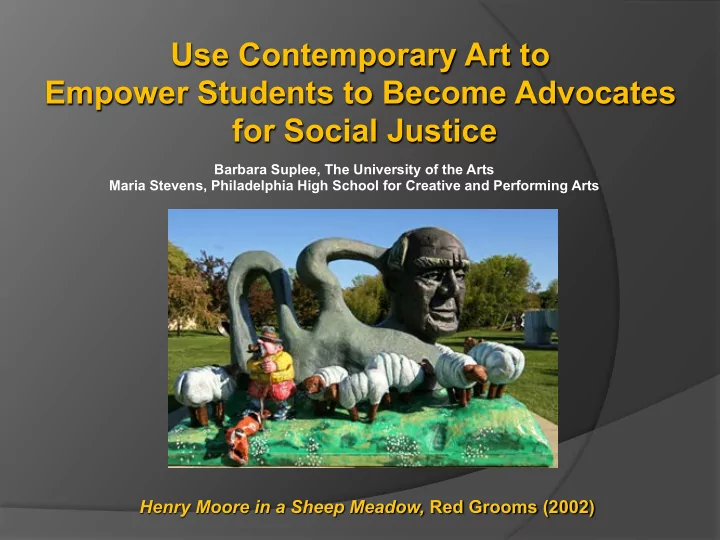
Henry Moore in a Sheep Meadow, Red Grooms (2002)

Barbara Suplee, The University of the Arts Maria Stevens, Philadelphia High School for Creative and Performing Arts

slide-2
SLIDE 2
  • Contemporary art is being created NOW
  • Artists are generally living and working
  • Much of today’s contemporary art is

conceptual

  • It can be alienating, controversial…but
  • Not all of it is controversial

Contemporary Art…What is it?

slide-3
SLIDE 3

Blue Rose, Wangechi Mutu (2007) Hand Art, Mario Mariotti (2000) Heartfelt, Sean Kenney (2009) Tar Beach, Faith Ringgold (1991)

slide-4
SLIDE 4
  • Promotes dialogue, divergent thinking,

and creativity

  • Helps students to think about equity, social

justice

  • Motivates them to become agents of change

Does it belong in your Classroom?

YES!

slide-5
SLIDE 5

Focus of most art rooms

slide-6
SLIDE 6

Mastery Learning

Step-by-step, teacher-directed instruction

slide-7
SLIDE 7

The Results

Promotes CONVERGENT THINKING, following directions

slide-8
SLIDE 8

Mastery Learning

Step-by-step, teacher-directed sketchbook assignment Step-by-step, teacher-directed sketchbook assignment

slide-9
SLIDE 9

The results

Promotes CONVERGENT THINKING, following directions

slide-10
SLIDE 10

Divergent vs. Convergent Thinking

Promotes multiple solutions/ideas vs. a single solution/idea

slide-11
SLIDE 11

We need both!

21st Century Skills (www.p21.org) 2014 National Visual Arts Standards (NVAS)

slide-12
SLIDE 12

How can we promote Divergent thinking?

Self-Directed Learners, Goal Setting, Personal Reflection?

slide-13
SLIDE 13

Maria Stevens

Philadelphia High School for Creative and Performing Arts (CAPA)

700+ Students (72% Minority Enrollment): Grades 9-12

slide-14
SLIDE 14

Martin Puyear

slide-15
SLIDE 15
slide-16
SLIDE 16

Martain Puyear: Memory and Form Project

slide-17
SLIDE 17
slide-18
SLIDE 18

Banksy- Armored Dove of Peace Vic Muniz-Pictures of Junk Martha Rosler- Bringing the War Home

Discussion: Questions , questions, questions??????

Why do we understand them?

Ai Weiwei- Sundflower Seeds

slide-19
SLIDE 19

Contemporary Artists

Christo /Jean Claude- Surrounded Islands 1983

Kara Walker- Darktown Rebellion

Jason Decacaires Taylor- Vicissitudes -2007 Andy Goldsworthy

slide-20
SLIDE 20

Naqoyqatsi

(/nɑːkɔɪˈkɑːtsi/ nah-koy-kah-tsee),[1] is a Hopi word meaning "life as war.” This 2002 film is directed by Godfrey Reggio and edited by Jon Kane, with music composed by Philip Glass. It is the third and final film in the Qatsi trilog Eighty percent of Naqoyqatsi uses archive footage and stock images manipulated and processed digitally.

The film “Naqoyqatsi” deals with an array of human experiences throughout time that make references to many global concerns such as

  • world hunger
  • natural disasters
  • animal extinction
  • war, politics,
  • violence
  • injustice
  • technology versus nature
slide-21
SLIDE 21
  • Ms. Lengauer /

Name:___________ Due:________ NAQOYQATSA Research Assignment Format: Typed 12 pt. font Centered title Name, date, teacher and class period on upper left Works cited attached Part 1: Researching the Film: Research the film NAQOYQATSA. Answer the following questions in full descriptive sentences/

  • paragraphs. (minimum 4 sentences per paragraph. 5 points per paragraph)
  • 1. Who was the film produced and created by? Who produced the musical score? (Give

pertinent background information for each).

  • 2. What does the title NAQOYQATSA mean? What language is it derived from?
  • 3. Research and describe the Qatsi trilogy. For the preceding films, list the titles, what they

mean, and the overall theme of each film.

  • 4. In two full paragraphs or more, describe the content of the film NAQOYQATSA. What was the

intent of the film? (Be sure to include a description of how nature and technology are being used to comment on humanity.)

  • 5. Describe how stock footage was used in this film.
  • 6. What were some comments made by critics? How do you think the film impacted its

audience? ____________________________________________________________________________

SOCIAL COMMENTARY LESSON: Student Research

slide-22
SLIDE 22

STUDENT RESEARCH

Part 2. Research the following specific works of art and artists. For each, include an image, the title, and the medium. ( 3 points each)

  • Marisol Escobar LBJ
  • Robert Arneson General Nuke
  • Pablo Picasso Guernica
  • Ai Weiwei Sunflower Seeds
  • Banksy Armored Dove of Peace
  • Vick Muniz Pictures of Junk
  • Joshua Allen Harris Installations
  • Martha Rosler Point and Shoot, from the series House Beautiful

Bringing the War Home

  • Judy Chicago The Dinner Party
  • Barbara Kruger I Shop Therefore I Am

Choose two works/ artists from the list above who intrigue you most. Describe in two paragraphs for each artist (10 points per paragraph, 4 paragraphs total for this section). Include: Some background information of the artist The title of the piece, and medium The political or social concepts that inspired the work The artist's intention in making this work

slide-23
SLIDE 23

Before viewing the film

Naqoyqatsa students were given a “response sheet” where they had to list any social commentaries or

  • ther insights on humanity

that they feel were being communicated in the film……

Generating Ideas……

slide-24
SLIDE 24

Divergent Thinking: Developing and Exploring Ideas

slide-25
SLIDE 25

Production: Giving Ideas Form and Meaning

slide-26
SLIDE 26
slide-27
SLIDE 27
slide-28
SLIDE 28
slide-29
SLIDE 29
slide-30
SLIDE 30

Strike Upon Mankind Liang Zhao – Sr.Ms. Lengauer – Mixed Media Sculpture “Clash with Mother nature” Mankind continues to push the limits …..,building skyscrapers taller than ever. We continue to destroy Mother Nature and what she provides for us on this planet. Deforestation, over fishing seas, polluting our only air supply and water, abusing the earth. As a result we can expect constant occurrences of natural disasters.

slide-31
SLIDE 31
slide-32
SLIDE 32

Sisla (Child in Punjabi)

Kerbin Rosario – Jr. /M. Lengauer – Mixed Media Sculpture “The Clothes We Wear” Many people think that the clothing they wear is machine made and that human labor has been completely taken over by

  • industrialization. In several middle eastern, northeastern and southeastern Asian countries, horrible tactics of human labor are still

used in order for chain stores and companies to reach success through mass production. Sweatshops are placed all over Asia in countries such as China, Vietnam, Cambodia, and Bangladesh. Employees work from sunrise to sundown in extremely horrible conditions every single day and face physical, verbal, and mental abuse daily. Female employees are usually raped or sexually assaulted as punishment for working too slow or messing up a garment. Male workers get spat on and beaten to a pulp for minor

  • mistakes. Children as young as the age of 4 are made to work in sweatshops because of their small fingers, making the production

rate of clothing speed up. These people face all these struggles and only make about eight cents an hour. Many chain stores such as Victoria’s Secret, Hollister, H&M, and Forever21 are dependent on sweatshops in order to release new clothing every 2 weeks. I hope this piece creates an awareness of the horror of inhumane treatment of humans.
slide-33
SLIDE 33
slide-34
SLIDE 34

Primary Distribution Danielle Wimberly – Sr.

  • M. Lengauer – Mixed Media

Sculpture “Liquid Silver”

Water has become privatized by the wealthy and powerful in the government and in many places around the world. Flint, Michigan is a prime example of this

  • issue. The fact that people do not have

control of their water and its cleanliness shows a terrifying glimpse into the future

  • f the battle for resources. The water is

represented as silver to demonstrate how valuable the water is to companies and how it is also vital for humans to live.

slide-35
SLIDE 35
slide-36
SLIDE 36

Artist discussing problems encountered in creating work of art and how she solved them.

slide-37
SLIDE 37

Artist discussing problems encountered in creating work of art and how she solved them.

slide-38
SLIDE 38
  • Research paper
  • Discussion of artists and meaning of the work
  • Worksheet #1- response sheets
  • Worksheet #2 - generating ideas
  • Worksheet #3- Project proposal with facts & sketches
  • PRODUCTION
  • Reflection sheets
  • Group critique sheets
  • Critiques and presentations

Divergent Activities From This Lesson

slide-39
SLIDE 39

Use the New (2014) Visual Arts Standards

slide-40
SLIDE 40

Focus on 4 Areas Pre-K-12

slide-41
SLIDE 41

Creating Presenting Responding Connecting

Through concept-based inquiry and investigation of 15 Enduring Understandings (Big Ideas), the new “standards essentially ask students to step back and consider art and its connections to their world– to think about art, culture, and history, in general” (Stewart, 2014).

slide-42
SLIDE 42

http://paeablog.org/become-a-member/lesson-plan-template/

PAEA Lesson Plan Template

slide-43
SLIDE 43

It’s all about their stories!

¡

¡ ¡ ¡ ¡ ¡ ¡ ¡ ¡ ¡ ¡

slide-44
SLIDE 44

* Concept-based Inquiry* Student-centered Instruction Independent Problem-solving Self-directed Learning Journaling List-making Free Association Collaboration Self-reflection Self-assessment *Contemporary Art*

In Conclusion…to promote

students’ deeper understanding of art, themselves, others, and their world, use:

slide-45
SLIDE 45

Thank You!

  • Questions?
  • Comments?