Urban ecology and greening cities Presentation to Sustainability - - PowerPoint PPT Presentation

urban ecology and greening cities
SMART_READER_LITE
LIVE PREVIEW

Urban ecology and greening cities Presentation to Sustainability - - PowerPoint PPT Presentation

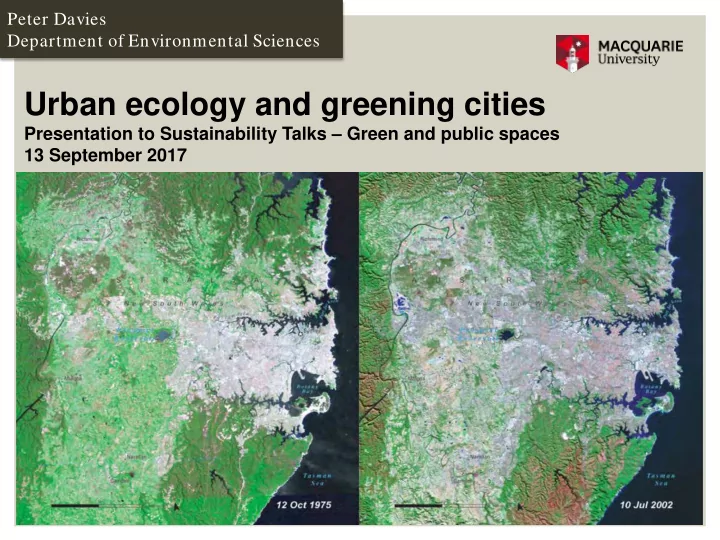
Peter Davies Department of Environmental Sciences Urban ecology and greening cities Presentation to Sustainability Talks Green and public spaces 13 September 2017 What we know AT A GLANCE Habitat is being lost failure to protect


slide-1
SLIDE 1

Urban ecology and greening cities

Presentation to Sustainability Talks – Green and public spaces 13 September 2017 Peter Davies Department of Environmental Sciences

slide-2
SLIDE 2

What we know

2

AT A GLANCE

Habitat is being lost – failure to protect large and small The natural environment is not valued in decision making Imagination is lacking

slide-3
SLIDE 3

Habitat loss

3

DEATH BY A THOUSAND CUTS

  • Biodiversity impacts tend to be

considered locally not regionally

  • incremental loss of habitat
  • reduction of habitat quality and
  • introduction of multiple stressors
  • Needs for a multi scale approach
  • Protection
  • Conservation
  • Management
slide-4
SLIDE 4

Habitat loss

4

DEATH BY A THOUSAND PIPES

Very low tipping point for a decline in urban waterway health

  • impervious surfaces exceed 5%-10%
  • approximately = periurban area
slide-5
SLIDE 5

Habitat loss

5

MATTERS MORE FOR SMALL SITES

Implications:

  • When small patch
  • f bushland is

cleared the impact

  • n species decline is

much greater than if the same amount were cleared from a larger patch

slide-6
SLIDE 6

Fragmentation leads to isolation and edge effects Edge to area ratios are important in managing core habitats particularly for urban sensitive species

Habitat loss

6

FRAGMENTATION AND EDGE EFFECTS 6

Typical of impacts of linear infrastructure Typical of land clearing around core bushland area for residential

slide-7
SLIDE 7

Habitat loss

7

DEVELOPMENT PATTERS MATTER

  • Protect core areas
  • Manage for the

landscape (not lot)

  • Com pact density will

protect more core habitat and provide more landscape scale biodiversity than low density sprawl

slide-8
SLIDE 8

Do we value the environment?

We know

  • 1. Values change over time
  • 2. Values differ between

groups of people

  • 3. Multiple values can be

assigned to the same place

  • 4. Multiple pathways exist

between values, attitudes and behaviours towards ecosystems

  • 5. Values influence peoples

judgement of management decisions

WHY VALUES MATTER

Is the environm ent valued as a resource or valued for its intrinsic worth?

slide-9
SLIDE 9

How to we value the environment

9

BIODIVERSITY OFFSETTING

Offsetting schemes avert not stop biodiversity loss

DECC (2007) Biobanking- Biodiversity Banking and Offsetting Scheme – Scheme Overview \ http:/ / www.environment.nsw.gov.au/ resources/ biobanking/ biobankingoverview07528.pdf

Biobanking can protect ‘higher value’ sites BUT this is a tradeoff

  • Results in m ore vegetation and

habitat clearing and

  • Will not prevent the ongoing

decline in biodiversity loss in cities

slide-10
SLIDE 10

Imagination and new ideas

10

CONNECT PEOPLE TO NATURE

Aesthetics does not always equal m ore biodiversity BUT

  • Backyards and private

gardens represent a significant proportion of green space in cities and should be actively managed

  • Collectively gardens can have a

positive contribution to conservation and biodiversity outcomes

slide-11
SLIDE 11

Imagination and new ideas

ITS GOOD TO BE MESSY

  • Incorporate buffers
  • r ‘un-managed’

areas in parks, golf courses and riparian corridors to increase biodiversity

  • May be in your

backyard too

slide-12
SLIDE 12

Imagination and new ideas

12

HOW WE LANDSCAPE OUR PARKS

Photos: J O’Meara

Sydney Olympic Park a) Low vertical structural complexity b) High vertical structural complexity with weeds being replaced c) Natural remnant

slide-13
SLIDE 13

Imagination and new ideas

13

CONSTRUCTED ENVIRONMENTS AND SUPPORT BIODIVERSITY

Photos: R. Morris

slide-14
SLIDE 14

HIERARCHY OF URBAN ECOLOGY ACTIONS

Protect and conserve Restore existing ecosystems Enhance remaining ecosystems Create and connect new habitats

14

Directions

RESPONDING URBANISATION