
SLIDE 1
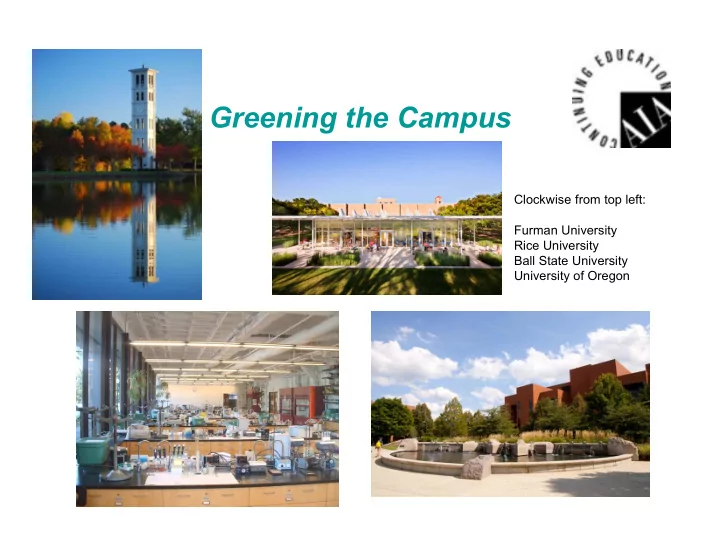
Greening the Campus
Clockwise from top left: Furman University Rice University Ball State University University of Oregon
Greening the Campus Clockwise from top left: Furman University - - PowerPoint PPT Presentation
Greening the Campus Clockwise from top left: Furman University Rice University Ball State University University of Oregon Greening the Campus Robert Cassidy Editorial Director rcassidy@scgmail.com Greening the Campus Building
Clockwise from top left: Furman University Rice University Ball State University University of Oregon
Robert Cassidy Editorial Director rcassidy@scgmail.com
Building Design+Construction and its parent company, SGC Horizon LLC, are approved providers of AIA CES “Discovery” continuing education programs. All content is noncommercial and addressed to the information and education needs of our audience members.
Christopher C. Ramey, AIA University of Oregon Eugene, Oregon
Campus Planning and Real Estate
Angela C. Halfacre, PhD Furman University Greenville, S.C.
Sustainability
Earth and Environmental Sciences
Robert J. Koester, PhD, AIA, LEED AP Ball State University Muncie, Indiana
Greening of the Campus Conference Series
Richard R. Johnson Rice University Houston, Texas
Facilities Engineering and Planning Dept
for the Study of Environment and Society
1. How Institutions can involve all stakeholders – students, faculty, staff – in campuswide sustainability efforts. 2. How large-scale green campus planning – beyond single buildings - can be done most effectively – including the creation of comprehensive environmental policies and practices for colleges and universities. 3. How durability and long-term care figure into green campus planning. 4. How design and construction firms can work most effectively with institutions of higher learning to optimize sustainability in campus planning – for energy savings, water conservation, and best use of sustainable materials and building products.
AIA CES Webcast - Learning Objectives
www.certainteed.com/continuinged
Earn 1.0 AIA CES “Discovery” HEALTH/SAFETY/WELFARE SUSTAINABILE DESIGN learning units by studying today’s webcast and taking the 10- question exam. To register, go to: www.BDCnetwork.com/Greening the Campus.
Angela Halfacre Furman University Christopher Ramey University Of Oregon Robert J. Koester Ball State University Richard R. Johnson Rice University
College and University Presidents Climate Commitment
Inventory
Ball State University
Ball State University Sustainability Initiatives
Strategic Plan 2007-12
Inventory
Ball State University Sustainability Initiatives
“…a clearinghouse for sustainable activities on campus”
Ball State University Sustainability Initiatives
policy
Sustainability Director
initiative
North College - Rice University
Rice University Sustainability Initiatives
LEED-registered buildings
Rice University Sustainability Initiatives Rice University Sustainability Initiatives
for one Green Seal-approved chemical
Rice University Sustainability Initiatives Rice University Sustainability Initiatives
Rice - 3900 undergrad, 2000 graduate students Furman – 2600 undergrad, 300 graduate Ball State – ~20,000
Oregon: 23,500
Furman University Sustainability Initiatives
and efficiency
into its university-wide strategic plan (one of Furman’s “5 Pillars”)
learning laboratories for our students, faculty and community members”
residence areas, over the next 4 years or so
Residence Hall Competitions 9 residential complexes “Significant reductions by virtue of behavior change” “The trick is having the buildings metered. In our case, it’s a lot of manual labor to go read
“That’s a pretty significant opportunity for conservation, and it does integrate quite well with the educational mission.” - Robert Koester Ball State University Sustainability Initiatives
Building-integrated solar array (photovoltaics) University of Oregon Sustainability Initiatives
University of Oregon Lillis Center
At the Recreation Center, a student initiative – largely student funded – is a large domestic water system that has a dashboard in the lobby where the students can see how that’s acting and what it’s doing for them. University of Oregon Sustainability Initiatives
U of Oregon Student Recreation Center
Furman University Sustainability Initiatives First institution [of higher learning] in South Carolina to mandate all major renovations and new buildings to be LEED certified – starting in 2003
Furman University Sustainability Initiatives Comprehensive “Sustainability Master Plan” (2009)
seeking to address
Furman University Sustainability Initiatives Key Points of Furman Sustainability Master Plan
related to sustainability
transportation system
the local and greater communities
Goal = carbon neutrality by 2026
carbon footprint comes from purchased utilities – purchased electricity Furman University Sustainability Initiatives
[e.g., compared to New England]
David E. Shi Center for Sustainability
University of Oregon Sustainability Initiatives
about 10 years - students, faculty and staff
University of Oregon Sustainability Initiatives
campus
coordinator
Rice University Sustainability Initiatives January 2011 launched “ICE Map” or “RICE Map” “Rice Integrated Climate and Energy Master Plan”
position for the future?”
Rice University Sustainability Initiatives Principles for planning in “RICE Map”
energy and water are interdependent
given Rice University’s proximity to the Texas Gulf Coast and vulnerability to hurricanes and tropical storms
Rice University Sustainability Initiatives Principles for planning in “RICE Map”
energy-generation investments
prepared for it
University of Oregon Sustainability Initiatives “Oregon Model for Sustainable Development”
Key component: Cap campus energy use at current level [at time of adoption]. “The idea is to strike a line [in energy use] and never use more energy than we’re using at that moment in time.” Formula: Offset new energy use by requiring new projects to pay for energy retrofits in existing buildings, which will equal the new energy that they are going to need in the new development.
University of Oregon Sustainability Initiatives “Oregon Model for Sustainable Development”
1. Setting a baseline: “LEED Gold is yesterday’s standard. How can we set threshold high enough to mean something?” 2. The cap process: Building will be designed to the energy use index, based on the region and type of building. 3. Target reduction: At least 60% below the baseline for a similar building in this region. 4. Team will calculate how much energy new building needs. 5. Existing buildings will be retrofitted to save the energy equal to the “new” energy that the new building will require.
University of Oregon Sustainability Initiatives “Oregon Model for Sustainable Development”
1. Funds will be controlled centrally 2. “Attack retrofit projects in a sensible way”: not all the “simple” ones first - make sure there’s a mix of savings. U of Oregon Environmental Action Plan found:
~$15 million “So … we have plenty of capacity to make this happen.”
University of Oregon Sustainability Initiatives “Oregon Model for Sustainable Development”
Potential for Stormwater Improvements The University will “improve stormwater quality on the campus by leveraging our advantage as a campus, so when a new project comes in, the water running off that project is in pretty good shape. “So [we could] take some of that resource and spend it on existing parking [or] other impervious surfaces on campus, and the net result is that we have improved the water quality across the campus.” - Chris Ramey
University of Oregon Sustainability Initiatives “Oregon Model for Sustainable Development”
Potential for End-User Involvement “To leverage our people power, coming up with a way to actually commission the users of the building, so that the users do not forget what it means to open and close the windows, and how to turn the lights [on and off].” - Chris Ramey This process will continue over ~24 months, to check the building’s performance and provide education and updates to the users.
Furman University Sustainability Initiatives Addressing Stormwater Issues at Furman University
Lake restoration project
New stormwater plan
Furman University Sustainability Initiatives Sustainability Science Major
Approved by faculty in Fall 2010 Only private liberal arts institution to offer such a degree Curriculum examines the complex relationships between human, social, and environmental systems. Focus: Problem identification and problem solving, using multiple disciplines.
Example: food systems, social justice implications of food supply and food access, food deserts, sustainable agriculture, the economics of sustainable food supply.
BSU Geothermal Energy Project
Will bring the entire campus - 45 buildings - online to a single district heating/cooling system, driven by ground-source heat pump technology. North and south halves of the campus will each have:
piping looping down into the earth The system will be linked laterally to run energy, both heating
Ball State University Sustainability Initiatives
BSU Geothermal Energy Project
Replacement cost for existing coal-fired boilers = $45 million (covered by state appropriation) Incremental cost for groundwater system = $25 million Total cost of groundwater system = $70 million Annual savings: $2 million/year in avoided fuel costs $2 million/year over $25 million incremental cost = 8% Return on Investment
Ball State University Sustainability Initiatives
Ball State groundwater program
University of Oregon
Rice University
paybacks Furman University
‘Payback Periods’ for Green Campus Projects
At Ball State, in our Climate Action Plan, all decisions [are] based on return on investment (ROI). “What’s good about that is you can go out 40 years and you’re still getting 2.5% on your money. “That’s a better way equate what would seem like a very long time horizon.” - Robert J Koester ‘Payback Period’ vs. ‘Return on Investment’ (ROI)
Green Campus Transportation Strategies
University of Oregon Sustainable Transportation Initiatives
“You have less need to park cars on campus, and you can dedicate more of your precious land to open space and buildings and other aspects of the campus” - even stormwater retention.
Green Campus Transportation Strategies
Rice University Sustainable Transportation Initiatives Located adjacent to 3 light-rail stations Free passes for light rail and metro bus system Zipcar program - provides “mobility on demand” With a 30% increase in the number of students at Rice in recent years, the number of student on-campus vehicle registrations has declined
Green Campus Transportation Strategies The End of Surface Parking Lots on Campus?
“From a master planning standpoint, it’s fair to say that surface parking lots are going to be a thing of the past. “We’re looking to structured parking, whether underground or aboveground. “Some great examples out there where you combine that structured use with another use.” - Richard Johnson
Green Campus Strategies: ‘Overdesign’ Issue Richard Johnson’s blog: “Greening the Campus: Inside the World of the Campus Sustainability Professional” http://greeningthecampus. wordpress.com/about/
Green Campus Strategies: ‘Overdesign’ Issue
“Would you wash your hands with a fire hose?” That’s what we’re getting with our designs.” Case Study
reduction).
Analysis: ME consultant was off by a factor of 50.
“When it comes to energy, we often get the equivalent
wash our hands, if we’re not careful.”
Green Campus Strategies: ‘Overdesign’ Issue Fighting Back Against ‘Overdesign’ Recommendation: “One way to combat ‘overdesign’ is to bring in the people from your university who are in charge of energy management – your maintenance people on the ground, who have a perspective of how similar buildings on campus will operate. “They can push back and say, These [consultants] are way off.” - Richard Johnson
Green Campus Strategies: ‘Overdesign’ Issue Fighting Back Against ‘Overdesign’ Recommendation: Think modular.
“The professionals involved in these calculations are
don’t think in terms of a modulated system, so if the calculations indicated you needed 100 tons for a given load, they would scale and size a machine that would deliver that at peak performance, when in fact much of the year it’s not running at full load, only part load.”
Green Campus Strategies: ‘Overdesign’ Issue Fighting Back Against ‘Overdesign’ Recommendation: Think modular.
1. Take that design intent – 100 ‘units’ of delivery. 2. Slice it into a 40-unit and a 60-unit package. 3. Run the 40-unit until it hits its peak, then switch to the 60-unit. “By modulating the delivery, you can have much more management control – several modules, instead of single unit.” - Robert J Koester
Green Campus Strategies: Advice for AEC Firms Need for Integrated Practice Model
Most AEC practice is built on a railroad-car model: the work stream is organized into a sequence of activities: programming, site analysis, schematics, design development, construction documentation, building observation during construction, and then perhaps post-occupancy evaluation. So it’s a very sequenced process.
Green Campus Strategies: Advice for AEC Firms Integrated Practice Model
1. All parties at the table on Day 1. 2. Ask the bigger questions about whole systems of the campus as well as the specifics of the building that you are charged to design. 3. Engage all the issues of all the various disciplines from the beginning. 4. Exchange to collectively target the goals of the project.
Green Campus Strategies: Advice for AEC Firms Integrated Practice Model
As you move thru time and hit moment for Construction Docs, much of the detailing is already worked out – as part of process of interactive design activity. An integrated practice model requires more time and budget on the front end to enable Building Team members to be at the table sooner. But you get savings long-term in both the delivery of the project in terms of fees and also cost management and operations.
Green Campus Strategies: Advice for AEC Firms Integrated Practice Model
At Furman we certainly are [demanding more team integration]. Example: Integrating all master planning processes, everything from student life perspective [in our new Student Life Master Plan], along with Sustainability Master Plan. The planning process, in terms of integrating all these various plans, including stormwater, is critical.
Green Campus Strategies: Advice for AEC Firms Integrated Practice Model
“Hypertrack” delivery for major capital projects at Rice University Concept: Bring together the architect, engineer, contractor, and major subcontractors from the earliest stages of design. Make decisions in a focused manner, and tightly scheduled that allows for a more efficient process. Example: Biosciences Research Collaborative Building
Green Campus Strategies: Advice for AEC Firms Integrated Practice Model
We’ve been using an eco-charrette, a kickoff session right from the start, where all the disciplines are together with the users, with several goals. One of most important goals: Have the users understand what it means to be in a sustainable building, and whether they can tolerate some of the resulting environments, and to see the values that come from that as well. - Chris Ramey, AIA
Green Campus Strategies: Advice for AEC Firms Choosing the Complete Team
“As facilities owners, we tend to spend a lot more time selecting our architects than we do our engineers. “If the engineering firm does not have the talent to deliver the innovative sustainable solutions that we’re seeking, then the university’s design aspirations will be at risk. “Universities will spend a lot of time seeking the gold standard
similar respect is not paid to the MEP firms. We should be looking for that “star” engineer as well. - Richard Johnson
Green Campus Strategies: Advice for AEC Firms Value Engineering ≠ Performance Design
“’Value engineering’ should not be considered equivalent to performance design.” Recommendation: The eco-charrette is the way to get the architect and the other allied professions working together early enough that they can establish the benchmarks of performance that they’re going to try to achieve as a team. Caution: “You don’t ‘value engineer’ things out to get there, you actually have to ‘value engineer’ things in – so it’s a whole different mindset.”
Green Campus Strategies: Advice for AEC Firms Value Engineering ≠ Performance Design
Recommendation: Think in terms of the bundling of
Example: If you properly daylight a building, you have less need for electrical lighting requirement. That dials down the amount of waste heat, which reduces the amount of cooling required. “It all starts linking together and that’s performance design, not value engineering reduction.” - Robert Koester
Green Campus Strategies: Advice for AEC Firms U of Oregon Process for Hiring Consultants “We’ve changed the way we hire consultants. “We hire the architect, then we sit with them as a team and interview the MEPs, so each MEP [candidate] has to come over the same hurdle that the architect did. “We stole that [idea] from the private sector, and it seems to be working pretty well.” - Chris Ramey
Green Campus Strategies: Advice for AEC Firms
How can Building Teams educate university clients about savings and quality of life? Recommendation: Tell the [sustainability] story in a way where [clients] can see the value. All of us in the [design] process have to do a better job of carefully explaining the value [of sustainable design]. The design field has to take the leadership. They’ve got to push back to us as owners and say, That’s not as good as you can do. I don’t think there’s as much responsibility for these kinds of issues as there could be. - Chris Ramey
Green Campus Strategies: Advice for AEC Firms
How can Building Teams educate university clients about savings and quality of life?
Recommendation: Use a facilitator. “Sometimes it helps to have a 3rd-party facilitator in those eco-charrettes … [a] person speaking
made more comfortable by having a third party asking for it and cultivating it and getting that conversation out on the table.” - Robert Koester
Green Campus Strategies: Advice for AEC Firms “We’ve had great experiences including the users of a particular [new] building in the process, along with the
[Building] Team.”
Example: including faculty in the design of Furman’s new Science Center
Charles H. Townes Center for Science [with Clemson University]
Green Campus Strategies: Advice for AEC Firms
Science Center houses the Earth and Environmental Services department along with the Physics department. “Faculty wanted more connection across departments, rather than seemingly around a disciplinary approach - to reflect science and sustainability across
incorporated in the design.”
Townes Center for Science, Furman University
Angela Halfacre Furman University Christopher Ramey University Of Oregon Robert J. Koester Ball State University Richard R. Johnson Rice University
This concludes the formal education program. Earn 1.0 AIA CES “Discovery” HEALTH/SAFETY/WELFARE SUSTAINABLE DESIGN learning units by studying today’s webcast and taking the 10- question exam. To register, go to: www.BDCnetwork.com/GreeningTheCampus.