Upgrading Transport to build and use new transport protocols - - PDF document

upgrading transport
SMART_READER_LITE
LIVE PREVIEW

Upgrading Transport to build and use new transport protocols - - PDF document


slide-1
SLIDE 1

1

  • Upgrading Transport

Protocols using Untrusted Mobile Code

Parveen Patel Andrew Whitaker Jay Lepreau David Wetherall Tim Stack (Univ. of Washington) (Univ. of Utah)

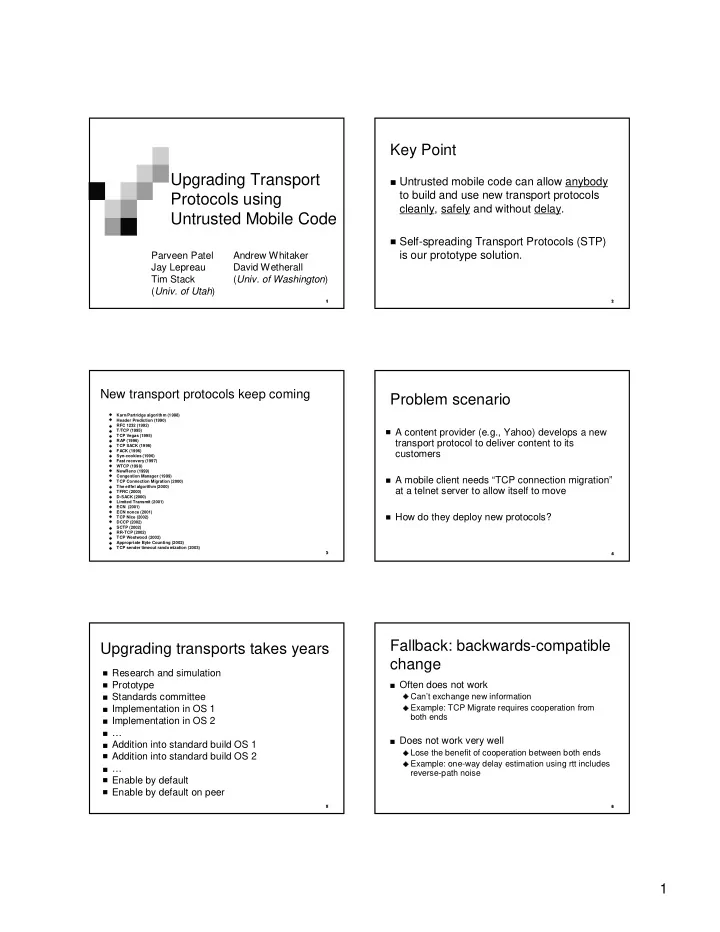
Key Point

✂ Untrusted mobile code can allow anybody

to build and use new transport protocols cleanly, safely and without delay.

✂ Self-spreading Transport Protocols (STP)

is our prototype solution.

New transport protocols keep coming

Karn/Partridge algorithm (1988)

Header Prediction (1990)

RFC 1232 (1992)

T/TCP (1995)

TCP Vegas (1995)

RAP (1996)

TCP SACK (1996)

FACK (1996)

Syn-cookies (1996)

Fast recovery (1997)

WTCP (1998)

NewReno (1999)

Congestion Manager (1999)

TCP Connection Migration (2000)

The eiffel algorithm (2000)

TFRC (2000)

D-SACK (2000)

Limited Transmit (2001)

ECN (2001)

ECN nonce (2001)

TCP Nice (2002)

DCCP (2002)

SCTP (2002)

RR-TCP (2002)

TCP Westwood (2002)

Appropriate Byte Counting (2002)

TCP sender timeout randomization (2003)

Problem scenario

A content provider (e.g., Yahoo) develops a new transport protocol to deliver content to its customers

A mobile client needs “TCP connection migration” at a telnet server to allow itself to move

How do they deploy new protocols?

Upgrading transports takes years

Research and simulation

Prototype

Standards committee

Implementation in OS 1

Implementation in OS 2

Addition into standard build OS 1

Addition into standard build OS 2

Enable by default

Enable by default on peer

Fallback: backwards-compatible change

Often does not work

Can’t exchange new information

Example: TCP Migrate requires cooperation from both ends

Does not work very well

Lose the benefit of cooperation between both ends

Example: one-way delay estimation using rtt includes reverse-path noise

slide-2
SLIDE 2

2

  • Solution: STP
✂ Host can upgrade its connection peer with

new transports by sending untrusted code TPFoo

(Use TPFoo)

TPFoo

TPFoo

Self-spreading Transport Protocols TPFoo

Upgrading with STP is faster

Research and simulation

Prototype

Standards committee

Implementation to the STP API

Implementation in OS 1

Implementation in OS 2

Addition into standard build OS 1

Addition into standard build OS 2

Enable by default

Enable by default on peer

STP Challenges

1.

Network safety – should not hog bandwidth or attack other nodes

2.

Host safety – must isolate and limit resource consumption

3.

Performance – should not undermine improvement due to extensions

☎✄

STP Design

Sockets Layer STP Network Layer

APPLICATION 1

Compiler

TP-B TP-A

STP SANDBOX

STP API

Download/Policy mgr

  • 1. Network safety

TCP background

TCP-friendliness is well-defined [SIGCOMM ’98]

1 Rate = ---------------------------------------------------------------

R*

(2 * L/3) + (t_RTO*3*

(3*L/8)*L*(1+32+L2))

R = Round-trip time, L = Loss-rate

TCP sending speed governed by inflow of acks from

  • receiver. Prevent a TCP receiver from faking acks

(hiding loss) by requiring it to echo a nonce. [ICNP’01]

Loss Detection in STP

Through the design of its API, STP enforces loss detection that is independent of transport protocol header formats.

STP TP-A

packet with nonce stp_send (packet, seq)

STP TP-A

packet with nonce packet with nonce

sender receiver

slide-3
SLIDE 3

3

Loss Detection in STP

STP TP-A

ack + nonce

STP TP-A

stp_send_ack (nonce) ack + nonce

sender receiver

stp_got_ack (seq, nonce)

  • 2. Host safety

Constrained domain: no shared state between transports

  • Makes resource accounting straightforward
  • Makes termination tractable

Memory safety: type-safety of Cyclone [PLDI ’02]

CPU timer-based CPU resource protection

  • 3. Performance

Connections proceed without delays

  • Code is downloaded out of the critical path
  • Benefits later connections
  • Exploits communication pattern of today’s Internet

Efficient to interface C with Cyclone

  • Share data between the kernel and Cyclone code
  • Not necessary to use garbage collection

Implementation

✁ Prototype in FreeBSD 4.7 ✁ Ported UDP-Flood, TCP NewReno and

TCP SACK to the STP API

✂☎✄

Evaluation

✁ Network Safety ✁ Overall Performance ✁ CPU Overhead ✁ Transport Experience ✂☎✆

STP enforces TCP-friendliness

✝ ✞ ✟ ✠ ✡ ☛ ☞ ✌ ✍ ✎ ✞ ✝ ✝ ✟ ✝ ✡ ✝ ☞ ✝ ✍ ✝ ✞ ✝ ✝ ✞ ✟ ✝ ✏✒✑✒✓✕✔✗✖✕✘ ✙✛✚☎✜ ✢✣✙✤✜ ✥✧✦✩★✤✥✫✪✭✬ ✮ ✯✰ ✱✲✳ ✴✶✵✶✷✤✸ ✹ ✺ ✻✼✻✾✽❀✿❂❁ ❃ ❄❅✺ ✻✼❆☎❆ ❇✶❈✶✷☎✿✭❁ ❃✼❄❉✺ ✻✼❆☎❆ ✴✶✵✶✷✤✸ ✹ ✺ ✻✼✻✾✽❀✿❂❊✼❄❋✺ ✻✾❆☎❆ ❇✶❈✶✷☎✿✭❊✼❄●✺ ✻✾❆☎❆
slide-4
SLIDE 4

4

✂✁

STP does not restrict TCP

0.5 1 1.5 2 2.5 3 10 20 30 40 50 60 70 80 90 100

Time (seconds) Mb/sec

TCP in STP TCP in FreeBSD

✂✁✄

STP is as fast as TCP for Internet-like paths

1.51 3.51 23.8 1.48 3.48 23.8 5 10 15 20 25 WAN1 WAN2 WAN3 Mbps Native-TCP STP-Cyclone

✂☎✂

STP transports achieve gigabit speed

860.3 895.3 752 894.5 688.5 894.3

200 400 600 800 1000 1500 Byte Eth 8192 Byte Eth Mbps Native TCP STP-C STP-Cyclone

2GHz machine with fast PCI bus

✂✁✂

CPU utilization (gigabit link)

Overhead inherent in Cyclone’s type-safety (bounds/null checks) is low: 6%

Suspect most of overhead due to marshaling that will be straightforward to optimize in newer version of compiler.

73% (1.54) 61% (1.29) 48% Receiver 73% (1.24) 59% (1.01) 59% Sender STP-Cyclone

(ratio to BSD)

STP-C

(ratio to BSD)

FreeBSD TCP Version

✂✁✆

Transport experience

✝ API supports all 27 studied extensions

except 2 that are inherently not TCP-friendly

✝ Shipping whole protocols is practical:

4K 33K 31K

Object

10K 95K 87K

Source(Gzip)

UDPFlood SACK TCP

Code

✂ ✞

Future work

✝ So far: ✟ STP is proof-of-concept of a system that

synthesizes a set of ideas

✠ Next up: Make the vision more real ✟ Stress-test system with adversarial transports ✟ Prove that API is sufficient and OS-portable ✟ Learn what policies work well in practice
slide-5
SLIDE 5

5

✂✁

Conclusions

STP lets anybody build and use new transport protocols cleanly, safely and without delay.

Built on untrusted mobile code

Avoids hacks, standards and OS vendors

This is a qualitative change!

Imagine real experience before standards

Fundamental change in incentive balance

✂✆

END OF TALK …. BACKUP/DETAIL SLIDES