Update Community Advisory Council Amy Nunziata Associate - - PowerPoint PPT Presentation

update
SMART_READER_LITE
LIVE PREVIEW

Update Community Advisory Council Amy Nunziata Associate - - PowerPoint PPT Presentation

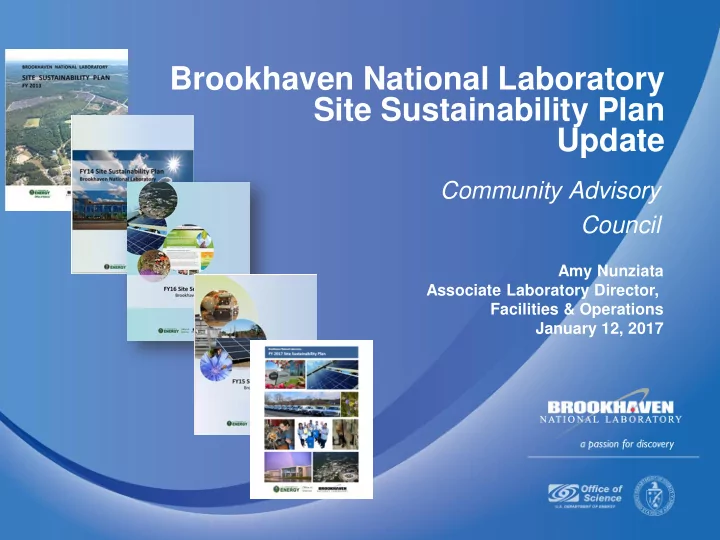
Brookhaven National Laboratory Site Sustainability Plan Update Community Advisory Council Amy Nunziata Associate Laboratory Director, Facilities & Operations January 12, 2017 Background DOE Strategic Sustainability Performance Plan

slide-1
SLIDE 1

Brookhaven National Laboratory Site Sustainability Plan Update

Community Advisory Council

Amy Nunziata Associate Laboratory Director, Facilities & Operations January 12, 2017

slide-2
SLIDE 2

Background

  • DOE Strategic Sustainability Performance Plan

establishes Department goals

  • Annual Site Sustainability Plan requirement
  • BNL uses a cross Laboratory Team approach
  • Executive Order 13693, Planning for

Federal Sustainability in the Next Decade, was signed March 2015.

  • Adds and extends many goals
  • The BNL Plan has been updated
  • as of Dec 2016
slide-3
SLIDE 3
slide-4
SLIDE 4

63% 19% 11% 1% 3% 3%

Energy Use represents 93% of BNL GHG Production

slide-5
SLIDE 5

BNL’s Energy Reduction Efforts

  • BNL has a long and successful history of identifying and implementing

energy conservation projects

  • Began an energy conservation program in 1973 to combat high energy

costs (first oil crisis)

  • Over $60 million has been

invested in a wide range of efforts that has curbed BNL’s energy consumption dramatically

  • Energy intensity (Btu/GSF)

has been reduced by over 67% comparing FY2016 to

  • FY1973
  • Saves about $12.6 million/year
  • in energy costs
  • Over 157,300 MTCO2e per year avoided

1,000 2,000 3,000 4,000 5,000 6,000 7,000

  • 50.00%
  • 45.00%
  • 40.00%
  • 35.00%
  • 30.00%
  • 25.00%
  • 20.00%
  • 15.00%
  • 10.00%
  • 5.00%

0.00% 1985 1988 1991 1994 1997 2000 2003 2006 2009 2012 2015 Heating Degree-Days Btu/Sq. Ft Change Btu/SF Change DOE Goals Htg Deg-Days Linear (Btu/SF Change)

DOE GOALS

  • 30% REDUCTION

BY 2005 vs 1985

  • 30% REDUCTION

BY 2015 vs 2003

  • 25% REDUCTION

BY 2025 vs 2015

BUILDING ENERGY PERFORMANCE

BTU / FT2 Change (%) vs. Baseline Year(s) Calculation updated withimproved meter data

slide-6
SLIDE 6

Goal 1: Greenhouse Gas (GHG) Reduction

  • In FY16, Scope 1 & 2 GHG decreased

36% from baseline

  • Continuing to improve building

efficiency

  • In FY16, Scope 3 GHG are up 14.5%

from FY15 and up 17.7% from baseline

  • Continuing to promote BlueJean

teleconferencing and increased carpooling # DOE Goal

1.1 50% Scope 1 & 2 GHG reduction by FY 2025 from a FY 2008 baseline 1.2 25% Scope 3 GHG reduction by FY 2025 from a FY 2008 baseline

6

slide-7
SLIDE 7

Goal 2: Sustainable Buildings and Regional & Local Planning

# DOE Goal

2.1 25% energy intensity (Btu per gross square foot) reduction in goal subject buildings, achieving 2.5% reductions annually, by FY25 from FY15 baseline 2.2 EISA Section 432 energy & water evaluations 2.3 Meter all individual buildings for electricity, natural gas, steam and water, where cost effective 2.4 At least 17% (by building count) of existing buildings >5,000 gross square feet to be compliant with revised Guiding Principles for HPSB by FY25, with progress to 100% thereafter 2.5 Efforts to increase regional and local planning coordination and involvement

  • The Utility Energy Service Contract

(UESC) Phase I was a success

  • Continuing emphasis on building

temperature setback

  • Green Energy surveys
  • Continuing metering of utilities
  • Achieved Goal 2.4 in FY16; currently 27%
  • f square footage classified as HPSB
  • Discovery Park continues to have

extensive involvement in state, regional, and local planning initiatives

  • Meetings with the Community Advisory

Council and the Brookhaven Executive Roundtable

7

slide-8
SLIDE 8

Goal 2: Sustainable Buildings and Regional & Local Planning

# DOE Goal

2.6a Identify existing buildings above 5,000 gross square feet intended to be energy, waste

  • r water net-zero buildings by

FY25 2.6b Identify new buildings >5,000 gross square feet entering planning process designed to achieve energy net-zero beginning in FY20

8

  • MPO hosted “Net-zero” design

training

  • Benchmarking with other labs

about Net-zero buildings

  • Will incorporate Net-zero designs

when economically feasible

  • Identified three potential buildings

to be furthered evaluated for Net- Zero designation

slide-9
SLIDE 9

Goal 3: Clean & Renewable Energy

# DOE Goal

3.1 Clean Energy percentage of total electrical and thermal energy accounted for by renewable and alternative energy shall be not <10% in F16-17, working toward 25% by FY25 3.2 Renewable Electric Energy account for not <10% of total electric consumption in FY16- 17 working toward 30% by FY25

  • Expansion of the Northeast Solar

Energy Research Center (NSERC) facility by 324kWkW

  • In FY16, NSERC produced ~49.4

million kWh

  • Purchase of 48.9 Renewable Energy

Credits (RECs)

  • In FY16, a combination of RECs and

NSERC and the peak output is now 781 kW

9

slide-10
SLIDE 10

Goal 4: Water Use Efficiency & Management

# DOE Goal

4.1 36% potable water intensity (Gal per gross square foot) reduction by FY25 from FY07 baseline

  • Long history of reducing water

consumption

  • Over 80% of water used is recharged

back to groundwater

  • Some concerns with new

programmatic growth

20.00 70.00 120.00 170.00 220.00 270.00

100,000 200,000 300,000 400,000 500,000 600,000 700,000 800,000 900,000 1,000,000

Annual Potable Water Use

kGal G/GSF

46% Decrease 55% Decrease

slide-11
SLIDE 11

Goal 5: Fleet Management

  • In FY16, 63% reduction in petroleum

consumption

  • 168% alternate fuel consumption in

FY16

  • 41% reduction from the FY14

baseline in fleet-wide per mile GHG emissions in FY16

  • Only 2 light duty vehicles ordered in

FY16 – both E-85

  • No passenger vehicles ordered for

FY16

  • GSA has not yet offered plug-in

hybrid electric passenger vehicles # DOE Goal

5.1 30% reduction in fleet-wide per mile GHG emissions by FY25 from a FY14 baseline 5.2 20% reduction in annual petroleum consumption by FY15 relative to a FY05 baseline 5.3 10% annual increase in alternative fuel consumption by FY15 relative to a FY05 baseline 5.4 75% of light duty vehicle acquisitions must consist of alternative fuel vehicles 5.5 50% of passenger vehicle acquisitions must consist of zero emission or plug-in hybrid electric vehicles by FY25

11

slide-12
SLIDE 12

Goal 6: Sustainable Acquisition

# DOE Goal

6.1 Promote sustainable acquisition and procurement, ensuring BioPreferred and biobased provisions and clauses are included in 95%

  • f applicable contracts
  • Included in BNL’s Terms and

Conditions

  • Blanket orders include

“Sustainable Acquisition” items

  • Currently converting online

purchasing system

  • Developing “kits” to promote the

most Environmentally Preferred Products for office supplies

12

slide-13
SLIDE 13

Goal 7: Pollution Prevention & Waste Reduction

# DOE Goal

7.1 Divert at least 50% of non- hazardous solid waste excluding construction and demolition debris 7.2 Divert at least 50% of construction and demolition materials and debris

  • In FY16 BNL achieved its highest

recycling/diversion rate at 79%

  • Exploring diverting food waste to an
  • ff-site contractor
  • The Lab typically recycles over 95%

C&D materials and debris

13

Goal

Before After BNL Concrete Crushing and Recycling Savings average $350,000 per event

slide-14
SLIDE 14

Goal 8: Energy Performance Contracts

  • UESC Phase I, completed in May

2015, was a success

  • 1st year performance within 2% of
  • riginal estimates
  • We are planning a Phase II

# DOE Goal

8.1 Annual targets for performance contracting to be implemented in FY 2017 and annually thereafter as part of the planning of section 14 of E.O. 13693.

14

slide-15
SLIDE 15

Goal 9: Electronic Stewardship

  • BNL procures Electronic Product

Environmental Assessment Tool (EPEAT) certified systems

  • All systems in BNL domain capable of

power management have the setting enabled

  • The Managed Print initiative promotes

network printers and automatic duplex printing

  • BNL recycles used and obsolete

electronic equipment

# DOE Goal

9.1 Purchases - 95% of eligible acquisitions are EPEAT- registered products 9.2 Power management - 100% of eligible computers and monitors have power management enabled 9.3 Automatic duplexing - 100% of eligible computers and imaging equipment have automatic duplexing enabled 9.4 End of Life - 100% of used electronics are reused or recycled using environmentally sound disposition options each year

15

slide-16
SLIDE 16

Goal 9: Electronic Stewardship

  • New data center to be designed to meet
  • ptimization initiative - Power Usage

Effectiveness (PUE) of 1.4. Striving for PUE design of 1.2

  • Establish PUE<1.5 for existing data

centers - efforts in progress

# DOE Goal

9.5 Data Center Efficiency: Establish a power usage effectiveness target in the range of 1.2-1.4 for new data centers and less than 1.5 for existing data centers

16

slide-17
SLIDE 17

Goal 10: Climate Change Resilience

# DOE Goal

10.1 Update policies to incentivize planning for and addressing the impacts of climate change 10.2 Update emergency response procedures to account for projected climate change, including extreme weather events 10.3 Ensure workforce protocols and policies reflect projected human health and safety impacts of climate change

  • Long-range planning at BNL

addresses climate change related to extreme weather events

  • The BNL Office of Emergency

Management (OEM) maintains the

  • Site Emergency Plan
  • Severe Weather Planning Guide
  • Hurricane Plan
  • Site Loss of Power Plan

17

  • The Lab has many workforce

policies and programs that reflect projected human health and safety impacts of climate change, particularly severe weather events

slide-18
SLIDE 18

Goal 10: Climate Change Resilience

# DOE Goal

10.4 Ensure site/lab management shows commitment to adaptation efforts through internal communications and policies 10.5 Ensure site/lab climate adaptation and resilience policies/programs reflect best available current climate change science, updated as necessary

  • Strengthened collaboration with NWS
  • n-site
  • Initiated a project to determine how

use of real-time weather data can shorten recovery time for utility system impacted by severe weather

  • Developed a team to improve modeling

regional climate

  • Engaged with NYC Mayor’s office:
  • Collaborations on solar forecasting
  • City-wide meteorological sensor

network

18

  • BNL Internal Communications

group publishes a biweekly web-based Memo from Senior Lab management

slide-19
SLIDE 19

Challenges Going Forward

  • Scope 3 GHG reductions in commuting and

air line travel

  • 25% reduction in energy intensity by FY25
  • Meeting goals for Net Zero Buildings
  • Meeting design requirements for existing

data centers

  • Monitoring of water usage

19

slide-20
SLIDE 20

Questions?