UPDATE ON Screening for unruptured aneurysms INTRACRANIAL Who to - - PowerPoint PPT Presentation

update on
SMART_READER_LITE
LIVE PREVIEW

UPDATE ON Screening for unruptured aneurysms INTRACRANIAL Who to - - PowerPoint PPT Presentation

2/16/2018 Current controversies UPDATE ON Screening for unruptured aneurysms INTRACRANIAL Who to screen? ANEURYSM What to do with small aneurysms? When to screen? How often? Nerissa U. Ko, MD, MAS Predicting aneurysms at


slide-1
SLIDE 1

2/16/2018 1

UPDATE ON INTRACRANIAL ANEURYSM

Nerissa U. Ko, MD, MAS Recent Advances in Neurology February 15, 2018

Current controversies

  • Screening for unruptured aneurysms
  • Who to screen?
  • What to do with small aneurysms?
  • When to screen?
  • How often?
  • Predicting aneurysms at high risk for

rupture

  • Any risk factors?
  • When to treat?

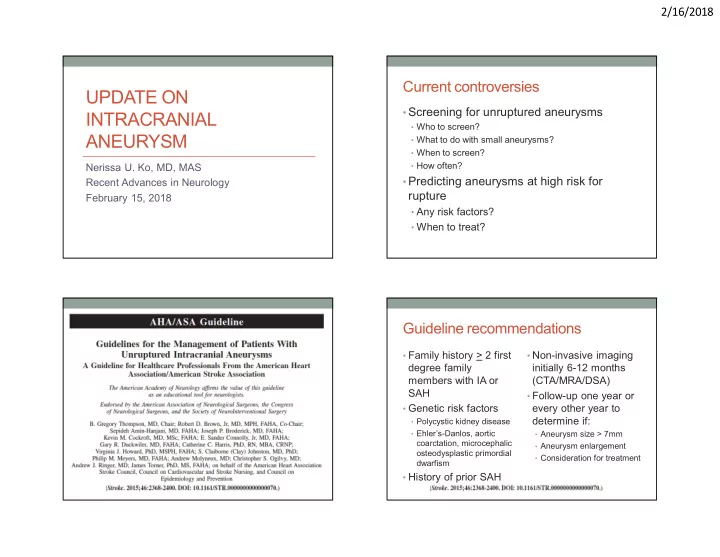
Guideline recommendations

  • Family history > 2 first

degree family members with IA or SAH

  • Genetic risk factors
  • Polycystic kidney disease
  • Ehler’s-Danlos, aortic

coarctation, microcephalic

  • steodysplastic primordial

dwarfism

  • History of prior SAH
  • Non-invasive imaging

initially 6-12 months (CTA/MRA/DSA)

  • Follow-up one year or

every other year to determine if:

  • Aneurysm size > 7mm
  • Aneurysm enlargement
  • Consideration for treatment
slide-2
SLIDE 2

2/16/2018 2

slide-3
SLIDE 3

2/16/2018 3

slide-4
SLIDE 4

2/16/2018 4

  • PHASES score
  • Population

(Finnish, Japanese)

  • HTN
  • Age > 70
  • Size
  • Hx SAH
  • Aneurysm location
  • Score < 3 associated

with lower, but not negligible risk of bleed

Summary

  • Small aneurysms have a very low risk of

growth and rupture

  • Recent modeling and systematic review

studies recommend no monitoring or intervention in small aneurysms in the general population

  • However, the dilemma of identifying which

small aneurysm will rupture remains problematic

Future directions

  • Better selection of high risk patients to

monitor, including women with FMD

  • Use of new grading scales like PHASES if

validated

  • Biological imaging of growth, areas of

activity

  • High resolution MRA, feromoxytol
  • Development of biomarkers to predict risk
  • DNA, mRNA, microRNAs, proteomics