
SLIDE 1
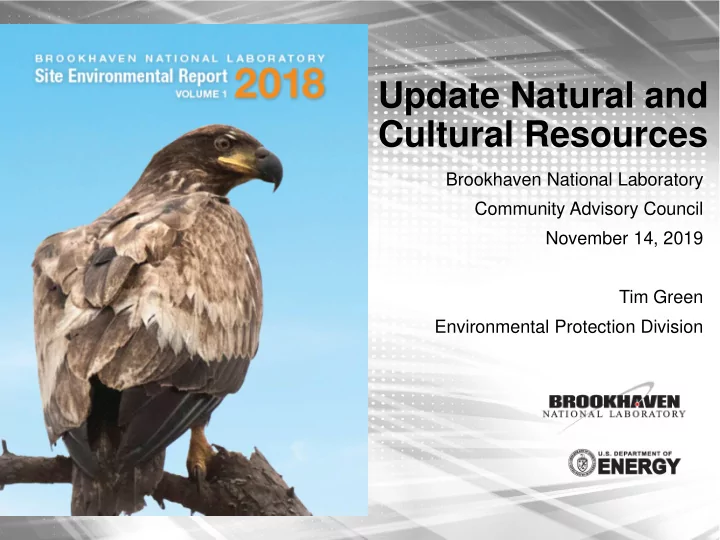
Update Natural and Cultural Resources
Brookhaven National Laboratory Community Advisory Council November 14, 2019 Tim Green Environmental Protection Division
Update Natural and Cultural Resources Brookhaven National - - PowerPoint PPT Presentation
Update Natural and Cultural Resources Brookhaven National Laboratory Community Advisory Council November 14, 2019 Tim Green Environmental Protection Division Agenda 2018 SER Chapter 6 Natural Resources Update Cultural Resources
Brookhaven National Laboratory Community Advisory Council November 14, 2019 Tim Green Environmental Protection Division
2
Ten-Year Trend of Cs-137 Concentrations in Deer Meat, dashed line is pre-cleanup avg. (2.57 pCi/g, wet weight), solid line is 10-year average (0.79 pCi/g, wet weight).
▪ Natural Resource Management
▪ Deer Management
▪ End of year population ~ 400
▪ One successful prescribed fire ▪ Continued opportunities for interns looking at a variety of ecological topics
▪ Long-time collaborator honored for
▪ Surveillance Monitoring
▪ Cs-137 in deer had similar results as past years - highest value 2.29 pCi/g, wet weight, off-site on Route 25. Highest onsite value was 2.19 pCi/g, wet weight. ▪ Ten-year trend shows decline; 2018
pCi/g, wet weight, with ten year on- site average being 0.79 pCi/g, wet weight
Murty Kambhampati (third from left) with interns and BNL collaborator Tim Green (fourth from left). Collaborations have been on going since 2006.
▪ Fish surveillance monitoring
▪ Peconic River dry most of year – no fish monitoring
▪ Peconic River Clean-up
▪ Final 2600 sq. ft. area naturally restoring, mostly open water habitat.
▪ Terrestrial vegetation and soils
▪ Grassy vegetation and soils similar to past years, highest veg. value was 0.22 pCi/g wet weight, highest soil was 0.22 pCi/g dry weight.
▪ Precipitation monitoring
▪ Low level mercury – highest value 8.59 ng/L ▪ Mercury in precipitation is higher than what is seen Sewage Treatment Plant effluents
2017 2019
4
5
▪ Internships
▪ 10 Undergraduate Interns ▪ 2 Faculty Members (Hofstra and SUNO)
▪ Projects
▪ Eastern box turtles – final summer ▪ Small mammals and ticks – pre-coyote data collection ▪ Forest health – deer exclosure surveys ▪ 4-Poster altered feeding schedule experiment ▪ Pollinator studies – established protocols for the LISF.
▪ MOU w/SUNY College of Environmental Science and Forestry (SUNY - ESF)
▪ Selection of first project – Forest Health Monitoring
▪ Apartments eligible for listing on National Register ▪ Formal recordation completed submitted to New York State Historic Preservation Officer (NYSHPO) ▪ NYSHPO requested Memorandum of Agreement
▪ Recommend saving portion of one apartment building
▪ Cement roads from WW I Camp Upton evaluated for historic significance
▪ Determined not eligible as they could not be confirmed from 1917-1918 period.
6
7
▪ Deer Management
▪ April 2019 ▪ Initial population estimated ~350 (this was likely low; probably between 400-500) ▪ 250 deer taken, 5,467 lbs. of meat donated ▪ 50 batch samples tested for Cs-137, nothing above 0.20 pCi/g, wet weight; avg. 0.06 pCi/g, wet weight ▪ Current estimate (fall 2019) before surveys ~ 250 ▪ Working on Interagency Agreement between DOE and USDA
▪ Fire Management
▪ Wildland Fire Management Plan in place ▪ Prescriptions in place ▪ Continued work to establish Memorandum of Understanding with NYSDEC or Central Pine Barrens Commission
8
▪ First Summer of Forest Health Monitoring ▪ 53 of 90+ plots monitored ▪ 8 Interns, 1 Professor, 1 Grad student
▪ Eastern Box Turtles
▪ Data analysis of 2011-2018 data collection started ▪ Intern analyzing movement of turtles and use of solar farm (publication almost ready for submission)
▪ Pollinator studies
▪ Interns from Southern University New Orleans established three-year study of LISF ▪ Continued in 2019 ▪ Important as New York is establishing requirements for solar farms
▪ New cameras purchased for consistency ▪ Second year of modified treatment
9
▪ 4 – Poster
▪ Continued deployment – under experimental conditions
weeks
▪ By year 3, 4-Posters were better than 90% effective at reducing ticks in areas of deployment ▪ Current effectiveness is 84% compared to first year of deployment
10
▪ HFBR Stack D&D
▪ Added Stack to 1999 MOU with NY State Historic Preservation Officer covering the BGRR ▪ Compiling information for MOU
▪ 1960s era efficiency apartments
▪ Recordation submitted to NYSHPO in 2018 ▪ NYSHPO would like to see at least part of one apartment building saved ▪ Negotiating an MOU
▪ NYSHPO visit – September 2019
▪ First visit since 2003 ▪ Representative gained insight about Laboratory
▪ Long Island Museum – History of BNL
▪ Identifying artifacts for exhibit
▪ More buildings are being determined eligible for listing on National Register
11
▪ Building evaluations for buildings 50+ years of age
▪ Evaluation is against four criteria
▪ National Register Criteria
Typically, a building or structure must retain three or more aspects of integrity in order to be considered eligible for listing on the National Register. Seven aspects of integrity include: integrity of design, location, setting, materials, workmanship, feeling, and association. In addition, abuilding or structure must meet one or more of the following National Register criteria: A) be associated with events that have made a significant contribution to the broad patterns of our history; or B) be associated with the lives of persons significant in our past; or C) embody the distinctive characteristics of a type, period, or method of construction, or that represent the work of a master, or that possess high artistic values, or that represent a significant and distinguishable entity whose components may lack individual distinction; or D) have yielded, or may be likely to yield, information important in prehistory or history.
12
13