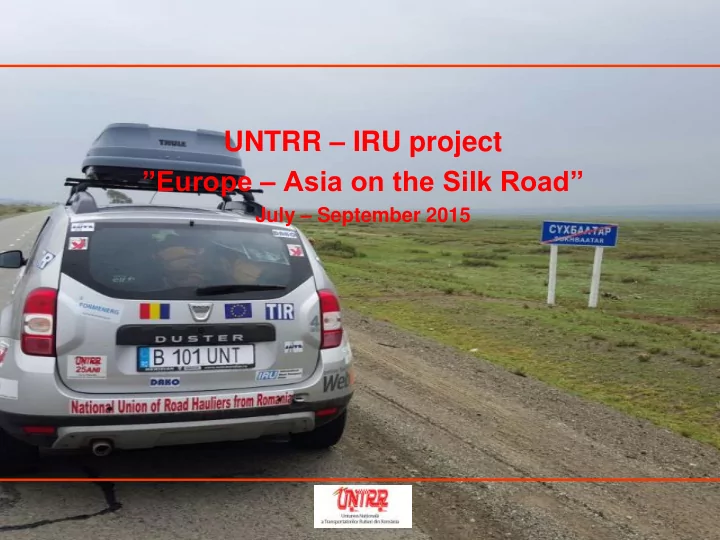
SLIDE 1
UNTRR – IRU project ”Europe – Asia on the Silk Road”
July – September 2015
SLIDE 2
Project coordinates
Period: 11 July – 10 September Distance covered: 27.000 km Countries: 14 (Romania - Bulgaria - Turkey – Georgia – Armenia – Azerbaijan - Iran – Turkmenistan - Uzbekistan- Tajikistan – Kirgizstan – Kazakhstan – Mongolia - Russian Federation – Ukraine) Diesel consuption: 1,700 liters Total waiting time at borbers: 7 h UNTRR team: 2 persons – Mr. Romeo Medan (Board Member) & Ms. Liana Berengea (Project Manager) – NO Russian speakers with Romanian passports (they needed visas in most countries on the route) 1 Romanian car: Dacia Duster
SLIDE 3 The project
- UNTRR & IRU started a project for the development of business relations
between Europe and Asia, called ”Europe – Asia on the Silk Road”, in order for European hauliers to capitalize China’s accession to TIR Convention
- UNTRR project was performed during the period of July-August 2015
- UNTRR delegation arrived until China border with Kyrgyzstan, Kazakhstan and
Mongolia.
SLIDE 4
The route of the project ”Europa – Asia on the Silk Road”
UNTRR delegation involved in the project “Romania – Asia on the Silk Road” crossed the following states: Romania - Bulgaria - Turkey – Georgia – Armenia – Georgia – Azerbaijan - Iran – Turkmenistan - Uzbekistan- Tajikistan – Kirgizstan – Kazakhstan – Russian Federation - Mongolia - Russian Federation – Ukraine – Romania.
SLIDE 5
The goal of the project
The goal of the project is to interconnect the European business environment with the large markets in the Asian region, given that the countries of Central Asia showed a very dynamic growth in the use of TIR system in recent years. This increase was notable in Kazakhstan and Kyrgyzstan, both important countries of transit for goods originating in China. All signs indicate that this trend will continue - especially if Afghanistan, Pakistan and China are to use TIR system in the near future.
SLIDE 6 Signing protocols with sister-associations
- Throughout this route, UNTRR delegation visited sister-associations (IRU members) and signed
cooperation protocols and exchanged information of interest for European hauliers that are performing transport operations on these routes.
- The associations where we signed the protocol were: Georgia, Armenia , Azerbaijan, Iran* (UNTRR
team arrived during Ramadan. Thus, the cooperation protocol will be signed this autumn), Turkmenistan* (the protocol has to be approved by the board), Uzbekistan, Tajikistan, Kyrgyzstan, Kazakhstan, Mongolia, Russia, Ukraine.
SLIDE 7 What information will be exchanged by the associations?
A regular exchange of operational experience and information regarding road transport in each country: the customs daily schedule, the customs requirements and conditions if any special, parking areas along the main routes, updated road maps, gas stations locations and diesel prices, road taxes and access taxes, any
- ther useful information where applicable like ferry schedule and prices, booking
systems etc.
SLIDE 8 Insights
Country Period
Medium speed Romania July 9 65.6 km 54 km/h Bulgaria July 9 – July 10 328.7 km 81 km/h Turkey July 10 – July 11 1993.6 km 75 km/h Georgia July 12 – July 13 429.4 km 50 km/h Armenia July 14 – July 15 604.1 km 58 km/h Azerbaijan July 16 – July 17 871 km 57 km/h Iran July 17 – July 20 2018 km 62 km/h Turkmenistan July 20 – July 21 648.7 km 84 km/h Uzbekistan July 22 – July 24 923.9 km 60 km/h Tajikistan July 25 – July 31 2591.5 km 42 km/h Kyrkyzstan July 31 – August 3 1494.9 km 57 km/h Kazahstan August 4 – August 8 1875.5 km 58 km/h Russia August 9 – August 10 938.7 km 68 km/h Mongolia August 11 – August 17 2282.4 km 54 km/h Russia August 18 – September 3 8407 km 74 km/h Ukraine September 3 – September 10 894.5 km 78 km/h
September 10 – September 11 249 km 50 km/h Romania September 11 475 km 59 km/h Total July 9 – September 11 27091.km 62 km/h
SLIDE 9 Infrastructure, parking, fuel stations (I)
- Turkey - the infrastructure is exceptional, not always you find highways, but
there are express roads
- Georgia – they are working on infrastructure. They also have an ongoing
national program to build 10 dedicated parking for trucks with gas stations, restaurants, repair service etc. 6 are almost ready; UNTRR caravan met two of them, which are finished, on the road.
- Armenia - roads are good. They have a piece of highway 120 km on the route
Sevan - Yerevan - Ararat.
- Azerbaijan - the roads are very good, wide, although they are not at the level of
a highway. They are working hard on the infrastructure level.
- Iran – the roads are fast with motorway profile, but often through towns. Of all
the countries on the route, Iran has the best infrastructure of gas stations, with truck parking.
SLIDE 10 Infrastructure, parking, fuel stations (II)
- Turkmenistan - Customs is open between 8:00 am and 18:00 pm but there are no problems.
The roads are good, straight and they are still working on them. The are parking lots around fuel stations.
- Uzbekistan – Very good roads are at a highway level. Unfortunately, although the fuel stations
indicate that they have diesel fuel, this is not easy to find. There are parking lots along the main roads.
- Tajikistan – they are working on roads, the country with the most difficult infrastructure.
Between Tashkent and Dushanbe there is a large tunnel under construction at 3,600 m altitude, so the route is deviated on a mountain side road. It's a very tough stretch. In Tajikistan there is a system of toll road very well done, with barriers in different places. Towards China border and Pamir things get complicated. For the last 6 months there is no traffic because the water ”took this road”. Goods are brought from China to Murghob with large trucks and then taken to Dushanbe with 7.5 tones trucks 7.5. It's hard to define this as a route to China and it is uncertain when this route will be reconstructed. UNTRR caravan crossed a 450 km road in 18 hours.
SLIDE 11 Infrastructure, parking, fuel stations (III)
- Kyrgyzstan - roads are better than in Tajikistan, relatively difficult to drive. There is an exit on the
border with China, at Nura (3,000 m altitude), where international goods traffic runs excellent.
- Kazakhstan - roads are good in general, they are working on them. There are some roads at
highway standards. It should be noted that, except for Russia and relatively in Iran, no country from this route signals, when entering the country, the maximum speed, the maximum weight per axle, maximum speed in localities etc. The average speed is 90 km per hour, but there are quite a few restrictions.
- Mongolia - we cannot talk about infrastructure. They have a single paved road from one end to
another linking China to Russia through Ulaanbaatar. On the route of the UNTRR caravan, through Kazakhstan - Russia – Mongolia (west side of the country) 300 km are paved, 700-800 km are a macadam road and 400-500 kilometers are dirt roads, basically you go through a dry riverbed.
- Russia – roads are impeccable, very well signaled, you have nothing to reproach. According to
the UNTRR caravan, the best way for hauliers to drive through China is the route Russia - Mongolia - China.
- Ukraine - the roads are good. Problems with the police because it was lost a license plate.
A full report of the project will be presented by the end of September.
SLIDE 12 Lead partner
IRU – International Road Transport Union - www.iru.org The International Road Transport Union (IRU) was founded in Geneva on 23 March 1948, one year after the United Nations Economic Commission for Europe (UNECE), to expedite the reconstruction of war-torn Europe through facilitated international trade by road transport. A global industry federation of national Member Associations and Associate Members in 74 countries on the 5 continents, the IRU today represents the interests of bus, coach, taxi and truck operators worldwide, from large fleets to individual
SLIDE 13 Sponsors
Vesta Investment - www.vesta.ro Romanian company specialized in production and installation
- f traffic safety equipment, for both vertical and horizontal
signaling, vehicle accessories and protection equipment. Lutz Assekuranz Makler GmbH - www.lutz-assekuranz.de – expert in the field of CASCO, CMR and Freight Forwarders Insurance Dako – www.dako.de German company for IT systems and services for transport, logistic, road traffic safety, banking system, multimedia. RARTEL – www.rartel.ro Romanian-Italian joint venture company providing solutions in satellite technologies field, using state-of-the-art equipment with highest technological standards. WebEye – www.webeye.eu Hungarian company providing vehicle tracking and fleet management services, Formenerg - www.formenerg.ro, training company in energy sector.
SLIDE 14
Thank you!