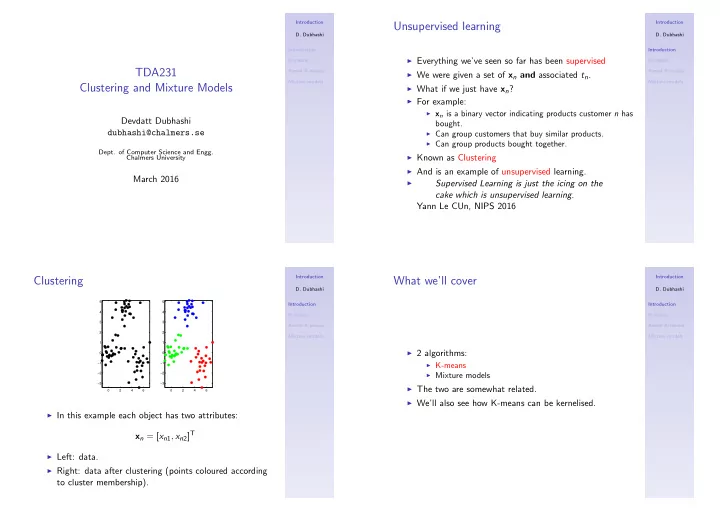

SLIDE 1
Introduction
- D. Dubhashi
Introduction K-means Kernel K-means Mixture models
TDA231 Clustering and Mixture Models
Devdatt Dubhashi dubhashi@chalmers.se
- Dept. of Computer Science and Engg.
Chalmers University
March 2016
Introduction
- D. Dubhashi
Introduction K-means Kernel K-means Mixture models
Unsupervised learning
◮ Everything we’ve seen so far has been supervised ◮ We were given a set of xn and associated tn. ◮ What if we just have xn? ◮ For example:
◮ xn is a binary vector indicating products customer n has
bought.
◮ Can group customers that buy similar products. ◮ Can group products bought together.
◮ Known as Clustering ◮ And is an example of unsupervised learning. ◮
Supervised Learning is just the icing on the cake which is unsupervised learning. Yann Le CUn, NIPS 2016
Introduction
- D. Dubhashi
Introduction K-means Kernel K-means Mixture models
Clustering
2 4 6 −3 −2 −1 1 2 3 4 5 2 4 6 −3 −2 −1 1 2 3 4 5
◮ In this example each object has two attributes:
xn = [xn1, xn2]T
◮ Left: data. ◮ Right: data after clustering (points coloured according
to cluster membership).
Introduction
- D. Dubhashi
Introduction K-means Kernel K-means Mixture models
What we’ll cover
◮ 2 algorithms:
◮ K-means ◮ Mixture models