United States Naval Nuclear Propulsion Program Presentation to - - PowerPoint PPT Presentation

united states naval nuclear propulsion program
SMART_READER_LITE
LIVE PREVIEW

United States Naval Nuclear Propulsion Program Presentation to - - PowerPoint PPT Presentation

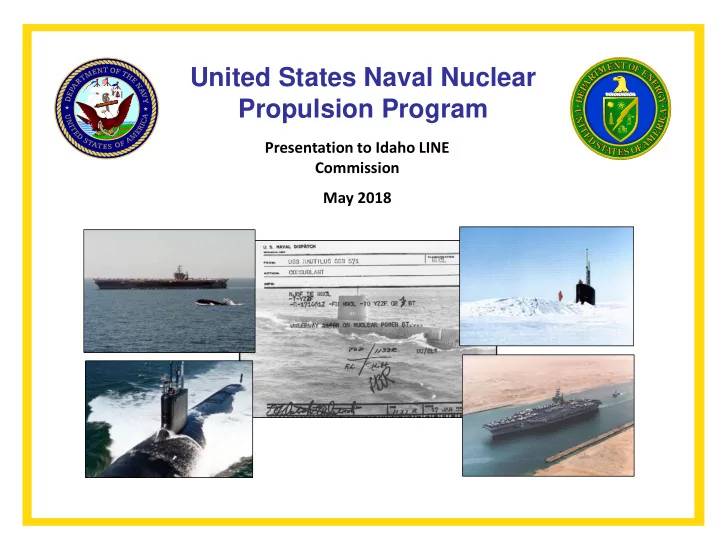
United States Naval Nuclear Propulsion Program Presentation to Idaho LINE Commission May 2018 Integrated Navy and DOE Program FOCUSED MISSION Provide militarily effective nuclear propulsion plants and ensure their safe, reliable, and


slide-1
SLIDE 1

Presentation to Idaho LINE Commission May 2018

United States Naval Nuclear Propulsion Program

slide-2
SLIDE 2

FOCUSED MISSION

  • Provide militarily effective nuclear propulsion plants and ensure

their safe, reliable, and long-lived operation CRADLE TO GRAVE RESPONSIBILITY AND ACCOUNTABILITY FOR ALL ASPECTS

  • Research, development, design, construction
  • Maintenance, repair, overhaul, disposal
  • Radiological controls, environment, safety, health matters
  • Officer operator selection, operator training
  • Administration (security, nuclear safeguards, transportation,

public information, procurement and fiscal management) PROGRAM RECORD

  • Program founded in 1948
  • Over 7,000 reactor-years of safe operations
  • Over 162,000,000 miles safely steamed
  • 101 operating reactors (compared to 99 commercial power reactors)
  • Welcomed in more than 150 ports in over 50 countries worldwide

Admiral James F. Caldwell, Jr.

EXECUTIVE ORDER 12344 SET FORTH IN PUBLIC LAW 98-525 AND 106-65

Integrated Navy and DOE Program

slide-3
SLIDE 3

Naval Nuclear Propulsion Program

NUCLEAR POWERED FLEET

  • 81 warships
  • About 45% of major combatants

DEDICATED LABORATORIES

  • Bettis Laboratory Site
  • Knolls Laboratory Site
  • Government Owned /

Contractor Operated R&D/TRAINING REACTORS

  • Train 3000 students/year

REPORT TO DIRECTOR

  • Ensures focus on mission
  • Immediate identification of concerns

SPECIALIZED INDUSTRIAL BASE

  • Single dedicated prime contractor
  • Hundreds of suppliers

SCHOOLS

  • Nuclear Power School
  • Nuclear Field “A” School

SHIPYARDS 4 Public / 2 Private NAVAL REACTORS FACILITY

  • Dry Storage Program
  • Expended Core Facility

Naval Reactors

Field Offices

slide-4
SLIDE 4

Naval Spent Fuel Shipping

WA OR ID MT ND SD WY NE MN WI IA IL MI IN OH KY MO CA NV UT AZ CO NM TX KS OK AR LA MS AL TN GA SC FL NC VA WV PA NY ME NH VT MA RI CT NJ DE MD

Originating Shipyard Destination (NRF) 874 CONTAINERS SAFELY SHIPPED (March 1957 to Present) After defueling, all naval spent fuel transported by rail to NRF for examination: – Ensures maximum performance of current fuel – Enables design of new fuel with longer lifetimes

slide-5
SLIDE 5

State of Idaho Agreement and Consent Order

The 1995 Agreement and Consent Order governs management of all spent nuclear fuel and transuranic waste at the Idaho National Laboratory

BACKGROUND

  • The agreement resolved litigation related to concern of Idaho officials that the INL was becoming a de facto

permanent repository for spent fuel and transuranic waste.

  • Litigation also led to preparation of a Programmatic EIS for management of spent nuclear fuel across the DOE.

ONGOING NAVY OBLIGATIONS

  • Limit shipments of naval spent nuclear fuel to Idaho to a running average of 20 containers per year.
  • Provide to Idaho annual reports on actual shipments made in the prior calendar year and expected shipments

during the next calendar year.

  • Include naval spent nuclear fuel among the early shipments to a permanent geologic repository or interim

storage site. 2008 ADDENDUM TO AGREEMENT

  • Continued use of the water pool at the Naval Reactors Facility beyond 2023.
  • Continued management of a limited in-process inventory of naval spent nuclear fuel at the Naval Reactors

Facility in Idaho beyond 2035.

NAVAL REACTORS IS COMPLIANT WITH THE AGREEMENT AND ADDENDUM

slide-6
SLIDE 6

Naval Reactors Facility

Expended Core Facility A1W Prototype S5G Prototype Spent Fuel Packaging Facility Overpack Storage Cask Shipping and Receiving Facility S1W Prototype

SERVING A VITAL ROLE SUPPORTING THE NATION’S NUCLEAR POWERED FLEET FOR OVER 60 YEARS

slide-7
SLIDE 7

Expended Core Facility

CAPABILITIES AND ACCOMPLISHMENTS:

  • Began operations in 1958
  • Large water pool
  • Visual examination, processing, and storage of spent fuel
  • Assembly/disassembly to support irradiation testing of new materials
  • Shielded hot cells for detailed examination of test specimens
  • Specialized facilities for placing spent fuel in sealed canisters for dry storage/disposal

Providing unique capabilities to the Naval Nuclear Propulsion Program

slide-8
SLIDE 8

Dry Storage Packaging Operations

  • Dry Storage Packaging is
  • n track to meet the 2023

provision of the Idaho Settlement Agreement and Consent Order.

  • Over 150 spent fuel

canisters have been loaded since 2003.

  • Spent fuel canisters are

ready to be shipped to a permanent repository.

OVER 70% OF NAVAL SPENT FUEL INVENTORY SUBJECT TO 2023 PROVISION HAS ALREADY BEEN PLACED IN DRY STORAGE

Placing Naval Nuclear Fuel into Dry Storage Canisters since 2003

slide-9
SLIDE 9

Cask Shipping and Receiving Facility

Cask Shipping and Receiving Facility was constructed for:

  • Unloading aircraft carrier fuel from M-290

shipping containers.

  • Loading spent fuel into shipping containers for

rail transport to a permanent repository or interim storage facility.

NAVAL SPENT FUEL CANISTERS ARE ROAD-READY FOR SHIPMENT

slide-10
SLIDE 10

Spent Fuel Handling Recapitalization Project

Naval Spent Fuel Handling Facility Cask Shipping and Receiving Facility & Overpack Storage Facility Expended Core Facility

VITAL RECAPITALIZATION EFFORT TO SUSTAIN THE NAVAL REACTORS FACILITY MISSION INTO THE FUTURE

slide-11
SLIDE 11

Socioeconomic Impact Summary

  • Naval Reactors invests more than $400M in Idaho

each year

  • Approximately 1,500 employees at NRF
  • Spent Fuel Handling Recapitalization Project will

provide additional jobs during construction

  • Each job at NRF adds about one to two jobs in the

community