
SLIDE 1
1
CHM 1045
Fall 2018
Unit I
Lecture slides from August 27 to September 9. Exam One is Wednesday, Sept 26.
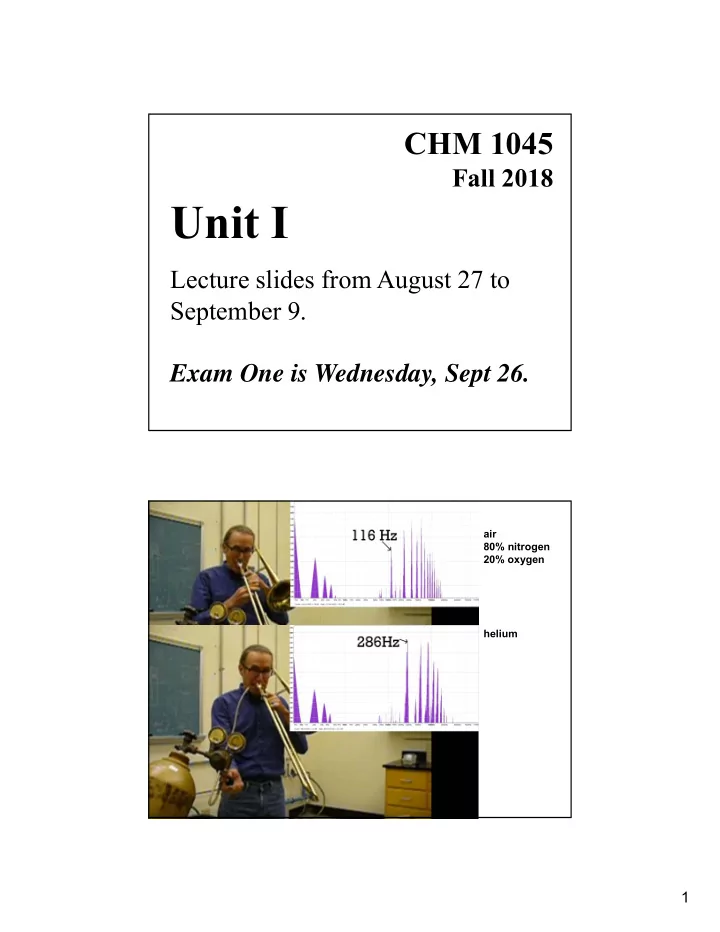
air 80% nitrogen 20% oxygen helium
Unit I Lecture slides from August 27 to September 9. Exam One is - - PDF document
CHM 1045 Fall 2018 Unit I Lecture slides from August 27 to September 9. Exam One is Wednesday, Sept 26. air 80% nitrogen 20% oxygen helium 1 air 80% nitrogen 20% oxygen helium 2 The process of deep-frying can be divided into four
1
air 80% nitrogen 20% oxygen helium
2
air 80% nitrogen 20% oxygen helium
3
The process of deep-frying can be divided into four stages:
(1) Initial heating. The surface of the food reaches the boiling point of water. (2) Surface boiling. The hot oil surrounding the food causes water inside the food to evaporate. (3) Decreasing heat transfer rate. Crust continues to dehydrate, less heat conduction, rate of heat transfer through escaping steam decreases (reduced bubbling). The remaining moisture inside of the food is slowly heated to the boiling point of water, which cooks the food inside as if it were boiled, gelatinizing the starch and denaturing the proteins in the food. (4) Bubble end point. Water from inside the food is no longer evaporating. Remove the fried food before it begins to absorb oil.
https://scienceandfooducla.wordpress.com/2015/08/25/fair-food-deep-frying/
4
Indiana Jones and the Raiders of the Lost Arc
Paramount, 1981
Assuming the statue is solid gold, how much will it weigh?
5
6
http://tmagazine.blogs.nytimes.com/ 2009/01/20/fresh-raw-milk-on-tap-in-turin/
¼ gallon = 1 quart
1 gallon ½ gallon 1 quart 1 liter
= 0.946 liters
Assuming the statue is solid gold, how much will it weigh?
7
Assuming the statue is solid gold, how much will it weigh?
A Partial History of the Number Zero
8
9
René Descartes (1596-1650) Daniel Gabriel Fahrenheit German physicist 1709, alcohol thermometer 1714, mercury thermometer 1724, Fahrenheit Scale, allowed temperatures to be recorded reproducibly.
10
Anders Celsius Swedish astronomer 1742, devised the centigrade
0 K
11
900 megahertz, 21.1-tesla NMR magnet at the FSU National High Magnetic Field Laboratory (Mag Lab)
liquid helium
4.2 K
As temperature increases, in general, the density of a substance will
12
How much does it cost to drive from Tallahassee to Miami?
13
Increasing from 8 pounds to 16 pounds, at what weight does a bowling ball sink?
14
15
http://www.school-for-champions.com/science/static_materials.htm
Becom e positive in charge
The following m aterials will tend to give up electrons when brought in contact withNeutral
There are very few m aterials that do not tend to readily attract or give up electrons when brought in contact or rubbed with other m aterials. Cotton Best for non-static clothes Steel Not useful for static electricityBecom e negative in charge
The following materials will tend to attract electrons when brought in contact withTriboelectric Series
16
(4.8 x 10⁻¹⁹ C)/(1.6 x 10-19 C) = 3 3 e (3.2 x 10⁻¹⁹ C)/(1.6 x 10-19 C) = 2 2 e (6.4 x 10⁻¹⁹ C)/(1.6 x 10-19 C) = 4 4 e (1.6 x 10⁻¹⁹ C)/(1.6 x 10-19 C) = 1 1 e (4.8 x 10⁻¹⁹ C)/(1.6 x 10-19 C) = 3 3 e
Assuming the lowest charge corresponds to having only one electron transferred to the oil drop, implies....
An effort to reconstruct Millikan's "exemplary" experimental thinking revealed serious discrepancies between Millikan's notebooks and his published "raw" data (Holton, 1978). The numerous notes which are scattered across the pages cast further doubt
This is almost exactly right & the best one I ever had!!! [20 December 1911] Exactly right [3 February 1912] Publish this Beautiful one [24 February 1912] Publish this surely / Beautiful !! [15 March 1912, #1] Error high will not use [15 March 1912, #2] Perfect Publish [11 April 1912] Won't work [16 April 1912, #2] Too high by 1½% [16 April 1912, #3] http://www1.umn.edu/ships/ethics/millikan.htm
17
The notebooks reveal that, indeed, substantial data are missing from Millikan's published reports. Of 175 total drops documented in the notebooks, only 58 (barely one-third) appear in the final paper. By contrast, Millikan had announced in his 1913 paper that "It is to be remarked, too, that this is not a selected group
days, during which time the apparatus was taken down several times and set up anew" [his own emphasis!]. In his 1917 book, The Electron, he repeats this statement and then adds, "These drops represent all of those studied for 60 consecutive days, no single drop being omitted.“ At first blush, this outrageous violation of scientific integrity would seem to discredit Millikan's findings. Even if one assumes that standards of reporting data earlier in the century were less rigorous, Millikan clearly misrepresented the extent of his data. One may caution students, however, that we may not want to conclude that therefore there was no good, "scientific" basis for his selective use
nature of the experimental task that they crudely document, reveals more tellingly the reasons that Millikan included some drops and excluded others. http://www1.umn.edu/ships/ethics/millikan.htm
18
19
http://www.moviemistakes.com/film3843
20
Iodine-131 is used to image the brain and monitor thyroid activity, but it is also a byproduct of nuclear fusion and causes cancer. An 131I nucleus contains: A. 53 protons and 78 neutrons B. 53 protons and 131 neutrons C. 78 protons and 53 neutrons D. 131 protons and 53 neutrons E. 131 protons and 78 neutrons
21