
SLIDE 1
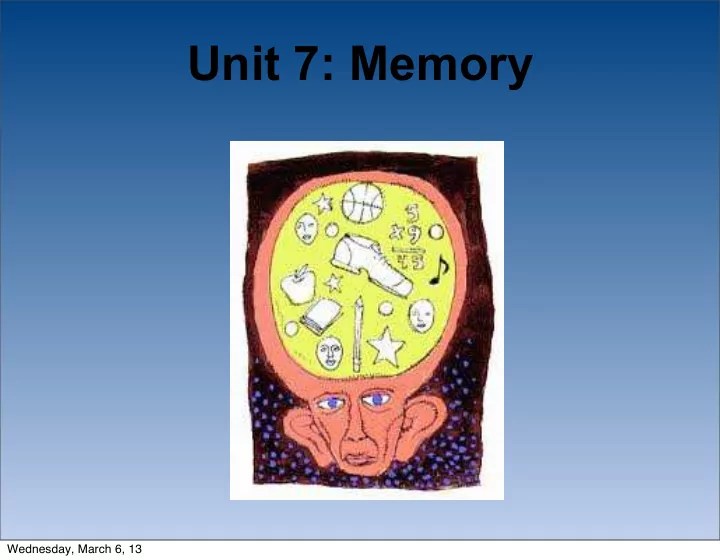
Unit 7: Memory
Wednesday, March 6, 13
Unit 7: Memory Wednesday, March 6, 13 The Phenomenon of Memory - - PowerPoint PPT Presentation
Unit 7: Memory Wednesday, March 6, 13 The Phenomenon of Memory Wednesday, March 6, 13 Memory: learning that persists over 3me; informa3on that has been stored and can be retrieved.
Wednesday, March 6, 13
Wednesday, March 6, 13
informa3on ¡that ¡has ¡been ¡stored ¡and ¡can ¡be ¡ retrieved.
Clive Wearing)
Wednesday, March 6, 13
Introduction Atkinson-Shiffrin Three-
Stage Model
Wednesday, March 6, 13
Introduction
processing model of memory
Wednesday, March 6, 13
Introduction
processing model of memory
memory
Wednesday, March 6, 13
Modified ¡Three-‑stage ¡Processing ¡Model ¡
Wednesday, March 6, 13
Modified ¡Three-‑stage ¡Processing ¡Model ¡
Wednesday, March 6, 13
Modified ¡Three-‑stage ¡Processing ¡Model ¡
Wednesday, March 6, 13
Modified ¡Three-‑stage ¡Processing ¡Model ¡
Wednesday, March 6, 13
Modified ¡Three-‑stage ¡Processing ¡Model ¡
Wednesday, March 6, 13
Modified ¡Three-‑stage ¡Processing ¡Model ¡
Wednesday, March 6, 13
Modified ¡Three-‑stage ¡Processing ¡Model ¡
Wednesday, March 6, 13
Modified ¡Three-‑stage ¡Processing ¡Model ¡
Wednesday, March 6, 13
Modified ¡Three-‑stage ¡Processing ¡Model ¡
Wednesday, March 6, 13
Modified ¡Three-‑stage ¡Processing ¡Model ¡
Wednesday, March 6, 13
Modified ¡Three-‑stage ¡Processing ¡Model ¡
Wednesday, March 6, 13
Modified ¡Three-‑stage ¡Processing ¡Model ¡
Wednesday, March 6, 13
Wednesday, March 6, 13
Encoding: Getting Information InHow
We Encode
Wednesday, March 6, 13
Encoding: Getting Information In
How We Encode
repetition)
Wednesday, March 6, 13
Encoding: Getting Information InHow
We Encode
Wednesday, March 6, 13
Encoding: Getting Information InHow
We Encode
Wednesday, March 6, 13
Encoding: Getting Information InHow
We Encode
Wednesday, March 6, 13
Encoding: Getting Information InWhat We Encode
Wednesday, March 6, 13
Encoding: ¡GeKng ¡Informa3on ¡In
What ¡We ¡Encode
Wednesday, March 6, 13
Encoding: ¡GeKng ¡Informa3on ¡InWhat ¡
We ¡Encode
Wednesday, March 6, 13
Encoding: ¡GeKng ¡Informa3on ¡InWhat ¡
We ¡Encode
Wednesday, March 6, 13
Encoding: ¡GeKng ¡Informa3on ¡InWhat ¡
We ¡Encode
Wednesday, March 6, 13
Encoding: Getting Information InWhat We Encode
Wednesday, March 6, 13
Encoding: Getting Information InWhat We Encode
Wednesday, March 6, 13
Encoding: Getting Information InWhat We Encode
Wednesday, March 6, 13
Encoding: Getting Information InWhat We Encode
Wednesday, March 6, 13
Encoding: Getting Information InWhat We Encode
Wednesday, March 6, 13
Encoding: Getting Information InWhat We Encode
Wednesday, March 6, 13
Encoding: Getting Information InWhat We Encode
Wednesday, March 6, 13
Encoding: Getting Information InWhat We Encode
Wednesday, March 6, 13
Encoding: Getting Information InWhat We Encode
Wednesday, March 6, 13
Storage: Retaining InformationSensory Memory
Wednesday, March 6, 13
Storage: Retaining InformationWorking/Short-Term
Wednesday, March 6, 13
Storage: Retaining InformationLong-
Term Memory
Wednesday, March 6, 13
Storage: Retaining InformationStoring Memories in the
(LTP)
Wednesday, March 6, 13
Storage: Retaining InformationStoring Memories in the
Stress Hormones and Memory
Wednesday, March 6, 13
Storage: Retaining InformationStoring Memories in the
Wednesday, March 6, 13
Storage: Retaining InformationStoring Memories in the
Wednesday, March 6, 13
Storage: ¡Retaining ¡Informa3onStoring ¡
Memories ¡in ¡the ¡Brain
Wednesday, March 6, 13
Retrieval: Getting Information Out
Wednesday, March 6, 13
Retrieval: Getting Information OutRetrieval Cues
devices
Wednesday, March 6, 13
Priming
Wednesday, March 6, 13
Priming
Wednesday, March 6, 13
Priming
Wednesday, March 6, 13
Retrieval: Getting Information OutContext Effects
Wednesday, March 6, 13
Retrieval: ¡GeKng ¡Informa3on ¡ OutContext ¡Effects
Wednesday, March 6, 13
Retrieval: ¡GeKng ¡Informa3on ¡ OutContext ¡Effects
Wednesday, March 6, 13
Retrieval: ¡GeKng ¡Informa3on ¡ OutContext ¡Effects
Wednesday, March 6, 13
Retrieval: ¡GeKng ¡Informa3on ¡ OutContext ¡Effects
Wednesday, March 6, 13
Retrieval: ¡GeKng ¡Informa3on ¡ OutContext ¡Effects
Wednesday, March 6, 13
Retrieval: ¡GeKng ¡Informa3on ¡ OutContext ¡Effects
Wednesday, March 6, 13
Retrieval: Getting Information OutMoods and Memories
¡ ¡ ¡ ¡ ¡ ¡ ¡ ¡ ¡ ¡ ¡ ¡ ¡ ¡ ¡ ¡ ¡ ¡ ¡ ¡ ¡ ¡ ¡ ¡ memory
Wednesday, March 6, 13
Wednesday, March 6, 13
Introduction
Wednesday, March 6, 13
Introduction
Wednesday, March 6, 13
Introduction
Wednesday, March 6, 13
Encoding Failure
Wednesday, March 6, 13
Encoding Failure
Wednesday, March 6, 13
Encoding Failure
Wednesday, March 6, 13
Storage Decay
Wednesday, March 6, 13
Storage Decay
Wednesday, March 6, 13
Ebbinghaus ¡Curve
Wednesday, March 6, 13
Ebbinghaus ¡Curve
Wednesday, March 6, 13
Retrieval Failure
Wednesday, March 6, 13
Retrieval FailureInterference
acting)
Wednesday, March 6, 13
Retrieval ¡FailureInterference
Wednesday, March 6, 13
Retrieval ¡FailureInterference
Wednesday, March 6, 13
Retrieval ¡FailureInterference
Wednesday, March 6, 13
Retrieval ¡FailureInterference
Wednesday, March 6, 13
Retrieval ¡FailureInterference
Wednesday, March 6, 13
Retrieval FailureMotivated Forgetting
personal histories
Wednesday, March 6, 13
Retrieval FailureMotivated Forgetting
personal histories
Wednesday, March 6, 13
Retrieval FailureMotivated Forgetting
personal histories
Wednesday, March 6, 13
Retrieval FailureMotivated Forgetting
personal histories
Wednesday, March 6, 13
Wednesday, March 6, 13
Misinformation and Imagination Effects
Wednesday, March 6, 13
Source Amnesia
Wednesday, March 6, 13
Discerning True and False Memories
Wednesday, March 6, 13
Children’s Eyewitness Recall
Wednesday, March 6, 13
Repressed or Constructed Memories of Abuse?
Wednesday, March 6, 13
Repressed or Constructed Memories of Abuse?
Wednesday, March 6, 13
Wednesday, March 6, 13
Improving Memory Techniques
and to help determine what you do not yet
Wednesday, March 6, 13
Wednesday, March 6, 13
Teacher ¡Informa3on
format ¡placed ¡a ¡few ¡limita3ons ¡on ¡the ¡presenta3on, ¡it ¡insured ¡the ¡file ¡would ¡be ¡ compa3ble ¡with ¡the ¡many ¡versions ¡of ¡Powerpoint ¡teachers ¡use. ¡ ¡To ¡add ¡ func3onality ¡to ¡the ¡presenta3on, ¡teachers ¡may ¡want ¡to ¡save ¡the ¡file ¡for ¡their ¡ specific ¡version ¡of ¡Powerpoint.
slides ¡are ¡animated. ¡ ¡To ¡increase ¡student ¡interest, ¡it ¡is ¡suggested ¡teachers ¡animate ¡ the ¡slides ¡wherever ¡possible.
pasted ¡to ¡a ¡specific ¡loca3on ¡in ¡the ¡presenta3on ¡follow ¡this ¡“Teacher ¡Informa3on” ¡
Wednesday, March 6, 13
Teacher ¡Informa3on
can ¡be ¡iden3fied ¡by ¡the ¡text ¡being ¡underlined ¡and ¡a ¡different ¡color ¡(usually ¡purple).
#3) ¡can ¡be ¡found ¡lis3ng ¡all ¡of ¡the ¡unit’s ¡subsec3ons. ¡ ¡While ¡in ¡slide ¡show ¡mode, ¡ clicking ¡on ¡any ¡of ¡these ¡hyperlinks ¡will ¡take ¡the ¡user ¡directly ¡to ¡the ¡beginning ¡of ¡ that ¡subsec3on. ¡ ¡This ¡allows ¡teachers ¡quick ¡access ¡to ¡each ¡subsec3on.
presenta3on ¡as ¡a ¡hyperlink. ¡ ¡While ¡in ¡slide ¡show ¡mode, ¡clicking ¡on ¡any ¡of ¡the ¡ hyperlinks ¡will ¡take ¡the ¡user ¡to ¡a ¡slide ¡containing ¡the ¡formal ¡defini3on ¡of ¡the ¡term. ¡ ¡ Clicking ¡on ¡the ¡“arrow” ¡in ¡the ¡boaom ¡le\ ¡corner ¡of ¡the ¡defini3on ¡slide ¡will ¡take ¡the ¡ user ¡back ¡to ¡the ¡original ¡point ¡in ¡the ¡presenta3on. ¡ ¡ These ¡hyperlinks ¡were ¡included ¡for ¡teachers ¡who ¡want ¡students ¡to ¡ see ¡or ¡copy ¡down ¡the ¡exact ¡defini3on ¡as ¡stated ¡in ¡the ¡text. ¡ ¡Most ¡teachers ¡prefer ¡ the ¡defini3ons ¡not ¡be ¡included ¡to ¡prevent ¡students ¡from ¡only ¡“copying ¡down ¡what ¡ is ¡on ¡the ¡screen” ¡and ¡not ¡ac3vely ¡listening ¡to ¡the ¡presenta3on. ¡ For ¡teachers ¡who ¡con3nually ¡use ¡the ¡Bold ¡Print ¡Term ¡Hyperlinks ¡
a ¡technique ¡to ¡expedite ¡the ¡returning ¡to ¡the ¡original ¡point ¡in ¡the ¡presenta3on.
Wednesday, March 6, 13
Teacher ¡Informa3on
build ¡on ¡one ¡another. ¡ ¡These ¡are ¡included ¡for ¡three ¡purposes. ¡ ¡
the ¡concepts. ¡ ¡
“what ¡might ¡come ¡next” ¡in ¡the ¡series ¡of ¡slides. ¡ ¡
any ¡ques3ons, ¡concerns, ¡sugges3ons, ¡etc. ¡regarding ¡these ¡presenta3ons. ¡
Kent ¡Korek Germantown ¡High ¡School Germantown, ¡WI ¡53022
Wednesday, March 6, 13
Division title (green print) subdivision title (blue print)
Wednesday, March 6, 13
Division title (green print)
Use ¡this ¡slide ¡to ¡add ¡a ¡table, ¡chart, ¡clip ¡art, ¡picture, ¡diagram, ¡or ¡video ¡clip. ¡ ¡Delete ¡this ¡box ¡ when ¡finished
Wednesday, March 6, 13
Definition Slide
= add definition here
Wednesday, March 6, 13
Wednesday, March 6, 13
Memory
= the persistence of learning over time through the storage and retrieval of information.
Wednesday, March 6, 13
Encoding
= the processing of information into the memory systems – for example, by extracting meaning
Wednesday, March 6, 13
Storage
= the retention of encoded information over time.
Wednesday, March 6, 13
Retrieval
= the process of getting information out of memory storage.
Wednesday, March 6, 13
Sensory Memory
= the immediate, very brief recording of sensory information in the memory system.
Wednesday, March 6, 13
Short-term Memory
= activated memory that holds a few items briefly, such as the seven digits of a phone number while dialing before the information is stored or forgotten.
Wednesday, March 6, 13
Long-term Memory
= the relatively permanent and limitless storehouse of the memory system. Includes knowledge, skills, and experiences.
Wednesday, March 6, 13
Working Memory
= a newer understanding of short-term memory that focuses on conscious, active processing of incoming auditory and visual- spatial information, and of information retrieved from long-term memory.
Wednesday, March 6, 13
Parallel Processing
= the processing of many aspects of a problem simultaneously; the brain’s natural mode of information processing for many
(serial) processing of most computers and of conscious problem solving.
Wednesday, March 6, 13
Automatic Processing
= unconscious encoding of incidental information, such as space, time and frequency, and of well-learned information, such as word meanings.
Wednesday, March 6, 13
Effortful Processing
= encoding that requires attention and conscious effort.
Wednesday, March 6, 13
Rehearsal
= the conscious repetition of information, either to maintain it in consciousness or to encode it for storage.
Wednesday, March 6, 13
Spacing Effect
= the tendency for distributed study or practice to yield better long-term retention than is achieved through massed study or practice.
Wednesday, March 6, 13
Serial Position Effect
= our tendency to recall best the last and first items in a list.
Wednesday, March 6, 13
Visual Encoding
= the encoding of picture images.
Wednesday, March 6, 13
Acoustic Encoding
= the encoding of sound, especially the sound of words.
Wednesday, March 6, 13
Semantic Encoding
= the encoding of meaning, including the meaning of words.
Wednesday, March 6, 13
Imagery
= mental pictures; a powerful aid to effortful processing, especially when combined with semantic encoding.
Wednesday, March 6, 13
Mnemonics
= memory aids, especially those techniques that use vivid imagery and organizational devices.
Wednesday, March 6, 13
Chunking
= organizing items into familiar, manageable units; often occurs automatically.
Wednesday, March 6, 13
Iconic Memory
= a momentary sensory memory of visual stimuli; a photographic or picture-image memory lasting no more than a few tenths of a second.
Wednesday, March 6, 13
Echoic Memory
= a momentary sensory memory of auditory stimuli; if attention is elsewhere, sounds and words can still be recalled within 3 or 4 seconds.
Wednesday, March 6, 13
Long-term Potentiation (LTP)
= an increase in a synapse’s firing potential after brief, rapid stimulation. Believed to be a neural basis for learning and memory.
Wednesday, March 6, 13
Flashbulb Memory
= a clear memory of an emotionally significant moment or event.
Wednesday, March 6, 13
Amnesia
= loss of memory.
Wednesday, March 6, 13
Implicit Memory
= retention independent of conscious
procedural memory)
Wednesday, March 6, 13
Explicit Memory
= memory of facts and experiences that one can consciously know and “declare.” (Also called declarative memory)
Wednesday, March 6, 13
Hippocampus
= a neural center that is located in the limbic system; helps process explicit memories for storage.
Wednesday, March 6, 13
Recall
= a measure of memory in which the person must retrieve information learning earlier, as
Wednesday, March 6, 13
Recognition
= a measure of memory in which the person need only identify items previously learned, as on a multiple-choice test.
Wednesday, March 6, 13
Relearning
= a measure of memory that assesses the amount of time saved when learning material for a second time.
Wednesday, March 6, 13
Priming
= the activation, often unconsciously, of particular associations in memory.
Wednesday, March 6, 13
Deja Vu
= that eerie sense that “I’ve experienced this before.” Cues from the current situation may subconsciously trigger retrieval of an earlier experience.
Wednesday, March 6, 13
Mood Congruent Memory
= the tendency to recall experiences that are consistent with one’s current good or bad mood.
Wednesday, March 6, 13
Proactive Interference
= the disruptive effect of prior learning on the recall of new information.
Wednesday, March 6, 13
Retroactive Interference
= the disruptive effect of new learning on the recall of old information.
Wednesday, March 6, 13
Repression
= in psychoanalytic theory, the basic defense mechanism that banishes from consciousness anxiety-arousing thoughts, feelings, and memories.
Wednesday, March 6, 13
Misinformation Effect
= incorporating misleading information into
Wednesday, March 6, 13
Source Amnesia
= attributing to the wrong source an event we have experienced, heard about, read about,
misattribution.) Source amnesia, along with the misinformation effect, is at the heart of many false memories.
Wednesday, March 6, 13