Unit19:RoadMap(VERBAL) - - PowerPoint PPT Presentation

unit 19 road map verbal
SMART_READER_LITE
LIVE PREVIEW

Unit19:RoadMap(VERBAL) - - PowerPoint PPT Presentation

Unit19:RoadMap(VERBAL)


slide-1
SLIDE 1
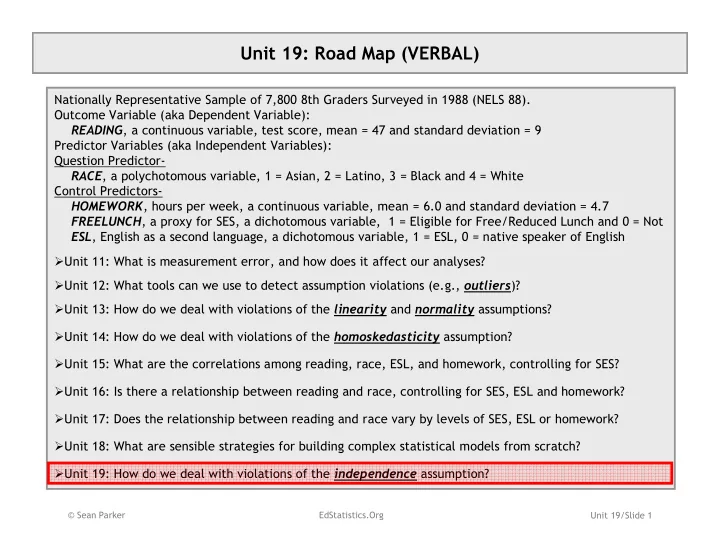
  • Unit19:RoadMap(VERBAL)

!"# $%&'()&'"* %'%+,+

  • %&'(.&'"*

/-%0 % '+12+!3+4%(,+5 6-%0 7(%'+8# +,# 9 %'+ :';%!%+ :%::%'+ ! +( : *57%< 2*5%7%#:#"< 3*=777 < ,*=777 ! < >*5%::% ! 7(%: < 8*.'7:%%: !7(< *)'7:%' !7(< *5':':%9%%%< *=777 " ! <

? -( %#$:

slide-2
SLIDE 2

2

Unit19:RoadMap(Schematic)

? -( %#$:

SinglePredictor

Continuous Polychotomous Dichotomous Continuous Regression Regression ANOVA Regression ANOVA T'tests Polychotomous Logistic Regression ChiSquares ChiSquares Dichotomous ChiSquares ChiSquares

Outcome MultiplePredictors

Continuous Polychotomous Dichotomous Continuous Multiple Regression Regression ANOVA Regression ANOVA Polychotomous Logistic Regression ChiSquares ChiSquares Dichotomous ChiSquares ChiSquares

Outcome

Units11'14,19: Dealingwith Assumption Violations

slide-3
SLIDE 3

3 ? -( %#$:

In'ClassProject

i ij ij ij ij ij ij ij i i i ij ij ij

u E LATINOxWAV BLACKxWAVE ASIANxWAVE E LATINOxWAV BLACKxWAVE ASIANxWAVE LATINO BLACK ASIAN WAVE WAVE READINGL + + + + + + + + + + + + + = ε β β β β β β β β β β β β 2 2 2 1 1 1 2 1

1 1 1 1 1 1 1 1 1 1 1

Fitandinterpretthismultilevelregressionmodel:

RepeatedMeasuresOutcomes:##$%&$%' Predictor: (ASIAN,BLACK,LATINO,WHITE)

FitandinterpretarepeatedmeasureANOVAmodel:

@ Wewilldothisstep'by'steptogetherinclass. @ Wewillrestructurethedatasettogetherstep'by'stepinclass. @ Youwilldummycodethevariablesbyyourselfbutwithasmuchhelpasyouneed. @ Youwillfitthemodelbyyourselfbutwithasmuchhelpasyou need. @ Wewillinterprettheresultstogetherstep'by'stepinclass.

slide-4
SLIDE 4

, ? -( %#$:

Unit19:FunkyResearchQuestion

A*$:''%B %/*$:%: :< )* ! %!:"+>8" &'* $%*".A%%C:A /-%*()*"1%'%:' 7:()*$+" ()*$+" D*

ε β β + + = BLE FUNKYVARIA READINGL

1

Wearegoingtoanswerthisfunkily abstract researchquestionusingthetoolsthatwe knowandlove.Thereisnothingnewinthis section.Whatmakesthisresearchquestion funkyismywithholdingofthemeaningof ()*.Ifyougetconfused,you canreplaceinyourmind()* with.So,insteadofthinkingabout Group1andGroup0,youcanthinkabout femalesandmales.

slide-5
SLIDE 5

>

ExploratoryDataAnalysis

slide-6
SLIDE 6

8

AnsweringtheQuestionUsingRegression

Onaverageinthepopulation,FunkyGroup1 tendstoscorehigherthanFunkyGroup0onthe IRTscaledreadingtest,(11854)=22.93," < .001.Basedon95%confidenceintervals,we concludethat,inthepopulation,theaverage scoreforFunkyGroup1( =52.0)isbetween 3.5and4.2pointshigherthantheaveragescore forFunkyGroup0( =48.2).

slide-7
SLIDE 7
  • AnsweringtheQuestionUsing'tests

'testOutput

slide-8
SLIDE 8
  • AnsweringtheQuestionUsingANOVA

ANOVAOutput

slide-9
SLIDE 9
  • ImportantObservations/Reminders

Notethatthe statisticissimplythe squareofthe statistic(insimple linearregression). Theintercept(aka,constant)isgoingtoplay averyimportantroleinthingstocome. Recallthattheinterceptisthemeanofour referencecategory.

slide-10
SLIDE 10
  • ThinkingMoreDeeplyAboutthey'Intercept

ε β β + + = BLE FUNKYVARIA READINGL

1

Model1:

They'interceptisrepresentedbyβ0,whichinturnrepresentsthemean

  • f whenallthepredictorshavevaluesofzero.Whatdoesβ0

representwhentherearenopredictorsinthemodel?

ε β + = READINGL Model0:

Whentherearenopredictorsinthemodel,β0 representsthe(unconditional)meanof+ Recallthatintheabsenceoffurtherinformation,themeanisourbestguessforindividuals,butwe recognizethattheguessisinallprobabilitywrongbyacertainamount,sowemakesurethatwe haveanerrorterminourmodel,ε. Variance(i.e.,theaveragesquaredmeandeviation)isameasure ofhowwrongthemeanisasa predictorofindividuals.

slide-11
SLIDE 11
  • OutputfromFittingtheUnconditionalModel(Model0)

Mean StandardDeviation Variance SumofSquared MeanDeviations NotethatSPSSdoesnot allowustofitunconditional OLSregressionmodels,soI madethisoutputbyhand.

slide-12
SLIDE 12

2

OutputfromFittingtheConditionalModel(Model1)

Mean Conditionalon ()*=0 StandardDeviation*

  • ftheResiduals

Variance*ofthe Residuals SumofSquared Residuals(i.e., DeviationsFromthe RegressionLine) Inthismodel,wemake predictionsofouroutcome conditionalonourpredictor, whichis$, forus.

*Basically

slide-13
SLIDE 13

3

CheckingAssumptionsforModel1:SearchingHI'N'LO

@ Heteroskedasticity—Wecanjudgebylookingattherightgraphs. @ Independence—Wecannotjudgebylookingatany

graphs.Weneedtounderstandoursampleandourvariable(s).

@ Normality—Wecanjudgebylookingattherightgraphs. @ Linearity—Wecanjudgebylookingattherightgraphs. @ Outliers—Wecanjudgebylookingattherightgraphs.

But,whatisour variable?

slide-14
SLIDE 14

,

RiddleRevealed

;(/-%*()*"1%'%:' 7:()*$+" ()*$+" /-%*)"1%'%:77% :7('7( :)$+" 707( :)$+"# 5>8''>2'E%77''E% ''70'"#

Forexample,this kidandthiskid arethesamekid Ourobservationsare clustered(inpairs);thus,

  • urindependence

assumptionisviolated.

StudentsNestedinClassrooms ClassroomsNestedInSchools SchoolsNestedinDistricts DistrictsNestedinStates Anew(multilevel)wayof thinking: ScoresNestedinStudents ChildrenNestedinFamilies FamiliesNestedin Neighborhoods NeighborhoodsNestedinCities BabiesNestedinNurseries NurseriesNestedinHospitals Wewilllearntohandletwo levelsatatime:

“Observations” Nestedin“Clusters”

slide-15
SLIDE 15

>

IndependenceSchmindependence:WhyCare?

Evenwhenahugesamplesize makesstatisticalsignificancea foregoneconclusion,westill wanttherightstandarderrors forourconfidenceintervals.

NotetheStandardErrors NotetheCorrelations

Mistakingorderfor chaosisnowayto goaboutthe businessoftruth.

http://onlinestat book.com/stat_si m/repeated_mea sures/index.html

slide-16
SLIDE 16

8

OneFinalRiddleBeforeWeGetStarted

Riddle:Aclassofstudentstakesamidtermexamandafinal exam.Theaveragescoreonthemidtermexamis78,and theaveragescoreonthefinalexamis92.Whatisthe correlationbetweenthetwosetsofexamscores?Canyou sayexactly?Canyouatleastsaythedirection? Answer:Wehavenoclue!Ifyouarelikeme,yourintuition isthatthecorrelation bepositive,butit! be negative.Imagineifallthepeoplewhodidtheworstonthe midtermexamwerejarredintoworkingharder(and smarter),sotheyendedupdoingthebestonthefinalexam.

Inthisdataset(n=7),thereisaperfectnegativecorrelation betweenthemidtermscoresandthefinalscores.Themeans aredifferent( =78and =92),andthestandarddeviations alsohappentobedifferent( =8.6and =2.2).But,the correlationdoesnotcare!Iteachthecorrelationcoefficient astheslopecoefficientfromtheregressionofastandardized

  • utcomeonastandardizedpredictor.Whenwestandardize,

weforcethemeanstobezeroandthestandarddeviationsto beonesothatwecancompareapplestoapples.SeeUnit4 forarefresher.Algebraically,acorrelationistheaverageof theproductsofthez'scores:

        −         − − =

= Y i n i X i XY

s Y Y s X X n r

1

1 1

Wesubtract

  • utthemeans

anddivide awaythe standard deviations.

slide-17
SLIDE 17
  • ? -(

%#$:

Unit19:MostBasicResearchQuestion

A*:( : :# %/*$:: : :<.'7%<

Becausethisresearchquestionissobasic,wehaveawidechoiceoftools:pairedsamplest'tests, repeatedmeasuresANOVA,andmultilevelregressionmodeling.Wewilltryallthreeinorder fromsimple(andleastflexible)tocomplicated(andmostflexible).

)* ! %!:"+>2" &'* $%*".A%%C:A /-%*Fromthet'testperspectivethereisnorealpredictor,justtwo(paired)

samples.FromtheANOVAperspectivethereisnorealpredictor,justasinglerepeatedmeasures factor,asortoffusionofouroutcomeinformationandwaveinformation.However,fromthe regressionperspective,wegettothinkintermsofoutcomesand predictorsandapplyallour modelbuildingstrategies:

)"1%'%:77%7 (7) +' :%) + 70 :%# :D*

i ij ij ij

u WAVE READINGL + + + = ε β β

1

Noticethe- subscripts andasecondtypeoferror

slide-18
SLIDE 18
  • DataSet(ForPairedSamples'testandRepeatedMeasuresANOVA)

Thisdatastructureisveryfamiliartous. Rowsrepresentkids.Weseethatthe firstkidinourdatasethas632790for anIDnumberandscores51.15pointson the1988(8th grade,baseline)reading testand70.06pointsonthe1990(10th grade,follow'up)readingtest.Columns representvariables.WehaveanID variabletohelpusidentifykids,andwe havetwotest'scorevariables. Formultilevelregressionmodeling,we willneedtorestructurethisdatasetinto a“person'perioddataset.” But,no worries,becauseSPSSwillbasicallydo theworkforus.Fornow,however, whileweworkthrough'testsand ANOVAs,we’llstayinthisfamiliar territory.

slide-19
SLIDE 19
  • 'testPerspective

Standarderrorscomeinmanyflavors,butattheircoretheyare justspecial standarddeviations;theyarestandarddeviationsofsamplingdistributions. Thebiggerthesamplesize,thesmallerthestandarddeviationofthe samplingdistribution,soweestimatestandarderrorsbydividingour

  • bservedstandarddeviationsbythesquarerootofoursamplesizes.See

Unit6forarefresher.Thereareslighttwistsfordifferenttests,andthe twisthereisthatwetakeintoconsiderationthecorrelation. Takesometimetoworkthroughthis.Hereisaspot wherethealgebracanbeinsightful.Forexample, weknowthatalargesamplesizeisgood.Seehow thesamplygoodnessofthesizeworksintothe equation.

http://onlinestatbook.com/stat_sim/repeated_measures/index.html

Notthatwhenthecorrelationiszero,theentire' 2r(sx)(sy)iszeroedout,andweendupwitharun'

  • f'the'mill'test.
slide-20
SLIDE 20

2

PairedSamples'testsinSPSS

T-TEST PAIRS=READING88 WITH READING90 (PAIRED) /CRITERIA=CI(.9500) /MISSING=ANALYSIS.

GotoAnalyze>CompareMeans>Paired'SamplesTTest… SelectyourfirstmeasureandassignittotheVariable1 column,andselectyoursecondmeasureandassignitto theVariable2column(shown). Clickpastwhenyouaredone,andrunyoursyntax.

slide-21
SLIDE 21

2

RepeatedMeasuresANOVAinSPSS

GotoAnalyze>GeneralLinearModel>RepeatedMeasures…

Defineyourrepeatedmeasuresfactor(s):(1) Giveita name.(2) Notethenumberoflevels(i.e.,waves, measures).(3) Addit.(4) Click“Define.” BuildyourANOVAmodel.Thestructureofyourwithin' subjectsvariable(s)isallsetupfromthelastdialogue box,soallyouneedtodoitplugandplay.Click“Paste” whenyouaredone.

(Youmaynotethatthereisroomtoaddgoodoldbetween'subjects factorsandcovariates(i.e.,continuouscontrols).

1 2 3 4

slide-22
SLIDE 22

22

ANOVAPerspective

GLM READING88 READING90 /WSFACTOR=R88vsR90 2 Simple /METHOD=SSTYPE(3) /CRITERIA=ALPHA(.05) /WSDESIGN=R88vsR90.

Thesyntaxisfairlysimple,andtheoutputshouldbevery simple,butSPSSproducesacraploadofdistractingoutput. Muchofthedistractingoutputhastodowiththesphericity assumption,whichyoucanreadaboutinChapter13ofthe OnlineStatBook.Com.Oftheumpteentables,thisistheonly reallyimportanttable,andstillit’sclutteredwithjunk.It shouldonlybetwolines:

Weconductedaone'waywithin'subjectsANOVAtodeterminewhetherIRTscales readingscoresimprovedfrom8th gradeto10th gradeinthepopulationofU.S. schoolchildrenofthelate’80sandearly’90s.Weobserveastatistically significant value,(1,5927)=2508.04," <.001,partialη2=.28.Acomparison

  • fmeanssuggeststhatstudentsonaverageimproved3.83pointsfromthe1988

8th gradereadingtest( =48.15, =8.38)tothe199010th gradereadingtest ( =51.98, =9.75). AsalwayswithANOVA,we needtouseplannedcontrasts, graphicalplots,"$! tests, andotheroptionstogetthe juicydetails. Recallthatthe statisticisthe squareofthe$statistic.Thet statisticfromourpaired samples'testwas'50.08. '50.082=2508.043 InANOVA,thecorrelationgets workedinthroughthemean squares.(And,that’sallwe reallyneedtoknow.)

slide-23
SLIDE 23

23

RegressionPerspective

Model1:

Thislooksverymuchliketheregressionmodelswithwhichwehavebeenworkingallalongthe way.Theonlydifferencesarethatnowwehave- subscriptsandaseconderrorterm.Inthenext fewslides,wewillexaminethe twodifferencesandtheirimplications. i ij ij ij

u WAVE READINGL + + + = ε β β

1

Notethatthesubscriptissueisreallyjustapickydetail,but Iwanttoemphasizeitinordertogetusthinkingabout cluster'observationdatastructure.Inparticular,wewanttothinkaboutstudent'score datastructures(aka,person' perioddatastructures)forourresearchquestion.Forotherresearchquestions,wemaywanttothinkabout mother'childdatastructuresorschool'studentdatastructures. Themagicofmultilevelregressionmodelinghappensinthecomplexerrorterm:wehaveoneerrortermforthe

  • bservationlevelandanothererrortermfortheclusterlevel. Inourexample,wewillhavestudent'levelerrorand

score'levelerror.Thekeytoparsingtheerrorwillbetheunconditionalmodel:

i ij ij

u READINGL + + = ε β0 Model0:

ij i ij

u READINGL ε β + + = ) (

Or,equivalently:

slide-24
SLIDE 24

2,

RegressionPerspective:- Subscripts

Model1:

i ij ij ij

u WAVE READINGL + + + = ε β β

1 Weuse- subscripts todistinguishourobservation'levelvariablesfromourcluster'levelvariables. Observation'levelvariablesgetan- subscript.Cluster'levelvariablesgetsimplyan subscript. Intheproblemathand,wehavescores(i.e.,ourobservations)nestedwithinstudents(i.e.,our clusters).However,thesystemwearegoingtodevelopisflexibleenoughtohandleanytwo'level nestedstructure.Forexample,wemighthavechildren(i.e.,our observations)nestedwithin mothers(i.e.,ourclusters),orwemighthavestudents(i.e.,ourobservations)nestedwithin schools(i.e.,ourclusters). )- representsthevalueofthe) variableforthe-th scoreoftheth student.E.g.,forthe 2nd scoreofthe896th student,) =1.

  • representsthevalueofthe variableforthe-th scoreoftheth student.E.g.,

forthe2nd scoreofthe896th student, =61.

Model2:

i ij i i i ij ij

u LATINO BLACK ASIAN WAVE READINGL + + + + + + = ε β β β β β

4 3 2 1

representsthevalueofthe variablefortheth student.E.g.,forthe896th student, =0.(Notethatsincethisisastudent'levelvariable,thereisnoneedtoattachittoaparticularscore.)

slide-25
SLIDE 25

2>

RegressionPerspective:- Subscripts(MoreExamples)

ModelX:

i ij ij i ij

u GESTATION MOMIQ T BIRTHWEIGH + + + + = ε β β β

2 1

Thisisastudyinwhichweaskwhethersmartermother’shaveheaviernewborns,controllingforlengthofgestation.We donotwantto ignorethefactthatnewbornsarenestedwithinmothers,because wehavetwinsandothersibsinourstudy.

..- representsthevalueofthe.. variableforthe-th childoftheth mother. E.g.,forthe3rd childofthe57th mother,.. =271. / representsthevalueofthe/ variablefortheth mother.E.g.,forthe57th mother, / =105.

ModelY:

i ij ij i ij ij

u TIO BLACKxBWRA BWRATIO BLACK MATH + + + + + = ε β β β β

1 2 1

ThisisastudyinwhichweaskabouttheBlack/Whitemathachievementgapandwhetheritvariesbytheracialcompositionofschools.

*- representsthevalueofthe* variableforthe-th studentoftheth school.E.g.,forthe 83rd studentofthe5th school,* =1. *. representsthevalueofthe*. variablefortheth SCHOOL.E.g.,forthe5th school,*. =0.75.

slide-26
SLIDE 26

28

Person'PeriodDataSetStructure

OldStructure NewStructure

Notethatformostmultileveldata,thecluster'observationdatasetstructureisnatural.Person'perioddatasetsaretheexception.Forexample,inamother'childdata set,everychildwillhaveamotherIDandachildID,orinaschool'studentdataset,everystudentwillhaveaschoolIDandastudentID.

Aperson'perioddatasethasonetimesliceperrow,buttherowsaregroupedbyanidentifyingvariableanddistinguishedwithinthe groupsbyanindexvariable.Noinformationislostwhenconvertingtoperson'perioddatasets.

slide-27
SLIDE 27

2

SPSSandDataSetRestructuring

GotoData>Restructure andSPSSwillwalkyou throughallthesteps.

slide-28
SLIDE 28

2

RegressionPerspective:ε- and ErrorTerms(PartIofIII)

Nowthatwehaveoneoutcome,wecanaskaboutthemeanandvarianceofTHEoutcome.

ε β + = READINGL Model0:

However,weknowthatthereisamultilevel structuretoourdataand,consequently,to

  • uroutcome.Weknowthataportionofthe

variationinscoresisattributabletothefact thatsomestudentsarebetterreadersthan

  • therstudents.Wealsoknowthataportion
  • fthevariationinscoresisattributableto

thefactthatstudentsimprovedfromthe8th gradetothe10th grade.Inotherwords,we haveperson'levelvariationandperiod'level variation.Instillotherwords,wehave student'levelvariationandscore'level variation(where“score” referstothe differingscoresforeachstudentdepending

  • nwave).

NotQuiteRight!

i ij ij

u READINGL + + = ε β0 Model0:

That’sRight!

ε representsthe residualforthe-th scoreoftheth studentoverand above,which representstheresidual forthethstudent.

slide-29
SLIDE 29

2

RegressionPerspective:ε- and ErrorTerms(PartIIofIII)

i ij ij

u READINGL + + = ε β0 Model0:

ij i ij

u READINGL ε β + + = ) (

MIXED READINGL /PRINT=SOLUTION /RANDOM INTERCEPT | SUBJECT(ID). CommandSPSStofitanintercept'onlymodel(i.e.,unconditionalmodel) thattakesintoconsiderationthemultilevelstructureofthedata. Wearenowtouchingonthedistinctionbetweenrandomeffectsand fixedeffectsinthegenerallinearmodel.Upuntilnow,wehave only dealtwithfixedeffectsmodels.Now,wearedealingwithamixed model:partfixed,partrandom.But,let’ssaveadeepdiscussionof randomeffectsforanotherday.(Weareindeepenoughalready!)

Specifyyouroutcomevariable. Specifyyourclusteringvariable.

Equivalent,“RandomIntercepts” Model: 86.4=24.7+61.7

slide-30
SLIDE 30

3

RegressionPerspective:ε- and ErrorTerms(PartIIIofIII)

i ij ij

u READINGL + + = ε β0 Model0:

Theintraclasscorrelation istheproportionoftotalvarianceattributabletothecluster level.Whentheintraclass correlationisextremelyhigh,alltheobservationswithineachclusterarebasicallythesamewithrespecttothe

  • utcomevariable.Whentheintraclasscorrelationisextremelylow,observationswithineachclusterareclustered

togetherinnameonlysincenothingistyingtogethertheiroutcomevalues.

n Correlatio Intraclass 71 . 7 . 61 7 . 24 7 . 61 Variance) Student

  • Within

(I.e., Variance Level

  • Score

7 . 24 Variance) Student

  • Between

(I.e., Variance Level

  • Student

7 . 61

2 2 2 2 2

= = + = + = = = =

u e u u

σ σ σ σ σ

ε

Whereasthe'testandANOVAusesthePearsoncorrelation, regressionusestheintraclasscorrelationtoaccountforthenon' independence(i.e.,clustering)ofobservations.

slide-31
SLIDE 31

3

???GuessingIntraclass Correlations???

Instudiesofstudentsnestedwithinschools,whatistheintraclass correlation? Theanswerisgoingtodependonouroutcome.Readingscores?Emotional disorders?Communityservice?Selfesteem?Locusofcontrol?For giggles, supposethatouroutcomehastodowithschoolclothing,andour datainclude studentsclusteredwithinschools.Belowaretwoschool'clothingstudies,each withitsowndataset.Whichofthetwodatasetswillhavethehigher intraclass correlation?

Study1 Study2

slide-32
SLIDE 32

32

RegressionPerspective:FittingOurFinalModel

MIXED READINGL WITH WAVE /PRINT=SOLUTION /FIXED=WAVE /RANDOM INTERCEPT | SUBJECT(ID). CommandSPSStofitamodel(i.e.,conditionalmodel)thattakes into considerationthemultilevelstructureofthedata.

Specifyyour predictorvariable(s).

Model1:

i ij ij ij

u WAVE READINGL + + + = ε β β

1

WAVE INGL D REA 8 . 3 2 . 48 ˆ + =

Interpretyourfittedmultilevelregressionmodelasyouwouldinterpretanyfittedregressionmodel.But, dosowithmoreconfidencebecauseyouhavenotignoredtheindependenceassumption! Youmaynotethatestimateddifferencebetweenwaves0and1and theassociatedstandarderrorandt' valueisidenticaltothosefromthepairedsamplest'test.Wehavecomebackfullcircle.

Wecanuseallour MRmodelingskills (controlling, interacting,and taxonomizing)to buildthissimple,

  • ne'predictor

modelintoafully' fledgedmultiple regressionmodel.

slide-33
SLIDE 33

33

RegressionPerspective:PresentingOurFinalModel

Wepresentandinterpretourfinalmodeljustaswewouldany regressionmodel,exceptweincludeourunconditionalmodel (i.e.,intercept'onlymodel)asabaseline.Fromthisbaseline,we cancomparecluster'levelvariancesandobservation'level variances.

Blech 7 . 61 4 . 65 1 nal unconditio l conditiona 1

  • Pseudo

2 2 2

= − = − =

u u u

R σ σ

30 . 7 24 3 17 1 nal unconditio l conditiona 1

  • Pseudo

2 2 2

= − = − = . . R

ε ε ε

σ σ

Thepseudo'R2 statisticisanice(butsometimesflawed)wayto describe thegoodnessoffit.ThetrueR2 statisticintheOLS regressiontowhichweareaccustomeddescribestheproportion

  • fvarianceintheoutcomethatispredictedbythepredictor(s).

Nowthattherearetwovariancesassociatedwiththeoutcome,we wanttwoR2 statistics,oneforeachtypeofvariation—cluster'level variation(i.e.,between'clustervariation)andobservation'level variation(i.e.,within'clustervariation).However,weareno longerdoingordinaryleastsquaredregression(OLS).Insteadof fittingourmodelbasedontheleastsumofsquares,wearefitting

  • urmodelbasedontheleast'2loglikelihood.Therefore,ourR2

statisticisnotatrueR2 statisticbutapseudo'R2 statistic.Ina multilevelmodel,thepseudo'R2 statisticispronetobreaking downwhenweincludeonlycluster'levelvariablesoronly

  • bservation'levelvariables.

Onaverage,inthepopulation,students improve3.8pointsontheIRTscaledreading testfromthe8th gradetothe10th grade. Basedonapseudo'R2 statisticof0.30,WAVE predicts30%ofthewithin'studentvariation inIRTscalesreadingscores.

slide-34
SLIDE 34

3,

Regression:ExploratoryDataAnalysisandAssumptionChecking

Hitherto,wehaveneglectthecrucialbookendstoregressionmodeling,exploratorydataanalysis andassumptionchecking.Wecan(andshould!)useallthetools thatwehavelearnedinthese regards,buttwiceover.Becausewehavetwolevels(thecluster'levelandtheobservation'level), wewanttoexploreeachlevelandchecktheresidualsassociationwitheachlevel.

ExploratoryDataAnalysis

@ SPLASH,DOLMASandABORTforthecluster' leveldata.Usethemeanobservationforeach cluster. @SPLASH,DOLMASandABORTforthe

  • bservation'leveldata.Useeachobservation,

butsubtractawaythemeanobservationfrom itsrespectivecluster.

AssumptionChecking

@ ExamineRVFplotsusingresidualsfromthe clusterlevel,. @ExamineRVFplotsusingresidualsfromthe

  • bservationlevel,εij.

*Obtaining mean observations for each cluster. *Obtaining observations minus cluster mean. Thisisnotfinished,butfornow,youcanfind theSPSScodeinthisarticle:

http://www.upa.pdx.edu/IOA/newsom/mlrclass/ho_cent ering%20in%20SPSS.pdf

*Obtaining cluster-level residuals. *Obtaining observation-level residuals. This is not finished, but for now, you can find the SPSS code in this article: http://www.cmm.bristol.ac.uk/learning' training/multilevel'm'software/reviewspss.pdf
slide-35
SLIDE 35

3>

'tests,ANOVAs,Regressions,OhMy!

Question:If'tests,ANOVAsandregressionsyieldidenticalresults,whyeverchoose thecomplexANOVAortheevenmorecomplexregressionoverthesimplet'test0$ Answer:FLEXIBILITY

t-test ANOVA Regression

Once Repeated Measures

Yes Yes Yes

Multiply Repeated Measures

No Yes Yes

Categorical Predictors (with or without interactions)

No Yes Yes

Continuous Predictors (without interactions)

No Yes Yes

Continuous Predictors (with interactions) No No Yes Any Cluster-Observation Data (e.g., students within schools

  • r children within mothers)

No No Yes!

Multilevelregressionmodelingisknownbymanynames,including “mixedmodeling,” “nested modeling” and“hierarchicallinearmodeling(HLM).” Unfortunately,“HLM” isnotonlytheacronym forhierarchicallinearmodeling,butitisalsothenameofproprietarysoftware.YoucanuseHLM (theproprietarysoftware)todoHLM,butyoucandoHLMinmost softwarepackages,includingSPSS.

Thereareaninfinitenumber

  • ferrorstructuresthatwe

canspecifyinmultilevel regressionmodeling,andwe touchedonthemostbasic. Considerscoresnestedwithin studentsnestedwithin variousteachersnested withinschools.