Unit 18 Field Programmable Gate Arrays (FPGAs) HARDWARE - - PowerPoint PPT Presentation

unit 18
SMART_READER_LITE
LIVE PREVIEW

Unit 18 Field Programmable Gate Arrays (FPGAs) HARDWARE - - PowerPoint PPT Presentation

18.1 18.2 Unit 18 Field Programmable Gate Arrays (FPGAs) HARDWARE IMPLEMENTATION Implementing Logic Functions with Memories TARGETS 18.3 18.4 Processing Logic Approaches Progression of HW Logic Density Recall HW/SW designs sit on a


slide-1
SLIDE 1

18.1

Unit 18

Field Programmable Gate Arrays (FPGAs) Implementing Logic Functions with Memories

18.2

HARDWARE IMPLEMENTATION TARGETS

18.3

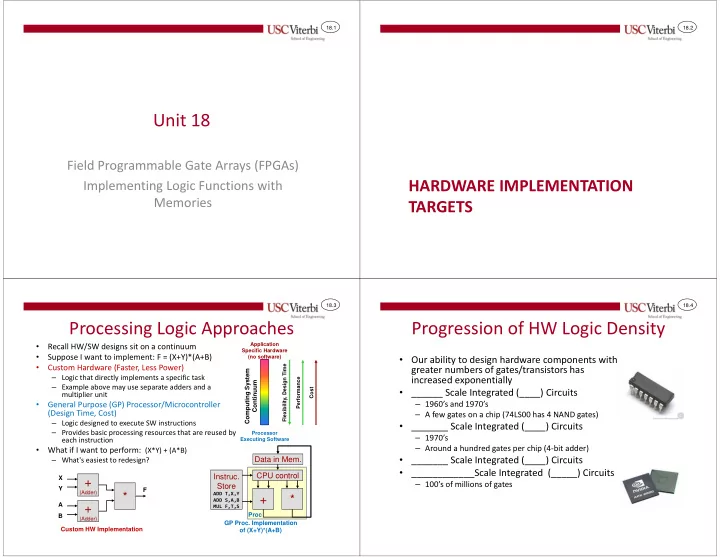
Processing Logic Approaches

  • Recall HW/SW designs sit on a continuum
  • Suppose I want to implement: F = (X+Y)*(A+B)
  • Custom Hardware (Faster, Less Power)

– Logic that directly implements a specific task – Example above may use separate adders and a multiplier unit

  • General Purpose (GP) Processor/Microcontroller

(Design Time, Cost)

– Logic designed to execute SW instructions – Provides basic processing resources that are reused by each instruction

  • What if I want to perform: (X*Y) + (A*B)

– What's easiest to redesign?

+ *

CPU control Instruc. Store

ADD T,X,Y ADD S,A,B MUL F,T,S

GP Proc. Implementation

  • f (X+Y)*(A+B)

+

(Adder)

+

(Adder)

*

X Y A B F Custom HW Implementation Computing System Continuum

Application Specific Hardware (no software) Processor Executing Software Flexibility, Design Time Performance Cost

Data in Mem.

Proc

18.4

Progression of HW Logic Density

  • Our ability to design hardware components with

greater numbers of gates/transistors has increased exponentially

  • ______ Scale Integrated (____) Circuits

– 1960’s and 1970’s – A few gates on a chip (74LS00 has 4 NAND gates)

  • _______ Scale Integrated (____) Circuits

– 1970’s – Around a hundred gates per chip (4-bit adder)

  • _______ Scale Integrated (____) Circuits
  • ____________Scale Integrated (_____) Circuits

– 100’s of millions of gates

slide-2
SLIDE 2

18.5

ASICs

  • Application Specific Integrated Circuits (ASICs) is

another name for a typical "chip"

  • Computer engineers determine the gates and

their interconnection that performs a specific task/application

– Start with high level "behavioral" description – Use CAD software tools to refine that to logic gates – Use CAD software tools to refine that to transistors and where each should be located on the surface of the chip and how they should be wired together – From there the chip is fabricated and mass-produced

  • Design process is expensive, and once

fabricated the design cannot be changed (but it is fast and uses less power)

In an ASIC design, a unique chip will be manufactured that implements our design at which point the HW design is fixed & cannot be changed (example: Pentium, etc.)

18.6

ASICs

18.7

Motivation for Reconfigurable Logic

  • Could we get some of the benefits of

both hardware (speed/power) AND software (flexible/reusable)

  • Yes…enter Field Programmable Gate

Arrays (FPGAs)

– Has prebuilt, generic hardware constructs that can be configured and interconnected based on one design and then reconfigured and interconnected later for another design

  • Let's learn more about the secret

ingredient to FPGAs…memories!

Computing System Continuum

Application Specific Hardware (no software / custom chip) Microcontroller/Processor Executing Software

Reconfigurable Hardware; FPGAs

FPGA’s have “logic resources” on them that we can configure to implement our specific

  • design. We can then

reconfigure it to implement another design

18.8

Where are FPGAs Used

  • Datacenters

– Bing search engine – Real-time data analytics – Compression and encryption – High-frequency trading

  • Robots and Rovers

– JPL and the Mars Rovers

  • Telecom
  • Aerospace
slide-3
SLIDE 3

18.9

USING MEMORIES TO BUILD COMBINATIONAL CIRCUITS

18.10

MEMORY BASICS

Dimensions and Operations

18.11

Memories

  • Memories store (write) and retrieve (read)

data

– Read-Only Memories (ROM’s): Can only retrieve data (contents are initialized and then cannot be changed) – Read-Write Memories (RWM’s): Can retrieve data and change the contents to store new data

18.12

ROM’s

  • Memories are just _____
  • f data with rows and

columns

  • When data is read, one

entire ____ of data is read

  • ut
  • The row to be read is

selected by putting a binary number on the _______ inputs

1 1 1 1 1 1 1 1 1 1 1 1 1 1 1 1 1

A2 A0 A1 D3 D2 D1 D0

1 2 3 4 5 6 7

Address Inputs Data Outputs ROM

slide-4
SLIDE 4

18.13

ROM’s

  • Example

– Address = 410 = 1002 is provided as input – ROM outputs data in that row (1101 bin.)

1 1 1 1 1 1 1 1 1 1 1 1 1 1 1 1 1

A2 A0 A1 1 1 1

1 2 3 4 5 6 7

Address: 1002 = 410 Data: Row 4 is

  • utput

ROM 1 D3 D2 D1 D0

18.14

Memory Dimensions

  • Memories are named by

their dimensions:

– Rows x Columns

  • n rows and m columns =>

__ x ___ ROM

  • n rows => log2n address bits

…or… 2k rows => k address bits

  • m cols => m data outputs

… 1 1 1 1

1 2 2n-2

ROM

. . . 2n-1

An-1 A0 A1 … Dm-1 D0

18.15

RWM’s

  • Writable memories

provide a set of data inputs for write data (as

  • pposed to the data
  • utputs for read data)
  • A control signal R/W

(1=READ / 0 = WRITE) is provided to tell the memory what operation the user wants to perform

1 1 1 1 1 1 1 1 1 1 1 1 1 1 1 1 1

A2 A0 A1 DO3 DO2 DO1 DO0

1 2 3 4 5 6 7

Address Inputs Data Outputs 8x4 RWM DI2 DI0 DI1 DI3 Data Inputs R/W

18.16

RWM’s

  • Write example

– Address = 310 = 0112 – DI = 1210 = 11002 – R/W = 0 => Write op.

  • Data in row 3 is
  • verwritten with the new

value of 11002.

1 1 1 1 1 1 1 1 1 1 1 1 1 1 1 1 1

1 1 ? ? ? ?

1 2 3 4 5 6 7

Address Inputs Data Outputs 8x4 RWM 1 1 Data Inputs R/W

1 1 0 0

A2 A0 A1 DI2 DI0 DI1 DI3 DO3 DO2 DO1 DO0 R/W

slide-5
SLIDE 5

18.17

USING MEMORIES TO BUILD COMBINATIONAL FUNCTIONS

Look-up tables…

18.18

Memories as Look-Up Tables

  • One major application of memories in digital

design is to use them as LUT’s (Look-Up Tables) to implement logic functions

– This is the core technology used by FPGAs (Field- Programmable Gate Arrays)

  • Idea: Use a memory to hold the ____________ of

a function and feed the inputs of the function to the __________ inputs to "__________" the answer

18.19

Implementing Functions w/ Memories

1 1 1 1

A2 A0 A1 D0

1 2 3 4 5 6 7

8x1 Memory

X Y Z F 1 1 1 1 1 1 1 1 1 1 1 1 1 1 1 1

Arbitrary Logic Function X Z Y F

1 1 1 1

A2 A0 A1 D0

1 2 3 4 5 6 7

8x1 Memory 1 1 X,Y,Z inputs “look up” the correct answer Use a memory with the same dimensions as 'output' side of the truth table. It's almost TOO easy.

X Y Z F X Y Z F A0 A1 A2 D0 8x1 Mem.

18.20

Implementing Functions w/ Memories

1 1 1 1 1 1 1 1

A2 A0 A1 D1

1 2 3 4 5 6 7

8x2 Memory

X Y Z C S 1 1 1 1 1 1 1 1 1 1 1 1 1 1 1 1 1 1 1 1

Multi-bit function (One's count) X Z Y C 8x2 Memory D0 S

1 1 1 1 1 1 1 1

A2 A0 A1 D1

1 2 3 4 5 6 7

1 1 1 D0 1+0+1 = 10 Use a memory with the same dimensions as 'output' side of the truth table. It's almost TOO easy.

slide-6
SLIDE 6

18.21

3-bit Squaring Circuit

  • Q: What size memory

would you use to build

  • ur 3-bit squaring

circuit?

  • A: ____ memory
  • Q: What would you

connect to the address inputs of the memory?

  • A: _______
  • Q: What bits would you

program into row 5 of the memory?

  • A: _______________

Inputs Outputs A A2 A1 A0 B5 B4 B3 B2 B1 B0 B=A2

1 1 1 1 2 1 1 4 3 1 1 1 1 9 4 1 1 16 5 1 1 1 1 1 25 6 1 1 1 1 36 7 1 1 1 1 1 1 49 18.22

4x4 Multiplier Example

Determine the dimensions of the memory that would be necessary to implement a 4x4-bit unsigned multiplier with inputs X[3:0] and Y[3:0] and outputs P[??:0] Question: How many bits are needed for P? Question: What are the contents of the numbered rows? Example: X3X2X1X0=0010 Y3Y2Y1Y0=0001 P = X * Y = 2 * 1 = 2 = 00010

ROM ... A2 A0 A1 A3 A6 A4 A5 A7 P0 2 20 39 255

18.23

Implementing Functions w/ Memories

  • To implement a function w/ n-variables and m outputs
  • Just place the output truth table values in the memory
  • Memory will have dimensions: 2n rows and m columns

– Still does not scale terribly well (i.e. n-inputs requires memory w/ 2n outputs) – But it is easy and since we can change the contents of memories it allows us to create "reconfigurable" logic – This idea is at the heart of FPGAs

18.24

FPGAS

slide-7
SLIDE 7

18.25

Basis of FPGA’s

  • Memories provide a __________ way

to implement any combinational logic function

– 2n x m memory can implement a function of _______________________

  • If we use RWM (read/write memory)

rather than ROM’s we can change what function the memory implements

  • Memories are referred to as Look-up

Tables (LUT’s)

1 1 1 1 1 1 1 1

X Cin Y Cout S D1 D0

1 2 3 4 5 6 7

8x2 Memory A2 A0 A1 Full Adder Implementation

18.26

Configurable Logic Blocks (CLB’s)

  • The memory allows for any

_______________ function

  • Provided D-FF’s allow designs

with ______________ logic

– “Bypass” mux selects the pure combinational output of the LUT

  • r the sequential/registered/D-FF
  • utput
  • Blue boxes indicate

________________ bits that control the operation and function of the logic

Any 3-input / 2-output combinational function FF’s if sequential logic needed 1 2 3 4 5 6 7 1 1 1 1 1 1 1 1 A0 A1 A2 D1 D0 8x2 Mem.

CLK D Q CLK D Q

CLB

1 1

bypass mux

18.27

Routing & Switch Matrices

  • Inputs and outputs of

neighboring CLB’s connect to a “____________” (SM)

  • Switch matrix is simply

composed of _______ that allow us to “________” inputs and

  • utputs to another

CLB or further away

SM CLB CLB CLB CLB

3 2 2 3 2 3 3 2

SM CLB CLB CLB CLB

3 2 2 3 2 3 3 2

SM CLB CLB CLB CLB

3 2 2 3 2 3 3 2

SM CLB CLB CLB CLB

3 2 2 3 2 3 3 2

18.28

Routing & Switch Matrices

  • Suppose we want

the connection shown in green and purple, what select values would be used?

B A L B A L L B A L B A ... ... ... ... C

To / from N SM

Switch Matrix (SM) CLB CLB

To / from E SM To / from S SM

CLB CLB

To / from W SM

A B D E F G H I J K L 11 1 1 11 1 11 11 1

slide-8
SLIDE 8

18.29

Place and Route

  • ASIC: Find where each gate should be placed on the chip and how to route

the wires that connect to it

– Direct connections can be faster

  • FPGA: Determine which LUT’s should be used and how to route through

switch matrices

– Added delay to go through the routing muxes

ASIC FPGA

SM CLB CLB CLB CLB

3 2 2 3 2 3 3 2

SM CLB CLB CLB CLB

3 2 2 3 2 3 3 2

18.30

Exercise

  • Find the configuration bits to build a 3-bit

free-running (always enabled) counter

1 2 3 4 5 6 7 A0 A1 A2 D1 D0 8x2 Mem.

CLK D Q CLK D Q

CLB

1 1

1 2 3 4 5 6 7 A0 A1 A2 D1 D0 8x2 Mem.

CLK D Q CLK D Q

CLB

1 1

HA 3-bit Reg. HA HA

1 Q0 Q1 Q2

B A L L B A ... ... C

To / from N SM

Switch Matrix (SM) CLB

To / from E SM

A B D E F 11 1 1 11

CLB CLB 1 CLB 2 CLB 1 CLB 2 CLB 2 CLB 1

Co

Q0 Co Q0* (Q0+1) 1 Q2 Q1 Co Q2* Q1* 1 1 1 1 1 1 1 1 1 1 1 1

18.31

ASIC’s vs. FPGA’s

  • ASIC’s

– ___________ – Handles _______ Designs – _______ Expensive – _____ Flexible (Cannot be ______________ to perform a new hardware function)

  • FPGA’s

– __________________ – ________ Designs – ______ Expensive – __________ Flexible

18.32

Modern FPGA's

  • SoC design (Xilinx Kintex [KU115])

– Quad-Core ARM cores – DDR3 SDRAM Memory Interface – ~800 I/O Pins – ~15M gate equivalent FPGA fabric

  • ~1M D-FFs + 552K LUTs
  • 1968 dedicated DSP "slices" 18x18 multiply + adder