Unified memory Talk outline [28 slides] GPGPU 2015: High - - PowerPoint PPT Presentation

unified memory talk outline 28 slides
SMART_READER_LITE
LIVE PREVIEW

Unified memory Talk outline [28 slides] GPGPU 2015: High - - PowerPoint PPT Presentation

Unified memory Talk outline [28 slides] GPGPU 2015: High Performance Computing with CUDA University of Cape Town (South Africa), April, 20 th -24 th , 2015 1. State of art of technology [12] 2. Programming with unified memory [4] 3. Examples


slide-1
SLIDE 1

Unified memory

GPGPU 2015: High Performance Computing with CUDA

University of Cape Town (South Africa), April, 20th-24th, 2015

Manuel Ujaldón

Associate Professor @ Univ. of Malaga (Spain) Conjoint Senior Lecturer @ Univ. of Newcastle (Australia) CUDA Fellow @ Nvidia

Talk outline [28 slides]

  • 1. State of art of technology [12]
  • 2. Programming with unified memory [4]
  • 3. Examples [8]
  • 4. Final remarks [4]

2

  • I. State of art of technology

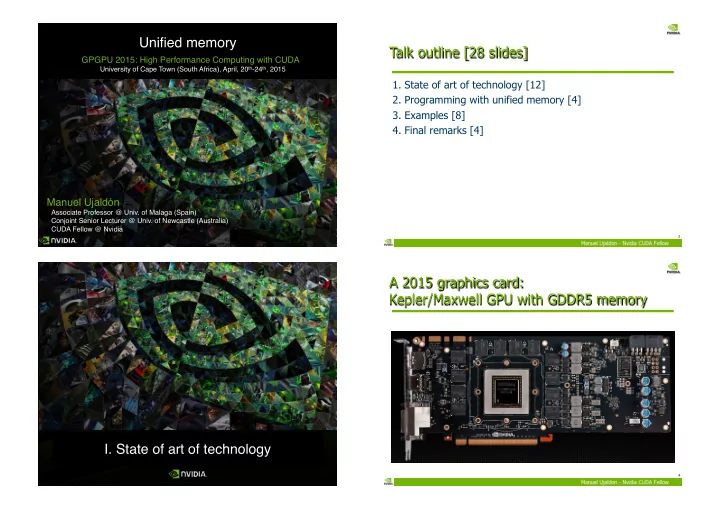
A 2015 graphics card: Kepler/Maxwell GPU with GDDR5 memory

4

slide-2
SLIDE 2

A 2017 graphics card: Pascal GPU with 3D memory (stacked DRAM)

5

The Pascal GPU prototype: SXM2.0 Form Factor

6

140 mm. 78 mm.

(* Marketing Code Name. Name is not final). SMX2.0*: 3x Performance Density

Details on silicon integration

DRAM cells are organized in vaults, which take borrowed the interleaved memory arrays from already existing DRAM chips. A logic controller is placed at the base

  • f the DRAM layers, with data matrices
  • n top.

The assembly is connected with through-silicon vias, TSVs, which traverse vertically the stack using pitches between 4 and 50 um. with a vertical latency of 12 picosecs. for a Stacked DRAM endowed with 20 layers.

7

20 ns. 40 ns. 60 ns. 80 ns. 100 ns. 120 ns. 140 ns. 160 ns. 180 ns. 200 ns. 0ns. 100 MHz

READ

Row

Col.

ACTIVE

Address bus Control bus Data bus RCD=2 CL=2 RCD=4 CL=4

DDR2-400, CL=4, quad-channel t = 50ns. Latency weight: 80%

RCD=4 CL=4

DDR2-400, CL=4, dual-channel

200 MHz

Time to fill a typical cache line (128 bytes)

8

RCD=2 CL=2

DDR-200, CL=2, dual-channel architecture

Dato Dato Dato Dato Dato Dato Dato Dato

RCD=2 CL=2

Dato Dato Dato Dato Dato Dato Dato Dato

DDR-200, CL=2 t = 45 ns. Latency weight: 89%

RCD=8 CL=8

DDR3-800, CL=8, quad-channel t = 200 ns. latency weight: 20% t = 120 ns. latency weight: 33% t = 80 ns. latency weight: 50% t = 60 ns. latency weight: 66%

The most popular memory in 2015 is DDR3-1600, with RCD=11 and CL=11. These two latencies represent 27.5 ns.

  • ut of 30 ns., 91.6% of the total time.

Dato Dato Dato Dato Dato Dato Dato Dato Dato Dato Dato Dato Dato Dato Dato Dato

SDRAM-100, CL=2 (1998)

(burst length: 16 words of 8 bytes to complete a cache lines 128 bytes long)

Tclk = 10 ns.

We have been waiting more than 15 years for this chance, and now with TSVs in 3D it is real.

slide-3
SLIDE 3

9

3D integration, side by side with the processor

3D technology for processor(s)

SRAM0 SRAM1 SRAM2 SRAM3 SRAM4 SRAM5 SRAM6 SRAM7 CPU+GPU

Links to processor(s), which can be another 3D chip, but more heterogeneous:

  • Base: CPU y GPU.
  • Layers: Cache (SRAM).

Step 5: Buses connecting 3D memory chips and the processor are incorporated. Step 3: Pile-up DRAM layers. Step 2: Gather the common logic underneath.

Logic base

Vault control Vault control Vault control Vault control

Memory control

Cossbar switch

Link interface Link interface Link interface Link interface

Step 1: Partition into 16 cell matrices (future vaults) Step 4: Build vaults with TSVs 3D technology for DRAM memory

DRAM0 DRAM1 DRAM2 DRAM3 DRAM4 DRAM5 DRAM6 DRAM7 Control logic

A typical multi-core die uses >50% for SRAM. And those transistors switch slower on lower voltage, so the cache will rely on interleaving

  • ver piled-up matrices,

just the way DRAM does. Typical DRAM chips use 74%

  • f the silicon

area for the cell matrices.

Using 3D chips to build a Haswell-like CPU

We have CPU, GPU and SRAM in different proportions within silicon die, depending on 8 available models:

10

And, in addition, we want to include some DRAM layers. Given the higher role played by latency, the last row is the winner: DRAM is the greatest beneficiary of 3D integration.

Core 2 Core 1 Cache 4 MB. Core 1 Core 2 Cache 4 MB. Core 1 Core 2 DRAM 32 MB. Cache 4 MB. Core 1 Core 2 Cache 8 MB. DRAM 64 MB.

Alternative 1 Alternative 2 Alternative 3 Alternative 4

Axiom: DRAM is 8 times more dense than a SRAM. Hypothesis: A core uses similar die area than 2 MB L3 (Ivy Bridge @ 22nm. fulfills this today if we left L2 aside). Evaluation: 2 layers, with the following alternatives (all reached similar temperatures):

Intel already authored a research showing the best choices (*)

11

(*) B. Black et al. "Die Stacking (3D) Microarchitecture", published in MICRO'06.

Layer #1 Layer #2 Area Latency Bandwidth Power cons. 2 cores + 4 MB L3 Empty 2 cores + 4 MB L3 8 MB L3 2 cores 32 MB. DRAM 2 cores + 4 MB L3 64 MB. DRAM 1+0 = 1 High High 92 W. 1+1 = 2 Medium Medium 106 W. 1/2+1/2=1 Low Low 88 W. 1+1 = 2 Very low Very low 98 W.

Today

12

GPU CPU

DDR4 Memory GDDR5 Memory

PCIe 16 GB/s DDR4 50-75 GB/s GDDR5 250-350 GB/s

slide-4
SLIDE 4

In two years

13

GPU CPU

DDR4 2.5D memory

NVLINK 80 GB/s DDR4 100 GB/s Memory stacked in 4 layers: 1 TB/s

In four years: All communications internal to the 3D chip

14

GPU CPU

Boundary

  • f the

silicon die

SRAM 3D-DRAM

The idea: Accustom the programmer to see the memory that way

15

GPU CPU

DDR3 GDDR5 Main memory Video memory PCI-express Maxwell GPU

CPU

DDR3 GDDR5 Unified memory

The old hardware and software model: Different memories, performances and address spaces. The new API: Same memory, a single global address space. Performance sensitive to data proximity. CUDA 2007-2014 CUDA 2015 on

  • II. Programming with unified memory
slide-5
SLIDE 5

Unified memory contributions

Simpler programming and memory model:

Single pointer to data, accessible anywhere. Eliminate need for cudaMemcpy(). Greatly simplifies code porting.

Performance through data locality:

Migrate data to accessing processor. Guarantee global coherency. Still allows cudaMemcpyAsync() hand tuning.

17

CUDA memory types

18

Zero-Copy (pinned memory) Unified Virtual Addressing Unified Memory CUDA call Allocation fixed in Local access for PCI-e access for Other features Coherency Full support in cudaMallocHost(&A, 4); cudaMalloc(&A, 4); cudaMallocManaged(&A, 4); Main memory (DDR3) Video memory (GDDR5) Both CPU Home GPU CPU and home GPU All GPUs Other GPUs Other GPUs Avoid swapping to disk No CPU access On access CPU/GPU migration At all times Between GPUs Only at launch & sync. CUDA 2.2 CUDA 1.0 CUDA 6.0

Additions to the CUDA API

New call: cudaMallocManaged(pointer,size,flag)

Drop-in replacement for cudaMalloc(pointer,size). The flag indicates who shares the pointer with the device:

cudaMemAttachHost: Only the CPU. cudaMemAttachGlobal: Any other GPU too.

All operations valid on device mem. are also ok on managed mem.

New keyword: __managed__

Global variable annotation combines with __device__. Declares global-scope migratable device variable. Symbol accessible from both GPU and CPU code.

New call: cudaStreamAttachMemAsync()

Manages concurrently in multi-threaded CPU applications.

19

Unified memory: Technical details

The maximum amount of unified memory that can be allocated is the smallest of the memories available on GPUs. Memory pages from unified allocations touched by CPU are required to migrate back to GPU before any kernel launch. The CPU cannot access any unified memory as long as GPU is executing, that is, a cudaDeviceSynchronize() call is required for the CPU to be allowed to access unified memory. The GPU has exclusive access to unified memory when any kernel is executed on the GPU, and this holds even if the kernel does not touch the unified memory (see an example

  • n next slide).

20

slide-6
SLIDE 6
  • III. Examples

First example: Access constraints

22

__device__ __managed__ int x, y = 2; // Unified memory __global__ void mykernel() // GPU territory { x = 10; } int main() // CPU territory { mykernel <<<1,1>>> (); y = 20; // ERROR: CPU access concurrent with GPU return 0; }

First example: Access constraints

23

__device__ __managed__ int x, y = 2; // Unified memory __global__ void mykernel() // GPU territory { x = 10; } int main() // CPU territory { mykernel <<<1,1>>> (); cudaDeviceSynchronize(); // Problem fixed! // Now the GPU is idle, so access to “y” is OK y = 20; return 0; }

Second example: Sorting elements from a file

24

CPU code in C GPU code from CUDA 6.0 on

void sortfile (FILE *fp, int N) { char *data; data = (char *) malloc(N); fread(data, 1, N, fp); qsort(data, N, 1, compare); use_data(data); free(data); } void sortfile (FILE *fp, int N) { char *data; cudaMallocManaged(&data, N); fread(data, 1, N, fp); qsort<<<...>>>(data, N, 1, compare); cudaDeviceSynchronize(); use_data(data); cudaFree(data); }

slide-7
SLIDE 7

Third example: Cloning dynamic data structures WITHOUT unified memory

A “deep copy” is required:

We must copy the structure and everything that it points to. This is why C++ invented the copy constructor. CPU and GPU cannot share a copy of the data (coherency). This prevents memcpy style comparisons, checksumming and other validations.

25

dataElem prop1 prop2 *text

“Hello, world”

CPU memory

dataElem prop1 prop2 *text

“Hello, world”

GPU memory

struct dataElem { int prop1; int prop2; char *text; }

Two addresses and two copies

  • f the data

Cloning dynamic data structures WITHOUT unified memory

26

dataElem prop1 prop2 *text

“Hello, world”

CPU memory

dataElem prop1 prop2 *text

“Hello, world”

GPU memory

void launch(dataElem *elem) { dataElem *g_elem; char *g_text; int textlen = strlen(elem->text); // Allocate storage for struct and text cudaMalloc(&g_elem, sizeof(dataElem)); cudaMalloc(&g_text, textlen); // Copy up each piece separately, including new “text” pointer value cudaMemcpy(g_elem, elem, sizeof(dataElem)); cudaMemcpy(g_text, elem->text, textlen); cudaMemcpy(&(g_elem->text), &g_text, sizeof(g_text)); // Finally we can launch our kernel, but // CPU and GPU use different copies of “elem” kernel<<< ... >>>(g_elem); }

Two addresses and two copies

  • f the data

Cloning dynamic data structures WITH unified memory

What remains the same:

Data movement. GPU accesses a local copy of text.

What has changed:

Programmer sees a single pointer. CPU and GPU both reference the same object. There is coherence.

To pass-by-reference vs. pass- by-value you need to use C++.

27

void launch(dataElem *elem) { kernel<<< ... >>>(elem); }

dataElem prop1 prop2 *text

“Hello, world”

GPU memory Unified memory CPU memory

Fourth example: Linked lists

Almost impossible to manage in the original CUDA API. The best you can do is use pinned memory:

Pointers are global: Just as unified memory pointers. Performance is low: GPU suffers from PCI-e bandwidth. GPU latency is very high, which is critical for linked lists because of the intrinsic pointer chasing.

28

key value next key value next key value next key value next key value next key value next All accesses via PCI-express bus

CPU memory GPU memory
slide-8
SLIDE 8

Linked lists with unified memory

Can pass list elements between CPU & GPU.

No need to move data back and forth between CPU and GPU.

Can insert and delete elements from CPU or GPU.

But program must still ensure no race conditions (data is coherent between CPU & GPU at kernel launch only).

29

key value next key value next key value next

CPU memory GPU memory

  • IV. Final remarks

Unified memory: Summary

Drop-in replacement for cudaMalloc() using cudaMallocManaged().

cudaMemcpy() now optional.

Greatly simplifies code porting.

Less Host-side memory management.

Enables shared data structures between CPU & GPU

Single pointer to data = no change to data structures.

Powerful for high-level languages like C++.

31

Unified memory: The roadmap. Contributions on every abstraction level

32

Abstraction level Past: Consolidated in 2014 Present: On the way during 2015 Future: Available in coming years High Medium Low Single pointer to data. No cudaMemcpy() is required Prefetching mechanisms to anticipate data arrival in copies System allocator unified Coherence @ launch & synchronize Migration hints Stack memory unified Shared C/C++ data structures Additional OS support Hardware-accelerated coherence

slide-9
SLIDE 9

NV-Link: High-speed GPU interconnect

33

NVLink NVLink POWER CPU POWER CPU X86 ARM64 POWER CPU

2016/17: Pascal 2014/15: Kepler

PCIe PCIe

Final summary

Kepler is aimed to irregular computing, enabling the GPU to enter new application domains. Win: Functionality. Maxwell simplifies the GPU model to reduce energy and programming effort. Win: Low-power, memory-friendly. Pascal introduces 3D-DRAM and NV-Link. Win: Transfers, heterogeneity.

3D memory changes memory hierarchy and boosts performance. NV-Link helps to communicate GPUs/CPUs in a transition phase towards SoC (System-on-Chip), where all major components integrate

  • n a single chip: CPU, GPU, SRAM, DRAM and controllers.

34