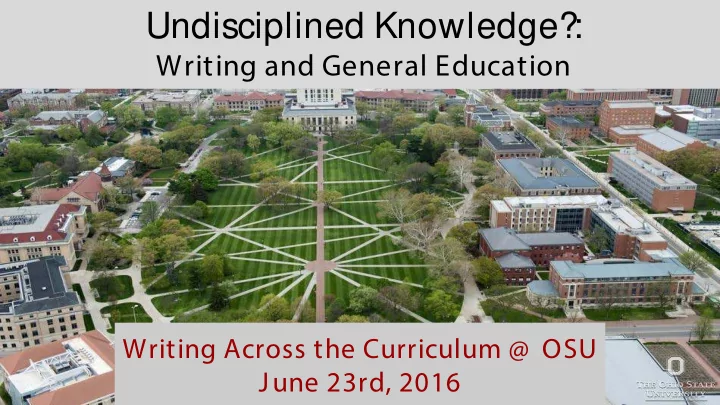
Undisciplined Knowledge? : Writing and General Education Writing - - PowerPoint PPT Presentation
Undisciplined Knowledge? : Writing and General Education Writing Across the Curriculum @ OSU June 23rd, 2016 2014 WAC survey of 2367 instructors Sec econd nd-lev evel el Writ ing ng Cour urse, e, d des esigna nat ed ed 2 2367
2014 WAC survey of 2367 instructors
Sec econd nd-lev evel el Writ ing ng Cour urse, e, d des esigna nat ed ed 2 2367
Required of all undergraduate students ~ 50 courses in 29 departments and programs
Sur urvey eyed ed ins nst ruc uct ors w who ho ha had t t aug ught ht a sec econd nd-lev evel el w writ ing ng c class bet et ween een Aut umn 2013 2013 and Aut umn 2014 2014 (261 261 in survey pool)
Asked questions about training for and oversight of teaching Asked about comfort teaching English language learners and the kinds of support they got to teach ELL students, and the kinds of support they offered to ELL students
Collec ect ed ed cour urse d e docum ument ent s: syllabus us and nd up up t t o t hr hree a ee assignm nment ent s
How our sample documents reflect common challenges for GE writing
Cha halleng enge 1 e 1--
- -lit t le
e alignm nment ent bet et ween een GE out ut comes es and nd cour urse e cont nt ex ext s: Tension between general motives for writing and particular motives for writing in a specific discipline (Yañez and Russell 2009). In n our ur c cour urse d e docum ument ent s, GE Out ut comes es o
- ft en
en:
Are cut and pasted with no explicit relation to course themes or content Use outdated GE language (not outcomes oriented, use even vaguer language)
Level Two (2367) 1. Through critical analysis, discussion, and writing, students demonstrate the ability to read carefully and express ideas effectively. 2. Students apply written, oral, and visual communication skills and conventions of academic discourse to the challenges of a specific discipline. 3. Students access and use information critically and analytically.
Aligned syllabii Reframe GE outcomes in relation to course goals
Landscape Architecture
Aligned assignments Align activities with reframed GE outcomes
Animal Science
From Challenges to Principles of Alignment
Writing and Communication GE objectives:
Students apply written, oral, and visual communication skills and conventions of academic discourse to the challenges of Landscape Architecture. Students write and engage with visual communication within a broad range of formats that are typical with contemporary design discourse... Throughout the course, students are provided a broad and critical overview of theories and methods of social scientific inquiry as they apply to the study of human‐animal relationships, with an emphasis on developing and communicating practical solutions to challenging social
- issues. In the final weeks of the course, students are
encouraged to formulate their own, well‐informed, views about how animals should be maintained within future human societies and to articulate these views via written and oral venues.
How our sample documents reflect common challenges for GE writing
Cha halleng enge 2 e 2--
- -”rev
ever erse” e” m mut ut t genr enres es: Written genres often have vague or contradictory purposes and audiences (“Mutt Genres,” Wardle 2009) Written genres in our course documents
Often were referred to in generalized terms (“Term Paper, “Essay 1,” “Analysis”) Often lack an explicitly articulated audience and purpose for writing (Cf. Meltzer 2014) Often defined by formal characteristics rather than rhetorical function (“3-5 pages, 12 point font, double spaced, APA style…”)
Genres with context Effective instructors introduce genre as serving an audience and context Genres with purpose Generic form serves some Concrete action mirroring or even engaging contexts outside classroom
From Challenges to Principles of Genre
Communication 2367: Audience Survey Paper: Knowing your audience is essential to effective persuasive
- communication. This assignment will help you
measure audience attitudes about your problem and recommended solution. This assignment has four components... Town Hall Meeting Speech: Your speech should persuade the audience to volunteer at or donate to the nonprofit
- rganization you have chosen.
How our sample documents reflect common challenges for GE writing
Cha halleng enge 3 e 3--
- -lac
ack of t ran ansferab abilit y: What is transfer? Detterman: “the degree to which a behavior will be repeated in a new situation” “As individuals move from context to context, they receive cues, both explicit and implicit, that suggest knowledge associated with a prior context may prove useful in the new context” (Nowacek, p. 12)
How our sample documents reflect common challenges for GE writing
Cha halleng enge 3 e 3--
- -lac
ack of t ran ansferab abilit y: Scaffolding usually offers little in the way of a framework to give students an opportunity to practice generalizable concepts in multiple specific contexts and reflect on learning(Beaufort 2007; Yancey, Robertson, and Taczak 2014). “too often, teachers assume that transfer will simply happen” (Nowacek, p. 15) Instead, we (aka teachers) must teach for transfer. General knowledge versus local knowledge
While many courses provided some scaffolding for writing tasks, few consistently provided: Scaffolded practice
Scaffolded practice in multiple contexts and genres
Scaffolded coherence
A coherent controlling purpose for the scaffolding of writing projects
Assignments with reflection
Opportunities to reflect on process and on learning
From Challenges to Principles of Transfer:
Psychology 2367.01 - Social Psychology
The study of how individuals perceive, influence, and relate to
- thers.
Challenge 1: Alignment
Multiple requirements Instructor excitement about content Student perceptions
Challenge 1: Alignment
Our ur St rat eg egies es: Increase focus on writing Connections to content Integrate goals Mapping curriculum, map assignments to goals Fight turnover
Challenge 2: “Fuzzy Genre”
What kind of assignment benefits students? Traditionally “take home essays” Audience, goal, disciplinary conventions
Challenge 2: “Fuzzy Genre”
Our ur St rat eg egies es: Prioritize what we value most in writing More meaningful connections between writing and content Learn more about assignments in other courses
Challenge 3: Transfer
Students feel “blindsided” Instructors don’t understand what is unique or challenging about disciplinary conventions Where does this course fit into students’ experience?
Challenge 3: Transfer
Our ur St rat eg egies es: Ask instructors to be more explicit about transfer Invite connections with prerequisite courses Encourage more cross-disciplinary exchange Assess!
Where do we go from here?
- 1. How do general education writing courses across the curriculum grapple with the
“content of writing” problem FYW faces?
- 1. How do we promote a more comprehensive alignment between writing instruction
(not just practice/process) and disciplinary content to promote transfer?
- 1. What kinds of institutional alliances can we make to promote this kind of
alignment?
- 1. What (more) kinds of research can we do to dig more deeply into curricular
alignment and student transfer of learning between general education and writing across the curriculum?