Understanding Ultrahigh Quality Factor Accelerator Cavities in the - - PowerPoint PPT Presentation

understanding ultrahigh quality factor accelerator
SMART_READER_LITE
LIVE PREVIEW

Understanding Ultrahigh Quality Factor Accelerator Cavities in the - - PowerPoint PPT Presentation

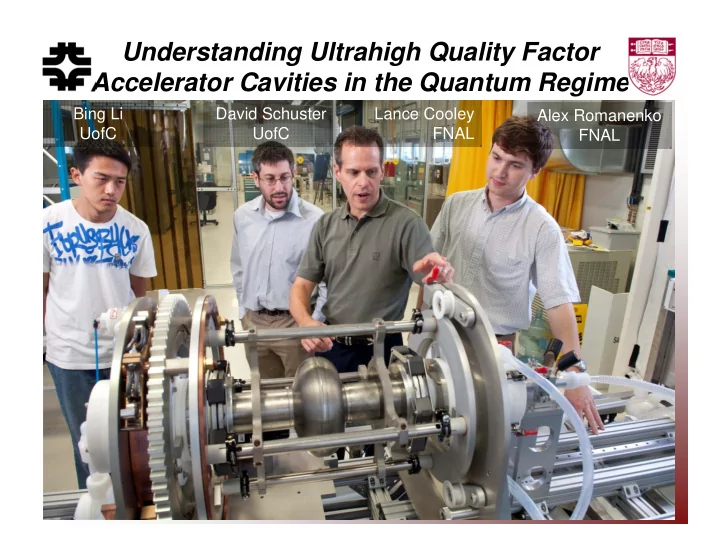
Understanding Ultrahigh Quality Factor Accelerator Cavities in the Quantum Regime Bing Li David Schuster Lance Cooley Alex Romanenko UofC UofC FNAL FNAL State of the art for SC qubits From this weeks APS Physics Viewpoint /PRL:


slide-1
SLIDE 1

Understanding Ultrahigh Quality Factor Accelerator Cavities in the Quantum Regime

Bing Li UofC David Schuster UofC Lance Cooley FNAL Alex Romanenko FNAL

slide-2
SLIDE 2

State of the art for SC qubits

From this week’s APS Physics Viewpoint /PRL:

  • Best T2 ~ 50 µsec
  • Q2 ~ 400,000

Why are we excited?

  • A typical accelerator cavity

has Q > 1010

  • This corresponds to T2 > 1

second!

  • H. Paik, D. I. Schuster, et. al. PRL 107, 240501 (2011)
slide-3
SLIDE 3

First results (power dependence)

Resonator Internal Quality 500,000 – 1M 50,000 – 150,000

slide-4
SLIDE 4

109

Typical Fermilab cavity performance

  • Q0 is limited to 109 by

excitation of normal electrons at 2 K

  • We expect residual

resistance of ~10 n based on known results for this process Rs 1/T 2K

slide-5
SLIDE 5

Quantum Computer vs. Accelerator Cavities

  • QC cavities optimized for coupling to single photon,

limited by loss of single photon

  • Accelerator cavities optimized for highest accelerating field,

limited by breakdown at maximum power

  • Both want high Q but everything else is different

Property QC Accelerator Comparison Quality Factor Frequency 4-10 GHz 1-10 GHz 1 Input power 10-18 W 1 W Temperature 0.01 K 2K Mode volume E field strength

slide-6
SLIDE 6

Millikelvin resonator characterization system

  • Measure samples down to 13 mK
  • Measure with powers down to <1 aW
slide-7
SLIDE 7

cavity 1 cm

Cu matchbox Cavity

Al Cavity (indium sealed) Have tried, Cu, Nb, Al, and “solder dipped” All SC ones achieved Q~1M

  • H. Paik, D. I. Schuster, et. al. PRL 107, 240501 (2011)

Now possible to couple qubits to 3D cavities

slide-8
SLIDE 8

First measurements of a Fermilab Cavity at T << 1 K!!

  • Fermilab cannot test below ~1.5 K

– This is uncharted territory!

  • Q = 40,000,000

– Higher than any QC qubit / resonator!

– … but why isn’t this 1010?

  • Reasonable frequency vs temp
  • Strange Q(T) dependence
  • For early data, cavity temperature

was not equal to fridge temperature

slide-9
SLIDE 9

Next steps

  • Try to understand why Q appears to be lower at UofC

– Improve measurements of the Fermilab cavities

  • Modify coupling of antenna
  • Bring in expertise of cavity test group at Fermilab
  • Phase-locked loop scheme should be used for high Q
  • Add magnetic shielding
  • Then:

– Design cavity compatible with SC qubit

  • Possibly fabricate it at Fermilab

– Dynamically tunable Q – Attempt to miniaturize cavities