Understanding the impact of Covid-19 in Tower Hamlets a summary 1. - - PowerPoint PPT Presentation

understanding the impact
SMART_READER_LITE
LIVE PREVIEW

Understanding the impact of Covid-19 in Tower Hamlets a summary 1. - - PowerPoint PPT Presentation

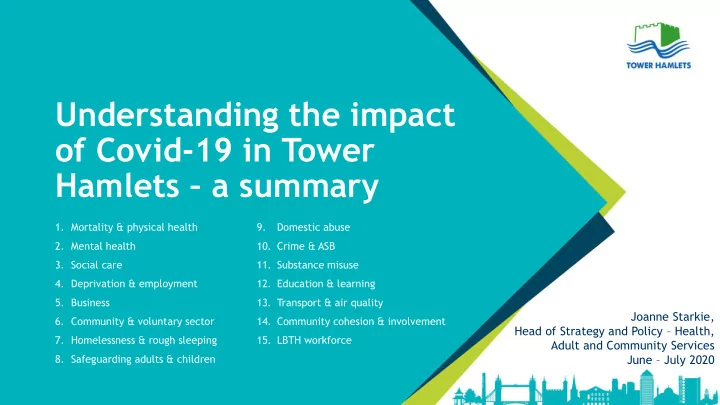
Understanding the impact of Covid-19 in Tower Hamlets a summary 1. Mortality & physical health 9. Domestic abuse 2. Mental health 10. Crime & ASB 3. Social care 11. Substance misuse 4. Deprivation & employment 12. Education


slide-1
SLIDE 1

Understanding the impact

  • f Covid-19 in Tower

Hamlets – a summary

  • 1. Mortality & physical health
  • 2. Mental health
  • 3. Social care
  • 4. Deprivation & employment
  • 5. Business
  • 6. Community & voluntary sector
  • 7. Homelessness & rough sleeping
  • 8. Safeguarding adults & children

Joanne Starkie, Head of Strategy and Policy – Health, Adult and Community Services June – July 2020

9. Domestic abuse

  • 10. Crime & ASB
  • 11. Substance misuse
  • 12. Education & learning
  • 13. Transport & air quality
  • 14. Community cohesion & involvement
  • 15. LBTH workforce
slide-2
SLIDE 2

Methodology

“We are not all in the same boat. We are in the same storm”

  • 1. Identified 15 issues felt to be most

affected by Covid-19

  • 2. Full impact assessment analyses the

impact Covid has had on each issue:

  • Across the UK
  • In Tower Hamlets
  • On any groups in our communities
  • Headline results from resident survey
  • 3. Predicted the potential impact of Covid
  • n each issue in future:
  • Challenges
  • Opportunities

…over next 12 months & longer-term

slide-3
SLIDE 3

Mortality, physical health, mental health, social care

  • Significant number of Covid-19 deaths & infections
  • Reduced emergency hospital admissions a concern
  • Some NHS services paused, many remodelled
  • Problems getting essential supplies
  • Healthy lifestyles & wider determinants
  • Mental health issues already high in LBTH
  • Impacts include stress, anxiety, loneliness, grief, PTSD
  • Impact on existing MH service users
  • Changing demand for MH support
  • Adult social care demand increased but manageable
  • Cost pressures in the system
  • Big impact on care homes, service users, families &

frontline staff

  • More living in poorer health
  • Increase in health inequalities
  • 20-30% increase in demand in mental health services
  • Longer-term mental health impacts
  • Increased demand & cost pressures in social care
  • BAU in health & care will start to resume
  • Capitalise on interest in staying healthy
  • Improve health through active travel
  • Opportunity to do more virtually/remotely
  • Raised profile for adult social care

Care homes

Deprivation

Carers Pregnancy Women & men Disability & LTC BAME Younger &

  • lder

Front line staff

slide-4
SLIDE 4

Deprivation, unemployment, business & VCS

  • Deprivation & unemployment had improved in LBTH

pre-Covid, but still big challenges

  • Economic ‘shock’ with Covid
  • Business & organisational impact uneven, depends
  • n sector. Hard hit areas include hospitality, retail,

market traders.

  • Furlough, lay offs & reductions in hours for many –

impact somewhat cushioned for now

  • LBTH possibly hit by economic shock harder than

most

  • Many business & VCS remodelled to accommodate

social distancing, many worried about future

  • Deprivation & financial problems worsen when

temporary support measures phase out

  • Ability to tackle poverty through employment lessens
  • Increased demand & cost pressures in council
  • Rich & poor gap widens
  • Longer-term consequences of increased deprivation

felt across the board

  • ‘V’ shaped economic rebound
  • Opportunity to recruit to ‘hard to fill’ roles
  • Cost benefits if less need for work space
  • Opportunity to do more with volunteers
  • New alternatives to high streets

With employment barriers BAME Lower incomes Women Younger adults In shadow economy With food insecurity

slide-5
SLIDE 5

Homelessness, rough sleeping, safeguarding & domestic abuse

  • Rough sleeping dropped in very short time period
  • Enabled wraparound health & care to go in
  • Protection from being newly homeless for now
  • Abuse & neglect harder to identify
  • Some in lockdown with abusers
  • Initial dip in children’s safeguarding referrals then

picked up

  • Key role of schools with both this & domestic abuse
  • Changes with missing children, suspected online

exploitation

  • No significant change in adult safeguarding numbers
  • Changes with Covid-related fraud, role of volunteers
  • Domestic abuse levels already high in LBTH
  • Indications of increase in DA across UK not seen in LBTH

at first. Dip in referrals then picked up

  • Finance pressure of sustaining positive impact on

rough sleeping

  • Increase in homelessness when eviction ban ends &

economic downturn

  • Longer wait on housing waiting list
  • Some abuse & neglect still hidden, some

resurgence in referrals as restrictions lift, including expected surge in children’s safeguarding

  • 20-30% increase in domestic abuse demand
  • Increased demands & cost pressures
  • Longer-term consequences for victims
  • Ambition to end rough sleeping achievable
  • Support to rough sleepers improves health
  • utcomes
  • If lockdown a trigger/way of hiding abuse, this will

ease as restrictions lift

Pregnancy Men & women Older people Children Disability

  • r LTC

Lower incomes SEND White & BAME

slide-6
SLIDE 6

Crime, ASB, substance misuse

  • Crime in UK reduced overall - including burglary &

assault

  • ASB reports in UK increased, likely driven by lockdown
  • LBTH in line with national trends
  • Crime & ASB a top resident concern pre-Covid
  • New financial fraud patterns
  • Pre-Covid, high crack & opiate use in LBTH
  • Drugs market has changed
  • Reports of opiate shortages & price rises
  • Much higher numbers of people referred for treatment
  • Impact on alcohol use is mixed
  • ‘Rebound’ in crime as lockdown eases
  • Types of crime evolve & adapt to circumstances
  • Increased rivalry between drug gangs
  • Switch to harmful opiate substitutes
  • When lockdown goes, reversal in positive trends &

more overdoses if oversupply, low cost & high purity

  • Crime levels stay lower than average whilst

restrictions in place

  • Long-term changes to how people live will impact

crime levels & types

  • Residents feel more empowered
  • Capitalise on increasing treatment referral rates to

reduce substance misuse

Deprivation Older people Young people BAME

slide-7
SLIDE 7

Education & learning

  • Home learning whilst schools closed
  • Concerns about quality & consistency
  • Key exams & assessments cancelled
  • Grades determined by replacement process
  • Pre-Covid, LBTH had good attainment levels-

particularly positive given deprivation levels

  • All but 4 local schools rated good or outstanding
  • Impact of social inequalities on home learning
  • Free school meals now restricted to eligible

families

  • Schools starting to reopen seen as contentious by

some

  • Children not school ready for September 2020
  • Overall negative impact on learning & attainment

from prolonged home learning in 2020

  • LBTH children harder hit by this if social

inequalities exacerbated

  • Broader wellbeing impacts arising from children

not being in school

  • Financial strain on universities from drop in

international student applications

  • Key challenges for schools going forward:

safeguarding, mental health & loss of learning

  • Some family relationships strengthened
  • Growing familiarity with technology for education
  • Potential for innovate ways of working

White, Mixed Heritage, Black Caribbean Boys Lower incomes Teenagers Ineligible for FSM Larger families Families with English as 2nd language SEND

slide-8
SLIDE 8

Transport, air quality, community involvement & cohesion

  • Car & public transport usage dropped in March
  • Car use in UK & London since crept back up
  • Minority of LBTH residents are car owners
  • Public transport discouraged & TfL now facing financial

problems

  • More walking & cycling space being created in London
  • Cycling down in LBTH, likely due to less commuting
  • Evidence of interest in more cycling
  • Air quality poor in LBTH pre-Covid
  • Air pollution dropped in UK & LBTH in tandem with

drop in car use

  • Rise in volunteering & Mutual Aid groups
  • Some tensions re: neighbours & social distancing
  • But general sense of coming together
  • Rebound in car use
  • Subsequent decline in air quality
  • TfL fares increase if bailed out
  • Climate change pushed down agenda
  • Fewer volunteers as more return to work
  • ‘Green recovery’
  • Meet the aims of the LBTH Transport Strategy
  • Capitalise on opportunities to increase levels of

walking & cycling

  • Improve air quality
  • Positive health impacts arising from this
  • Tackle climate change
  • Galvanise & act on ‘community spirit’
  • Mutual Aid groups outlast pandemic
  • Volunteers remain higher than pre-Covid
slide-9
SLIDE 9

Council workforce

  • Staff absence levels higher than average
  • But services coped well with the pandemic
  • Services remodelling away from face-to-face provision

unless essential

  • More working from home
  • ‘New’ pandemic-related services
  • More formal & informal redeployment within council
  • Experience of staff likely to be highly variable (‘same

storm, different boat’)

  • LBTH staff survey positive about feeling connected to

team & doing meaningful work

  • More staff absence if future peaks
  • Pandemic response impacts BAU & fluctuates as

restrictions are eased or re-imposed

  • Health & safety issues to address as more work

from home

  • Some staff need support to recover from pandemic
  • Build on sense of team & common purpose
  • Opportunity to recruit to ‘hard to fill’ roles
  • Longer term changes to how people work
  • This & technology could reduce financial pressures
slide-10
SLIDE 10

Cross-Cutting Themes

  • Inequality. Socio-economic, older people, young people, BAME

communities, women, people with disabilities.

  • The importance of staff & resident interaction.
  • How to address the far-reaching impacts of an economic downturn.
  • How to address emerging issues and consequent rise in demand

for support, including for: mental health, social care, homelessness, unemployment, domestic abuse, issues & services related to increased levels of poverty.

  • How to hold onto gains: crime, substance misuse treatment, rough

sleeping, air quality

  • How to grasp opportunities: familiarity with technology, community

mobilisation & cohesion, healthy lifestyles, ‘green recovery’

slide-11
SLIDE 11

Context & interdependencies

Part of the ‘Dealing with the Impact’ recovery workstream Interdependencies

  • Covid-19 Equalities Impact Assessment (read-across)
  • Covid-19 Resident Survey Results (read-across)
  • 2020 Strategic Plan
  • Finance report

Governance structure defined to address the impact in the medium & long-term