Understanding Scottish Places Scottish Government Town Centre Review - - PDF document

understanding scottish places
SMART_READER_LITE
LIVE PREVIEW

Understanding Scottish Places Scottish Government Town Centre Review - - PDF document

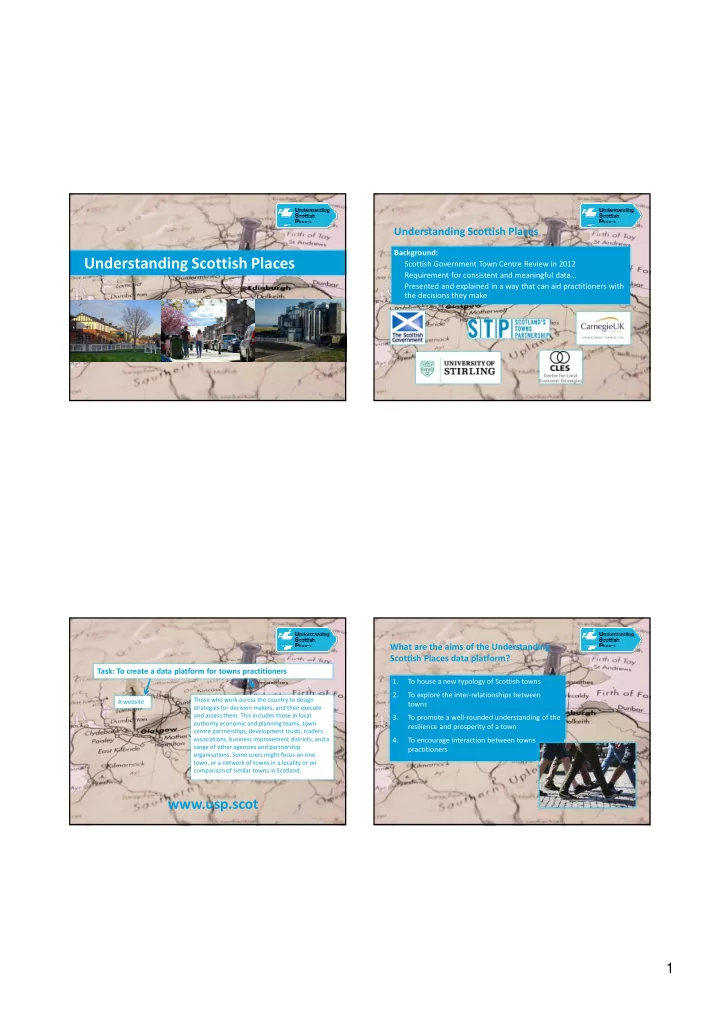
Understanding Scottish Places Background: Understanding Scottish Places Scottish Government Town Centre Review in 2012 Requirement for consistent and meaningful data Presented and explained in a way that can aid practitioners


slide-1
SLIDE 1

1

Understanding Scottish Places

Background:

  • Scottish Government Town Centre Review in 2012
  • Requirement for consistent and meaningful data…
  • Presented and explained in a way that can aid practitioners with

the decisions they make

Understanding Scottish Places

A website Those who work across the country to design strategies for decision makers, and then execute and assess them. This includes those in local authority economic and planning teams, town centre partnerships, development trusts, traders associations, business improvement districts, and a range of other agencies and partnership

  • rganisations. Some users might focus on one

town, or a network of towns in a locality or on comparison of similar towns in Scotland.

Task: To create a data platform for towns practitioners

www.usp.scot

1. To house a new typology of Scottish towns 2. To explore the inter-relationships between towns 3. To promote a well-rounded understanding of the resilience and prosperity of a town 4. To encourage interaction between towns practitioners

What are the aims of the Understanding Scottish Places data platform?

slide-2
SLIDE 2

2

Clarify the number of towns in Scotland (479 identified) Categorise towns based on their size and characteristics Based on the 2011 census using the following indicators:

Typology

Demographics Community Work

Resident population Pre-school age Primary school age Secondary school age (-16) 16-25 25-45 45-65 65-80 80+ One person household Married with no children household Married with children household Co-habiting with no children household Co-habiting with children household Lone parent with no children household Lone parent with children household Multipersonhousehold No deprivation Deprivation 1 Deprivation 2 Deprivation 3 or 4 No Car 1 Car 2 or more cars Part time work Full time work Agricultural employment Mining employment Construction employment Wholesale and retail employment Transport employment Hospitality employment Information technology employment Financial sector employment Real estate employment Professional employment Administration employment Public administration employment Health sector employment Social grade 1 Social grade 2 Social grade 3 Social grade 4 Unemployed Student Retired Working in the house Inactive Employees Self-employed

Housing

Home owner Council or social housing Private rental housing

Education

No education Level 1 education Level 2 education Level 3 education Level 4 education

Inter-relationships between towns

Includes 11 indicators

  • Number of registered charities
  • Number of GP surgeries
  • Number of hospitals
  • Number of children in primary schools
  • Number of children in secondary schools
  • Number of jobs
  • Diversity of jobs
  • Public sector jobs
  • Number of shops
  • Distance travelled to work
  • Distance travelled to study
  • INDEPENDENT
  • INDEPENDENT TO INTER-DEPENDENT
  • INTER-DEPENDENT TO INDEPENDENT
  • INTER-DEPENDENT
  • INTER-DEPENDENT TO DEPENDENT
  • DEPENDENT TO INTER-DEPENDENT
  • DEPENDENT

A 7-part scale USP Town Audit

  • Allows users to gather additional data
  • Makes use of locally-sourced data
  • Includes qualitative data such as resident surveys
  • 4 case studies - Musselburgh, Hamilton, Upper

Nithsdale, Kirkcaldy

Audit KPIs Cultural Facilities Community Services Cultural and Community Events Impressions score Number of listed buildings Development land Evening economy Local Food and drink Bed spaces Self-reliance Partnership progression Planning and delivery

Created by STP in partnership with EKOS and 3 case study towns

slide-3
SLIDE 3

3

Encourage interaction between towns practitioners

  • Forum facility on STP’s site
  • Sharing of information, ideas and policies
  • Between towns of the same type (e.g. so that

innovative solutions can be shared)

  • Between towns in the same area (e.g. so that

complementary solutions can be formed)

  • Part of the wider work of Scotland’s Towns Partnership

Launch Event – Wednesday 29 April

Launched in Musselburgh by Margaret Burgess MSP, Minister for Housing and Welfare

11 12

slide-4
SLIDE 4

4

13 14 15 16

slide-5
SLIDE 5

5

17

Try it out!

  • 1. Which has a larger population, Galashiels or Hawick?
  • 2. Who has more professional/managerial workforce?
  • 3. In which town do people travel greater distances to work (10-30km)?
  • 4. Which town has the lower skill levels?
  • 5. Which town has more people per shop?
  • 6. Why is Galashiels more independent in terms of employment?
  • 7. What is Hawick most dependent upon compared to Galashiels?
  • 8. What is Galashiels most dependent upon compared to Hawick?

www.usp.scot

18

Getting the most from USP

Comparing a cluster of places. Galashiels, Melrose and Selkirk. Questions of jobs, skills and travelling to get them?

19

Getting the most from USP

Comparing a cluster of places. Galashiels, Melrose and Selkirk. Questions of public service demand and where they are?

20

Getting the most from USP

How does Selkirk compare with

  • ther similar

towns in Scotland – Forres and Blairgowrie?

slide-6
SLIDE 6

6

21

Getting the most from USP

How does Galashiels compare to

  • ther towns.

More distant but still in Scottish Borders – Duns and Peebles

22

Developing USP

A series of USP User Laboratory events over summer 2015 Gathering feedback to present to Scottish Government in the autumn Practitioner and academic outputs are in development

23

Existing ideas for future development

Additional data?

  • Broaden: Data sets must include all 479

towns

  • Deepen: Addition of data for a particular

place where area or region that has good consistent data on a specific topic

  • Enhance: Could USP encourage more

collection of data?

  • User suggestions so far: Business type,

vacant/derelict land, transport (buses links, use of taxis), heritage, digital access

24

Other suggestions for future development:

  • City districts?
  • Smaller settlements?
  • Digitisation of the audit tool?
slide-7
SLIDE 7

7

25

Discussion questions

  • 1. What is good about the tool?
  • 2. What is not so good about the tool?
  • 3. Is the interdependency tool useful? Why?
  • 4. What can you usefully learn from similar

towns?

  • 5. Is USP helpful in strategy building and

planning?

  • 6. What other data would you like to see

included?

Thanks for attending and engaging

Feedback does not end today. You can contact us via : @CarnegieUKTrust @sparks_stirling @CLESTweet @ScotlandsTowns rebecca@scotlandstowns.org / georgina@carnegieuk.org

www.usp.scot