
SLIDE 1
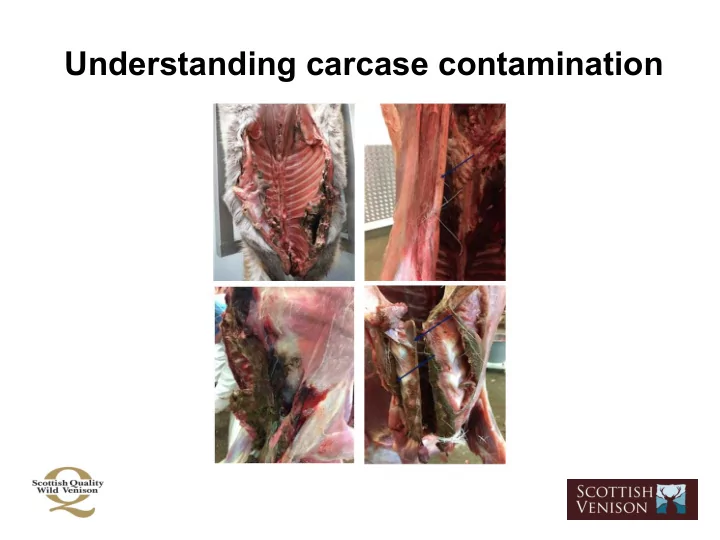
Understanding carcase contamination Gross or minor contamination? - - PowerPoint PPT Presentation
Understanding carcase contamination Gross or minor contamination? In food production, contamination risk assessment usually covers four types: Physical Chemical Microbiological Allergenic This presentation concentrates on
In food production, contamination risk assessment usually covers four types:
This presentation concentrates on microbiological contamination – but
At each stage of the process from shot to sale contamination risk must be considered, assessed and minimised.
3.1.4 Gralloching must be carried out in a hygienic and approved manner, according to Best Practice Guidance and as soon as possible (1 hour maximum) after despatch. Cuts made outside the larder must be minimal. The pluck may be removed from carcase at the time of gralloching. 3.1.5N Carcasses that are grossly contaminated must not be presented for human consumption. Gross contamination – which potentially contains food poisoning bacteria – can occur as a result of gut spill at point of kill or gralloch. The risk is especially heightened with spillage from the rectum, the greatest source of E. coli O157 contamination.
Guidance Note
consideration should be given to removing this section and the rectum at the larder, or by means of a double cut allowing this section to be carefully lifted backwards from the carcase. At all times great care must be taken to minimise the risk of contamination.
3.1.8 Carcasses must be transferred to the larder as soon as possible after despatch and actively chilled to a temperature of 7°C or less within a reasonable period of time after killing and achieve a temperature throughout the meat of not more than 7°C. Note: Active chilling is not required where the climatic conditions are suitable eg when ambient temperature is less than 5 - 7°C. For reporting of the process to be absolutely thorough the actual ambient temperature should be recorded. 3.1.9 Carcasses must not be left outside overnight, unless, under exceptional circumstances where health and safety is an issue for those involved with their retrieval.
Guidance note Where carcasses have been left outside for an extended period then the trained hunter must consider any possible contamination hazards and take steps to control these e.g. if the carcase has been attacked by vermin or the ambient temperature has been too high to prevent active cooling then the carcase will be unfit for human consumption and should not be put into the food chain.
3.2.1 Vehicles used for transport must be kept clean, hygienic and disinfected. Vehicles must be designed, constructed and maintained to enable wild game carcases to be transported in a hygienic condition The cold chain must be maintained during transport ie carcasses must not be allowed to warm up during transit. 3.2.5 Stacking of carcasses should be avoided from the cull site to the larder.
4.2.3 Carcasses must be condemned, in part or total, if any of the following apply:
hour of being culled.
temperature of the carcasses may have exceeded 7oC (ie a standard setting for an average size chiller is usually 4oC).
both could qualify as gross.
has entered the seams of the meat. Even a small amount entering the seams is considered gross.
should not be trimmed before sending, even to remove contamination, as this trimming may remove evidence of disease that the FSS meat inspector requires to assess the carcase.
inspection then corrective trimming can take place but it is the responsibility of the hunter to ensure that the animal had no disease and that the carcase trimming was done hygienically.
presentable once all visible signs of contamination are removed?
doubtful carcase, or do not present it for uplift.
FSS Inspector to decide, then do not submit it into the food chain at all.
Gross contamination Carcase is dry and visibly clean
Extensive shot damage Limited, trimable and non-faecal
Visit the Scottish Venison channel
www.bestpracticeguides.org.uk www.sqwv.co.uk www.scottishvenison.info
Visit or follow us:
Watch our food safety fi