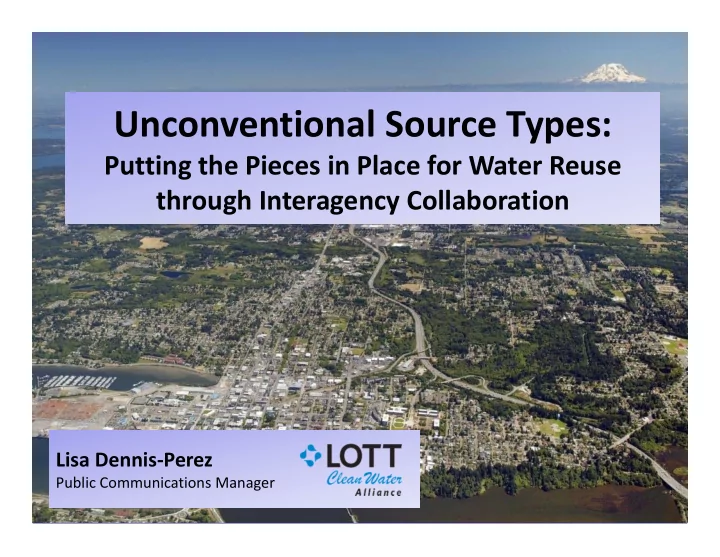
SLIDE 1 Unconventional Source Types:
Putting the Pieces in Place for Water Reuse through Interagency Collaboration
Lisa Dennis‐Perez
Public Communications Manager
SLIDE 2
Mission: Preserve and protect public health and the environment by cleaning and restoring water resources for our communities
SLIDE 3
Budd Inlet Treatment Plant
SLIDE 4
SLIDE 5 Wastewater Resource Management Plan
Four part approach:
- Flow Reduction
- Increased Wintertime Discharge
- Reclaimed Water
- Groundwater Recharge
SLIDE 6
Producing Reclaimed Water
SLIDE 7
Budd Inlet Reclaimed Water Plant
SLIDE 8
SLIDE 9
Martin Way Reclaimed Water Plant
SLIDE 10
SLIDE 11
Establishing Policy Infrastructure
“once we produce the water, then what?”
SLIDE 12
- Who owns/ has rights to the water?
- How far does LOTT’s responsibility go?
- Can responsibility be transferred?
- Who will purvey the water?
- How will water be shared among partners?
- How much will reclaimed water infrastructure cost?
Who pays?
Policy Questions
SLIDE 13
- LOTT serves as the “wholesaler”
- City water utilities serve as the “retailer”
- LOTT’s permit responsibility remain to end use
- Legal agreements secure shared responsibility
- Water is allocated to partners based on their
relative flow contributions
- LOTT provides “trunk” lines between LOTT uses
- Cities are responsible for distribution to customers
Policy Basics
SLIDE 14 Policy Framework
State Reclaimed Water Permit General Interlocal Agreement Distribution Agreement Model End User Agreement End User Agreements Ordinances Supply Agreements
State Level Regional Partners City Level
SLIDE 15
Putting Reclaimed Water to Use
SLIDE 16
SLIDE 17
Pipelines to Tumwater and West Olympia
SLIDE 18
Heritage & Marathon Parks
SLIDE 19
Percival Landing
SLIDE 20
Port of Olympia
SLIDE 21
LOTT Regional Services Center
SLIDE 22
Hands On Children’s Museum and East Bay Public Plaza
SLIDE 23
Future Uses
SLIDE 24
Future Uses
SLIDE 25
Hawks Prairie Reclaimed Water Ponds and Recharge Basins
SLIDE 26
Hawks Prairie Reclaimed Water Ponds and Recharge Basins
SLIDE 27
Gaining Public Acceptance
SLIDE 28
SLIDE 29
East Bay Public Plaza and WET Science Center
SLIDE 30 Legend RW production site GW recharge site UGA boundary
East Mullen Hawks Prairie Rixie Rd South Deschutes Henderson Mullen Road RWP Martin Way RWP Budd Inlet TP Tumwater RWP
Reclaimed Water Treatment and Recharge Sites
Planning for the Future
SLIDE 31 Regulatory Uncertainties & Watershed Management Issues
- Deschutes River/Capitol Lake/Budd Inlet TMDL
- State Reclaimed Water Rule development
- Thurston County Critical Areas Ordinance
– Critical Aquifer Recharge Areas chapter
SLIDE 32
Reclaimed Water Infiltration Study
What are the risks from infiltrating reclaimed water into groundwater because of chemicals that may remain in the water from products people use every day, and what can be done to reduce those risks?
SLIDE 33 How Will Study Results Be Used?
– Continuing the reclaimed water program as planned – Treating the reclaimed water to a higher quality, using advanced treatment processes – Investing in other uses of the water to reduce the amount being infiltrated
– Decide if program changes are needed – Develop future regulations
SLIDE 34 Reclaimed Water As a Water Source
- Stretch Water Supplies through Non‐Potable Reuse
– Irrigation: Parks, Streetscapes, Golf Course – Cleaning and Process Water: Treatment Plants, Port – Decorative Water Features: LOTT Building, Park, Pond Site
- Replenish Groundwater Supplies
– Infiltration of Reclaimed Water: LOTT Hawks Prairie and Future Sites
- Mitigate for New Water Rights
– Infiltration of Reclaimed Water: Lacey and Olympia’s Woodland Creek Recharge Facility
SLIDE 35
Questions?
Lisa Dennis‐Perez
Public Communications Manager www.lottcleanwater.org lisadennis‐perez@lottcleanwater.org (360) 528‐5719