
SLIDE 1
Uncertainty
Russell & Norvig Chapter 13
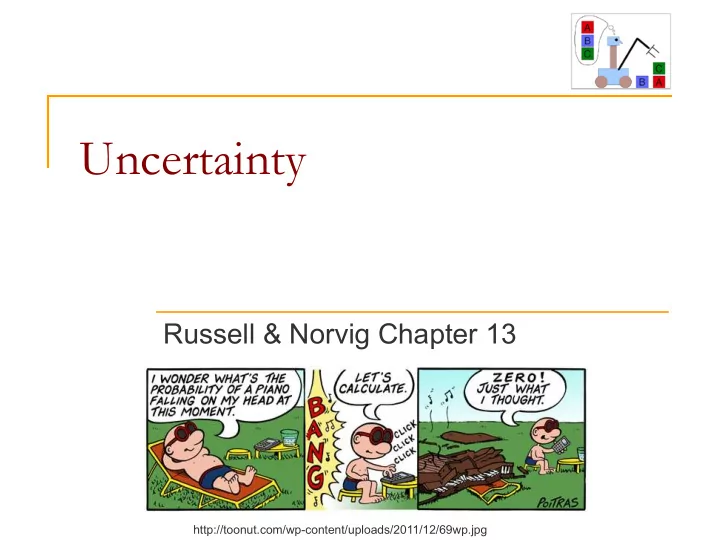
http://toonut.com/wp-content/uploads/2011/12/69wp.jpg
Uncertainty Russell & Norvig Chapter 13 - - PowerPoint PPT Presentation
Uncertainty Russell & Norvig Chapter 13 http://toonut.com/wp-content/uploads/2011/12/69wp.jpg Uncertainty Let A t be the action of leaving for the airport t minutes before your flight Will A t get you there on time? Uncertainty results
http://toonut.com/wp-content/uploads/2011/12/69wp.jpg
Let At be the action of leaving for the airport t minutes before your flight Will At get you there on time? Uncertainty results from:
1.
partial observability (road state, other drivers' plans, etc.)
2.
noisy sensors (traffic reports)
3.
uncertainty in action outcomes (flat tire, etc.)
4.
complexity of modeling traffic
Let At be the action of leaving for the airport t minutes before your flight Will At get you there on time? A purely logical approach either
1.
risks falsehood: “A120 will get me there on time”, or
2.
leads to conclusions that are too weak for decision making:
“A120 will get me there on time if there's no accident and it doesn't rain and my tires remain intact etc.” (A1440 might reasonably be said to get me there on time but I'd have to stay overnight in the airport …)
n How to represent uncertainty in knowledge? n How to perform inference with uncertain
n Which action to choose under uncertainty?
n Implicit
q Ignore what you are uncertain of when you can q Build procedures that are robust to uncertainty
n Explicit
q Build a model of the world that describes uncertainty about
its state, dynamics, and observations
q Reason about the effect of actions given the model
n Default Reasoning:
q Assume the car does not have a flat tire q Assume A120 works unless contradicted by evidence
n Issues: What assumptions are reasonable? How to
handle contradictions?
n Worst case reasoning (the world behaves according to
Murphy’s law).
n Probability
q Model agent's degree of belief q Given the available evidence, A120 will get me there on time with
probability 0.95
n Probabilities relate propositions to agent's own state of
knowledge e.g., P(A120 | no reported accidents) = 0.96
n Probabilities of propositions change with new evidence:
e.g., P(A120 | no reported accidents, 5 a.m.) = 0.99
Suppose I believe the following:
P(A60 gets me there on time | …) = 0.001 P(A90 gets me there on time | …) = 0.70 P(A120 gets me there on time | …) = 0.95 P(A150 gets me there on time | …) = 0.99 P(A1440 gets me there on time | …) = 0.9999
n Which action to choose?
Depends on my preferences for missing flight vs. time spent waiting, etc.
q Utility theory is used to represent and infer preferences q Decision theory = probability theory + utility theory
n For any events A, B in a space of events Ω
q 0 ≤ P(A) ≤ 1 q P(Ω) = 1 and P(φ) = 0 q P(A ∨ B) = P(A) + P(B) - P(A ∧ B)
q 0 ≤ P(ω) ≤ 1 q P(A ∨ B) = P(A) + P(B) - P(A ∧ B)
ω∈Ω
n You draw a card from a deck of cards (52
q A king q A face card q A spade q A face card or a red suit q A card
n Frequentist interpretation n Bayesian interpretation
n Draw a ball from an urn containing n balls of
n The probability of the event “the ball is red”
q E.g. the probability that you will get to the airport
q There are theoretical justifications for subjective
n Probability is "degree-of-belief”. n To the Bayesian, probability lies subjectively in the
n In contrast, to the frequentist, probability lies
n A random variable can be thought of as an unknown value
that may change every time it is inspected.
n Suppose that a coin is tossed three times and the sequence of heads
and tails is noted. The event space for this experiment is: S={HHH, HHT, HTH, HTT, THH, THT, TTH, TTT}. X - the number of heads in three coin tosses. X assigns each outcome in S a number from the set {0, 1, 2, 3}.
n We can now ask the question – what is the probability for observing a
particular value for X (the distribution of X).
Outcome HHH HHT HTH THH HTT THT TTH TTT X 3 2 2 2 1 1 1
n Boolean random variables
e.g., Cavity (do I have a cavity?) Distribution characterized by a number p.
n Discrete random variables
e.g., Weather is one of <sunny,rainy,cloudy,snow>
n Domain values must be exhaustive and mutually exclusive n The (probability) distribution of a random variable X with m values
x1, x2, …, xn is: (p1, p2, …, pm) with P(X=xi) = pi and Σi pi = 1
n Given n random variables X1,…, Xn n The joint distribution of these variables is a table
n Example:
Toothache
¬Toothache
Cavity 0.04 0.06
¬Cavity 0.01
0.89
n P(Toothache) = P((Toothache ∧Cavity) v (Toothache∧¬Cavity))
= P(Toothache ∧Cavity) + P(Toothache∧¬Cavity)
= 0.04 + 0.01 = 0.05 We summed over all values of Cavity: marginalization
n P(Toothache v Cavity) =
P((Toothache ∧Cavity) v (Toothache∧¬Cavity)
v (¬Toothache ∧Cavity)) = 0.04 + 0.01 + 0.06 = 0.11 These are examples of inference by enumeration
Toothache
¬Toothache
Cavity 0.04 0.06
¬Cavity 0.01
0.89
n Definition:
n Read: probability of A given B
q Example: P(snow) = 0.03 but P(snow | winter) = 0.06,
P(snow | summer) = 1e-4
n can also write this as:
n called the product rule
P(Cavity|Toothache) = P(Cavity∧Toothache) / P(Toothache) = 0.04/0.05 = 0.8
Toothache
¬Toothache
Cavity 0.04 0.06
¬Cavity 0.01
0.89
n Events A and B are independent if
q Example: the outcomes of rolling two dice
Image from: http://commons.wikimedia.org/wiki/File:Thomas_Bayes.gif
n Given:
n Using Bayes’ rule:
Toothache
¬Toothache
Cavity 0.04 0.06
¬Cavity 0.01
0.89
Suppose you're on a game show, and you're given the choice of three doors: Behind one door is a car; behind the others, goats. You pick a door, say No. 1, and the host, who knows what's behind the doors, opens another door, say No. 3, which has a goat. He then says to you, "Do you want to pick door No. 2?" Is it to your advantage to switch your choice?
source: http://en.wikipedia.org/wiki/Monty_Hall_problem
Your pick Host opens Should you pick this one instead?
OK 1,1 2,1 3,1 4,1 1,2 2,2 3,2 4,2 1,3 2,3 3,3 4,3 1,4 2,4 OK OK 3,4 4,4 B B
There is no safe choice at this point! But are there squares that are less likely to contain a pit?
OK 1,1 2,1 3,1 4,1 1,2 2,2 3,2 4,2 1,3 2,3 3,3 4,3 1,4 2,4 OK OK 3,4 4,4 B B
There is no safe choice at this point! But are there squares that are less likely to contain a pit?
OK 1,1 2,1 3,1 1,2 OK OK B B OK 1,1 2,1 1,2 2,2 OK OK B B OK 1,1 2,1 3,1 1,2 OK OK B B
0.2 x 0.2 = 0.04 0.2 x 0.8 = 0.16 0.8 x 0.2 = 0.16
OK 1,1 2,1 1,2 1,3 OK OK B B OK 1,1 2,1 3,1 1,2 1,3 OK OK B B
0.2 x 0.2 = 0.04 0.2 x 0.8 = 0.16
2,2 1,3 3,1 1,3 2,2 1,3 3,1 2,2 2,2
n The naïve representation runs into problems. n Example:
q Patients in a hospital are described by attributes such as: n
Background: age, gender, history of diseases, …
n
Symptoms: fever, blood pressure, headache, …
n
Diseases: pneumonia, heart attack, …
n A probability distribution needs to assign a number to each
combination of values of these attributes
q Size of table is exponential in number of attributes
n Provide an efficient representation that relies
n P(A ∧ B ∧ C) = P(A|B,C) P(B|C) P(C)
B E P(A|…) T T F F T F T F 0.95 0.94 0.29 0.001
Burglary Earthquake Alarm MaryCalls JohnCalls
P(B) 0.001 P(E) 0.002 A P(J|A) T F 0.90 0.05 A P(M|A) T F 0.70 0.01
B E P(A|…) T T F F T F T F 0.95 0.94 0.29 0.001
Burglary Earthquake Alarm MaryCalls JohnCalls
P(B) 0.001 P(E) 0.002 A P(J|A) T F 0.90 0.05 A P(M|A) T F 0.70 0.01