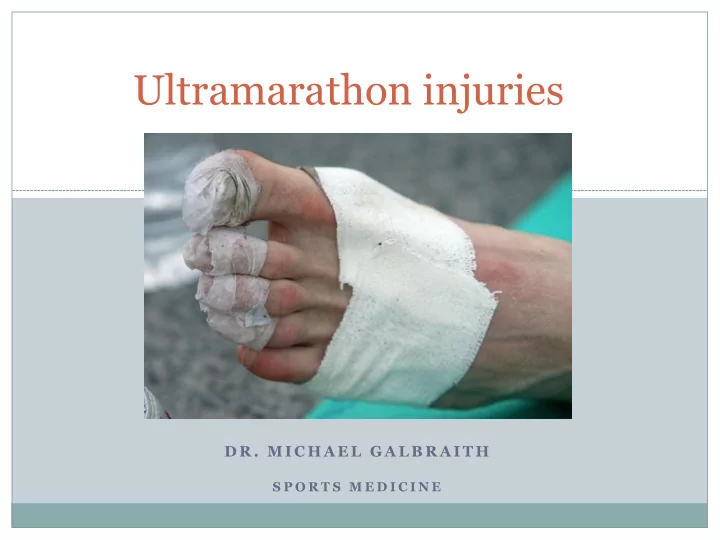
SLIDE 1 D R . M I C H A E L G A L B R A I T H
S P O R T S M E D I C I N E
Ultramarathon injuries
SLIDE 2
Disclaimer:
I’m not a long-distance runner Who’s never run an Ultramarathon?
SLIDE 3 Goals:
Stimulate discussion – share wisdom Learn a few random facts about injuries in
Ultramarathons
SLIDE 4 Blisters
What causes it?
Friction: shoes & socks rubbing against skin
SLIDE 5 How do you prevent Blisters?
Well-fitted shoes Keep feet dry change socks regularly Good socks
avoid cotton synthetic material nylon, wicking socks, Smartwool
SLIDE 6
How do you prevent Blisters?
Coat feet w/ lubricant Use tape Drain large blisters; leave small ones alone Trim toenails File calluses
SLIDE 7
SLIDE 8
Blisters - tape
Apply protective tape or pads to feet if prone to
blisters in specific hot spots
SLIDE 9
Blister tapes & pads
SLIDE 10
Blister Tx – Moleskin donut pads
SLIDE 11 What causes Chafing?
Repeated friction &
rubbing of skin against loose clothes or other skin
SLIDE 12
SLIDE 13
How do you prevent Chafing?
Avoid cotton & loose fitting clothes Wear clothes made of breathable synthetic material
(like CoolMax) to wick moisture away; wear well- fitting bra
Stay dry – apply Gold Bond, Talcum powder or corn
starch to moisture-prone areas
Lubricant: Vaseline, Body glide, etc.
SLIDE 14
SLIDE 15
Chafing prevention
SLIDE 16
Chafing prevention
SLIDE 17
SLIDE 18
Chafing Tx
SLIDE 19
Blisters & Chafing – final tips
Never ignore a small, little irritation in your feet A little pebble or tiny crease in your sock will come
back to haunt you tenfold if you don’t address the issue immediately and aggressively
Practice taping, lubing, lancing, and coating before
you have to do it on Race Day
Create foot problems in training to be able to solve
them on race day
SLIDE 20 Stress Fx
Myth:
It can’t be broken if I can
still move it!
Where can you get Stress
Fx?
Who cares about a Stress
Fx?
SLIDE 21
Who cares about a stress Fx?
SLIDE 22
SLIDE 23
SLIDE 24
What’s going on?
45 y/o runner notices dark red blood in urine 6
hours after his 50K?
Gross Hematuria
SLIDE 25 Exercise-related Hematuria
Aka: March hemoglobinuria (military), Footstrike
Hemolysis
Causes?
Trauma to bladder injury to RBCs (due to repeated trauma when
foot strikes ground)
SLIDE 26 Exercise-related Hematuria
Usually, runners don’t have any symptoms Rarely serious When to consult Dr?
If blood in urine persists > 2-3 days
Tx: none - hydration
SLIDE 27 What’s going on?
25 y/o runner found confused, disoriented,
lethargic, staggering on running course…..
Pt temp:
40°C (oral) 41.7° C (rectal)
SLIDE 28 Exertional Heat Stroke
What is it?
Body’s inability to cool
itself
Temp > 40° C Feel like garbage Confusion, disoriented
How’s this different than Heat Exhaustion?
SLIDE 29 Exertional Heat Stroke
Tx: rapid cooling!
Ice baths Ice packs to groin, axilla Fan Fluids
Likely fatal if not treated promptly on site….not in ER!
SLIDE 30
SLIDE 31 Heatstroke
Pt’s condition rapidly improved w/:
ice bath Cool washrag to forehead Fan IV fluids Continuous monitoring w/ rectal thermometer
SLIDE 32
What’s going on?
25 y/o runner found confused, lethargic,
staggering on running course….. & collapses
What other problems could be going on?
SLIDE 33
Collapsed athlete
Exertional Heat Stroke Exercise-associated Collapse – fatigue, dehydration Postural Hypotension Hypoglycemic – low sugar Hyponatremia – low Na 2+ Heart attack – MI Sudden Cardiac Death Not everything is dehydration or fatigue
SLIDE 34 Exercise-associated Hyponatremia
What is it?
Low sodium during long-endurance exercise
SLIDE 35 Exercise-associated Hyponatremia
What causes it?
Drinking too much water – overhydration Excessive ADH secretion (hormone released to reabsorb fluid)
SLIDE 36 Exercise-associated Hyponatremia
How do they present?
Confused Disoriented Collapsed lethargic
What type of runners does it usually affect:
Novice Slow Female
SLIDE 37
How much fluid to drink?
Two ends of the spectrum:
Drink everything in sight Restrict fluid intake - water’s for pansies S0….what’s the answer?
SLIDE 38 How much fluid to drink?
Everybody’s water, food & salt requirements are different –
not a once size fits all
Moderation is key Affected by environmental factors, weather, exercise
intensity, terraine, etc.
Drink to thirst – drink to replace fluid losses! Listen to your body
SLIDE 39 How much fluid to drink?
Learn your sweat rate – high variability (500ml-
5L/hr)
Weigh before and after race – difference is good
estimate of fluid lost
For every lb lost, replace w/ 16 oz of fluid
if a pt lost 4 lbs during exercise, they should replace w/ (4 x 16
Most runners tend to underestimate
fluid loss – causing dehydration
SLIDE 40
Jogger’s nipple
SLIDE 41
SLIDE 42
Nipple products
SLIDE 43
Nipple products
SLIDE 44
I knew I shouldn’t have eaten at Fuddruckers last night
SLIDE 45 Exercise-induced GI distress
Runner’s diarrhea – “Runner’s trots”, “the Gingerbread man” Cramping Nausea/Vomiting Bloody stool Incidence: > 30%-50
SLIDE 46 Runner’s Diarrhea
Cause: unclear ??
ischemia – poor blood flow to intestines mechanical - repetitive trauma/jarring of bowel diet – high fiber, vegetables, legumes, dairy,
caffeine
Pre-race jitters, stress
SLIDE 47 Runner’s Diarrhea
Treatment:
Replace fluids, electrolytes
Imodium pre-race (for known victims) – don’t take
regularly
Avoid NSAIDs Usually resolves w/in hours or days
SLIDE 48
Exercise-induced GI distress tips:
Learn food triggers BEFORE race day – food diary Stay adequately hydrated Avoid caffeine: coffee/tea, energy drinks/gels Experiment w/ energy gels & bars BEFORE race day Don’t eat immediately prior to race (~ 2 hr) Don’t carb load at Fuddruckers the night before the
big race
SLIDE 49 When to throw in the towel?
When should you call it quits during the Ultra?
What’s the nature of the injury? Could there be permanent injury?
What are your goals? What’s your motivation?
SLIDE 50
When to throw in the towel?
SLIDE 51
SLIDE 52
SLIDE 53
Ultramarathon Injury Nuggets
Take care of your feet One size doesn’t fit all to training, nutrition Drink to thirst – listen to your body &
replace losses
Learn food triggers before race day Know your medical resources – if having
problems during training or race day
(who’s your Sports Med doc?)
SLIDE 54
Ultramarathon Injury Nuggets
For every lb lost, replace w/ 16 oz of fluid Some collapsed athletes could be critically
ill, not just dehydrated and tired
Tx for heat stroke: rapid cooling See a Doc if blood in urine > 2-3 days Don’t be the one with bloody nipples
SLIDE 55
References:
www.irunfar.com www.Badwater.com www.badwater.com – see 2012 Race magazine for
injuries
Badwater – training & preparation - Krabak BJ, Waite B, Schiff MA. Study of injury and
illness rates in multiday ultramarathon runners. Med Sci Sports Exerc. 2011 Dec;43(12):2314-20.
SLIDE 56 References:
Roberts WO. A 12-yr profile of medical injury and illness
for the Twin Cities Marathon. Med Sci Sports Exerc. 2000 Sep;32(9):1549-55.
Khodaee M, Ansari M. Common ultramarathon injuries
and illnesses: race day management. Curr Sports Med
- Rep. 2012 Nov-Dec;11(6):290-7.
www.saltyrunning.com - Captaining an Ultrarunning Aid
Station
BJSM interview 2013, Dr. Noakes Sallis Robert. Heat & Hydration in Sports, CASEM
Annual Conference 2013