UCSF Vascular Symposium 204 Aggressive assessment and management - - PowerPoint PPT Presentation
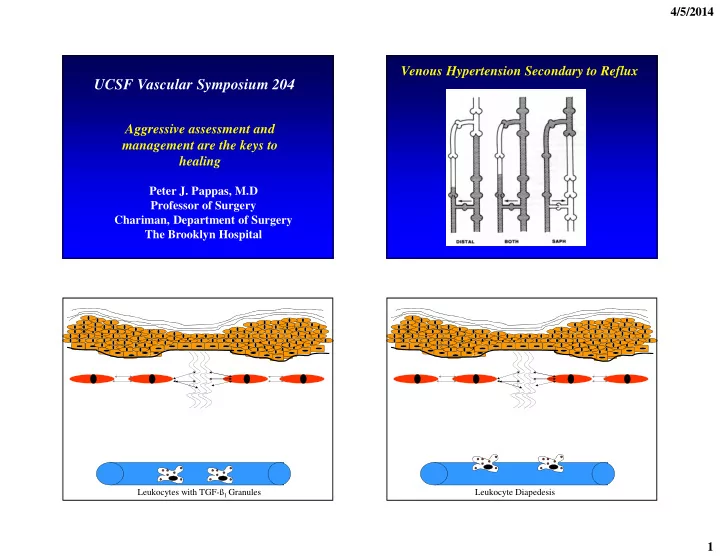
4/5/2014 Venous Hypertension Secondary to Reflux UCSF Vascular Symposium 204 Aggressive assessment and management are the keys to healing Peter J. Pappas, M.D Professor of Surgery Chariman, Department of Surgery The Brooklyn Hospital
4/5/2014 2
TGF-ß1 Release TGF-ß1 Release
4/5/2014 3
TGF-ß1 stimulated fibroblasts differentiate into myofibroblasts.
Injury Stimulus causes cytokine release And RAS activation with possible Senescence development and MMP Synthesis RAS Activation RAS Activation Normal wound healing process
4/5/2014 4
Impaired venous ulcer healing process
Treatment Options for Venous Ulcers And Levels of Evidence
- Compression Therapy
- Vein Surgery
– Superficial – Deep – Perforator
- Skin Grafting
Compression modalities
Unna Boot Multi layer Bandage
Circaid Compression Stocking
Compression Rx: Evidence of Efficacy
- Cochrane library review
– Meta-analysis
- Reviewed over 200 studies of Rx of VSU
- Conclusions
– Overall dataset is relatively poor – Appears clear that compression is better than no compression in healing VSU – Sustained compression of high strength is better than non-sustained compression
4/5/2014 5 Recent Trials of Compression Methods
Primary author Journal ref
# pts
% healed group A % healed group B
P val
Nelson J Vasc Surg 2007;45:134 245; 4 layer vs single layer 67% 4 layer at 24 wks 49% single layer at 24 wks .009 Nelson Br J Surg 2004 91:1292 387; 4 layer vs short str 92 days median for 4 layer 126 days median for SS < .05 Partsch Vasa 2001;30:108 112; 4 layer vs short str 62% 4 layer at 16 wks 73% SS at 16 wks NS Franks Wound Rep Regen 2004;12:157 156; 4 layer vs SS 69% 4 layer at 24 wks 73% SS at 24 wks NS Polignano J Wd Care 2004;13:21 68; 4 layer vs Unna 74% 4 layer at 24 wks 66% Unna at 24 wks NS
Percent healed at: 6 weeks 29% 10 weeks 57% 16 weeks 75% 52 weeks 93% 1 amputation required (0.4%)
Weeks of Treatment
10 20 30 40 50 60 70 80 90 100 4 8 12 16 20 24 28 32 36 40 44 48 52 56
Healing Rate for 252 Ulcers: UNC experience
J Vasc Surg Sept 1999
Weeks of Treatment
Percent healed at 10 weeks
- f Rx:
< 5 cm2 77% 5 to 20 cm2 61% > 20 cm2 22% All curves significant difference (P < .01) 10 20 30 40 50 60 70 80 90 100 2 6 10 14 18 22 26 34 42 52
< 5 cm2 n = 91 5 - 20 cm2 n = 94 > 20 cm2 n = 67
Healing Rate by Initial Ulcer Size
Compression and Compliance
Mayberry et al. Surgery 1991; 81:575-58
4/5/2014 6
Wrong Diagnosis: Venous Mimics
- Basal or squamous cell
carcinoma.
- Rheumatoid, lupus,
scleroderma and other collagen vascular disorders.
- Tuberculosis and syphilis.
- Pyoderma gangrenosum.
- AIDS.
- Arteriovenous
malformations.
- Cryoglobulinemia and
macroglobulinemia.
- Burns and insect bites.
Level of Evidence for Venous Ulcer Surgery Versus Compression
Summation Data for Studies Prior to 2000
Howard et al. The role of superficial venous surgery in the management of Venous ulcers: A systematic review. Eur J Vasc Endovasc Surg. 2008;36: 458-465.
Randomized Clinical Trials For Venous Ulcer Surgery
4/5/2014 7
C5-6 Disease - The ESCHAR Trial
Barwell JR, Lancet 2004
- Prospective randomized trial
– High ligation, stripping, phlebectomy and Compression versus – Multilayer compression bandaging
- 500 patients with CEAP 5 and 6 disease
– Isolated superficial reflux - 300 (60%) – Mixed superficial / deep reflux - 200 (40%)
- Endpoints
– 24 week ulcer healing – 12 month ulcer recurrence
Barwell et al. Eschar Trial. Lancet 2004; 363: 1854-1859
ESCHAR Trial - Ulcer Healing
Barwell JR, Lancet 2004
- 24 week ulcer healing - 65% in both groups
0% 10% 20% 30% 40% 50% 60% 70% 80% 90% 100% 3 6 9 12 Months % Healed
Surgery Compression
ESCHAR Trial - Ulcer Recurrence
Barwell JR, Lancet 2004
- 12 month freedom from
recurrence (p < 0.0001) – Surgery + Compression - 12% – Compression alone
- 28%
- Four year freedom from
Recurrence (p<0.01) – Surgery + compression 31% – Compression alone
56%
0% 10% 20% 30% 40% 50% 60% 70% 80% 90% 100% 3 6 9 12 Months Freedom from Recurrence
Surgery Compression
4/5/2014 8
Ulcer Healing With Surgery
24 weeks
Gloviczki et al. J Vasc Surg 1999;29:489-502.
Effect Of Outflow Obstruction On Ulcer Healing: NASEPS Registry Data
Gloviczki et al. J Vasc Surg 1999;29:489-502.
Recurrence Rate With Outflow Obstruction: NASEPS Registry Data
Gloviczki et al. J Vasc Surg 1999;29:489-502.
Inadequate Surgical Correction
- LSV not ligated flush at
saphenofemoral junction.
- LSV tributaries left intact.
- LSV ligated and not
- stripped. Recurrence at
thigh due to Hunterian perforator.
- Pelvic vein varicosity.
- Neovascularization.
Stonebridge et al. Br J Surg 1995; 82: 60-62.
4/5/2014 9
Calf Muscle Pump Dysfunction
- Always consider calf muscle
pump dysfunction in patients with venous ulcer and no evidence of reflux on duplex examination.
- Important cause of pump
dysfunction is poor ankle range of motion.
- Role of physical therapy?
Back et al. J Vasc Surg, 1995;22:519-523.
Clinical Trials Data For Varicose Veins, Not Ulcer Healing: Stripping and compression versus Endovenous Technologies
CEAP Class 2 and 3 Disease: Primary Varicose Veins
History of Venous Surgery
- Trendelenburg (1890) GSV ligation upper/mid 1/3
- Homans (1916) - Flush Saphenofemoral ligation
- Mayo (1906) - Extraluminal stripper
- Babcock (1907) - Rigid intraluminal stripper
- Myers (1947) - Flexible intraluminal stripper
- 2006 - Endovenous Ablation (Laser / RF)
4/5/2014 10
Mechanism of Action Randomized Controlled Trials
- RF versus Surgery
Rautio 2002 Lurie 2005 Hinchcliff 2006 Stötter 2006
- Laser versus Surgery
de Medeiros 2005 Rasmussen 2007 Kalteis 2008 Ogawa 2008 Darwood 2008
- RF versus Laser
Morrison 2005 Almeida 2008 Goode 2008
- Varisolve Foam vs
Surgery/Sclero Wright 2006 * Foam sclero combined with sapheno-femoral ligation vs surgery Bountouroglou 2006, 2008
Stripping vs Endovenous RF Ablation
Lurie et al, J Vasc Surg 2003 Eur J Vasc Endovasc Surg 2005
- Prospective, multicenter randomized trial
Stripping n = 36 RF Ablation n = 44 p Ablation @ 1 wk 100% 90.5% Ablation @ 2 yrs 100% 92% Return to nl activity 3.89 days 1.15 days .02 Return to work 12.4 days 4.7 days < .05 Global QOL @ 1 wk + 3.7
- 9.2
.001 Global QOL @ 4 mo NS
4/5/2014 11
Evolves Trial
Venous Clinical Severity Scores
Eur J Vasc Endovasc Surg 2005
Global Quality of Life Scores
Eur J Vasc Endovasc Surg 2005
QoL scores: Immediate and Long-Term
Eur J Vasc Endovasc Surg 2005
4/5/2014 12 Stripping vs Endovenous Laser Ablation
Rasmussen et al; J Vasc Surg 2007
- Randomized trial of
– High ligation & stripping (HL/S) - 68 legs – Endovenous laser (EVL) - 69 legs
- Office based procedures
– U/S guided tumescent anesthesia – Simultaneous miniphlebectomy
- Treatment failure at 6 months
– HL/S - 2 – EVL - 3
Stripping vs Endovenous Laser Ablation
Rasmussen et al; J Vasc Surg 2007 7.7 7.6 12 3.948 6.9 7 12.9 4.347 2 4 6 8 10 12 14 Normal Activity Work Pain Medication Cost X 1000 (euro)
HL/S EVL
No significant difference in VCSS, AVVSS, or SF-36 at 3 months p < 0.05
What Endovenous Critics Ignore
Rasmussen et al; J Vasc Surg 2007
- Highly selected population
– 1135 patients screened – 121 (11%) patients enrolled
- Office-based stripping is not standard in North America
- Although QoL not different at 3 months, early reduction of bodily
pain is important to the patient
- Return to work longer than in other series
– Cost benefit of € 312 based upon return to work in 7 days – Costs equivalent at return to work of 5.2 days
REACTIV Trial
Michaels et al, Heath Technol Assess 2006
- 246 patients extensive vv and saphenous reflux randomized to
– Conservative measures (n = 122) – Saphenous stripping / phlebectomy (n = 124)
- HRQoL (SF-6D) at 1 yr significantly better with surgery
- Fewer symptoms at 1 year with surgery
0% 10% 20% 30% 40% 50% 60% 70% 80% 90%
Aching Heaviness Itching Swelling Cosmesis
Symptoms Improved or Absent Conservative Surgery
4/5/2014 13
The Economics of Venous Ablation
4.7 12.4 7 7.6 20 14 4 17 8.9 11.5 2 4 6 8 10 12 14 16 18 20 Return to Work (Days) Lurie Rasmussen Kalteis Darwood Weighted Average
Endovenous Stripping
- Return to work variable with
- Healthcare system
- Social expectations
- Adjunct procedures (high ligation, phlebectomy)
Cost-Effectiveness of Surgery
Ratcliffe et al; Br J Surg 2006
- Randomized trial of conservative tx vs surgery
- 24 mo cost effectiveness of £4682 per QALY gained
- Below NHS threshold of £20,000 per QALY
Conservative Surgery Mean Difference Mean NHS Cost £344.53 £733.10 £388.57 AUC SF-6D 1.42 1.50 0.083 ICER *
£4682
* Incremental cost effectiveness ratio
Results of Valvular Repair Techniques
Kistner, Surgical Management of Venous Disease, ed Raju, Villavicencio, 1997
Combined Arterial And Venous Insufficiency
- Treiman et al. studied patients with combined arterial and
venous disease*. – Group 1:
- Patent arterial graft, venous stripping for superficial
reflux, no DVT.
- 95% of ulcers healed
– Group 2:
- Patent arterial graft, superficial and deep venous
reflux, no DVT.
- Four ulcers healed, three remained unhealed.
Treiman et al. J Vasc Surg 2001;33:1158-1164.
4/5/2014 14
Combined Arterial And Venous Insufficiency
- Group 3: Patent arterial graft and prior
proximal DVT. – 41% healed their ulcers, 36% remained unhealed and 13% required BKA.
- Group 4: Occluded arterial grafts
– 0% ulcer healing.
Future Directions Bioengineered Skin Bioengineered Skin
4/5/2014 15
Biofilm
Diagnosis and Treatment Algorithm For Poor Ulcer Healing
Hemodynamic Assessment Correct arterial Insufficiency Control Local wound environment Infection Compression Revascularization Followed by Venous surgery Arterial Insufficiency Ligation Stripping SEPS Valve Repair Endovascular Corrective Surgery Compression Physical Therapy Calf pump Dysfunction Other Causes APG Reflux +/- Obstruction Imaging Duplex Venography Venous Hemodynamic Assessment Recurrent Disease History and Physical
yes no yes no
Conclusions
- Surgery for Venous ulcers heals ulcers at same
rate as compression but is better at preventing recurrences.
- Endovenous ablation appears better than stripping
in terms of pain and QoL.
- Registry data provides useful information that
hasn’t been addressed in clinical trials: AVR
Conclusions
- High Venous Ulcer recurrence rates, despite best
medical care indicates an enormous need for better wound care products. – Smart dermal substitutes. – Smart stockings that provide clinicians information.
- Computer chips that can be interrogated.
- Compliance chips.