Uberizing Energy: How Digital Technologies Will Change the - - PowerPoint PPT Presentation

uberizing energy
SMART_READER_LITE
LIVE PREVIEW

Uberizing Energy: How Digital Technologies Will Change the - - PowerPoint PPT Presentation

Uberizing Energy: How Digital Technologies Will Change the Competitive Landscape of the Energy Sector Monday, 14 October 2019 Associate Professor Robert K. Perrons Queensland University of Technology www.perrons.net Who am I? Since 2011,


slide-1
SLIDE 1

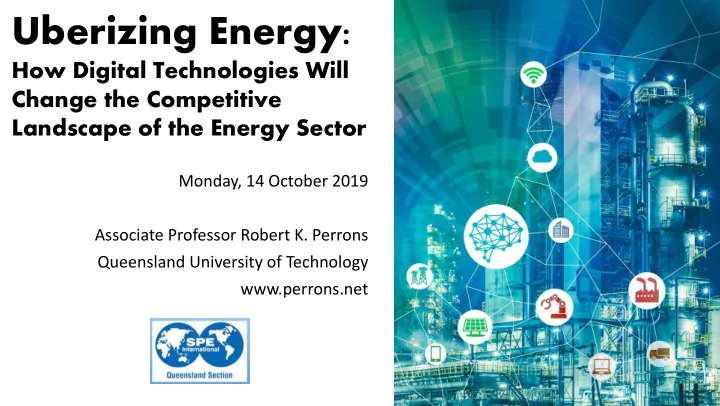
Uberizing Energy:

How Digital Technologies Will Change the Competitive Landscape of the Energy Sector

Monday, 14 October 2019 Associate Professor Robert K. Perrons Queensland University of Technology www.perrons.net
slide-2
SLIDE 2

Who am I?

  • Since 2011, Associate Professor at Queensland University of Technology
  • Before that, Shell International E&P
  • Executive Coordinator of global R&D portfolio
  • Smart Fields digital oilfield program
  • PwC Chair in Digital Economy , projects with and
  • Member of United Nations Expert Group – Resources and Energy
  • Serve in Australian Government’s “Expert Network” to provide advice on

emerging energy technologies, and adviser to MIT’s Mining, Oil & Gas Club, several energy and resource sector tech startups around the world

slide-3
SLIDE 3

SPE Global Innovation Surveys

  • We led the global surveys in 2012 and in 2017
  • Spent years evangelizing and sharing 2012 results
  • Examined at how innovation happens in global E&P industry at business

unit level

  • Just about to publish the 2017 results
  • This time, looking at individual level innovation
slide-4
SLIDE 4

Overview

  • Why talk about Uber?
  • What technological advances are contributing to

these new marketplace dynamics?

  • How are value networks and industries being

reconfigured by these technological changes?

  • What might this mean for the energy industry?
slide-5
SLIDE 5

What has done?

  • Ravi, the taxi driver who recently

took me to the Brisbane airport

  • His rough estimate:
  • 2 years ago, 20-minute wait in

between jobs at this time of year.

  • Now, 90-minute waits are pretty

normal.

slide-6
SLIDE 6

The demise of the taxi industry in the U.S.

  • In Q1 2014, 37% of the business traveler ground

transportation market was delivered via taxis

  • Uber and other ride-hailing services were only 8%
  • By Q1 2018, however, taxis were responsible for only 6%
  • f the market
  • Uber and other ride-hailing services had grown to 70.5%

https://www.forbes.com/sites/michaelgoldstein/2018/06/08/uber-lyft-taxi-drivers/#717d0e2259f0 Article published on 8 June 2018

slide-7
SLIDE 7

Meanwhile, how is doing?

slide-8
SLIDE 8

A working definition of “Uberization” based on this evidence

  • Digital technologies enabling tectonic shift in

profitability and market power within an industry

  • Only took a few years
  • The company that wins often isn’t an industry

incumbent—and may not even have existed before

  • New market leader plays “digital intermediary” role,

but doesn’t invest in capital-intensive parts of the sector

slide-9
SLIDE 9

Note: I did not come up with the fruit fly metaphor myself. It’s a recurring theme in: Fine, C. H. (1998). Clockspeed: Winning Industry Control in the Age of Temporary Advantage. Reading, Massachusetts: Perseus Books.

slide-10
SLIDE 10

Source: McKinsey 10

Industry clockspeed

slide-11
SLIDE 11

Great innovation is happening in green energy technologies…

slide-12
SLIDE 12

… and in more traditional energy markets

Shell’s Prelude FLNG facility

slide-13
SLIDE 13

Relatively slow rate of innovation in the upstream oil & gas industry

ADSL (broadband telecom) Consumer products (US average) Upstream Oil & Gas Industry (15 tech. cases) Medicine (Merck-average)

Prototype to field test Field test to commercial Commercial to 50% penetration Idea to prototype

5 10 15 20 25 30 35

Years

slide-14
SLIDE 14

“… the energy sector… is unusually large, diverse, and complex.”

Richard G. Newell, Duke University

“… the energy system is so big, so complicated, so important, and therefore so slow to change”

Richard K. Lester, MIT David M. Hart, George Mason University

slide-15
SLIDE 15

15

Ubiquitous computing

slide-16
SLIDE 16

16

Internet reached “critical mass”

slide-17
SLIDE 17

17

Dramatic increase in available computing power

slide-18
SLIDE 18

18

Precipitous drop in price of data storage

slide-19
SLIDE 19

19

Advances in mathematics

slide-20
SLIDE 20

20

Proliferation of cloud computing

slide-21
SLIDE 21

21

Emergence of “digital natives”

slide-22
SLIDE 22

Source: McKinsey 22

  • Price of sensors dropping

quickly

  • As a result, increasingly

cheap and easy to harvest digital information about almost every aspect of physical systems—including energy networks

  • Digital data infinitely

replicable and shareable for near-zero cost

Image from: http://blog.open-xchange.com/2015/02/09/iot/

slide-23
SLIDE 23

23

Image from http://blog.softwareinsider.org/engagement/. Accessed on 24 June 2015.

Cumulative result: Changes in connectivity within society and markets

slide-24
SLIDE 24

Source: McKinsey 24

Effect of digital technologies on value networks

  • Data that used to be transmitted via internal

processes can now be seamlessly shared digitally

  • Increased transparency of and accessibility to

inner workings of system can lead to increased modularity of architecture

  • Mix-and-match parts of energy network like

parts of a stereo system

slide-25
SLIDE 25

Source: McKinsey 25

Digital technologies can disaggregate and modularize industries

Physical networks can be decoupled from their supporting functions

slide-26
SLIDE 26

Look who just moved into the neighborhood…

slide-27
SLIDE 27

Can we call it an invasion if we’re inviting them in?

slide-28
SLIDE 28

Source: McKinsey 28

Changing cast of characters in the energy industry

  • GE’s acquisition of Baker Hughes announced in 2016
  • A clever strategy for plugging GE’s “Industrial Internet of

Things” (IIoT) technology platform into the oil & gas space

  • GE is now reducing stake in Baker Hughes, but not because
  • f IIoT
slide-29
SLIDE 29

Image from: http://www.hitachi.com/environment/showcase/solution/energy/smartgrid.html

Smart grids and the rise of the “prosumer”

slide-30
SLIDE 30

Source: McKinsey 30

Data as an asset

  • Data becoming more mission-

critical to profitability

  • Role of data integrator and high-

level analyzer will confer strategic advantage within industry’s ecosystem

  • Vantage point
slide-31
SLIDE 31

“Once you turn something digital, it hops on to that Moore’s Law pace of change and accelerates.”

  • Salim Ismail -- famous Silicon Valley technology strategist, and former

head of Yahoo’s incubator

slide-32
SLIDE 32
slide-33
SLIDE 33

Thank you! Questions?