U&D Corridor Advisory Committee Meeting Minutes June 2, 2015 - - PDF document

u d corridor advisory committee
SMART_READER_LITE
LIVE PREVIEW

U&D Corridor Advisory Committee Meeting Minutes June 2, 2015 - - PDF document

U&D Corridor Advisory Committee Meeting Minutes June 2, 2015 6:30 DATE & TIME: Legislative Chambers, 6 th Floor, COB, Kingston, NY LOCATION: PRESIDING OFFICER: Chairman Tracey Bartels LEGISLATIVE STAFF: Fawn A.


slide-1
SLIDE 1

1

U&D Corridor Advisory Committee

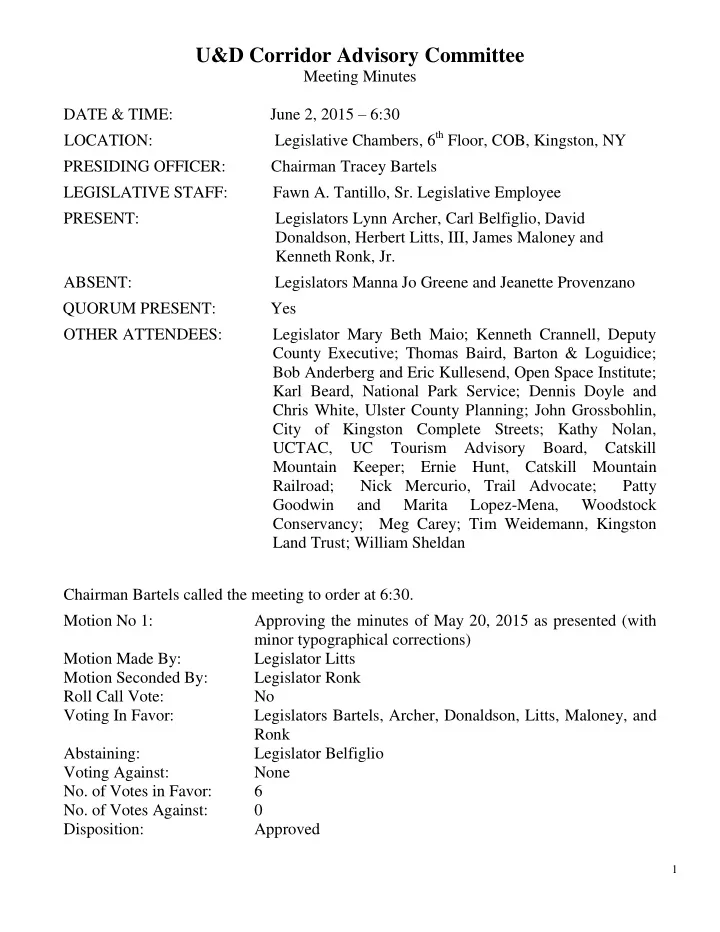
Meeting Minutes DATE & TIME: June 2, 2015 – 6:30 LOCATION: Legislative Chambers, 6th Floor, COB, Kingston, NY PRESIDING OFFICER: Chairman Tracey Bartels LEGISLATIVE STAFF: Fawn A. Tantillo, Sr. Legislative Employee PRESENT: Legislators Lynn Archer, Carl Belfiglio, David Donaldson, Herbert Litts, III, James Maloney and Kenneth Ronk, Jr. ABSENT: Legislators Manna Jo Greene and Jeanette Provenzano QUORUM PRESENT: Yes OTHER ATTENDEES: Legislator Mary Beth Maio; Kenneth Crannell, Deputy County Executive; Thomas Baird, Barton & Loguidice; Bob Anderberg and Eric Kullesend, Open Space Institute; Karl Beard, National Park Service; Dennis Doyle and Chris White, Ulster County Planning; John Grossbohlin, City of Kingston Complete Streets; Kathy Nolan, UCTAC, UC Tourism Advisory Board, Catskill Mountain Keeper; Ernie Hunt, Catskill Mountain Railroad; Nick Mercurio, Trail Advocate; Patty Goodwin and Marita Lopez-Mena, Woodstock Conservancy; Meg Carey; Tim Weidemann, Kingston Land Trust; William Sheldan Chairman Bartels called the meeting to order at 6:30. Motion No 1: Approving the minutes of May 20, 2015 as presented (with minor typographical corrections) Motion Made By: Legislator Litts Motion Seconded By: Legislator Ronk Roll Call Vote: No Voting In Favor: Legislators Bartels, Archer, Donaldson, Litts, Maloney, and Ronk Abstaining: Legislator Belfiglio Voting Against: None

  • No. of Votes in Favor:

6

  • No. of Votes Against:

Disposition: Approved

slide-2
SLIDE 2

2

Presentation of preliminary findings of Open Space Institute and Barton & Logidice Chairman Bartels turned the meeting over to Thomas Baird from Barton & LoGuidice (B&L) and Bob Anderberg and Eric Kullesend from Open Space Institute (OSI) to present the preliminary finding of the U&D Corridor in the 11.5 mile area within the New York City Department of Environmental Protection (NYCDEP) property along the Ashokan Reservoir.

  • Mr. Baird explained how they divided the corridor in this area into 5 sections and created

detailed maps using surveys and global positioning systems (GPS). He described various challenges such as failed culvers and washouts as well as opportunities such as scenic vistas and recreational opportunities.

  • Mr. Baird reported that the corridor is largely intact and described logical access points

and trail heads; discribed two major projects restoring Butternut Cove and the Boiceville Trestle; discussed terrain of 4 typical sectors; various surface materials that could be utilized to comply with the NYCDEP requirement for permeable trail surfaces and various environmental concerns.

  • Mr. White told the committee that this report was preliminary and the final report was

expected in 30 to 60 days. He is planning to make a formal public presentation of these findings in the Towns of Olive and Hurley later in June or July and ask for feedback from the public. If all goes well, the county can begin planning of the trail in the fall. _______________________________________________________________________ 2006 U&D Rail and Trail Feasibility Study Chairman Bartels opened the discussion of the 2006 U&D Rail and Trail Feasibility Study that was distributed to committee members in hard copy and electronically last month. Legislator Litts noted that the B&L presentation just made and this study broke the corridor into segments. He thought this was a good approach and recommended the committee use the upcoming “whistle stop” field trips to determine how logically divide the corridor into segments for their discussions of the feasibility studies for each section. Legislator Ronk felt that some aspects of the report could be useful but noted that many problems have been exasperated since this study by storm damage and many of the numbers quoted were no longer valid. He was troubled that the report recognizes that the NYCDEP would only allow a rail OR trail thru their property yet recommends both a rail and trail together without addressing how to overcome NYCDEP objections. Legislator Archer observed that the study was looking at where it would be appropriate to have both rail and trail and begin a discussion. She noted that as you go through various reports and studies it is apparent that this discussion has changed over the years.

slide-3
SLIDE 3

3

Legislator Belfiglio noticed that on page 13 the report states that from MP 10 to MP 22 the corridor was permitted by NYCDEP for railroad purposes only. Chairman Bartels noted that the MOA approved last month between Ulster County and NYCDEP was the first formal step in changing the “railroad only” policy. Legislator Ronk reminded the committee that for most of the corridor, Ulster County just has a right of way (ROW) across the land and doesn’t own the land itself. Legislator Donaldson reported that Ulster County does own some parts of the corridor but there are at least 35 easements, including the one with NYCDEP. Legislator Litts said the committee would need to conduct due diligence on those other 34 easements to ensure that whatever the county does will not compromise those ROWs.

  • Ms. Nolan told the committee she attended all the meetings leading up to the 2006 Rail

with Trail Feasibility Study and the basic premises was that the rail could not be

  • removed. There was a strong sentiment at the time to have a trail across the NYCDEP

property and the NYCDEP was just formulating a policy on the uses within the corridor. She said the consultants doing the study recognized the benefits of having a trail in this area and it was not until the end of the process that the NYCDEP sent the letter stating they would only allow one use. Since that time the NYCDEP position has solidified and prospect of doing a trail was developed.

  • Mr. Doyle reported that in 2006 the discussion of doing both a rail and trail along the

NYCDEP section had the trail leaving the corridor and running along Route 28 and 28A. Legislator Belfiglio referred to page 36, section 4 of the study that discussed the grade from Interstate 87 to the West Hurley station. It describes a steep grade suggesting that the train would act like a ski lift to carry passengers to scenic vistas. He had concerns about steep grades. There was a discussion about the grades thru this area that Legislators who have walked it did not see as a problem. They questioned why the report discusses this as a challenge. Legislator Litts noted that railroad grades are less than 3% and usually only 1 to 2%. Chairman Bartels suggested that when they take the “whistle stop” field trip being planned, they can take a look at these areas. ____________________________________________________________________

slide-4
SLIDE 4

4

“Whistle Stop” Field Trip Chairman Bartels opened the discussion for plans for a bus trip to look at various sections

  • f the U&D Corridor. Plans are to begin at the Cornell Street yard and go to Belleayre

Mountain stopping at areas that are accessible from the road. The trip is planned for Friday, June 26, 2015 at 9 am meeting at the County Office Building. A second trip is planned with both the railroad and walking on Saturday, July 11, 2015 starting at 8 am. Mr. Hunt offered to take members on the train from Kingston Plaza to Hurley Mountain Road. Members who want to continue could then walk from Hurley Mountain Road to the Glenford Dike. Discussion of the Presentation Legislator Litts asked to discuss the presentation made by B&L. He reported that in his experience as an engineer with these vintage bridges and culverts most of these were

  • verbuilt. He suggested there are more modern and affordable ways to design and widen the

trail bed such as the use of gabion retaining walls and relining culverts and these alternatives

  • ffer sound solutions that could shave millions of dollars off of these projects. He also

suggested the use of decking from the Tappan Zee Bridge could be used to span the Boiceville Trestle area. There was a discussion about how the county might request this decking. Mr. Doyle told the committee that Ulster County has already requested them for other bridge projects.

  • Mr. White warned that the FEMA funding the county hopes to use would require replacing

what was there and this funding could be lost if those plans changed. He told the committee he has applied for grants to fund the engineering and expressed concern that this committee was doing bridge design. Legislator Litts mentioned an email legislators received that discussed $180 Million in grants the county could apply for. He describe the dimensions of the decking and restated that his point was to suggest there are more affordable ways to create a 12 foot wide trail bed than B&L discussed in their presentation.

  • Mr. White said he did not realize the committee was going to question the B&L presentation

He said that B&L was looking to minimize moving materials on and off the right of way and recognized that in areas where the rock cuts are too narrow to accommodate a 12 foot trail it may be less than the American Association of State Highway and Transportation Officials

slide-5
SLIDE 5

5

(AASHTO) Standards. He said as the trail is designed the county will have to decide how much we can spend to widen the trail through these rock cuts and if spending the money on these areas is appropriate. He noted similar judgments and justifications will need to be considered when discussing the trail surface. Legislator Litts suggested that as plans are developed some of the elements of the railroad be left in place such as switches, cabooses or train cars on sections of track as historic landmarks and points of interest. __________________________________________________________________________ Video of U&D Corridor MP 6.3 to MP 11 Chairman Bartels asked Mr. Hunt to describe a 23 minute video taken from a railroad maintenance car that traveled on the tracks from Hurley Mountain Road to the Glenford Dike. The committee asked questions and discussed various issues while watching the video. ___________________________________________________________________________ New Business Chairman Bartels said she would like a list properties the U&D Corridor crosses and mapping

  • f the county easements. She noted that there are sections the county owns, sections where

the county just has a ROW and sections where property owners have encroached on the county ROW.

  • Mr. White said that as part of the future planning process is going out and fact checking the

details of these ROWs. Since no one has “watched” this corridor for many years, this will have to be researched as part of the planning process.

  • Mr. Hunt offered to share valuation maps that were made around 1960.
  • Mr. Doyle said his office made those maps and could provide them but that it would take

actual title searches of each property to know what the terms of the ROW is in each case.

  • Mr. White said that rail banking would protect any reversion of the ROW if the rails are

removed and there are a lot more than 35 easements. He noted that the Ulster County is the

  • wner in fee of the U&D corridor west of the Ashokan NYCDEP section.
slide-6
SLIDE 6

6

Chairman Bartels repeated that it would be helpful to the committee to see maps that show the corridor ROW, where it is 20 feet wide, where it is 60 feet wide and other features.

  • Ms. Nolan said a large part of the B&L project that was presented involved mapping the

U&D corridor through the NYCDEP property. She warned that the committee shouldn’t put too much weight on such a map of these other sections yet. Chairman Bartels noted that as an advisory committee, they are not looking for mapping detail necessary for engineering but just basic mapping information that will be useful as a place to start. She felt it would be helpful to understand more about exactly what the asset is and where it is. She understands that it is only preliminary information.

  • Mr. Hunt suggested that between the valuation maps and the tax maps the committee could

get a sense of how wide the easement is in various areas.

  • Ms. Nolan said that as part of the 2006 Rail with Trail Feasibility Study they looked at these

maps and in some areas the ROW is 66’ wide and some areas it jumps to 275’wide and seemed to be whatever the railroad was able to get from the property owner.

  • Mr. Doyle noted that the committee could not rely on the information in the valuation maps.

He warned that there were areas that the railroad owned that were not transferred to the county and only a title search could drill down to that level of detail. He generalized the ROW is at least 66 feet wide and while there may be some reversionary deeds east of NYCDEP property, the county owns the ROW west of NYCDEP property. He asked “What is the question the committee is trying to answer?” Legislator Litts gave an example of a property owner with a ROW to a piece of land who began to build a house before he discovered the ROW was limited to grazing cows and other agricultural uses and was forced to purchase other property to access the property and finish building his house. Legislator Litts noted the county is considering spending millions of dollars and should have a clear idea of what or where issues with the ROW exist before proceeding.

  • Mr. Doyle said there is no danger of the county not being able to maintain the corridor ROW.

Congress set up a rail banking process to protect the corridor. He warned that committee not to spend money doing unnecessary research.

  • Mr. White noted that rail banking is only important between the Cornell Street yard and the

NYCDEP property. He felt the NYCDEP section of trail is a stand-alone project. Chairman Bartels reminded the members that the committee is charged with considerations of the entire corridor. She is not asking for new research – she is only asking for existing information.

slide-7
SLIDE 7

7

  • Mr. White felt the committee should focus on the primary question “Is railroad even viable

from Hurley Mountain Road to the Glenford Dike?” and if the committee decides that the County cannot do both, it must then determine which uses is preferable. He reminded the committee that the County has an attorney on retainer who is an expert in this area. This attorney has given the county a legal opinion that rail banking will protect the ROW. He suggested that the committee is getting “off track” and what they were asking for was not relevant. There was a discussion about the development of various existing trails, resistance from property owners and ensuing lawsuits, railroad right of ways that were sold or lost and what key questions should be asked. __________________________________________________________________________ There being no further business before the Committee, a motion was made by Legislator Litts, seconded by Legislator Donaldson and carried to adjourn the meeting at 8:45 PM. Respectfully submitted this 5th day of June, 2015 Fawn A. Tantillo, Senior Legislative Employee Minutes Approved on -------------, 2015.

slide-8
SLIDE 8

Ulster County Rail Trail Project

Ashokan Reservoir June 2, 2015 Kingston, NY

slide-9
SLIDE 9

Ulster County Rail Trail Project

Ashokan Reservoir

  • Segment 1 = 4.0 mi
  • Segment 2 = 4.0 mi
  • Segment 3 = 1.0 mi
  • Segment 4 = 2.3 mi
  • Segment 5 = 0.2 mi
slide-10
SLIDE 10

Ulster County Rail Trail Project

Ashokan Reservoir

Feasibility Study

What was Done and Why

  • Mapping & Gather Data – Hands on Field Work to Aid in

Planning and Design

  • Challenges – Culvert, Trestle
  • Inventory Conditions
  • Discover Opportunities – Scenic, Access, Recreation
  • Butternut Creek Culvert and Boiceville Trestle Analysis
slide-11
SLIDE 11

Feasibility Study Summary Determination

  • Corridor is Largely Intact
  • Developing Trail in Corridor is Straightforward
  • Logical and Easy Access Points
  • Engineering and Construction Not Overly Complicated
  • Opportunity to be a Model of Development

 Recreation & Environmental Stewardship  Watershed Protection

  • Butternut Cove Culvert & Boiceville Trestle can be broken
  • ut as separate Projects
  • $4 – 4.5 Million, Butternut & Boiceville Funded Separately
slide-12
SLIDE 12

Ulster County Rail Trail Project

Ashokan Reservoir

Mapping and Data Collection

  • Land Surveying – Slopes, Contours
  • Approximate Wetland Boundaries
  • Drainage Structure Elevations & Locations
  • Development of Electronic Mapping
  • Property Boundaries
  • Engineering Data Collection, Safety Needs
  • Condition Ratings & Needs Assessment
  • Drainage Systems Evaluations
  • Corridor Constraints
  • Corridor Opportunities
  • Conceptual Design - Feasibility
slide-13
SLIDE 13

Mapping and Data Collection Standardized Data Collection Two Person Team Efficient & Comprehensive

slide-14
SLIDE 14

Mapping and Data Collection

slide-15
SLIDE 15

Mapping and Data Collection

slide-16
SLIDE 16

Rail Trail Sections

33,000 LF

slide-17
SLIDE 17
  • Steep Slope Locations Would Require Large Volumes of Off-site Fill

Material, Tree Cutting, Mitigation

  • Culvert Extensions, Significant Slope Stabilization
  • Rock Removal locations total more than two (2) miles
  • Railroad Restoration Costs

Rail With Trail

slide-18
SLIDE 18

Rail Trail Sections

8,000 LF

slide-19
SLIDE 19

Rail Trail Sections

13,400 LF

slide-20
SLIDE 20

Rail Trail Sections

6,000 LF

slide-21
SLIDE 21

Mapping and Data Collection

C D B A C C B A

7 Changes in 1900’ or Just Over 5 Football Fields

slide-22
SLIDE 22

Mapping and Data Collection

How is the Data Used ?

Bring the Fact Finding and Concepts to the Next Level

slide-23
SLIDE 23

Ulster County Rail Trail Project

Ashokan Reservoir Section

Existing Conditions

slide-24
SLIDE 24

Ulster County Rail Trail Project

Ashokan Reservoir Section

Existing Conditions

slide-25
SLIDE 25

Existing Conditions Existing Conditions

slide-26
SLIDE 26

Existing Conditions

slide-27
SLIDE 27

Existing Conditions

slide-28
SLIDE 28

Existing Conditions

Laid up Stone Culvert

slide-29
SLIDE 29

Existing Conditions

slide-30
SLIDE 30

Existing Conditions

slide-31
SLIDE 31

Existing Conditions

slide-32
SLIDE 32

Butternut Cove Culvert

slide-33
SLIDE 33

Butternut Creek Culvert

  • Progression of Deterioration Going Back

30+ years

  • Assessment and Study by B&L in Summer 2014
  • Estimated Repair Cost $1.1 to 1.2 M
  • Additional Repairs after inspection Barrel and

Wingwall

  • Study Used to Apply for Grant Funding in

Fall 2014

slide-34
SLIDE 34

Butternut Cove Culvert

slide-35
SLIDE 35

Boiceville Trestle

slide-36
SLIDE 36

Boiceville Trestle

slide-37
SLIDE 37

Boiceville Trestle

  • Damaged August/September 2011 – Irene & Lee
  • Assessment and Study by B&L in Summer 2014
  • Estimated Replacement Cost $2.6 – $ 4.2 M
  • Study Used for Funding from FEMA in Fall 2014
slide-38
SLIDE 38

Boiceville Trestle - Constructability

slide-39
SLIDE 39

Opportunities

slide-40
SLIDE 40

Opportunities

  • Scenic Vistas both East and West end
  • Most of Corridor readily available
  • Logical Access Points – Jones Cove, Woodstock Dike
slide-41
SLIDE 41

Scenic Vistas Opportunities

slide-42
SLIDE 42

Opportunities

slide-43
SLIDE 43

Opportunities

slide-44
SLIDE 44

Trail Surfaces

slide-45
SLIDE 45

Trail Surfaces

  • Stone Dust
  • Various Gradations of Stone or Stone and Sand
  • Asphalt
  • Asphalt Millings / Sand Mixture
  • Porous Asphalt, Porous Pavers, Porous Concrete
  • Mechanically Constrained Stone – Gravel Pave2
  • Modifier Stabilized Soils (Soiltac, Staloc, others)

Trail Surface has Not been determined

Maintenance Needs - To Be Strongly Considered

Volunteers Make up large Proportion of Work Force

slide-46
SLIDE 46

Environmental

  • Initial Screenings
  • Wetland Maps
  • Endangered Species
  • No SHPO Historic

Structures

  • Removal of Ties Required
  • Detailed Assessments not

conducted at this time

slide-47
SLIDE 47

Feasibility Determination

slide-48
SLIDE 48

Feasibility Study Summary Determination

  • Corridor is Largely Intact
  • Developing Trail in Corridor is Straightforward
  • Logical and Easy Access Points
  • Engineering and Construction Not Overly Complicated
  • Opportunity to be a Model of Development

 Recreation & Environmental Stewardship  Watershed Protection

  • Butternut Cove Culvert & Boiceville Trestle can be broken
  • ut as separate Projects
  • $4 – 4.5 Million, Butternut & Boiceville Funded Separately