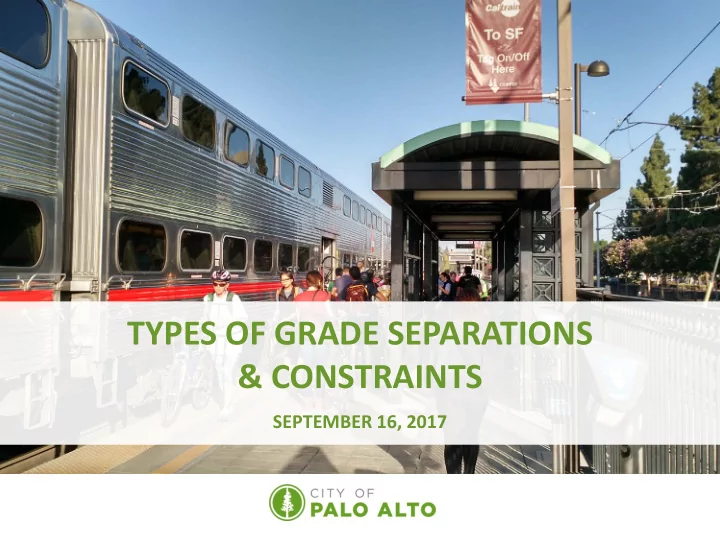
TYPES OF GRADE SEPARATIONS & CONSTRAINTS SEPTEMBER 16, 2017 1 - - PowerPoint PPT Presentation

types of grade separations constraints
SMART_READER_LITE
LIVE PREVIEW

TYPES OF GRADE SEPARATIONS & CONSTRAINTS SEPTEMBER 16, 2017 1 - - PowerPoint PPT Presentation

TYPES OF GRADE SEPARATIONS & CONSTRAINTS SEPTEMBER 16, 2017 1 Potential Changes to Existing Crossings 2 Types of Crossing Modification Road Closure at Tracks Close City Road that crosses RR Property Fence RR Property


slide-1
SLIDE 1

1

TYPES OF GRADE SEPARATIONS & CONSTRAINTS

SEPTEMBER 16, 2017

slide-2
SLIDE 2

2

Potential Changes to Existing Crossings

slide-3
SLIDE 3

3

Types of Crossing Modification

Road Closure at Tracks

  • Close City Road that crosses RR Property
  • Fence RR Property
  • Modify Alma intersection
  • Reroute traffic to other crossings

Pros:

  • Increased safety
  • Eliminate train horn
  • Traffic reduced
  • n/near closed road
  • Alma traffic

improved

  • Low cost
  • Low property

Impacts Cons:

  • Increased traffic
  • n/near other

crossings

  • Longer routes for

bikes/peds

  • More vehicle trips
slide-4
SLIDE 4

4

Road Closure at Tracks Sample location: North California Avenue, Palo Alto

Types of Crossing Modification

slide-5
SLIDE 5

5

Types of Crossing Modification

Lower Road/Ped/Bikes under tracks

  • Change local road profile to go under tracks
  • Bike/Ped under RR – higher than road
  • Retaining Walls parallel to road
  • Train crosses over road on bridge – same elevation.
  • Lower Alma to local road elevation

Pros:

  • Increased safety
  • Eliminate train horn
  • Improved traffic flow
  • n grade separated

street Cons:

  • Increased traffic on

local street(s)

  • Increased noise

from vehicles

  • Property impacts
  • Potential impact to

street system

  • Utility impacts
slide-6
SLIDE 6

6

Types of Crossing Modification

Lower Road/Ped/Bikes under tracks Sample Location: Jefferson Ave, Redwood City

slide-7
SLIDE 7

7

Types of Crossing Modification

Raise Road/Ped/Bikes over Tracks

  • Change local road profile to go over tracks
  • Bike/Ped follow road profile
  • Retaining Walls parallel to road
  • Train crosses under road on existing ground
  • Alma crosses under local road

Pros:

  • Increased safety
  • Eliminate train horn
  • Improve traffic flow

Cons:

  • Increased traffic on

local road(s)

  • Increased noise

from vehicles

  • Property impacts
  • Local street

connections lost

  • Utility impacts
slide-8
SLIDE 8

8

Raise Road/Ped/Bikes over tracks Sample location: Scott Boulevard, Santa Clara

Types of Crossing Modification

slide-9
SLIDE 9

9

Hybrid Option 1 – Lower Road/Ped/Bikes + Raise tracks

  • Change local road profile to go under tracks
  • Bike/Ped higher than road profile
  • Retaining Walls parallel to road & parallel to tracks
  • Train crosses over road at higher elevation
  • Alma lowered to elevation of local road

Pros:

  • Increased safety
  • Eliminate train horn
  • Improved traffic flow
  • Reduced property

impacts from other alternatives Cons:

  • Increased traffic on

local road(s)

  • Increased noise

from vehicles and train travel

  • Property impacts
  • Utility impacts

Types of Crossing Modification

slide-10
SLIDE 10

10

Hybrid Option 1 – Lower Road/Ped/Bikes and Raise tracks Sample location: Holly Street, San Carlos

Types of Crossing Modification

slide-11
SLIDE 11

11

Lower Railroad Tracks under Local Road

  • Change RR profile to go under local road
  • Bike/Ped stay at road elevation
  • Retaining walls parallel to tracks
  • Road crosses over RR tracks on bridge
  • No impact to Alma (after construction)

Pros:

  • Increased safety
  • Eliminate train

horn and reduce travel noise

  • Improve traffic flow
  • Few property

impacts (after construction)

Types of Crossing Modification

Cons:

  • Increased traffic on

local road(s)

  • Increased noise

from vehicles

  • Utility impacts
  • Major construction

Impacts

slide-12
SLIDE 12

12

Lower RR Tracks under Local Road Sample location: E Compton Boulevard, Compton (Alameda Trench Corridor)

Types of Crossing Modification

slide-13
SLIDE 13

13

Existing Features, Conditions or Requirements that Influence Development of a Project:

  • Property
  • Utilities
  • Creeks
  • Grades (Design criteria)
  • Alma Street
  • Aesthetics
  • Stations
  • Existing undercrossings
  • Caltrain modifications
  • Ground water
  • High-Speed Rail passing

track

  • Construction staging

Project Constraints

slide-14
SLIDE 14

14

Property

  • City ‘fully’ developed -
  • ccupied parcels abut virtually

all roads and/or Caltrain corridor

  • Alternatives impact homes,

schools, commercial property

  • Property costs are high
  • Challenge to replace lost use

elsewhere

Project Constraints

slide-15
SLIDE 15

15

Utilities

  • Roadways are really

utility corridors

  • Aging utilities
  • Gravity systems may

require pumps

Project Constraints

slide-16
SLIDE 16

16

Creeks

  • Require 32.5’ minimum

clearance if RR tracks below

  • Not relocatable

Project Constraints

slide-17
SLIDE 17

17

Project Constraints

Grades (Design Criteria)

  • Design speed defines profiles –

safe sight distance

  • Minimum vertical clearances must

be achieved (see right)

  • RR max standard grade = 1%
  • ADA max grade = 5%
  • Roadways up to 8% could

discourage active transportation

slide-18
SLIDE 18

18

Alma Street

  • Parallels Caltrain tracks in Palo Alto
  • Major transportation corridor in the City
  • Losing connections from local streets affects overall

circulation in city

Project Constraints

slide-19
SLIDE 19

19

Aesthetics

  • Outside downtown, low rise

development

  • Elevating roadway (up to 35’)
  • r train (up to 30’) would be

visible change

  • Grade separations will

change current ‘feel’ of local neighborhood(s)

Project Constraints

slide-20
SLIDE 20

20

Caltrain Stations

  • Changing profile of RR tracks

could impact station

  • Requires level section of track

up to 1000’ long

  • Access to stations could

be changed, perhaps up

  • r down

Project Constraints

slide-21
SLIDE 21

21

Existing Undercrossing Sample Location: Embarcadero Road, Palo Alto

  • Lowering railroad would allow

and/or require rebuilding.

  • If Undercrossing stays,

train must be lower => longer trench

Project Constraints

slide-22
SLIDE 22

22

Caltrain Modifications

  • Electrification increases cost of

any changes to Caltrain facility

  • Construction staging more

complicated in order to keep OCS operational

  • OCS adds visual element to

RR corridor when at or above existing grade

Project Constraints

slide-23
SLIDE 23

23

Cost

  • Project Costs range from

$1,000,000-$1,150,000,000

$ $ $ $ $ $ $ $ $ $ $ $

Project Constraints

slide-24
SLIDE 24

24

Ground Water

  • Ranges 10-30’+ below grade
  • Underground water flows in ‘rivers to the bay’

High-Speed Rail Passing Track

  • Makes all grade separations bridges longer/wider
  • Impacts more property, utilities, etc.
  • Complicates construction
  • Increases project costs

Construction Staging

  • Temporary impacts to traffic, property, utilities

Additional Project Constraints

slide-25
SLIDE 25

25

RAIL CORRIDOR PRESENTATION #2

SEPTEMBER 16, 2017

slide-26
SLIDE 26

26

Groundwater

  • Groundwater ranges from as

little as 10 feet up to 30 feet or more below existing ground

  • Impacts structures
  • Underwater ‘rivers’ potentially

impacted as water flows to bay

Project Constraints