Types of Environments Goal Based Agents Plan ahead Fully - - PDF document

types of environments
SMART_READER_LITE
LIVE PREVIEW

Types of Environments Goal Based Agents Plan ahead Fully - - PDF document

3/22/2018 Outline CSE 473: Artificial Intelligence Spring 2018 Search Problems Uninformed Search Methods Problem Spaces & Search Depth-First Search Breadth-First Search Uniform-Cost Search Steve Tanimoto Heuristic


slide-1
SLIDE 1

3/22/2018 1

CSE 473: Artificial Intelligence

Spring 2018

Problem Spaces & Search

Steve Tanimoto

With slides from : Dieter Fox, Dan Weld, Dan Klein, Stuart Russell, Andrew Moore, Luke Zettlemoyer

Outline

  • Search Problems
  • Uninformed Search Methods
  • Depth-First Search
  • Breadth-First Search
  • Uniform-Cost Search
  • Heuristic Search Methods
  • Best-First, Greedy Search
  • A*

Agent vs. Environment

  • An agent is an entity that

perceives and acts.

  • A rational agent selects

actions that maximize its utility function.

  • Characteristics of the

percepts, environment, and action space dictate techniques for selecting rational actions.

Agent Sensors ? Actuators Environment

Percepts Actions

Types of Agents

  • Reflex
  • Goal oriented
  • Utility-based

4

Goal Based Agents

  • Plan ahead
  • Ask “what if”
  • Decisions based on

(hypothesized) consequences of actions

  • Must have a model of how

the world evolves in response to actions

  • Act on how the world

WOULD BE

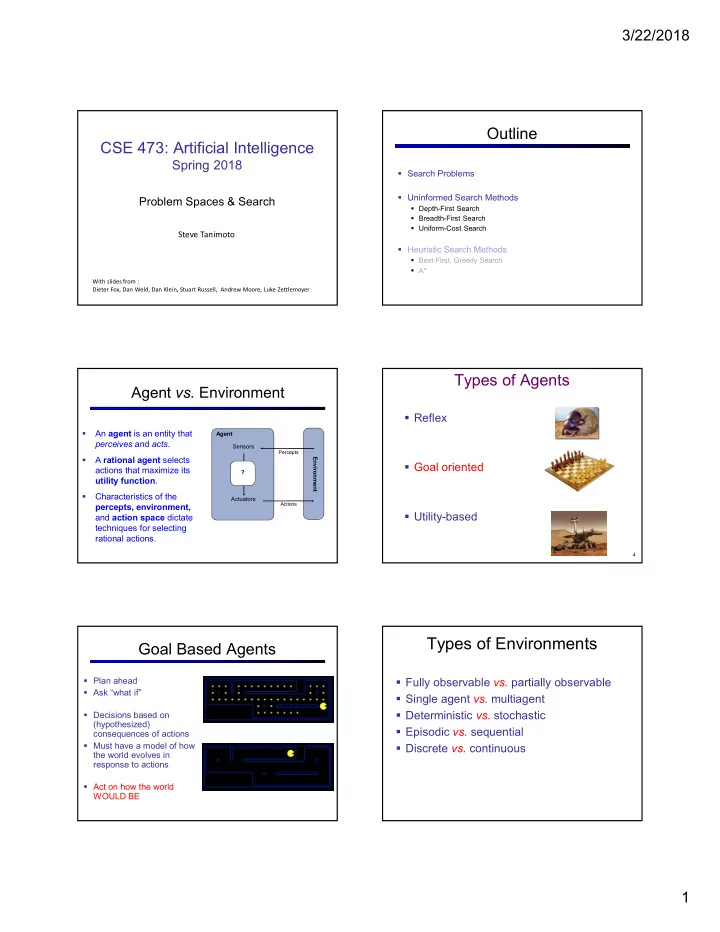
Types of Environments

  • Fully observable vs. partially observable
  • Single agent vs. multiagent
  • Deterministic vs. stochastic
  • Episodic vs. sequential
  • Discrete vs. continuous
slide-2
SLIDE 2

3/22/2018 2

Search thru a

  • Set of states
  • Operators [and costs]
  • Start state
  • Goal state [test]
  • Path: start a state satisfying goal test

[May require shortest path] [Sometimes just need a state that passes test]

  • Input:
  • Output:

Problem Space (aka State Space) Problem Space (aka State Space)

Example: Traveling in Romania

  • State space:
  • Cities
  • Successor function:
  • Roads: Go to adjacent city

with cost = distance

  • Start state:
  • Arad
  • Goal test:
  • Is state == Bucharest?
  • Solution?

Example: Simplified Pac-Man

  • Input:
  • A state space
  • A successor function
  • A start state
  • A goal test
  • Output:

“N”, 1.0 “E”, 1.0

State Space Sizes?

  • Search Problem:

Eat all of the food

  • Pacman positions:

10 x 12 = 120

  • Pacman facing:

up, down, left, right

  • Food configurations: 230
  • Ghost1 positions: 12
  • Ghost 2 positions: 11

10 x 12 = 120 up, down, left, right 230 12 11 120 x 4 x 230 x 12 x 11 = 6.8 x 10¹³

State Space Graphs

  • State space graph:
  • Each node is a state
  • The successor function is

represented by arcs

  • Edges may be labeled with

costs

  • In a search graph, each state
  • ccurs only once!
  • We can rarely build this graph

in memory (so we don’t)

S

G d b p q c e h a f r Ridiculously tiny search graph for a tiny search problem

Search Trees

  • A search tree:
  • Start state at the root node
  • Children correspond to successors
  • Nodes contain states, correspond to PLANS to those states
  • Edges are labeled with actions and costs
  • For most problems, we can never actually build the whole tree

“E”, 1.0 “N”, 1.0

This is now / start Possible futures

slide-3
SLIDE 3

3/22/2018 3

State Space Graphs vs. Search Trees

S a b d p a c e p h f r q q c G a q e p h f r q q c G a

S G

d b p q c e h a f r

We construct both on demand – and we construct as little as possible. Each NODE in in the search tree is an entire PATH in the state space graph.

Search Tree State Space Graph

State Space Graphs vs. Search Trees

S

G b a

Consider this 4-state graph:

Important: Lots of repeated structure in the search tree!

How big is its search tree (from S)?

Tree Search Search Example: Romania Searching with a Search Tree

  • Search:
  • Expand out potential plans (tree nodes)
  • Maintain a fringe of partial plans under

consideration

  • Try to expand as few tree nodes as possible

General Tree Search

  • Important ideas:
  • Fringe
  • Expansion
  • Exploration strategy
  • Main question: which fringe nodes to explore?
slide-4
SLIDE 4

3/22/2018 4

Tree Search Example

S G

d b p q c e h a f r

Depth-First Search Depth-First Search

Strategy: expand a deepest node first Implementation: Fringe is a LIFO stack S G

d b p q c e h a f r

Depth-First Search

S

a b d p a c e p h f r q q c

G

a q e p h f r q q c

G

a S G

d b p q c e h a f r q p h f d b a c e r

Strategy: expand a deepest node first Implementation: Fringe is a LIFO stack

Search Algorithm Properties Search Algorithm Properties

  • Complete: Guaranteed to find a solution if one exists?
  • Optimal: Guaranteed to find the least cost path?
  • Time complexity?
  • Space complexity?
  • Cartoon of search tree:
  • b is the branching factor
  • m is the maximum depth
  • solutions at various depths
  • Number of nodes in entire tree?
  • 1 + b + b2 + …. bm = O(bm)

… b 1 node b nodes b2 nodes bm nodes m tiers

slide-5
SLIDE 5

3/22/2018 5

Depth-First Search (DFS) Properties

… b 1 node b nodes b2 nodes bm nodes m tiers

  • What nodes does DFS expand?
  • Some left prefix of the tree.
  • Could process the whole tree!
  • If m is finite, takes time O(bm)
  • How much space does the fringe take?
  • Only has siblings on path to root, so O(bm)
  • Is it complete?
  • m could be infinite, so only if we prevent cycles
  • Is it optimal?
  • No, it finds the “leftmost” solution, regardless of

depth or cost

Breadth-First Search Breadth-First Search

S

a b d p a c e p h f r q q c

G

a q e p h f r q q c

G

a

S

G d b p q c e h a f r Search Tiers Strategy: expand a shallowest node first Implementation: Fringe is a FIFO queue

Breadth-First Search (BFS) Properties

  • What nodes does BFS expand?
  • Processes all nodes above shallowest solution
  • Let depth of shallowest solution be d
  • Search takes time O(bd)
  • How much space does the fringe take?
  • Has roughly the last tier, so O(bd)
  • Is it complete?
  • d must be finite if a solution exists, so yes!
  • Is it optimal?
  • Only if costs are all 1 (more on costs later)

… b 1 node b nodes b2 nodes bm nodes d tiers bd nodes

DFS vs BFS

Algorithm Complete Optimal Time Space DFS

w/ Path Checking

BFS N unless

finite

N O(bm) O(bm) Y Y O(bd) O(bd)

Memory a Limitation?

  • Suppose:
  • 4 GHz CPU
  • 32 GB main memory
  • 100 instructions / expansion
  • 5 bytes / node
  • 40 M expansions / sec
  • Memory filled in 160 sec … 3 min
slide-6
SLIDE 6

3/22/2018 6

Iterative Deepening

Iterative deepening uses DFS as a subroutine:

  • 1. Do a DFS which only searches for paths of

length 1 or less.

  • 2. If “1” failed, do a DFS which only searches paths
  • f length 2 or less.
  • 3. If “2” failed, do a DFS which only searches paths
  • f length 3 or less.

….and so on.

Algorithm Complete Optimal Time Space DFS

w/ Path Checking

BFS ID Y N O(bm) O(bm) Y Y O(bd) O(bd) Y Y O(bd) O(bd)

… b

BFS vs. Iterative Deepening

  • For b = 10, d = 5:
  • BFS = 1 + 10 + 100 + 1,000 + 10,000 + 100,000 =

111,111

  • IDS = 6 + 50 + 400 + 3,000 + 20,000 + 100,000 =

123,456

  • Overhead = (123,456 - 111,111) / 111,111 = 11%
  • Memory BFS: 100,000; IDS: 50

32

Costs on Actions

Notice that BFS finds the shortest path in terms of number of

  • transitions. It does not find the least-cost path.

START

GOAL

d b p q c e h a f r 2 9 2 8 1 8 2 3 1 4 4 15 1 3 2 2

Uniform Cost Search

START

GOAL

d b p q c e h a f r 2 9 2 8 1 8 2 3 1 4 4 15 1 3 2 2

Expand cheapest node first: Fringe is a priority queue

Uniform Cost Search

S

a b d p a c e p h f r q q c

G

a q e p h f r q q c

G

a Strategy: expand a cheapest node first: Fringe is a priority queue (priority: cumulative cost) S G

d b p q c e h a f r

3 9 1 16 4 11 5 7 13 8 10 11 17 11 6 3 9 1 1 2 8 8 2 15 1 2 Cost contours 2 …

Uniform Cost Search (UCS) Properties

  • What nodes does UCS expand?
  • Processes all nodes with cost less than cheapest solution!
  • If that solution costs C* and arcs cost at least ε , then the “effective

depth” is roughly C*/ε

  • Takes time O(bC*/ε) (exponential in effective depth)
  • How much space does the fringe take?
  • Has roughly the last tier, so O(bC*/ε)
  • Is it complete?
  • Assuming best solution has a finite cost and minimum arc cost is

positive, yes!

  • Is it optimal?
  • Yes!

b C*/ε “tiers” C ≤ 3 C ≤ 2 C ≤ 1

slide-7
SLIDE 7

3/22/2018 7

Uniform Cost Search

  • Strategy: expand lowest

path cost

  • The good: UCS is

complete and optimal!

  • The bad:
  • Explores options in every

“direction”

  • No information about goal

location

Start Goal … c  3 c  2 c  1

Uniform Cost Search

Algorithm Complete Optimal Time Space DFS

w/ Path Checking

BFS UCS Y N O(bm) O(bm) Y Y O(bd) O(bd) Y* Y O(bC*/ε) O(bC*/ε)

… b

C*/ε tiers

Uniform Cost: Pac-Man

  • Cost of 1 for each action
  • Explores all of the states, but one

The One Queue

  • All these search algorithms

are the same except for fringe strategies

  • Conceptually, all fringes are

priority queues (i.e. collections

  • f nodes with attached

priorities)

  • Practically, for DFS and BFS,

you can avoid the log(n)

  • verhead from an actual

priority queue, by using stacks and queues

  • Can even code one

implementation that takes a variable queuing object

To Do:

  • Look at the course website:
  • http://http://courses.cs.washington.edu/courses/cse473/18sp/
  • Do the readings (Ch 3)
  • Do Project 0 if new to Python
  • Start Project 1.