Tying/bundling and mixed bundling (2) Contractual tying: condition - - PDF document

tying bundling and mixed bundling 2
SMART_READER_LITE
LIVE PREVIEW

Tying/bundling and mixed bundling (2) Contractual tying: condition - - PDF document

TYING / BUNDLING UNDER ARTICLE 102 OF THE EU TREATY Konstantina Strouvali European Commission DG Competition, Unit A1 Antitrust case support and policy 14th EU China Competition Week Shenzhen, 24 March 2017 Tying/bundling and mixed bundling


slide-1
SLIDE 1

TYING/BUNDLING UNDER ARTICLE 102 OF THE EU TREATY

Konstantina Strouvali

European Commission DG Competition, Unit A1 ‐ Antitrust case support and policy

14th EU‐China Competition Week Shenzhen, 24 March 2017

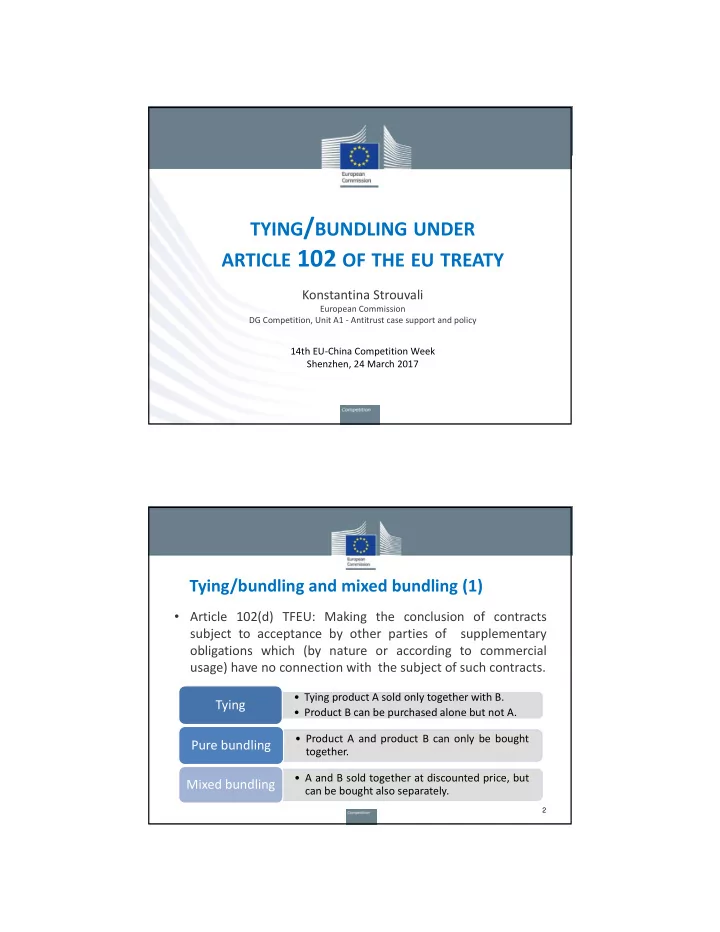
Tying/bundling and mixed bundling (1)

2

  • Article 102(d) TFEU: Making the conclusion of contracts

subject to acceptance by other parties of supplementary

  • bligations which (by nature or according to commercial

usage) have no connection with the subject of such contracts.

  • Tying product A sold only together with B.
  • Product B can be purchased alone but not A.

Tying

  • Product A and product B can only be bought

together.

Pure bundling

  • A and B sold together at discounted price, but

can be bought also separately.

Mixed bundling

slide-2
SLIDE 2

Tying/bundling and mixed bundling (2)

3

  • Contractual tying: condition to buy another product (tied

product) or refusal to supply a product separately.

  • Technological tying: the tying product works properly only

together with the tied product.

  • Penalising acquisition of the products separately.
  • Main

difference between tying/bundling and mixed bundling: the form of the restriction of choice of consumers to obtain the tying product without the tied product (coercion vs inducement) reflected in different test!

When is tying an infringement?

4

Dominance in the tying market. The practice concerns distinct products. The practice has likely anticompetitive effects There is no objective justification or outweighing efficiencies.

slide-3
SLIDE 3

Dominance

5

  • The extent to which a firm can behave independently of its

competitors/customers.

  • Relates to the degree of competitive constraints imposed by:
  • existing supply/position of actual competitors;
  • the threat of expansion of actual competitors and entry of

potential competitors;

  • the bargaining strength of customers.
  • Market share above 50% over a longer period of time, where

competitors are considerably smaller, would be prima facie evidence of dominance (save in exceptional circumstances).

Distinct products (1)

6

  • Not necessarily a relevant market test!
  • Would a substantial number of customers purchase the tying

product without the tied product from the same supplier?

  • Direct evidence that when given a choice customers

purchase separately;

  • Indirect evidence from the supply side, e.g. existence of

specialised undertakings in the tied market (Tetra Pak II)

  • r tendency not to tie such products in case of non

significant market power.

  • Complementary products may constitute distinct products

for the purposes of assessing tying under Article 102.

slide-4
SLIDE 4

Distinct products (2)

7

Commission in Microsoft: “the fact that the market provides media players separately is evidence for separate consumer demand for media players, distinguishable from the demand for client PC operating systems”. Microsoft argued that the Commission should have examined instead, if the tying product was regularly offered without the tied product or whether customers wanted Windows without media functionality. The General Court agreed with the Commission and rejected Microsoft’s argument noting that, “it is quite possible that customers will wish to obtain the products together, but from different sources.”

Anticompetitive effects (1)

8

  • Foreclosure:
  • Harm in the tied market: exit or marginalisation of

competitors in the tied market leading to higher prices (leveraging).

  • Harm in the tying market: making entry in the tying

market more difficult.

  • Harm in both markets: avoid substitution and raise

prices.

  • Greater risk of foreclosure when tying is difficult to

reverse (technological tying).

slide-5
SLIDE 5

Anticompetitive effects (2)

9

  • Actual negative effects are not required. Likely/potential

harm will suffice.

  • By object or by effect analysis? See Commission in

Microsoft:"good reasons not to assume without further analysis that tying WMP constitutes conduct which by its very nature is liable to foreclose competition.”

  • Examining effects can be a qualitative analysis.
  • Intent can be a relevant, but is not a necessary factor.

Anticompetitive effects (3)

10

  • The General Court in the Microsoft case:
  • Leverage of quasi monopoly from PC OS to Media Player

(unparalleled advantage of distribution method) & risk of de facto standardisation of Windows MP.

  • Restriction of consumers’ access to similar or better

quality products than Windows MP.

  • Erection of an entry barrier given impact on behaviour of

content providers and software designers due to indirect network effects.

slide-6
SLIDE 6

Anticompetitive effects of mixed bundling

11

  • Mixed bundling is a multi‐product rebate.
  • Establishing foreclosure effects in the case of mixed bundling

is different than in non‐price tying practices.

  • Test: is the incremental price above the long run average

incremental cost of including the product in the bundle?

  • Foreclosure is likely to be stronger, if the undertaking is

dominant for more than one of the bundled products.

  • Competition among bundles: is the price of the bundle as a

whole predatory?

Objective justification/efficiency defences (1)

12

  • Tying and bundling may generate efficiencies (e.g. reduction

in transaction costs for consumers; reduction of distribution and packaging costs for suppliers).

  • Two‐pronged test under Article 102 of the Treaty (step 1 likely

negative effects; step 2 efficiencies).

  • For efficiencies, the burden of proof is on the undertaking to

show that the four conditions apply cumulatively:

  • the efficiencies are the result of the conduct;
  • the conduct is indispensable;
  • the

efficiencies

  • utweigh

the negative effects for consumers;

  • the conduct does not eliminate effective competition.
slide-7
SLIDE 7

Objective justification/efficiency defences (2)

13

  • Although there are two distinct steps for the assessment
  • f the conduct, it is an iterative process (which allows to

take account of parties' arguments already in step 1).

  • This might explain why there are not many examples out

there of successful efficiency defences.

  • Efficiency

defence nonetheless important for safeguarding rights

  • f

defence and avoiding enforcement errors .