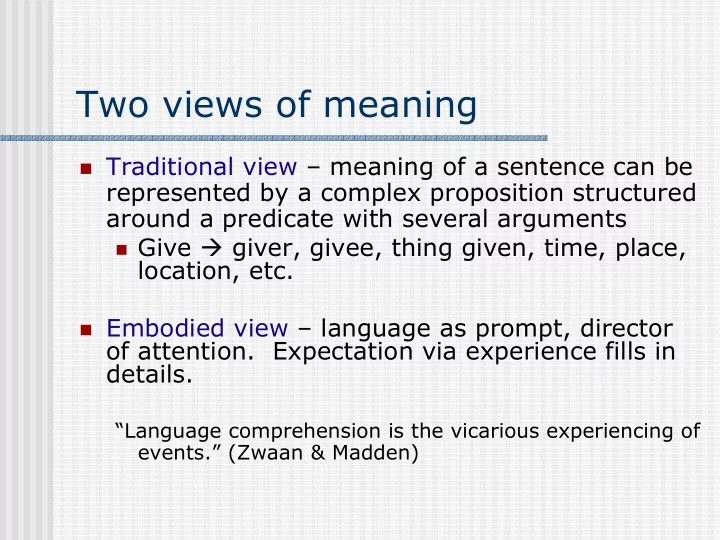
SLIDE 1 Two views of meaning
Traditional view – meaning of a sentence can be
represented by a complex proposition structured around a predicate with several arguments
Give giver, givee, thing given, time, place,
location, etc.
Embodied view – language as prompt, director
- f attention. Expectation via experience fills in
details.
“Language comprehension is the vicarious experiencing of events.” (Zwaan & Madden)
SLIDE 2
Embodied view of meaning
“Very sparse grammar guides us along the same rich mental paths, by prompting us to perform complex cognitive operations. What is remarkable is that by and large subjects engage in quite similar constructions…. The reason seems to be that the cultural, contextual, and cognitive substrate on which the language forms operate is sufficiently uniform across interlocutors to allow for a reasonable degree of consistency in the unfolding of the prompted meaning constructions.” (Fauconnier) < http://cogweb.ucla.edu/Abstracts/Fauconnier_99.html
SLIDE 3
Symbol grounding problem
Symbol grounding problem
“Although cognitive neurolinguists examine the neural basis for human linguistic abilities, most research on the links between language and brain functions ignore the importance of people’s ordinary, kinesthetic experiences” (Gibbs)
High dimensional representation
“There may be ways in which embodied meanings can be explicitly part of propositional and high-dimensional representations of linguistic meaning.” (Gibbs)
SLIDE 4
Indexical hypothesis
Indexical hypothesis (Glenberg < Gibbs)
(1)
Words and phrases indexed to objects in environment
(2)
Affordances derived What are the ways of interacting with objects mentioned?
(3)
Meshing of affordances to constrain meaning possibilities
SLIDE 5 Indexical hypothesis
- Shorter reading times for afforded sentences
than non-afforded
1.
Art used the chair to defend himself against the snarling lion
2.
Art used the chair to propel himself across the room
SLIDE 6 Beachcomber model
- Beachcomber model (Zwaan & Madden)
“The mind is like a beachcomber, taking whatever is washed up on the beach to build
- structures. Each piece of driftwood has a
particular shape, which puts constraints on where the piece will fit in the evolving structure…and on whether and how subsequent pieces will fit”
1.
Fred stole all the books in the library.
2.
Fred read all the books in the library.
SLIDE 7
Evidence for embodied understanding
(Zwaan, Magliano & Graesser < Gibbs)
Longer reading times for parts of stories exhibiting changes of character, location, time period, etc.
People appear to flesh out important embodied
characters as they read
SLIDE 8 Evidence for embodied understanding
Evidence that listeners assume perspective
Experiment 1: (Morrow, Bower & Greenspan < Gibbs) Task: subjects memorize building layout including objects in rooms. Then, they read a story describing a person moving through building.
SLIDE 9
Where is the piano/book? Fast response Where is the bathtub/sofa? Slower response
SLIDE 10
Evidence for embodied understanding
Experiment 2: (Keefe & McDaniel < Gibbs) Task: read a sentence then pronounce a word. Ex.
1.
After standing through the three-hour debate, the tired speaker walked over to his chair.
2.
The tired speaker moved the chair that was in his way and walked to the podium to continue the three-hour debate. Subjects were able to pronounce word sat faster after reading sentence (1) than (2).
SLIDE 11
Evidence for embodied understanding
Experiment 3 (Glenberg, Meyer & Linden) Task: Read sentence, see word, decide if word was mentioned in sentence. Ex.
1.
The jogger took off the sweatshirt before jogging.
2.
The jogger put on a sweatshirt before jogging. Faster decision time for sweatshirt if sentence (2) read than sentence (1).
SLIDE 12
Cognitive linguistics
Cognitive linguistics
“language is in the service of constructing and communicating meaning, and it is for the linguist and cognitive scientist a window into the mind” (Fauconnier)
SLIDE 13
Cognitive linguistics
“Language is only the tip of a spectacular
cognitive iceberg, and when we engage in any language activity, be it mundane or artistically creative, we draw unconsciously on vast cognitive resources, call up innumerable models and frames, set up multiple connections, coordinate large arrays of information, and engage in creative mappings, transfers, and elaborations.” (Fauconnier)
SLIDE 14 Cognitive linguistic evidence for embodiment
“Cognitive linguistic research analyzes
systematic patterns of conventional and novel linguistic expressions to uncover patterns of metaphorical though that give rise to such language.” (Gibbs)
- Ex. ANGER IS HEATED FLUID IN A CONTAINER
SLIDE 15 Cognitive linguistic evidence for embodiment
Being angry is such a complicated
- emotion. At first, anger burns in my
chest… the anger just boiled inside me…Simply telling him that I was upset made my anger fizzle out a little. As we talked my anger slowly melted away.
SLIDE 16 Cognitive linguistic evidence for embodiment
Image schema
Fundamental experiential categories
Verticality, color, cause/effect, source-path- goal, containment
Do image schemas aid in interpreting
metaphorical expressions?
- Ex. Does our bodily understanding of
containment aid in interpreting idiomatic meaning of expressions relying on a containment metaphor such as He blew his stack.
SLIDE 17 Cognitive linguistic evidence for embodiment
Gibbs Study 1
- Physical reality - container exploding is
caused by internal pressure caused by increase in heat, explosions is unintentional and violent
- Will people understand anger idioms (with
containment basis) differently than literal paraphrases?
1.
Blow your stack/flip your lid
2.
Get very angry
SLIDE 18 Cognitive linguistic evidence for embodiment
- Easier to process blow your stack when in
context that described cause of anger as due to internal pressure, where expression was unintentional and violent. Longer to read if these contradicted (compared to got very angry?)
- 1. *Slowly/quietly/carefully, he blew his stack.
- 2. Slowly/quietly/carefully, he got very angry.
SLIDE 19 Cognitive linguistic evidence for embodiment
Gibbs study 2 Task: Read a sentence, see a word. Lexical decision task based after seeing word.
- Ex. Read sentence like:
- 1. John blew his stack
- 2. John got very angry
- 3. John bit her head off
See word like: heat or lead
SLIDE 20
Cognitive linguistic evidence for embodiment
Lexical decisions made faster if word
viewed after reading a sentence containing metaphorical language cohered with that metaphor.
SLIDE 21 Cognitive linguistic evidence for embodiment
Gibbs Study 3 Examine Desire as hunger metaphor Hunger experience
- Stomach grumbles
- Stomach aches
- Feel dizzy
- *Knees swell
1.
I have a stomach pain for my old way of life
2.
*My knees swell for information about my ancestry
SLIDE 22 Cognitive linguistic evidence for embodiment
Gibbs Study 4 Examine metaphorical extensions of stand
- 1. Relevant Image schemas identified for literal
meaning of stand
- Balance
- Verticality
- Center-periphery
- Resistance
- Linkage
SLIDE 23
Cognitive linguistic evidence for embodiment
2.
Image schemas ranked for metaphorical uses It stands to reason As the matter stands Linkage > balance > center-periphery > resistance > verticality Don’t stand for such treatment Stand against great odds Resistance > center-periphery > linkage > balance > verticality
SLIDE 24 Cognitive linguistic evidence for embodiment
3. Assess whether senses of stand seen as being similar were predictable from image schema profiles
- 79% of results were predictable
- Image schematic meaning (body based)
significant part of foundation for linguistic meaning
SLIDE 25
The embodied mind
Fallacy of mind/body separation--no
separate faculty of reason. The mind is the body.
Structure of world is body-based Categorization is what we do as neural
beings
Categorization creates structure, allows
us to comprehend the world and make decisions that advance our goals.
SLIDE 26
The embodied mind
Humans, like animals, are neural beings with
similar fundamental needs: food/water/shelter/sex
Simple animals have abilities to recognize food
from non-food.
More advanced animals have more capacity to
create categories
SLIDE 27 Color as embodied percept
- Color is not in the world, but in the brain
Experience of color depends on:
1)
Wavelength of reflected light
2)
Lighting conditions
3)
Receptors
4)
Neural circuitry
- Thinking of color as the internal representation
- f the external reality of surface reflectance is
inaccurate
SLIDE 28
Color as embodied percept
Bananas are yellow
Lighting conditions drastically alter the
actual wavelengths hitting our retinas, yet no color change is perceived
The sky is blue
The sky is colorless
SLIDE 29 Basic level categories
It appears that our concepts reflect the world as
it is---rather, we identify the objects around us based on how we interact with them.
Basic level categories
Based on our optimal interaction with the
environment
SLIDE 30 Basic level categories
Berlin and Rosch – Basic level categories 1. Highest level at which a single mental image can represent the entire category
- Chair, screwdriver, dog (basic)
- Furniture, tool, animal (superordinate)
SLIDE 31
Basic level categories
2. Highest level at which category members have similarly perceived overall shapes.
cat, but not animal, hammer, but not tool
3. Highest level at which a person uses similar motor actions for interacting with category members
Separate motor programs for interacting with chair, bed, table, but not for interacting with furniture.
SLIDE 32
Basic level categories
4. Level at which most of our knowledge is organized