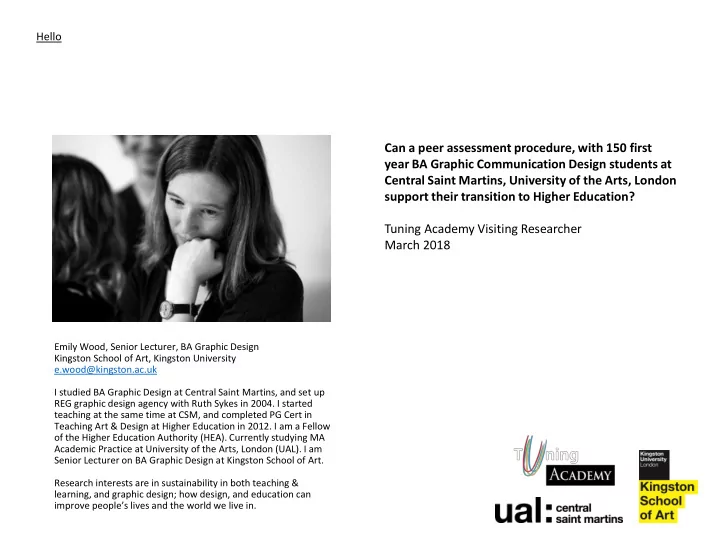
SLIDE 1 Emily Wood, Senior Lecturer, BA Graphic Design Kingston School of Art, Kingston University e.wood@kingston.ac.uk I studied BA Graphic Design at Central Saint Martins, and set up REG graphic design agency with Ruth Sykes in 2004. I started teaching at the same time at CSM, and completed PG Cert in Teaching Art & Design at Higher Education in 2012. I am a Fellow
- f the Higher Education Authority (HEA). Currently studying MA
Academic Practice at University of the Arts, London (UAL). I am Senior Lecturer on BA Graphic Design at Kingston School of Art. Research interests are in sustainability in both teaching & learning, and graphic design; how design, and education can improve people’s lives and the world we live in.
Can a peer assessment procedure, with 150 first year BA Graphic Communication Design students at Central Saint Martins, University of the Arts, London support their transition to Higher Education? Tuning Academy Visiting Researcher March 2018
Hello
SLIDE 2
University of the Arts, London is ‘the largest specialist arts and design university in Europe’ comprising of six art colleges: Camberwell College of Arts Central Saint Martins Chelsea College of Arts London College of Communication London College of Fashion Wimbledon College of Arts 13,000 undergraduate students from more than 100 countries
Background
Central Saint Martins A world famous arts and design college, committed to the imaginative and ethical engagement of the arts, design and performance to effect real change - socially, politically and economically.
SLIDE 3 An introduction to BA Graphic Commuication Design, by course leader Peter Hall https://www.youtube.com/watch?v=n_L5bSjuXHQ
BA Graphic Communication Design
Expanded practice of a graphic designer The designer who “can encompass many things: the designer as researcher, thinker, activist, publisher, innovator, and agent for social change.”1
Student work; Lucy Budd, Nasharla Green, Inguna Ziemele, Thomas Moore, Dom Biddulph 1 A Shaughnessy and T Triggs, ‘Graphic Language’, Design Observer, 2 December 2014, http://designobserver.com/feature/graphic-language/38675.
Background
SLIDE 4 Background
BA Graphic Communication Design A course “… that will equip students with the creative, conceptual, technical and meta-level thinking skills expected of designers of the 21st Century.” Joseph Aoun in Robot-Proof, proposes a set of skills which students in higher education need to be taught to fulfil the future change in work (working alongside robots); developing the skills that make us uniquely human; the things that robots can’t do;
- creativity,
- empathy,
- flexibility and
- collaboration.
Central Saint Martins, ‘BA (Honours) Graphic Communication Design, Central Saint Martins, Course Handbook 2016/17’, 2016. Joseph Aoun, Robot-Proof: Higher Education in the Age of Artificial Intelligence (Cambridge, MA: The MIT Press, 2017).
SLIDE 5
Background
SLIDE 6
Terminology: BA Graphic Communication Design = 3 year undergraduate degree course (10 Units in total) Year 1: Units 1-4 Pass all units to progress to Year 2. All teaching is done using design briefs as the starting point for projects. The brief outlines the context of a project, provides references & schedule. Unit 1: 20 credit unit (low stakes) One brief for first 5 weeks of term Tea eaching methods: introductory lectures / discussion groups/ tutorials /presentations/ portfolio / crits
Background
SLIDE 7 Research context
Role as first year leader Supporting students’ transition into Higher Education:
- Academic
- Emotional
- Life skills
- Independent learning
Biggs, A R J, J Clark, and I Hall. ‘Building Bridges: Understanding Student Transition to University’. Quality in Higher Education 18, no. 1 (2012): 3–21
SLIDE 8
BA Graphic Communication Design class of 2019! 150 students from 31 countries 76% female / 14% male 17% over 21 years old 44% UK / 13% rest of EU / 43% International Previous educational experience: 70% Foundation year in Art & Design (FAD) 15% Other FE (eg BTEC) 10% A levels / school 5% Other
Diverstiy
SLIDE 9 Research context
Unit 1: An Introduction to Graphic Communication Design at Central Saint Martins Project brief: To investigate the role of the designer in addressing complex social problems using Design Thinking methodology
Figure 1: Design Thinking Process adapted from Standford d.school ‘Tools for Taking Action.’, Stanford d.school, accessed 26 February 2018, https://dschool.stanford.edu/resources/
SLIDE 10 Research context
Can a peer assessment with a large class of first year BA graphic communication design students at Central Saint Martins, University of the Arts, London help to support their transition to Higher Education? Can peer assessment support this transition through:
- Increasing assessment literacy (academic)
- Teaching collaboration skills; for education &
employment (life skills)
- Increased engagement & deeper learning (academic)
- Empowering students to become independent
learners (independent learning)
- Building a community (emotional)
Independent learning (Liu & Carless) Deeper learning (Kolb) Self-regulatory learning & empowerment (Evans) Group projects (Jacques & Salmon) Accurate feedback (Falchikov & Goldfinch) More and quicker feedback (Gibbs)
SLIDE 11 Methodology
Action research methodology: “research which is carried out to test a particular intervention”
LS Norton, Action Research in Teaching and Learning: A Practical Guide to Conducting Pedagogical Research in Universities. (Abingdon: Routledge, 2009).
SLIDE 12
Methodology
Design thinking methodology: Action research methodology:
SLIDE 13
Methodology
Action research methodology: Data collection during and after the ACTION, involving the participants To inform the next cycle of action research…
SLIDE 14 Procedure
5 week project Group verbal presentation Online submissions
- Group evaluation
- Self -reflection
SLIDE 15 Procedure
- Start with the group grade and
feedback from the peer assessment sheet Summative assessment
- Adjust for individual students
according to Group Evaluation & Self-Reflection
SLIDE 16 Procedure
Project timeline Data collection points October All year briefing about the peer assessment (by researcher) Student interviews; group (5 students) November Submission of student work: three parts a) Presentations of projects (peer assessed) b) Group evaluation (individual) c) Self-reflections (individual) December Holistic assessment of Unit 1 by tutors using the group peer assessment, adjusted the grade and feedback according to b & c. Inputted feedback and grade online for individual students Unit 1 online unit evaluation (sent out by university) February Student interviews; group (5 students) June Online questionnaire (sent by researcher) October Student interviews; 2 individual second year students (S & J)
SLIDE 17 Results
Data collected from
- Online questionnaire (sent by researcher)
- 25% response rate
- Unit evaluation (sent by university)
- 45% response rate
- 11 student interviews (group / individual)
- 2 staff interviews
- Researcher’s observations
Plus: comments made by students in their self-reflections & group evaluation forms (all students submitted on line)
SLIDE 18 Results
Increasing assessment literacy
73% 19% 8%
Yes No Not sure
Online questionnaire: Reflecting now back on the experience, did this assessment help you to understand how you would be assessed at CSM? Unit evaluation: I understood the assessment criteria and what was required of me to do well in this unit 73% of students found that the peer assessment helped them to understand how they would be assessed at CSM. BUT 19% said it didn’t help them and 8% weren’t sure? 70% of students said that they strongly agreed or agreed that they understood the assessment criteria and what was required of them to do well. BUT 11% disagreed… how can this be overcome?
7 63 18 10 1 10 20 30 40 50 60 70 Strongly agree Agree Neither agree or disagree Disagree Strongly disagree
%
SLIDE 19 Results
Increasing assessment literacy
Student interview + “I think seeing the inner workings of how the marking system works is important, especially while answering a brief.”
- “I didn’t understand the language of the learning outcomes;
however, now I think that its ok… Now I think that the marking criteria should be open enough to question ‘what is research?’” Staff interview + “One concern would be that students coming in from different education systems, might expect a tutor to be assessing their
- work. Not their peers. So it was a moment of transition for them
to think that their work has value in the eyes of other people not just in the eyes of the tutor.”
- “the exercise brought up the gap between the understanding of
the student experience and the gap created by the staff when they wrote those learning outcomes.”
SLIDE 20 Discussion
Increasing assessment literacy
Expected:
- Most students demonstrated a cognitive understanding of why they were doing this
exercise, and how it had improved their design process.
- However, there were many comments around the language of the marking criteria and
academic assessment Not expected:
- 27% said they didn’t think, or didn’t know, if this procedure helped them to understand
how they would be assessed at CSM. Next iteration: After the briefing run a workshop:
- How it will help them with their design projects
- Address further issues around “it’s the tutor’s job”
Highlights a difficulty with language used for assessment language; different educational backgrounds/ students without FAD (increasing) / previous styles of teaching / 45% learning in their second language
SLIDE 21 Results
Learning collaboration skills; for education & employment
Online questionnaire: When you were doing the peer assessment with your group, how did you find it? Unit evaluation: How did this unit challenge your thinking: The majority of students (95%) found most of the peer assessment in their group either straightforward, or mostly ok
24% 71% 5% Found it straightforward; we all agreed with each other Some were ok, and
depended on the presentations It was hard because we disagreed with each
“The 5 week project enabled the group to come up with a creative solution via problem solving and thinking. The broad results from all groups show that we all thought of extremely different solutions, shows the diverse creative processes enabled by group work and problem solving.”
SLIDE 22 Results
Learning collaboration skills; for education & employment
Student interview + “Group work has expectations; be on time, contribute – you can’t sit back & coast… I didn’t want to not contribute ideas, so I took charge of the group and organised it.” “Now I’m heavily based in collaboration. I like to know what people are good at.”
- “Also intimidating; we didn’t know each other – we were
complete strangers. One person didn’t come in, and didn’t join in, didn’t take part in the group… “ Staff interview + “… one of the skills [for employment] is self efficacy which means your perception of yourself against your peers. And so this method of peer assessment is the first step for the students realising that their work is not happening in isolation; it's happening in an arena where other people are going to be evaluating them” Self reflection “I have never done a group project before. This project was enjoyable and struggle at the same time. Most challenging parts was speak out my opinion and talk to our group.”
SLIDE 23 Discussion
Learning collaboration skills; for education & employment
“It was a good way to start off the c know the people on our course… it 'uni .” Expected: The majority of teams found working together either straightforward,
About 5% of the teams broke down in some way, and were supported by staff at these points 2 of the teams split into 2 separate groups to complete the project. Not expected: So few problems with the teams… Next iteration: Could do more, although what was done was quite effective;
- Why they are doing it: education & employability
SLIDE 24 Results
Increased engagement / deeper learning
Online questionnaire: Why do you think we asked you to assess your peers (open answer) Unit evaluation: The unit challenged me to develop my thinking (not directly related to the peer assessment) The most frequent answer was to learn to give feedback to one another 72% of students said that they strongly agreed or agreed that the unit had challenged them to develop their thinking
10 20 30 40 50 60 70 Strongly agree Agree Neither agree
Disagree Strongly disagree
2 4 6 8 10 12
Get a wider range of feedback (2 answers) Understand the project (3) Improve my own work based on the criteria (3) Learn from seeing everyone's work (4) Tutors opinions may not match student opinions (4) Understand the marking matrix (9) Learn to give feedback to each other (11) Work as a team and figure out how to collaborate (4)
SLIDE 25 Results
Increased engagement / deeper learning
Student interview + “Assessing someone else helps your learning & helps your understanding of what you’re doing yourself” “In the second year, the grade that I get doesn’t matter, the feedback matters more.”
- “The tutor handed the marking criteria out to us, and started
explaining them to us, I switched off!!” “I think that getting feedback from other students is very valuable, however I’m not sure if this should count towards
- ur official grade because everyone has their own personal
preferences when it comes to design.” Staff interview + “by the end of this I think the staff team were able to pull out 12 students who needed additional study support”
- “But what we've learned from this is that although we're briefing
students once or twice about this on paper, and verbally, it takes a while cognitively for certain students to pick this up.”
SLIDE 26 Discussion
Increased engagement & deeper learning
Expected: Understood how the marking matrix can support the design process Understood that it was an exercise to help them give feedback to one another Not expected: The open comments demonstrated that many students had deep understanding
- f why they were asked to do this peer assessment:
“Giving feedback to other students helps them develop their own practice and helped me think more critically about my own work.” There were a few comments about personal preferences & personal opinions. Next iteration: Would like this to be part of a larger project that runs through three years. Follow up with interviews with second and third years to understand if deeper learning is evident
SLIDE 27 Results
Empowering students to become independent learners
Online questionnaire: Do you think this understanding of assessment will help you for the rest of this course? Unit evaluation: How did this unit challenge your thinking? 82% thought that the understanding that they had of assessment from the peer assessment procedure would help them for the rest of their course BUT 18% said no or not sure
82% 10% 8%
Yes No Not sure
“For this Unit I was exposed to a lot
- f new ways of thinking. I found myself
having to try quite hard to explore a wider range of ideas, which I enjoyed a lot. The 'hands off' approach was also greatly beneficial to me in developing into a more independent designer, but help and guidance was available to me when I needed it.”
SLIDE 28 Results
Empowering students to become independent learners
Student interview + “It gives you a guidance; a start and end point for a project. I now know that I shouldn’t go into a project without research.”
- “[The peer assessment process] is a type of empowerment
for us… not the best one. I felt like I could mark someone; it would be a real mark. I felt it was something that would
- impact. I didn’t find enjoyment in having the power to
determine one’s grade it was quite stressful.” Staff interview + ”It did make them feel much more in control of what they handed in at the end, because we saw some reiterated projects following this peer assessment” “They [used to] say ‘it's nice, I like it’. And now they say; this has achieved the communication aims, for example. So it gave the students the scaffolding to pin this theory to and it gave them a vocabulary.”
SLIDE 29
Discussion
Empowering students to become independent learners
Expected: “It gives me some sort of like, a comforting structure to follow; if I’m lost in this total flunk, I can see like, how to manoeuvre to the next step ” “Now it’s more that we want to help each other progress and give constructive feedback." Not expected: “I didn’t find enjoyment in having the power to determine one’s grade it was quite stressful.” Next iteration: Research needs to continue into the second and third year. Build on peer assessment for next assessments
SLIDE 30 Results
Building a community
Online questionnaire: Should other students be involved with your assessment, or do you think it's something that only tutors should do? Unit evaluation: What changes, if any, would you make to improve this unit for
- ther students in the future?
The majority of students (63%) are happy to be assessed by peers, but a large proportion still think that assessment is for tutors.
“Although some groups might not go well, I think it is a great opportunity to meet the
- thers especially people from different
cultural background by the grouping
“Made friends with my group members so was good to have a group project at the start of the unit.”
63% 24% 5% 8% Yes, I'm happy for other students to assess me No, assessment is for tutors I liked assessing others, but I didn't like being assessed myself Other comments
SLIDE 31 Results
Building a community
Student interview + “Getting your peers to pay attention to you, you have to kind
“I thoroughly enjoyed working with my group, we have become good friends and created a great idea together which we all contributed to in different ways.” “Now, in the second year: I’ve understood what you meant about learning from the people around you.. if you want to improve you have to speak to your peers” Staff interview + “I don't think it broke any friendships. It could there could have been disagreement in the room and that's something that we want the students to learn.”
- “There’s something about putting a group of students through a
shared difficult experience; in terms of bringing them together; they struggled as a group during the project & during the assessment but mainly came out strong friends.” Other student comments “… thank you for our group members take cared of me.” (self-reflection)
SLIDE 32
Discussion
Building a community
Expected: Lots of positive comments about making good friends / working together / learning about the importance of learning from each other / building a community Not expected: Demonstrated an understanding of how the project itself and the way we assessed linked to them; as first years, building a new community Next iteration: Fund / implement some of their community building ideas, to show commitment to them and their work.
SLIDE 33 Discussion
The projects
Feast Friday Pop-up Portraits
SLIDE 34 Discussion
The projects
Ball pit Use me, like me, share me
SLIDE 35
Final conclusions
Issues Researcher’s role: first year leader + group tutor Questions on survey could now be improved + cross tabulation with student’s different background experiences Possible increased workload for staff: digital tools needed More interviews from students who didn’t self select
SLIDE 36 Final conclusions
Moving forwards Students from different backgrounds are increasing;
- Increasing student numbers
- Increasing ‘widening participation’
- Different educational experiences
The success of the project has to do with: – Quality of the briefing to students – Support given to students; seminars and workshops about the new way of learning
SLIDE 37 Final conclusions
Can a peer assessment with a large class of first year BA Graphic Communication Design students at Central Saint Martins, University of the Arts, London help to support their transition to Higher Education?
- Demonstrated evidence of increasing assessment literacy
through comments and online questionnaire:
- The students successfully collaborated (brought some
existing skills, developed others). Good time to do it as they are all new.
- Evidence of increased engagement & deeper learning
although would need to continue through three years of the course
- Some students showed evidence of becoming independent
learners (first stage / first year / still more to do)
- Building a community. 150 students; 30 ideas for building
communities at CSM.
SLIDE 38
Thank you
To all the students who took part in the project To the course team at CSM, especially the hourly paid Associate Lecturers, who trusted and supported me To Kingston School of Art for supporting my research and this trip to Bilbao To Tuning Academy, Bilbao for having me Emily Wood, Senior Lecturer, BA Graphic Design Kingston School of Art, Kingston University e.wood@kingston.ac.uk
Portrait of Emily done by a student during the peer assessment briefing