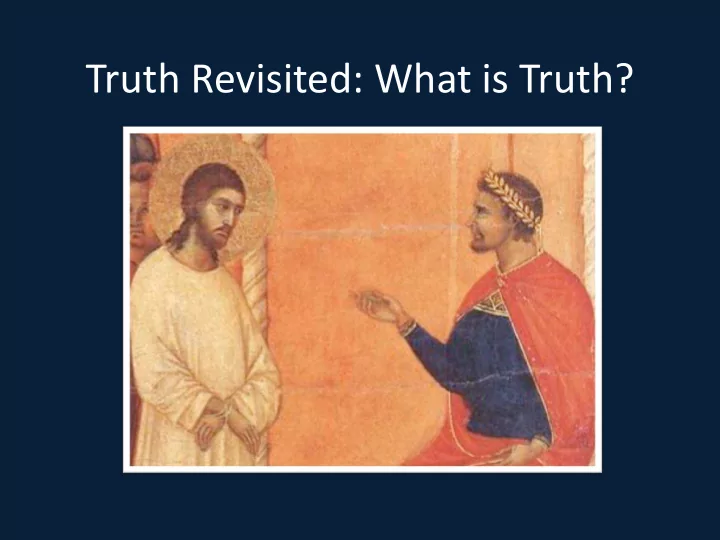
SLIDE 1
Truth Revisited: What is Truth?
SLIDE 2
- Pilate therefore said to Jesus: “Art thou a king
then?”
- Jesus answered: “Thou sayest that I am a king.
For this was I born, and for this came I into the world; that I should give testimony to the
- truth. Everyone that is of the truth, heareth
My voice.”
- Pilate saith to Him: “What is truth?”
Truth is Important.
SLIDE 3
Essential mark of ALL Truth: CONFORMITY… the correspondence between two things.
SLIDE 4
SLIDE 5 Truth is Important.
How we understand truth and falsehood affects…
- how we think,
- what we know,
- how we perceive the world/universe,
- how we behave towards others,
- who our friends are,
- how we live our lives, and
- how we die.
SLIDE 6 Truth is FUNDAMENTAL.
- A small mistake in the foundation
leads to bigger problems later.
- Small error in the premises leads to
bigger problems in the conclusion.
SLIDE 7
His Majesty to St. Teresa of Jesus: “All the harm that comes to the world comes from its not knowing the truths of Scripture in clarity and truth... Alas, daughter, how few there are who truthfully love Me!... Do you know what it is to love Me truthfully? It is to understand that everything that is displeasing to Me is a lie.”
SLIDE 8
- Fr. Fredrick Faber: “Heaven is the land of love;
but the hatred of heresy will not diminish there; for the hatred of heresy is the adoring love of God’s ever-blessed truth.”
SLIDE 9 Traditional Understanding of Truth
- St. Thomas Aquinas: Universal Doctor of the Church (1225-1274)
SLIDE 10
Different KINDS of Truth are based on what conforms to what. Different KINDS of Truth means there are LEVELS of truth. Different LEVELS of Truth means Truth is HIERARCHICAL.
SLIDE 11 First & Highest Truth is GOD Himself.
- Conformity is between God knowing (the
Father) and God as known (the Word or the Son).
- Conformity is infinite and perfect.
- God the Son (the Word of God) is Truth.
SLIDE 12 Truth is Personal
“I AM the Truth”—John 14:6
SLIDE 13 All truth flows from this ONE Truth
“All things were made by Him [the Word]: and without Him was nothing that was made”—John 1:3 “By the words of the Lord are His works”—Eccl. 42:15
SLIDE 14
Next Level: Ontological Truth
Things outside conform to ideas inside.
SLIDE 15
1st Kind of Ontological Truth: Creation
Created things conform to God’s idea of them.
SLIDE 16
2nd Kind of Ontological Truth: making
Man makes things to conform to his own idea.
SLIDE 17 Creation made perfectly true… conforming to God’s Word.
“He hath made nothing defective”—Eccl. 42:25
SLIDE 18
The Devil: the First Liar
The abuse of the free choice of the will brought lies and perversions into creation.
SLIDE 19 “He stood not in the truth; because truth is not in him. When he speaketh a lie, he speaketh of his own: for he is a liar, and the father thereof”—John 8:44
SLIDE 20
Adam and Eve embraced his lie.
Man became divided.
SLIDE 21 A Consequence: Three Images of Man
- That which we have of ourselves…
which is flawed. Lack of truth or conformity between thought & thing.
- That which God has of us right now.
Perfectly true.
- That which God wants us to be.
SLIDE 22 “No Word is impossible for God”
“By the words of the Lord are His works”—Eccl. 42:15.
SLIDE 23 Truth precedes Power and Love
- God cannot love what is not true.
- God cannot make or do something that
contradicts Himself… that contradicts His Word.
- God cannot make another God.
- If power and love are not based on truth, they
lose their foundation… and become arbitrary… leading to might makes right.
SLIDE 24
Next Level: Logical Truth
The mind conforms to things outside itself.
SLIDE 25 This is a tree This is not mineral, animal, etc.. This is an
This is not a fruit or evergreen tree, etc..
SLIDE 26 Last Kind: Virtue of Truthfulness
- Inclines man to manifest himself, in his life, in his
speech, and in his dress according to the conviction of his mind. NO DOUBLESPEAK.
- Perfects man’s ability to communicate outwardly,
whether by word or action, what he holds to be true in his mind and heart.
- The conformity is between interior and exterior
- f man.
- “Let what you say be simply ‘Yes’ or ‘No’;
anything more than this comes from the evil
- ne…”
- Essential for a wholesome society & good gov’t.
SLIDE 27
Traditional Levels/Kinds of Truth
God Ontological Logical Virtue of Truthfulness
SLIDE 28 Sciences and their objects
- The sciences are defined ordered according to
what truth is being sought.
- Some truths are more universal than others.
- The more universal the truth, the higher the
science.
- Lower sciences use the principles derived by
the higher sciences.
SLIDE 29 Hierarchy of the Sciences
1) THEOLOGY: study of the highest Truth… God, using Divine Revelation. 2) THEORETICAL SCIENCE: Aristotle says these are sought for their own sake. – Metaphysics (Philosophy including psychology as study of the soul) – Physics (followed by Physiology, Zoology, Biology) – Mathematics 3) PRACTICAL SCIENCES: Doing something. – Politics -- study of right & wrong of human action as a society – Ethics -- study of right & wrong of human action as an individual – Logic -- study of right & wrong of human judgment – Rhetoric 4) PRODUCTIVE SCIENCE: Making. Building. – Art, poetry, engineering, drama All that are lower borrow from those above… e.g., engineering needs
- physics. ethics needs metaphysics. poetry needs mathematics.
SLIDE 30 These truths are OBJECT based
According to this understanding of truth…
- man ultimately strives to know God as the
Supreme Being. (faith enables us to KNOW God).
- the Creator can be known through His creation.
- man humbly accepts that God made things from
the beginning in a certain way. Thus, he seeks to know the objects of creation in themselves as well as something of the Creator Who made them.
- man seeks to imitate His Creator by making
things and doing things according to the truth.
SLIDE 31 Summary: Traditional Understanding
The traditional understanding of truth is …
- timeless since it starts with God Himself and flows
from His creating all things through His Eternal Word.
- vertical in that it seeks to elevate man’s mind upward
to the Creator.
- clear, ordered, hierarchical, and object based.
- of the rational part of man.
- unchanging and permanent in that it depends upon the
essences God placed in things from the beginning. And these DO NOT CHANGE.
SLIDE 32 New Understanding of Truth
Rene Descartes: “Father of Modern Philosophy” (1595-1650)
SLIDE 33 Doubted EVERYTHING in order to seek fundamental truth
- Rightly held that all truths were linked with one another.
- Sought to find the fundamental truth that could not be doubted.
- Proceed from there to open the way to all science/knowledge.
- To find the one fundamental truth, take journey of doubting
EVERYTHING until find what could not be doubted.
- Instead of seeing the reality around him as certain and real,
Descartes doubted its Existence since he had been wrong before (e.g., paddle looks bent in the water).
- And so, he doubted and doubted and doubted until he realized that
he was doubting. He could not doubt that he was doubting. Thus, he concluded, “I think, therefore, I am.”
- He proceeded to build his entire philosophical system on man’s
rational powers alone. He based even his existence on this… “I think, therefore, I am.”
SLIDE 34 Modern Thinkers Adopt Descartes
Immanuel Kant (1724-1804): “Have courage to use your own understanding!”--that is the motto of
- enlightenment. Man is his own supreme guide.
SLIDE 35 New Truth is SUBJECT based
- This leads to a near complete reversal of the
traditional/classical understanding of truth.
- No longer do we have an object based reality…
but rather a subject based reality. All depends on the thinking and experiences of man.
- Man himself becomes the highest truth. Man
becomes the source of truth. Man has taken the place of God!
- Descartes resurrects ...perverts the Ancient Greek
Protagoras: “Man is the measure of all things.”
SLIDE 36 New Truth involves Motion/Becoming
- To understand the modern notion of truth, we
need to factor in the contributions of men like Newton, Hegel, Marx and Darwin.
- They saw the world under the aspect of
motion, strife and struggle.
- Newton spoke of forces, Darwin of natural
selection and evolution, while Hegel and Marx used the notion of dialectic.
- Key factor is that of BECOMING.
SLIDE 37
Hegelian Dialectic
SLIDE 38
Example of Hegel’s Dialectic Today
SLIDE 39 1st CRITICAL Pitfall of New Truth
- The rule of non-contradiction basically states that one
thing cannot be another at the same time and the same way.
- With the thesis-antithesis-synthesis dialectic, modern
man often does not abide by the rule of non- contradiction but allows contradictory and duplicitous situations to develop and even co-exist, working to bring some future synthesis.
- This leads to many instabilities in the life of people and
the working of a nation. Cognitive Dissonance.
- St. Paul: there “shall come dangerous times. Men shall
be… Ever learning, and never attaining to the knowledge of the truth”—2Tim 3:7.
SLIDE 40 The New Truth as embraced today
- Using these faulty ways of thinking, the new
understanding of truth can be captured as the conformity between the mind and life.
- This is a total reversal of the established order of
truth as the conformity between thought and things that are fixed in their essence.
- This means that if life changes so will what I
believe as true change with it.
- The truth is no longer that which IS, but that
which is BECOMING and so is constantly and always changing.
SLIDE 41 2nd Pitfall of New Truth: RELATIVISM
- Since ontological truth based on God as the
creator is effectively eliminated, man becomes the measure of all things…not the unchanging Son of God (the Eternal Word).
- Thus, RELATIVISM becomes a problem. Each man
has his own rational ability and own life experiences…and thus, each man will have a different view on what is true and what is not true.
- Potentially, each man can make his own little
world.
SLIDE 42 Some Recent Examples
- Sept 2013 interview with Pope Francis: “Everyone has his
- wn idea of good and evil,” and everyone should “follow
the good and fight evil as he conceives them.”
- Nov 2013: Italian President quoted Pope Francis: “In your
words, we have felt vibrate the spirit of the Second Vatican Council, as ‘rereading of the Gospel in the light of contemporary culture.’”
- Oct 2014 Synod of Bishops Instrumentum Laboris, no. 30:
“respondents propose … public discussion … which could permit a re-reading of the concept of the natural law in a more meaningful manner in today’s world.”
- Sept 2014 German ethics panel ruling on whether a brother
and sister can legally marry: “At the heart of liberty is the right to define one’s own concept of existence, of meaning,
- f the universe, and of the mystery of human life.”
SLIDE 43 Occult Connections
Madame Helena Blavatsky
Russian Occultist, founder of Theosophy, 1831-1891.
SLIDE 44 Occult Connections
- She was “seeking ways to liberate the human mind.”
- When asked, “Is there such a thing as absolute truth in
the hands of any one party or man?” She answers: “there cannot be. There is no room for absolute truth upon any subject whatsoever… But there are relative truths, and we have to make the best we can of them.”
- One of her life’s goals: to encourage the study of
Comparative Religion, Philosophy, and Science. She held that truth is “the substratum and basis of all the world-religions and philosophies.”
- Relativism is occult based…flows out of the mouth of
the devil, the first liar.
SLIDE 45 Summary
- Whereas the traditional view is God-centered, the latter is man-centered.
- The one is VERTICAL since it looks up or leads one up while the other is
HORIZONTAL since it looks out or even down.
- Whereas there was HIERARCHY in the truth before, all is flattened now or
even inverted. It is EGALITARIAN.
- Whereas the traditional view of truth is TIMELESS, this one is TEMPORAL since
it is based man’s view of life…which is always BECOMING.
- Whereas the traditional view was more defined, clear and limpid, this one
tends to be confused and chaotic since it is always developing and changing. It is unstable. It is REVOLUTIONARY.
- Whereas the traditional form of truth operates from the rational part of man,
this form of truth easily becomes more “charismatic” since it easily falls prey to man’s emotions, affections, feelings and imagination.
- The traditional view is humble in that it accepts things the way God made
them…and seeks to use them according to their natures. The new way manipulates the natures of things to conform to his own ideas.
SLIDE 46
There is a battle going on here!
Let us consider how this battle is played out in a few categories.
Traditional Truth vs. Modern Truth
SLIDE 47 FOOD/NUTRITION
- TRADITIONAL: accepts the way God made the
food supply and works accordingly. Works with the genetic code placed in things (e.g., hybrids).
- MODERN: does not accept things as they are but
seeks to modify things to fit modern man’s needs by stripping them of parts (e.g., refining and processing) and by modifying them (GMO).
- Nature is biting back (health problems/cancers).
SLIDE 48 ART
- TRADITIONAL: vertical, meditative, detailed,
- rdered. People gather around them and think
about higher things.
- MODERN: flat, confused, mushy, unsettled.
People pass by them.
- Undefined, amorphous art equals undefined and
amorphous truth. Art that is so formless it could mean anything equals truth that is formless and could mean what people want it to mean.
SLIDE 49
SLIDE 50 Communist Goals for America
- Continue discrediting American culture by
degrading all forms of artistic expression. An American Communist cell was told to “eliminate all good sculpture from parks and buildings, substitute shapeless, awkward and meaningless forms.”
- Control art critics and directors of art museums.
“Our plan is to promote ugliness, repulsive, meaningless art.”
[cf. The Naked Communist (10th ed. 1961), Current Communist Goals, p 260.]
SLIDE 51
ARCHICTECTURE
SLIDE 52
SLIDE 53
SLIDE 54
SLIDE 55 MUSIC: Traditional
- Ordered, vertical, humble, rational.
- Elevates the heart and mind upwards without
focusing in on anyone man involved (e.g., Gregorian Chant and Polyphony and various classical works).
- They strike us in the rational and spiritual part
- f our souls and filter downward.
- They are enduring and are still inspiring
people to this day.
SLIDE 56 MUSIC: Modern
- Began to focus on individuals with operas.
Now music is about star performers.
- It is more and more jumpy, bass (as well as
base), of the emotions and moods of man.
- Major themes of Rock-n-Roll: licentiousness,
violence, drugs, rebellion.
- Appeals to the lower parts of man.
SLIDE 57 MORALITY: Traditional
- Object based morality. What is right and wrong is clear
and objective… as summarized by the Ten
- Commandments. This is what the stone tablets
symbolize…they are engraved in the stone of this universe.
- What is wrong is always and everywhere wrong. They
are timeless. God is saying, I made you this way.
- Intentions, although good, cannot change the
goodness or badness of an object.
- Man must work according to the NATURE of things as
God made them.
SLIDE 58 MORALITY: Modern
- Since man is always becoming, so too his
morality… producing a subject based morality that ends up being relative. What was wrong for me yesterday, may not be so tomorrow.
- Values clarification.
- Intention based morality.
- If it can be thought of, it can be done.
- Might makes right. Will is supreme. Freedom
- f choice.
SLIDE 59 Humanist Manifesto I-III
- “…we begin with humans not God, nature not deity.”
- “Using technology wisely, we can control our environment,
conquer poverty, markedly reduce disease, extend our life- span, significantly modify our behavior, alter the course of human evolution and cultural development, unlock vast new powers, and provide humankind with unparalleled
- pportunity for achieving an abundant and meaningful
life.”
- “… values and ideals, however carefully wrought, are
subject to change as our knowledge and understanding advance”
- “We affirm that moral values derive their source from
human experience.”
SLIDE 60
Marriage
SLIDE 61 LANGUAGE
- TRADITIONAL: seeks a fixed language that is
not easily manipulated. Language that will convey truths down through time.
- MODERN: wants a language that evolves, is
flexible and adaptable. Wants to use the same words but with new and different meanings.
SLIDE 62 MAN
- TRADITIONAL: is of the rational part of man and has highest
truth as its ultimate goal. It seeks what is above and mortifies the body and whatever gets in the way from below.
- MODERN: The new understanding of truth has man as its
primary focus… thus it tends to drop down to the immediate needs of the body… avoiding what is painful as a general rule. Man conforms to the needs of the body first and foremost because they are more immediate. Thus, penance and mortification are things of the past. People are quick to medicate and seek the various outlets the world will provide them (“comfort foods”, sleep, alcohol, TV, movies, traveling, gambling, etc.). This path is more of the senses, imagination, and affections, whereas the other is more of the intellect and will.
SLIDE 63
- Because modern man sees no hierarchy in truth, he
sees no reason to suffer in the body for a higher truth
- r a higher good.
- Because the new truth tends toward living more in the
body than in the rational part of man, it easily tends toward instability of the mind (neurosis).
- Because modern truth changes and is subject based, all
sorts of duplicitous situations develop like passive aggressive behavior and pitting people against each
- ther (which is just a form of Hegelian dialectic in
action). Such behavior destroys the virtue of truthfulness and the ability of people to live in a community with some stability and peace.
SLIDE 64 Natural Sciences in charge
- Hierarchy of sciences breaks down.
- Math and physics & other natural sciences will
tell us what is true.
- The motto of the 1933 Chicago Century of
Progress World’s Fair: “Science finds, Industry applies, Man conforms.”
SLIDE 65 Truth: For this I was Born…
How we understand truth and falsehood affects…
- how we think,
- what we know,
- how we perceive the world/universe,
- how we behave towards others,
- who our friends are,
- how we live our lives, and
- how we die.
SLIDE 66