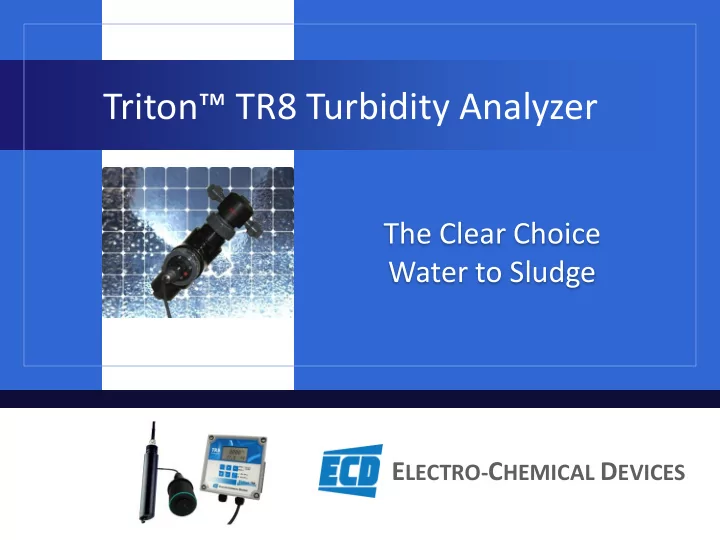
Triton TR8 Turbidity Analyzer The Clear Choice Water to Sludge E - - PowerPoint PPT Presentation
Triton TR8 Turbidity Analyzer The Clear Choice Water to Sludge E LECTRO- C HEMICAL D EVICES What is Turbidity? Standard Methods for the Examination of Water and Wastewater describes Turbidity as an expression of the optical property
What is Turbidity?
Standard Methods for the Examination of Water and
Wastewater describes Turbidity as “an expression of the
- ptical property that causes light to be scattered and
absorbed rather than transmitted in a straight line through the sample”.
In simple terms, turbidity is the degree of cloudiness or
haziness of a water sample caused by un-dissolved particles like silt, clay, emulsions or gas bubbles.
How is Turbidity Measured?
The Degree Light is
Scattered is Dependent
- n the Particle’s Size,
Shape, Color and Refractive Index.
Forward Scattering is
very dependent on Particle size.
Scattering at 90° is less
dependent on Particle size.
Measurement of the
light at 90° is referred to as Nephelometric.
Detector
Nephelometric Measurement Light Scattering
How is Turbidity Measured?
The TRITON™ TR8
Turbidity sensor uses the Nephelometric method according to ISO 7027 / EN27027.
The TRITON™ TR8 has
three Detectors.
- A Reference detector to
compensate for variations caused by aging or power fluctuations of the LED.
- A Short Path length
detector that is best for higher ranges.
- A Long Path length
detector that is best for lower ranges.
- 1. LED (880 nm)
- 2. Reference
Detector
- 3. Short Path
Detector
- 4. Long Path
Detector
- 1. LED Emitter
- 2. Short Path
- 3. Long Path
- 4. Wiper
How is Turbidity Measured?
The Long Path length
detector measures Low level turbidity.
Increasing the turbidity
increases the number of particles and the intensity
- f the scattered light.
Further increases start to
block some of the scattered light and the intensity drops.
Now there are two
turbidity values for the same intensity value,
- ops!
Intensity vs. Turbidity Long Path Short Path
0 FNU Increasing FNU → 10,000 FNU
How is Turbidity Measured?
The Short Path length
detector measures High level turbidity and has a different Intensity Profile.
Comparing the two Path
Length intensities allows the TRITON TR8 to determine the true turbidity value.
This also provides a
larger Measuring Range than most competitive analyzers.
Long Path Short Path Intensity vs. Turbidity
0 FNU Increasing FNU → 10,000 FNU
How is Turbidity Measured?
Measurement units
- FNU: Formazine
Nephelometric Unit
- NTU: Nephelometric
Turbidity Unit
- FTU: Formazine Turbidity
Unit
- FNU=NTU=FTU
The Standard Calibration
for all three is with Formazine, 400 FNU
Other Measurements
- Grams per Liter, g/l
- Parts Per Million, ppm
- % Concentration, %
0.05 - 1 FNU 20-50 FNU 500-1000 FNU 6-10 g/l
What is the TRITON™ TR8
Complete Turbidity
Analyzer System
- Transmitter
- Sensor
- Installation Assemblies
Two Separate Ranges
- One Analyzer, Two Sensors
- Clean Water (< 500 FNU)
- Waste Water
Units of Measure TR8 TR8- High FNU, FTU, NTU 0.000 – 9999 0.00 – 9999 ppm 0.00 – 3000 0.00 – 9999 grams/liter 0.0 – 3.0 0.0 – 300.0 % Concentration 0.0 – 200.0 0.0 – 200.0
TRITON™ TR8 Analyzer
User Configurable Units of
Measure:
- FNU, FTU, NTU
- ppm, g/l, % concentration
- Temperature
NEMA 4X Enclosure Choice of Power Supply
- 115 VAC, 230 VAC or 24 VDC
Single 0/4 -20 mA output,
(optional 2nd output)
Single Alarm Relay (optional
2 or 4 additional 250 VAC, 30 VDC 2 amp relays)
TRITON™ TR8 Sensors
Two Ranges (p/n 1398XXX-1 or -2)
- The Standard is (-1 ) designed for
Clean Water < 500 NTU
- High Range (-2) water to sludge
Choice of Cable Lengths
- 7 meter
- 15 meter
With or Without Wiper Factory Calibrated (FNU, NTU)
- Separately or with Flow Cell
- Easy Calibration in 100%, 33% 10%
dilution of the measured solution.
Durable Sapphire windows
- Easily cleaned with wet cloth
G1 and ¾” MNPT threads
TR8 Sensor Specifications
Measurement Principle
- Nephelometric 90° NIR (880 nm)
- ISO 7027/EN27027
Measurement Range
- Standard: 0.000-500 FNU
- High Range: to 9999 FNU
Temperature Range
- 5° - 50° C
Pressure Range
- 85 psig at 25° C
- 15 psig at 50° C
Accuracy
- Maximum error < 5% of reading
Repeatability
- < 1% of reading
Installation Assemblies
Immersion Assembly
- 1 meter (P/N 1000223)
- Optional 2” rail mounting
brackets (P/N 2000278)
Flow Thru Tee with
Spray Cleaner
- Only available as a set
with the Sensor. Factory calibrated in Flow Cell.
De-bubbler Flow Cell
- Only available as a set
with sensor. Factory Calibrated in Flow Cell.
De-bubbler Flow Cell Flow Thru With Spray Cleaner
De-Bubbler Flow Assembly
Gas Bubbles cause high
readings, beware of:
- Cold water warming up
- Pressurized water going
to atmospheric pressure
- Water depressurized by
Siphoning action out of the flow cell
De-bubbler Assembly is
a flow cell that provides a split stream bubble trap, eliminating bubbles from the measurement chamber
Where is Turbidity Used ?
Waste Water Treatment
- Primary Clarifier,
Aeration, Secondary Clarifier, Sand Filter Break through and Backwash, Outfall
- Activated Sludge, Sludge
Thickening, Digesters
Water Treatment
- Incoming water, Filter
Monitoring/Break through, Clear Well/Distribution.
Rinsing Applications
Dilution Applications
TRITON™ TR8 Features
Factory Calibrated for
Easy Start Up
Dual Optical Pathways
for Extended Range
Internally Referenced
LED for Stability
Sapphire Windows
Resist Scratching
Optional wiper
assembly with easily replaced rubber wipers
Digital Signal for noise
free Transmission up to 200 meters.
ELECTRO-CHEMICAL DEVICES Contact ECD
For over 40 years Electro-Chemical Devices (ECD) has been a recognized leader in industrial process instrumentation: Liquid analytical sensors, controllers, transmitters, analyzers and electrodes.
Phone: +1-714-695-0051 +1-800-729-1333 Fax: +1-714-695-0057 email: sales@ecdi.com web: www.ecdi.com Electro-Chemical Devices 1500 North Kellogg Dr Anaheim Ca 92807