Trigonometry on Right Triangles Trigonometry is introduced to - - PowerPoint PPT Presentation

trigonometry on right triangles
SMART_READER_LITE
LIVE PREVIEW

Trigonometry on Right Triangles Trigonometry is introduced to - - PowerPoint PPT Presentation

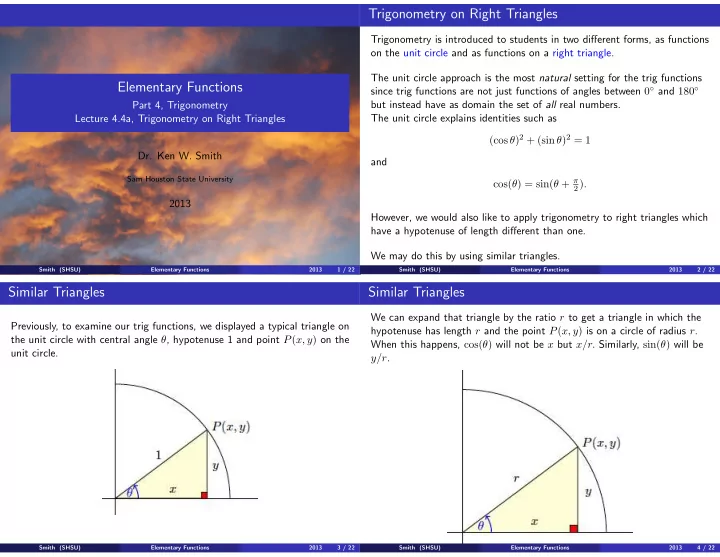
Trigonometry on Right Triangles Trigonometry is introduced to students in two different forms, as functions on the unit circle and as functions on a right triangle. The unit circle approach is the most natural setting for the trig functions


slide-1
SLIDE 1

Elementary Functions

Part 4, Trigonometry Lecture 4.4a, Trigonometry on Right Triangles

  • Dr. Ken W. Smith

Sam Houston State University

2013

Smith (SHSU) Elementary Functions 2013 1 / 22

Trigonometry on Right Triangles

Trigonometry is introduced to students in two different forms, as functions

  • n the unit circle and as functions on a right triangle.

The unit circle approach is the most natural setting for the trig functions since trig functions are not just functions of angles between 0◦ and 180◦ but instead have as domain the set of all real numbers. The unit circle explains identities such as (cos θ)2 + (sin θ)2 = 1 and cos(θ) = sin(θ + π

2 ).

However, we would also like to apply trigonometry to right triangles which have a hypotenuse of length different than one. We may do this by using similar triangles.

Smith (SHSU) Elementary Functions 2013 2 / 22

Similar Triangles

Previously, to examine our trig functions, we displayed a typical triangle on the unit circle with central angle θ, hypotenuse 1 and point P(x, y) on the unit circle.

Smith (SHSU) Elementary Functions 2013 3 / 22

Similar Triangles

We can expand that triangle by the ratio r to get a triangle in which the hypotenuse has length r and the point P(x, y) is on a circle of radius r. When this happens, cos(θ) will not be x but x/r. Similarly, sin(θ) will be y/r.

Smith (SHSU) Elementary Functions 2013 4 / 22

slide-2
SLIDE 2

Similar Triangles

Or – imagine a triangle with hypotenuse of length H, opposite side of length O, adjacent side of length A. The point P(x, y) sits on the circle of radius H and sin(θ) = O

A.

Smith (SHSU) Elementary Functions 2013 5 / 22

Similar Triangles

All of these triangles are similar and so the trig functions of the angle θ, as ratios of side lengths, are unchanged.

Smith (SHSU) Elementary Functions 2013 6 / 22

Similar Triangles

If we are willing to draw a right triangle and use the Pythagorean theorem, then we can solve any right triangle problem in which we are given a side and another angle. Some worked problems using similar triangles.

1 Find sec(θ) if sin(θ) = 3 5.

  • Solution. Draw a right triangle which has an angle with sin(θ) = 3

5.

(A 3-4-5 triangle will do.) Then compute the secant of the angle θ. The secant is the reciprocal of cosine and so sec(θ) = hyp adj = H A . The answer is 5

4.

Smith (SHSU) Elementary Functions 2013 7 / 22

Similar Triangles

2 Find tan(θ) if cos(θ) = 2 5.

  • Solution. Draw a right triangle which has an angle with cos(θ) = 2

5.

(The most obvious triangle will have a hypotenuse of length 5 and an side adjacent to θ with length 2.) The “opposite” side will then have length √ 21, by the Pythagorean Theorem. Compute the tangent of the angle θ. (Tangent is the ratio opp

adj .) The answer is √ 21 2 .

Smith (SHSU) Elementary Functions 2013 8 / 22

slide-3
SLIDE 3

Similar Triangles

3 Suppose sec θ = 7 2 and tan θ is negative. Find all six trig functions of

the angle θ.

  • Solution. Since the tangent is negative and cosine (= 2

7) is positive,

then we know x is positive and y is negative and so the angle θ points into the fourth quadrant. Draw a line segment of length 7 from the

  • rigin into the fourth quadrant, to a point P(2, y). By the

Pythagorean theorem, the absolute value of y is √ 72 − 22 = √ 45 = √ 9 · 5 = 3 √

  • 5. So y = −3

√ 5 and our line segment ends at the point P(2, −3 √ 5). Now read off the values of the various trig functions: cos θ = 2

7, sin θ = −3 √ 5 7

, tan θ = −3

√ 5 2

. The reciprocals of these are sec θ = 7

2, csc θ = − 7 3 √ 5 = − 7 √ 5 15 , cot θ = − 2 3 √ 5 = − 2 √ 5 15 .

Smith (SHSU) Elementary Functions 2013 9 / 22

Trig on right triangles

In the next presentation, we will apply our understanding of trigonometry to solving various right triangles. (End)

Smith (SHSU) Elementary Functions 2013 10 / 22

Elementary Functions

Part 4, Trigonometry Lecture 4.4b, Applications of Right Triangles

  • Dr. Ken W. Smith

Sam Houston State University

2013

Smith (SHSU) Elementary Functions 2013 11 / 22

Applications with right triangles

Anytime we have a right triangle, then, if we can measure one of the acute angles and also know the length of a side, then we know everything about the triangle. We will then find one of the acute angles of the triangle (such as θ, drawn in red) and we will also be able to find the length of one of the sides. Once we have this information, the lengths of the other two sides can be computed using our trig functions.

Smith (SHSU) Elementary Functions 2013 12 / 22

slide-4
SLIDE 4

Some worked problems

1 A radio tower is stands on a flat field. I walk 1000 feet away from the

base of the radio tower and look up at the top of the tower. I measure a 71◦ angle between the horizon and the top of the tower. How tall is the tower?

  • Solution. Draw a right triangle. The radio tower is a vertical line

perpendicular to the ground. (In the picture, this vertical line segment has length O.) Draw the ground as a horizontal line and mark the length of that horizontal line as A = 1000 feet. The hypotenuse makes an angle θ = 71◦ with the ground. The tangent of 71◦ is tan 71◦ = O

A = O

  • 1000. Solve for O:

O = 1000 · tan 71◦ ≈ 1000 · 2.904 = 2904 feet

Smith (SHSU) Elementary Functions 2013 13 / 22

Similar Triangles

2 I am flying a kite on the beach. The kite is attached to 3000 feet of

  • string. At the time that the string plays out the kite makes an angle

with the horizon of 38◦. Assuming that the 3000 feet of string is a straight line, how high is the kite?

  • Solution. Draw a picture. The kite, the person holding the kite and

the ground directly below the kite form three vertices of a right triangle with the right angle at the point on the ground directly below the kite. The hypotenuse of this right triangle is H = 3000 feet. The kite is O feet above the ground. The sine of θ = 38◦ is sin 38◦ = O

H = O 3000 and so O is equal to

O = 3000 · sin(38◦) ≈ 1847 feet .

Smith (SHSU) Elementary Functions 2013 14 / 22

Parallax

Astronomers use simple right triangles to find the distance to nearby stars. As the earth revolves around the sun, it marks out a ellipse (almost a circle) of radius 93 million miles. Over the course of the year, a nearby star should appear to move back and forth in the night sky as the earth revolves around the sun and so we should be able to measure that angle of apparent motion and use a right triangle (with one side equal to 93,000,000 miles) to compute that distance.

Smith (SHSU) Elementary Functions 2013 15 / 22

Parallax

Smith (SHSU) Elementary Functions 2013 16 / 22

slide-5
SLIDE 5

Parallax

Let the sun form a right angle vertex of a triangle. Set the earth and star as the other two vertices. If the star does not move, it would appear to form a right angle with the earth in this figure. But if the star is “nearby” then the line of sight to the star forms an angle α with the anticipated line of sight. The star appears to have moved.

Smith (SHSU) Elementary Functions 2013 17 / 22

Parallax

By a standard result from geometry, this angle α (the apparent motion of the star) is also the acute angle of the triangle at the vertex given by the star. If A is the distance from the star to the sun and O = 93, 000, 000 = 9.3 × 10⁷ miles then the cotangent of α is A

O and so

A = 9.3 × 10⁷ × cot α.

Smith (SHSU) Elementary Functions 2013 18 / 22

Parallax

The ancient Greeks thought of this idea and attempted to measure

  • parallax. But when they did this, the stars didn’t seem to move!! So either

this picture was wrong (maybe the earth was the center of the universe?)

  • r the stars must be billions of miles away! Convinced that the universe

could not be billions of miles in size, most Greeks agreed with Aristotle’s belief that the earth was the center of the universe and that the sun revolved around the earth. Now we know better – and indeed, with modern equipment, we have been able to measure the parallax of some stars.

Smith (SHSU) Elementary Functions 2013 19 / 22

A worked problem.

The closest star to us, Proxima Centauri has a parallax of 0.77”, that is, 0.77 arcseconds. How far away is Proxima Centauri?

  • Solution. A minute of arc is one-sixtieth of a degree; a second of arc is
  • ne-sixtieth of a minute. So an arcsecond is

1 602 = 1 3600 degrees. The

angle 0.77 arcseconds is equal to 0.77

602 = 0.77 3600 degrees. The tangent of this

angle is tan( 0.77

3600

  • ) ≈ 0.00000373307. The cotangent of 0.77

3600

  • is the

reciprocal of this, approximately 267876. So the distance to Proxima Centauri is 267876 · 93000000 = (2.67876 × 105) · (9.3 × 107) miles, about 2.49 × 10¹³ miles!

Smith (SHSU) Elementary Functions 2013 20 / 22

slide-6
SLIDE 6

A worked problem.

The distance to Proxima Centauri is 267876 · 93000000 = (2.67876 × 105) · (9.3 × 107) miles

  • r about 2.49 × 10¹³ miles!

The fastest rocket ever made reaches speeds of 25,000 miles per hour. A rocket traveling at that speed would take over one hundred thousand years to reach Proxima Centauri. Light travels about 5.879 × 10¹² miles in a year, so this distance is about 4.24 light years. And this is our closest star.... It is no wonder that the Greeks could not measure parallax; the universe is indeed unbelievably large!

Smith (SHSU) Elementary Functions 2013 21 / 22

Trig on Right Triangles

In the next presentation, we will look at graphs of the six trig functions. (End)

Smith (SHSU) Elementary Functions 2013 22 / 22