
SLIDE 1
Database Management Systems, R. Ramakrishnan and J. Gehrke 1
Tree-Structured Indexes
Database Management Systems, R. Ramakrishnan and J. Gehrke 2
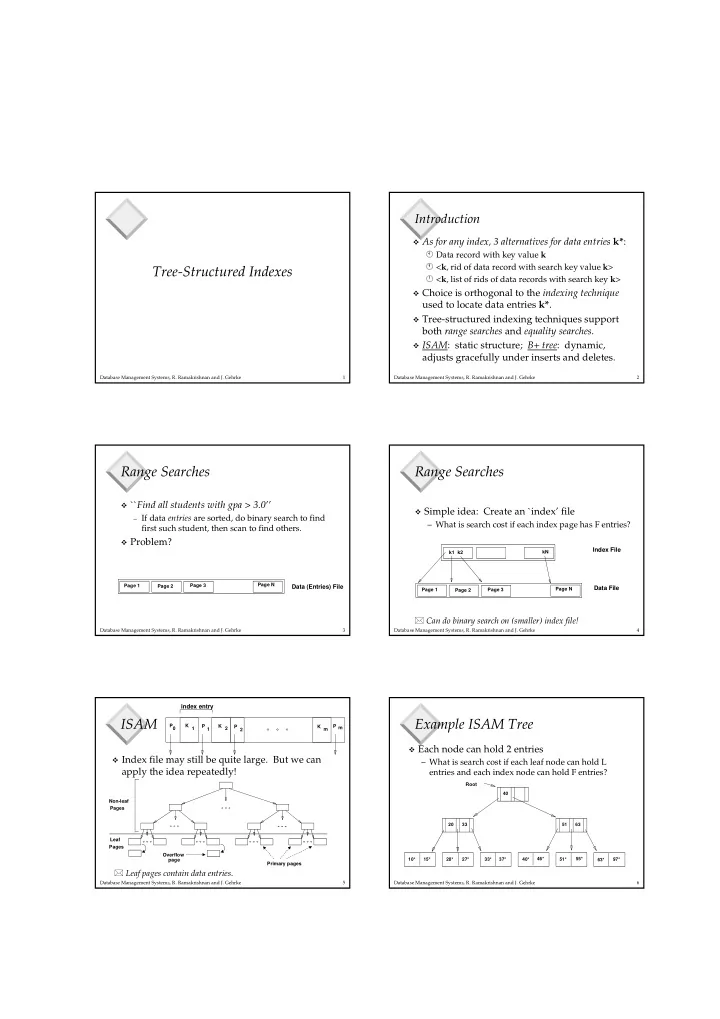
Introduction
As for any index, 3 alternatives for data entries k*:
Data record with key value k <k, rid of data record with search key value k> <k, list of rids of data records with search key k>
Choice is orthogonal to the indexing technique
used to locate data entries k*.
Tree-structured indexing techniques support
both range searches and equality searches.
ISAM: static structure; B+ tree: dynamic,
adjusts gracefully under inserts and deletes.
Database Management Systems, R. Ramakrishnan and J. Gehrke 3
Range Searches
``Find all students with gpa > 3.0’’
– If data entries are sorted, do binary search to find
first such student, then scan to find others.
Problem?
Page 1 Page 2 Page N Page 3
Data (Entries) File
Database Management Systems, R. Ramakrishnan and J. Gehrke 4
Range Searches
Simple idea: Create an `index’ file
– What is search cost if each index page has F entries? Can do binary search on (smaller) index file!
Page 1 Page 2 Page N Page 3
Data File
k2 kN k1
Index File
Database Management Systems, R. Ramakrishnan and J. Gehrke 5
ISAM
Index file may still be quite large. But we can
apply the idea repeatedly!
Leaf pages contain data entries.
P0 K 1 P 1 K 2 P 2 K m P m
index entry
Non-leaf Pages Pages Overflow page Primary pages Leaf Database Management Systems, R. Ramakrishnan and J. Gehrke 6
Example ISAM Tree
Each node can hold 2 entries
– What is search cost if each leaf node can hold L entries and each index node can hold F entries?
10* 15* 20* 27* 33* 37* 40* 46* 51* 55* 63* 97* 20 33 51 63 40 Root