
SLIDE 1
Transportation and Mobility
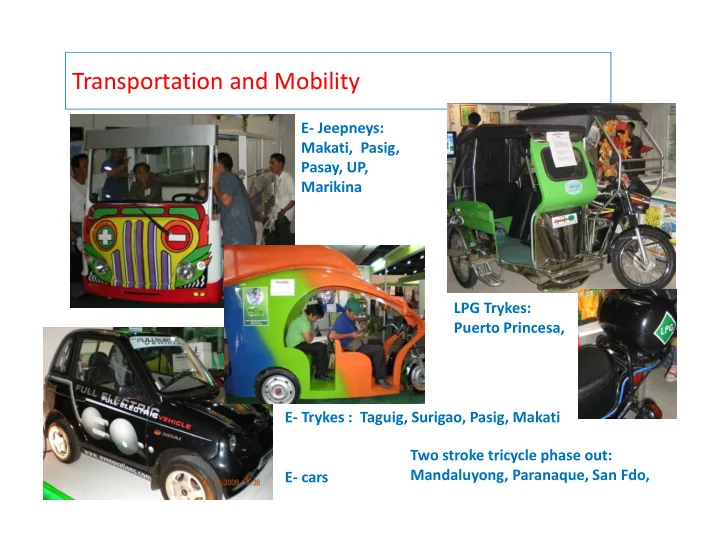
E- Trykes : Taguig, Surigao, Pasig, Makati E- Jeepneys: Makati, Pasig, Pasay, UP, Marikina E- cars LPG Trykes: Puerto Princesa, Two stroke tricycle phase out: Mandaluyong, Paranaque, San Fdo,
Transportation and Mobility E- Jeepneys: Makati, Pasig, Pasay, - - PowerPoint PPT Presentation
Transportation and Mobility E- Jeepneys: Makati, Pasig, Pasay, UP, Marikina LPG Trykes: Puerto Princesa, E- Trykes : Taguig, Surigao, Pasig, Makati Two stroke tricycle phase out: Mandaluyong, Paranaque, San Fdo, E- cars Transportation
E- Trykes : Taguig, Surigao, Pasig, Makati E- Jeepneys: Makati, Pasig, Pasay, UP, Marikina E- cars LPG Trykes: Puerto Princesa, Two stroke tricycle phase out: Mandaluyong, Paranaque, San Fdo,
E10 Fuel Economy Run
Payatas Garbage- to – Energy Project
during the project’s 10-year life.
community and Visayas Avenue Extension nearby.
Operated by Montalban Methane Power Corp. (MMPC) with an expected 500,000 carbon credits from the operations of its power plant at the Rodriguez landfill in the next five years. The P1.5-billion methane power plant began operations in 2009 with an initial output of two megawatts of electricity which is expected to increase to 15 megawatts of power per year, which can sustain roughly 15,000 households. The plant is expected to run through 1,500 tons of garbage per day from the 14 ha. landfill.
Philippine Business for the Environment
20 units of 70-meter high VestasV82-1.65MW wind turbines with a total capacity to 33MW
SMART’s “Alternative Power for Cell Sites” program uses renewable energy sources to power cell sites in “off-grid locations”
cell site is not normally feasible. To date, Smart has about 68 cell sites in different areas across the Philippines powered by renewable energy. Of this figure, 41 are run by wind energy while 27 are hybrid – using both wind and solar energy. Benefits of the program include reduced
lower diesel consumption, reduced oil spills and carbon emissions, better community relations and seamless data/ voice service in off-grid areas.
Barcelona, Spain on Feb 18, 2009 SMART is awarded the very first Green Mobile Award given by the worldwide industry association for the company's use of alternative power (wind/ solar) for cell sites in remote areas.
Sustainable Energy
Avon Manufacturing facility at the Calamba Premier International Park-- distribution of power, water, lighting and air conditioning is computer controlled; heavy investment in ozone – friendly refrigerants. Avon chose refrigerant 134A, which has zero ozone impact Bayerhouse - uses a raised floor system for efficient and flexible office layout. Its windows are thermally insulated to cut energy consumption for heat ventilation, air conditioning and natural daylight use; second runner up in 2005 Asean Energy Awards
Philippine Green Building Council’s Eco - Home
Sustainable Community Planning:
www.ayalaland.com.ph.
Master planned communities: seeking to integrate economic, social and environmental objectives in community development environmentally sustainable design architecture and planning 50% balance between open and built spaces; healthy tree-to-house ratio to reduce soil erosion and encourage water retention 4-hectare lake serving as a rainwater catchment area for the dual-piping system permeable road paving that help recharge the aquifer and reduce downstream effects waste management system and also operate sewage treatment plants green buildings
heat insulation and sun-shading to avoid direct sunlight
(March 31, 2009) – Texas Instruments Incorporated (TI) (NYSE: TXN) today
announced that its newest building in the Philippines, located in Baguio City, is now LEED (Leadership in Energy and Environmental Design) certified, making it the first LEED-certified building in the country. It is oriented with respect to the sun path to minimize unwanted heat gain and maximize natural
reduce heat gain. The efficiency measures resulted in a 24 percent reduction in energy use. Extensive water reuse and recycling resulted in a 70 percent reduction in water consumption.
Texas Instruments' Philippines, Inc. building earns the first LEED certification in the country
Berde – “Building for Ecologically Responsive Design Excellence” rating system of the Philippine Green Building Council
criteria as basis for awarding green certification in terms of environment-friendliness using a rating system of 1 to 5
Philippine Business for the Environment
Methodology ACM0014/Version 02.1 World Bank Community Development Carbon Fund (CDCF)
Philippine Business for the Environment
Near Central Azucarera de La Carlota, Inc., a raw sugar mill, at Barangay Roberto S. Benedicto/Nagasi, La Carlota City, Negros Occidental
Initial ethanol production volume of 100,000 liters per day Methane generation of 34,450 cubic meters per day Raw Material: Molasses of at least 365 tons per day Major components of the facility are: Ethanol manufacture Slops treatment Concentration and Waste to energy conversion
provided by a contractor on a turnkey basis.
Source: JTMijares, May 2009 Presentation at PBE Seminar
to the atmosphere, the most significant being CO2. Holcim is reducing its demand for natural resources and its CO2 emissions per tonne of product by replacing fossil fuels and raw materials with waste and industrial by-products.
Quarrying & Raw materials preparatioin
Clinker production Cement grinding and distribution
Rainwater collection Wastewater Reuse
Component Material
cotton, wool
GreenChoice Philippines
RECYCLED /REUSABLE PRODUCTS
Nike Trash Talk basketball shoes made of recycled materials while meeting company’s stringent on-court performance requirements
synthetic leather waste generated by the company’s own factories.
while theoutsole incorporates the so- called Nike Grind, which is made up
shoes.
cardboard shoebox.
Nokia prototype phone using the “Remade” concept of developing products out of recycled materials.
aluminum cans
from soft drink bottles
automobile tires.
Hewlett-Packard ink- cartridge recycling program for inkjet
cartridges
recycled content has already manufactured
cartridges and diverted about 8.8 million pounds
landfills.
Healthier, Organic or locally produced/ pesticide – free food products; Household products free from harmful chemicals/ fertilizers
easily reduced in volume
Eco – design
reduced the materials by redesigning the flute; Every aspect performs a function, giving strength and rigidity to the bottle, but webbed structure of the bottle also gives it an iceberg shape so it can be easily compressed for disposal.
Aimed to reduce the environmental impact of the international sports tournament through
through wider use of public transport and clean energy source
In the 12 stadiums, tanks were installed to recover rainwater to be used for the sanitation system and the men's room urinals are cleaned automatically, without using water. With the aim of curbing vehicle use, the admission tickets for the 64 matches allow the fans to ride public transportation services free of charge within a 24-hour period. In some stadiums, electricity is produced by solar cells for train stations and other public spaces. Total solar energy generation for the World Cup will be around 2,500 kilowatts during peak hours. Instead of buying beverages in throwaway bottles or cans, drinks will be sold in recyclable containers. Expected 100,000 tons carbon dioxide from the flights and local travel of the 3.2 million tourists who will visit the World Cup will be offset by an investment by the German government of some 1.5 billion dollars in environmental protection projects in Africa and Asia in a green credit exchange, and installations in India that produce biogas from fermented cattle manure to supplant the use of fossil fuels in community kitchens there Efforts to reduce energy consumption during the international football tournament include recovering heat from the air conditioning systems of all of the stadiums and using highly efficient, emission-free gas boilers, as well as low-energy lightbulbs.
(Case Example): Carbon footprint for air travel to BAQ 2008? Ref: Air Mile Calculator - http://www.airtimetable.com/Air_mile_calculator.htm / www.webflyer.com/travel/milemarker/index.php
Within Asia (0.24 kgCO2/mile) Outside Asia (0.18 kgCO2/mile)
Climate-friendly BAQ
The BAQ 2008 Organizing Committee is doing its share to reduce this year's carbon footprint through the following:
Participants are encouraged to be aware of the carbon footprint of their flight to Bangkok, and to take personal measures to reduce their impact on climate change. Participants who apply for sponsorship will need to submit the BAQ Carbon Pledge upon confirmation of their sponsorship.
Previous BAQs made use of bottled water during plenary, sub-plenary, subworkshops, pre-events
committee agreed with the IQP to avoid the use of bottled waters during the workshop.
The previous BAQs spent an average of up to 500 reams of paper (250,000 pages) for hand-outs - equivalent to 4,204 kg CO2. For BAQ 2008, the Organizing Committee shall limit the hand-outs to be given and shall provide soft copies of the presentations and other pertinent documents
copies) which is roughly equivalent to 1,177 kg CO2. This year the BAQ organizing committee will not print a Compendium of Abstracts and will instead post in the BAQ website the abstracts a week before BAQ. BAQ 2008 will also reduce availability of photocopied materials by at least 30%.
Climate-friendly BAQ continued
CO2 Previous BAQs shuttled participants between hotels and the venue as well as hotels and the social event venues. This is the first BAQ wherein the participants will not have to ride buses from their hotels to the venue of the event. The Organizing Committee of the BAQ has made it a point that the participants be housed in hotels which are near the venue to eliminate unecessary travel and CO2 emissions. The venue for BAQ 2008, Imperial Queen's Park Hotel, is also a short walk away from the train station. The total estimated distance travelled for the shuttles was 500km, equivalent to 95kg CO2.
The BAQ Organizing Committee will implement a cool-biz approach for BAQ 2008. This year, the organizers are encouraging the participants to wear light business attire (no coats, jackets and ties) so they feel cool during the workshop while the temperatures of air conditioners are set at 26 degrees Celsius. It is fortunate that during the month of November, the average temperature in Bangkok is about 27 degrees Celsius.
– implementation of a large – scale home – based working project called Workabout for 13,000 home – based employees – Reduces travel time, travel – related CO2 emissions, company overhead, increase work efficiency
BT 2007 Sustainability Report
PET and other plastics Aluminum and Tin Cans E- waste Junk car batteries Used ink cartridges
36
Source: GHG Protocol, www.ghgprotocol.org
Source: Manila Water Co Sustainability Report, 2008
38
Packaging companies worldwide are taking stock of their environmental impacts specifically their carbon emissions!
Development Bank Land Bank
Philippines Philippines Central Luzon Doctors’ Hospital
Some Users of GHG Protocol Corporate Standard in the Philippines