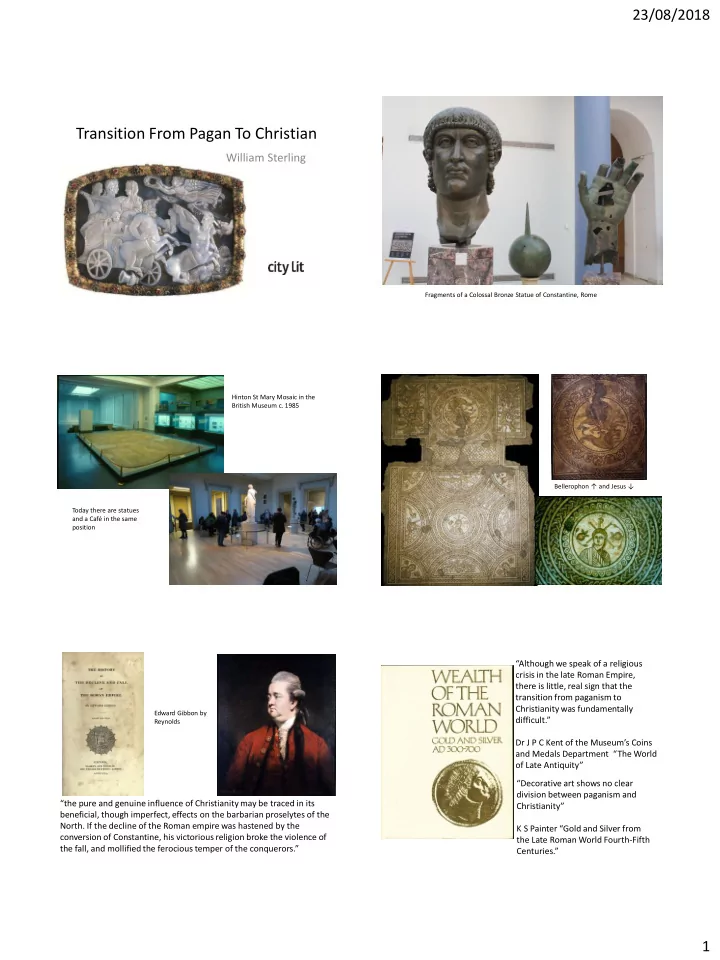
Transition From Pagan To Christian William Sterling Fragments of a - - PDF document

transition from pagan to christian
SMART_READER_LITE
LIVE PREVIEW

Transition From Pagan To Christian William Sterling Fragments of a - - PDF document

23/08/2018 Transition From Pagan To Christian William Sterling Fragments of a Colossal Bronze Statue of Constantine, Rome Hinton St Mary Mosaic in the British Museum c. 1985 Bellerophon and Jesus Today there are statues and a Caf


slide-1
SLIDE 1

23/08/2018 1

Transition From Pagan To Christian

William Sterling

Fragments of a Colossal Bronze Statue of Constantine, Rome Hinton St Mary Mosaic in the British Museum c. 1985 Today there are statues and a Café in the same position Bellerophon ↑ and Jesus ↓

“the pure and genuine influence of Christianity may be traced in its beneficial, though imperfect, effects on the barbarian proselytes of the

  • North. If the decline of the Roman empire was hastened by the

conversion of Constantine, his victorious religion broke the violence of the fall, and mollified the ferocious temper of the conquerors.”

Edward Gibbon by Reynolds

“Although we speak of a religious crisis in the late Roman Empire, there is little, real sign that the transition from paganism to Christianity was fundamentally difficult.” Dr J P C Kent of the Museum’s Coins and Medals Department “The World

  • f Late Antiquity”

“Decorative art shows no clear division between paganism and Christianity” K S Painter “Gold and Silver from the Late Roman World Fourth-Fifth Centuries.”

slide-2
SLIDE 2

23/08/2018 2

“The new religion and new ecclesiastical practices were a steady focal point around which the new ideological currents and social realignments revolved, as Christianity gradually penetrated the various social strata before becoming the official religion of the

  • state. At the same time, important

aspects of the classical spirit and civilisation still survived to complete our picture of late antiquity.” Eutychia Kourkoutidou-Nicolaidou “From the Elysian Fields to the Christian paradise” “The Christian culture that would emerge in late antiquity carried more of the genes of its “pagan” ancestry than of the peculiarly Christian mutations.” Wayne A Meeks “Social and ecclesial life of the earliest Christians” “I don’t think there was ever anything wrong with the ancient world. It was perfectly fine the way it was - before it

  • changed. And I knew whom to

blame.”

Jacques Carrey’s Drawings of the Parthenon Pediments 1674

slide-3
SLIDE 3

23/08/2018 3

Bronze Statuette of Nero as Alexander from Gaul found in Suffolk, British Museum Marble bust of Trajan celebrating his Decennalia in 107/8 Carved gem of Decius, British Museum Marble bust of Diocletian, Istanbul Coin of Galerius, British Museum Coin of Licinius I, British Museum Constantine’s Arch The Inscription on Constantine’s Arch translates as: “To the Emperor Caesar Flavius Constantinus, the greatest, pious, and blessed Augustus: because he, inspired by the divine (or divinity), and by the greatness of his mind, has delivered the state from the tyrant and all of his followers at the same time, with his army and just force of arms, the Senate and People of Rome have dedicated this arch, decorated with triumphs” Spread of Christianity Dark Blue before Constantine, Light Blue up to c. 600

slide-4
SLIDE 4

23/08/2018 4

Fragments of the Colossal Acrolithic Statue, Rome with helpful tourist to show scale Reconstruction of Constantine Statue from the New Basilica in Rome Jupiter based on the Statue of Zeus at Olympia, British Museum The Great Cameo showing Constantine with his family crowned by the goddess of Victory and a chariot drawn by centaurs, Leiden Helena with a reworked head on an earlier statue ← (Rome) and a pepper pot from the Hoxne hoard (British Museum) Helena’s Sarcophagus, Vatican Cameo of Constantine being crowned by Constantinople Coin of Constantine from 313 with Sol Invictus behind him

slide-5
SLIDE 5

23/08/2018 5

Constantine and family watching the chariot racing in Constantinople from the base of the obelisk in the Circus Maximus of the new city Mosaic of Charioteer Eros from Tunisia C4th Terracotta bowl with charioteer c. 375 Silver dish showing the triumph of Constantius II with a Chi-Rho on a shield but Victoria crowning him Silver gilt missorium

  • f Theodosius I to

celebrate his decennalia 388 still using Classical figures at the bottom

ΙΧΘΥΣ

Iota (i) for Iēsous (Ἰησοῦς) - Jesus Chi (ch) for Christos (Χριστός) - anointed Theta (th) for Theou (Θεοῦ) - God's Upsilon (y) for (h)yios (Ὑἱός) - Son Sigma (s) for sōtēr (Σωτήρ) - Saviour

Early Christian inscription from Ephesus

slide-6
SLIDE 6

23/08/2018 6

Triclinium mosaic from Populonia, BM Fish and bread from Roman catacombs Fish in a spoon from Thetford Hoard C4th, BM Fish dish from Kaiseraugst 351 Christian funerary stele for Licinia Amias early C3rd Rome – note Dis Manibus, fish and anchor Gravestone for Titus Valerius Pudens C1st Lincoln, BM – note dolphins (ie fish in Roman terms) and trident Two Roman marriage rings C4th and C5th, British Museum Jason and the Golden Fleece Red Figure Attic Plate Roman Sarcophagus c. 250, British Museum Jonah Sarcophagus c. 280-300, British Museum – note lamb and peacock

slide-7
SLIDE 7

23/08/2018 7

Sarcophagus from Cemetery of St Calixtus Rome showing typical Marriage roundel with Jonah beneath Jonah Sarcophagi from Rome ↑ and British Museum is↓ Jonah figure from 250-280 now in Cleveland Museum Moschophoros c. 570 BC Roman copy of Kriophoros of Kalamis The Good Shepherd from the catacombs of Domitilla Rome Silver bowl from the Carthage Treasure C4th, British Museum

slide-8
SLIDE 8

23/08/2018 8

Christian Baptistry at Dura Europos Syria with the good shepherd and Adam and Eve prior to 256 Good Shepherd from the Catacomb of Priscilla, 250–300 Mercury from the Chaourse Hoard C3rd, BM Good Shepherd Roman catacombs C2nd Roman ivory boxes with pastoral scenes, British Museum Marble table leg from Thessaloniki c 350-400 Roman rings with pastoral scenes, British Museum

slide-9
SLIDE 9

23/08/2018 9

Silver plate from the Klimova Hoard 527-565 Sarcophagus of Livia Primitiva with fish, good shepherd and anchor Marble worshippers with Orans arms, British Museum Shedrak, Meshack and Abednego in the Burning Fiery Furnace from the Roman catacombs Noah and dove from the Roman catacombs Catacombs of Domitilla Roman Villa at Lullingstone C4th, British Museum Lullingstone

slide-10
SLIDE 10

23/08/2018 10

Head of Mercury from Uley, British Museum Two ivory panels showing Bellerophon killing the Chimera and the apotheosis of a Roman emperor with old gods including Sol probably dating form the reign of Gratian 375-383, British Museum The Projecta Casket from the Esquiline Treasure mid C4th, British Museum – Venus riding in her giant shell supported by Tritons is mirrored below by Projecta herself Top of the Casket with Inscription: Secunde et Proiecta Vivatis in Christo – Secundus and Projecta may you live in Christ Muse Casket and Tyche of Constantinople from the Esquiline Treasure Saucepan from Esquiline Treasure with Venus and Adonis, Louvre Silver saucepan from Algeria with Neptune and dolphins C6th

slide-11
SLIDE 11

23/08/2018 11

Statuette of Venus from the Kaiseraugst hoard 350-1 Silver flak with Nereid and sea creatures dating from Constans II 641- 651 now in Russia Nereid from Projecta casket Nereid from Byzantine silk c. 600 used as relic wrapping now I Switzerland Eros on a sea creature C6th, British Museum Thetford Hoard C4th, British Museum The Great Dish from the Mildenhall Treasure, British Museum Mildenhall silver Mildenhall ladle and spoons

slide-12
SLIDE 12

23/08/2018 12

Votive plaques from Stony Stratford ↑ and Barkway ← and →, British Museum Votive plaques from Ashwell, British Museum ↑ Votive plaques from Water Newton → and ← British Museum Silver bowl with cover from Mildenhall with centaurs and giant heads Mildenhall bowl with pastoral scenes and giant heads Kaiseraugst dish with pastoral scenes and giant heads Achilles plate from the Kaiseraugst Treasure

slide-13
SLIDE 13

23/08/2018 13

Silver dish with Meleager and Atalanta from reign of Heraclius 613-629 Russia Cyprus Treasure 641-651 with St Stephen or St Bacchus, British Museum Spoon from the Cyprus Treasure c. 600 British Museum Spoons from the Butchery Lane Hoard Canterbury Items from the Carthage Treasure C4th, British Museum

slide-14
SLIDE 14

23/08/2018 14

Hercules on the Mildenhall Great Dish Hercules wrestling Antaeus from the Hoxne Treasure Byzantine gold medallion with Hercules, British Museum Bottom of a glass showing a couple with a statue of Hercules from a Christian burial, British Museum Chaourse hoard Water Newton Pepper pot from the Chaourse Hoard mid C3rd, British Museum Pepper pot from the Hoxne Treasure early C5th, British Museum The Franks Casket c. 700 Northumbria, British Museum