Transient Capability of a Multi-group Pin Homogenized SP 3 Code - - PDF document

transient capability of a multi group pin homogenized sp
SMART_READER_LITE
LIVE PREVIEW

Transient Capability of a Multi-group Pin Homogenized SP 3 Code - - PDF document

Transactions of the Korean Nuclear Society Virtual Spring Meeting July 9-10, 2020 Transient Capability of a Multi-group Pin Homogenized SP 3 Code SPHINCS Hyun Ho Cho 1) , Junsu Kang 1) , Joo Il Yoon 2) and Han Gyu Joo 1)* Seoul National University,


slide-1
SLIDE 1

Transient Capability of a Multi-group Pin Homogenized SP3 Code SPHINCS

Hyun Ho Cho1), Junsu Kang1), Joo Il Yoon2) and Han Gyu Joo1)* Seoul National University, 1 Gwanak-ro, Gwanak-Gu, Seoul, 08826, Korea1) KEPCO Nuclear Fuel Co. Ltd., 242, Daedoek-daero 989beon-gil, Yuseong-gu, Daejeon, 34057, Korea2)

*Corresponding author: joohan@snu.ac.kr

  • 1. Introduction

The conventional two-step method is still a powerful and practical tool for nuclear design and analyses which involve repeated steady-state and transient calculations with reasonable accuracy. In this regard, nTRACER/SPHINCS advanced two-step calculation system employing the simplified P3 (SP3) method utilizing pin-homogenized group constants (GCs) and pin-sized finite difference method (FDM) is developed at Seoul National University [1]. The C5G7-TD benchmark (Deterministic Time Dependent Neutron Transport Benchmark without Spatial Homogenization) [2] is proposed to ensure reliable modeling of reactor physics based on neutron kinetics equations without the use of diffusion approximation and spatial homogenization. It contains six series of space-time neutron kinetics test problems with a heterogeneous domain description for solving the time-dependent multi-group neutron transport equation without feedbacks. Recently, the transient capability of nTRACER [3], direct whole core transport code, has been examined with C5G7-TD [4]. In accordance with the purpose aiming for analyzing space-time neutron transport equation with heterogeneous domain description, the C5G7-TD benchmark problems were solved by nTRACER employing faithful models of the core configuration and transient control parameters. However because of its large computational burden as well as computing time, in order to establish an efficient core analyses system, conventional two-step method is still required. In this regard, for the complete pin-by-pin core analyses, a transient calculation module has been recently implemented in the SPHINCS code. The transient capability of SPHINCS involves the solution of the time-dependent SP3 equation that is properly reformulated to be applicable to the FDM

  • solver. In the nTRACER/SPHINCS pin-wise two-step

calculation system, nTRACER provides pin- homogenized GCs by single assembly level calculations. SPHINCS then performs core calculation based on pin- wise GCs with super-homogenization (SPH) factors. In this work, the implementation of the transient calculation features of SPHINCS is provided and the assessment of that is done solving C5G7-TD.

  • 2. Derivation of Time Dependent SP3 Equation

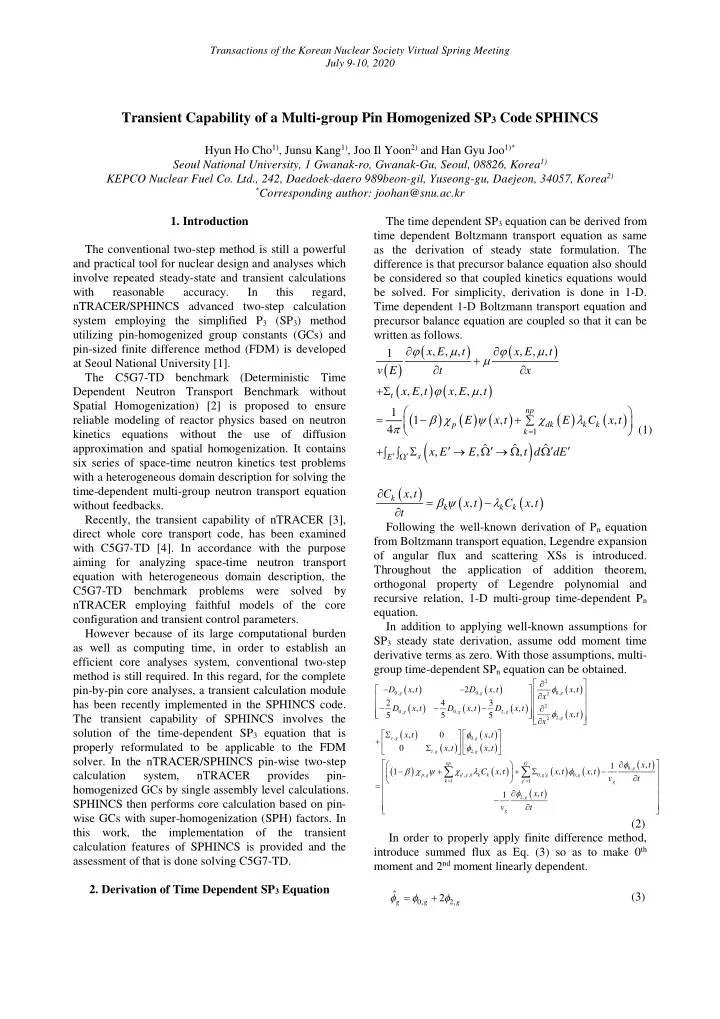
The time dependent SP3 equation can be derived from time dependent Boltzmann transport equation as same as the derivation of steady state formulation. The difference is that precursor balance equation also should be considered so that coupled kinetics equations would be solved. For simplicity, derivation is done in 1-D. Time dependent 1-D Boltzmann transport equation and precursor balance equation are coupled so that it can be written as follows.

( ) ( ) ( ) ( ) ( ) ( ) ( ) ( ) ( ) ( )

( )

( ) ( ) ( )

1

, , , , , , 1 , , , , , 1 1 , , 4 ˆ ˆ ˆ , , , , , ,

t np p dk k k k s E k k k k

x E t x E t v E t x x E t x E t E x t E C x t x E E t d dE C x t x t C x t t ϕ µ ϕ µ µ ϕ µ β χ ψ χ λ π β ψ λ

= ′ ′ Ω

∂ ∂ + ∂ ∂ +Σ   = − + ∑     ′ ′ ′ ′ + Σ → Ω → Ω Ω ∫ ∫ ∂ = − ∂ (1) Following the well-known derivation of Pn equation from Boltzmann transport equation, Legendre expansion

  • f angular flux and scattering XSs is introduced.

Throughout the application of addition theorem,

  • rthogonal property of Legendre polynomial and

recursive relation, 1-D multi-group time-dependent Pn equation. In addition to applying well-known assumptions for SP3 steady state derivation, assume odd moment time derivative terms as zero. With those assumptions, multi- group time-dependent SPn equation can be obtained.

( ) ( ) ( ) ( ) ( ) ( ) ( ) ( ) ( ) ( ) ( ) ( ) ( ) ( ) ( )

2 0, 0, 0, 2 2 0, 0, 2, 2, 2 , 0, , 2, , , , 0, 0, 1 1

, , 2 , 2 4 3 , , , , 5 5 5 , , , , 1 1 , , ,

g g g g g g g r g g t g g np G p g d g k k k g g g k g g

x t D x t D x t x D x t D x t D x t x t x x t x t x t x t C x t x t x t v φ φ φ φ φ β χ ψ χ λ φ

′ ′ = =

  ∂   − −   ∂       − − −  ∂        ∂       Σ +     Σ     ∂   − + + Σ −     =

∑ ∑

( ) ( )

0, 2,

, , 1

g g g

x t t x t v t φ     ∂     ∂   −   ∂  

(2) In order to properly apply finite difference method, introduce summed flux as Eq. (3) so as to make 0th moment and 2nd moment linearly dependent.

0, 2,

ˆ 2

g g g

φ φ φ = +

(3)

Transactions of the Korean Nuclear Society Virtual Spring Meeting July 9-10, 2020

slide-2
SLIDE 2

With time discretization, multi-group time-dependent SP3 equation re-formulated for finite difference method is as follows.

( ) ( ) ( ) ( ) ( ) ( ) ( ) ( ) ( ) ( ) ( ) ( )

2 1 1 1 1 0, , , 2 2 1 1 1 1 1 2, , 2, , , 2 1 0, 0, 1 0,

1 2 , , 2 , ˆ , 2 2 4 5 3 , , , , , 3 3 3 3 1 , , 2 1 , 3

n n n n g r g r g g g g n n n n n g r g g r g t g g g n n g g g n g

d D x t x t x t x t dx v t v t d x t x t D x t x t x t v t dx v t q x t x t v t q x t φ φ φ

+ + + + + + + + + + +

  − + Σ + − Σ −     ∆ ∆             − Σ − − + Σ + Σ + ∆ ∆     + ∆ = − +

( ) ( )

0, 2,

5 , , 3

n n g g g g

x t x t v t v t φ φ             +     ∆ ∆      

(4) In this formulation, main difference compared to time-independent SP3 equation is the augmentation of removal cross section.

  • 3. Core Modeling and Group Constants & SPH

Factors Generation Radial geometry of the C5G7-TD core is exactly same as that of the C5G7-MOX benchmark core. In nTRACER modeling, sufficient number of flat source regions were used and the ray tracing parameters as well as sub-pin modeling were applied identically for both group constants generation and the reference solution

  • generation. Simple Crank-Nicolson method was used as

temporal discretization scheme in nTRACER and 2.5ms time step size was used and finite time discretization whose time step size is same as that of nTRACER was used in SPHINCS. In the C5G7-TD problem sets, postulated transient event is approximated as a step change or ramp change

  • f material composition as well as change of moderator

density. When utilizing pin-homogenized GCs generated in single assembly unit into two-step calculation, SPH method is introduced in SPHINCS in

  • rder to reduce pin-homogenization error.

Unless proper SPH factors are incorporated into pin- homogenized GCs, the effect of rod insertion would be distorted as shown in Fig. 1 and Fig. 2. Each figure shows the necessity of generating SPH factors throughout the core power behavior and reactivity change respectively using TD1-5 problem. Fractional total core fission rate shown in Fig. 1 shows about - 7.5% discrepancy and reactivity change also shows large difference. At that time step of maximum difference of total core fission rate, pin power distribution has even much more discrepancy. Largest pin power difference is about -17% so that it can be said that the postulated system is completely wrong. However when properly generated SPH factors are incorporated into pin-homogenized GCs, large discrepancy disappears and the comparison of results show excellent agreement.

Fig.1. Necessity of generation of SPH factors with core power behavior for TD1-5 problem

  • Fig. 2. Necessity of generation of SPH factors with reactivity

change for TD1-5 problem

  • 4. Analyses of 2-D Problems

The 2-D problems consist of TD0 through TD3 problems that contain their

  • wn sub-problems.

Simulation of a postulated control rod insertion and withdrawal event is modeled by time-dependent change in the cross sections which is step change for TD0 and ramp change for TD1 and TD2. The TD3 problem involves the ramp changes in the moderator density. 4.1. TD0-Set with 5 sub-problems The TD0 problems postulate control rod insertion and withdrawal as a step change of the material composition. It is assumed that all the control rods are fully removed from the core initially and the transient is initiated by an abrupt control rod insertion. Detailed control rod movement is depicted in benchmark specifications [2]. Pin-wise GCs and incorporated SPH factors are generated for every type of fuel assemblies at each fractional control rod insertion points. In other words, 10% and 5% of rod insertion cases respectively for initial 1s and next 1s are considered. For all the sub-problems for TD0, results of SPHINCS show excellent agreement compared with those of nTRACER in spite of abrupt step-wise rod

Transactions of the Korean Nuclear Society Virtual Spring Meeting July 9-10, 2020

slide-3
SLIDE 3

insertion and withdrawal. Comparison of fractional total core fission rate as well as core reactivity is shown in

  • Fig. 3 and Fig. 4 respectively and the agreement

between those appears excellent.

  • Fig. 3. Comparison of core power behavior for TD0

between SPHINCS and nTRACER

  • Fig. 4. Comparison of reactivity change for TD0 between

SPHINCS and nTRACER

4.2. TD1-Set with 5 sub-problems The TD1 problems consists of control rod insertion and withdrawal cases with a ramp change reaching maximum 1% change of the material composition. Linear replacement of the moderator-filled guide tube material by the control rod material increases during initial 1s and the returns to 0 for another 1s. Pin-wise GCs and corresponding SPH factors are generated for each type of assemblies at the maximum rod insertion point, i.e. 1s. For all the cases of TD1 set, transient calculation results of SPHINCS show excellent agreement for power behavior as well as reactivity change compared with those of nTRACER as shown in Fig. 5 and Fig. 6.

  • Fig. 5. Comparison of core power behavior for TD1

between SPHINCS and nTRACER

  • Fig. 6. Comparison of reactivity change for TD1 between

SPHINCS and nTRACER

4.3. TD2-Set with 5 sub-problems TD2 problems also have 5 sub-problems and their transient simulation is similar to TD1 but difference is control rod insertion magnitude. Maximum depth that the control rods can reach is ten times larger than TD1, which is 10% change of the material composition. Perturbation of material composition happens in a linear manner as same as TD1. As same as in TD1, SPHINCS results of all the sub- problems for TD2 show excellent agreement compared with those of nTRACER in aspect of both fractional total core fission rate and reactivity change as shown in

  • Fig. 7 and Fig. 8.

4.4. TD3-Set with 4 sub-problems The TD3 problems are intended as a simulation of a transient event of the change of core moderator density and contain 4 sub-problems according to the rate of change of moderator density. The moderator density in all fuel assemblies starts to decrease linearly before reaching its minima after 1s into the transient and then returns to its initial value within next 1s. Therefore pin- wise GCs and SPH factors for each type of fuel

Transactions of the Korean Nuclear Society Virtual Spring Meeting July 9-10, 2020

slide-4
SLIDE 4

assembly are generated at the minimum moderator density point. The results of SPHINCS for all the sub-problems show excellent agreement compared with those of nTRACER for both power behavior and reactivity change as shown in Fig. 9 and Fig. 10.

  • Fig. 7. Comparison of core power behavior for TD2

between SPHINCS and nTRACER

  • Fig. 8. Comparison of reactivity change for TD2 between

SPHINCS and nTRACER

  • Fig. 9. Comparison of core power behavior for TD3

between SPHINCS and nTRACER

  • Fig. 10. Comparison of reactivity change for TD3 between

SPHINCS and nTRACER

  • 4. Conclusion

For the complete pin-by-pin core analyses, a transient calculation module has been implemented in the SPHINCS code with a proper reformulation of multi- group time-dependent SP3 equation applicable to the finite difference method. All the 2-D problems of C5G7-TD benchmark were analyzed by SPHINCS and compared with the corresponding nTRACER direct whole core solutions. Utilizing pin-homogenized GCs incorporated with SPH factors, the results of SPHINCS show excellent agreement compared with those of nTRACER for all the 2-D problems of C5G7-TD. It turned out that the SPH factors generated for single assembly at the reference condition work well in the core during the off-reference transient conditions. SPH factors also make pin-sized FDM available so that it is essential to generate those in core analyses. The excellent agreement of the pin-homogenized transient solutions with the direct whole core solutions confirms the soundness of nTRACER/SPHINCS two-step core analyses system for both steady-state and transient calculations. REFERENCES

[1] H. H. Cho, H. Hong, H. G. Lee and H. G. Joo, Preliminary Development of Simplified P3 based Pin-by-pin Core Simulator SPHINCS, Transactions of the Korean Nuclear Society Spring Meeting, Jeju, Korea, May 23-24, 2019. [2] V. F. Boyarinov, P. A. Fomichenko, J. Hou and K. Ivanov, Deterministic Time-Dependent Neutron Transport Benchmark without Spatial Homogenization (C5G7-TD), NEA/NSC/DOC, 2016. [3] Y. S. Jung, C. B. Shim, C. H. Lim and H. G. Joo, Practical Numerical Reactor Employing Direct Whole Core Neutron Transport and Subchannel thermal/hydraulic solvers, Annals

  • f Nuclear Energy, Vol. 62, p.357-374, 2013.

[4] M. Ryu and H. G. Joo, nTRACER Whole Core Transport Solutions to C5G7-TD Benchmark, M&C 2017, Jeju, Korea, April 16-20, 2017 Transactions of the Korean Nuclear Society Virtual Spring Meeting July 9-10, 2020