SLIDE 21 Marine Environment Laboratories Monaco International Atomic Energy Agency
- Dept. of Nuclear Sciences and Applications
Conclusions……
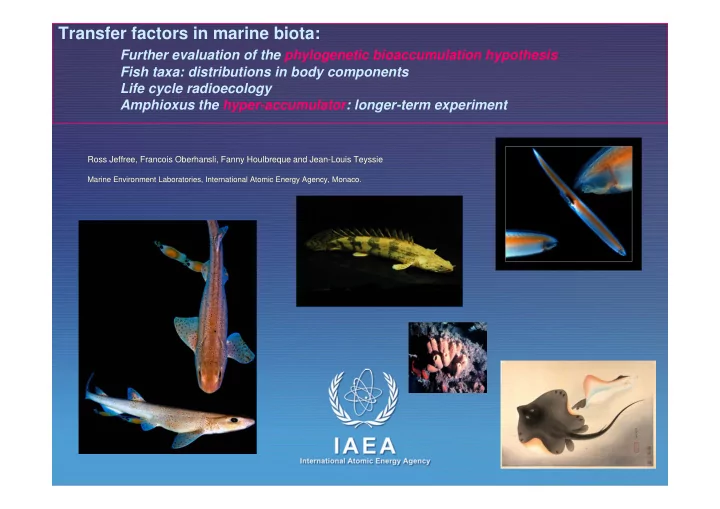
- Results are still generally consistent with the working hypothesis of phylogenetically-based
bioaccumulation patterns in marine fishes, freshwater fishes, cephalochordata and sponges, based on whole body: water CFs, viz.;
– Different between species and higher taxonomic categories – Differences tend to be greater with longer period of evolutionary divergence
- What physiological/ anatomical differences are driving the contrasts in bioaccumulation patterns?
– Data for CFs in six dissected body compartments show strong contrasts between
bony and cartilagenous fishes; radiological implications
– Still to interpret in terms of well established differences between teleosts and
chondrichthyans in physiology and anatomy
- Comprehensive life history radioecology
- done for humans, so worth considering for other selected biota
- Amphioxus
– Bioaccumulation capacity is confirmed and indicated to be greater than initially
indicated