SLIDE 1
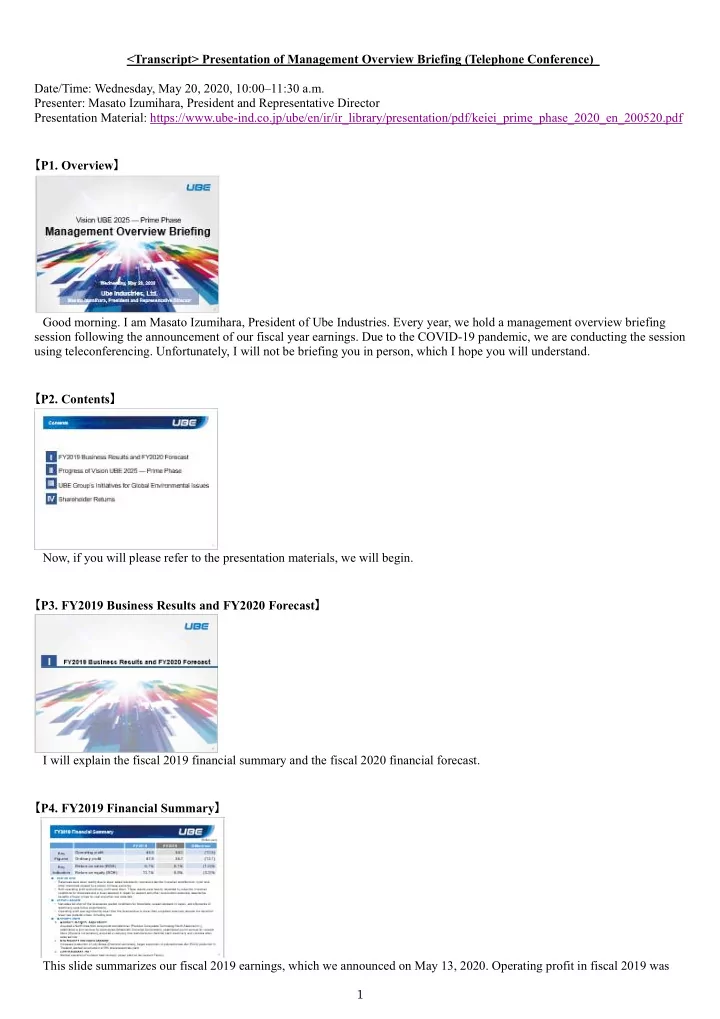
1 <Transcript> Presentation of Management Overview Briefing (Telephone Conference) Date/Time: Wednesday, May 20, 2020, 10:00–11:30 a.m. Presenter: Masato Izumihara, President and Representative Director Presentation Material: https://www.ube-ind.co.jp/ube/en/ir/ir_library/presentation/pdf/keiei_prime_phase_2020_en_200520.pdf 【P1. Overview】 Good morning. I am Masato Izumihara, President of Ube Industries. Every year, we hold a management overview briefing session following the announcement of our fiscal year earnings. Due to the COVID-19 pandemic, we are conducting the session using teleconferencing. Unfortunately, I will not be briefing you in person, which I hope you will understand. 【P2. Contents】 Now, if you will please refer to the presentation materials, we will begin. 【P3. FY2019 Business Results and FY2020 Forecast】 I will explain the fiscal 2019 financial summary and the fiscal 2020 financial forecast. 【P4. FY2019 Financial Summary】 This slide summarizes our fiscal 2019 earnings, which we announced on May 13, 2020. Operating profit in fiscal 2019 was
SLIDE 2 2 ¥34 billion, down 24% or ¥10.5 billion year on year. For key indicators, return on sales (ROS) was 5.1% and return on equity (ROE) was 6.9%. The year-on-year results were significantly impacted by the slowdown of the Chinese economy, particularly from the second half of fiscal 2019. The slump spread throughout the manufacturing sector including the automotive sector. As a result, there was a decline in market conditions for nylon and other chemicals, while machinery orders including for metal and plastic processing machinery declined, and there was lower demand in Japan for cement and other construction materials. Despite benefiting from the decline in coal and other raw material prices, revenues and profits were down overall. Earnings fell significantly short of the forecast, for the same reasons. However, if we compare the earnings with the revised forecast that we announced in February 2020, operating profit was only slightly lower than the revised forecast, while ordinary profit and profit attributable to owners of the parent exceeded the revised forecast. This leads us to believe that the COVID-19 pandemic did not have a significant impact on the fiscal 2019 earnings. As to the measures taken in fiscal 2019, in terms of alliances, mergers, and acquisitions, we acquired a nylon compound manufacturer in North America called Premium Composite Technology North America Inc. This follows our acquisition of Repol S.L. of Europe in 2019. We also decided to form a joint venture with Mitsubishi Chemical Corporation in the electrolyte business and a joint venture with Kyocera Corporation in the ceramic filter business. Additionally, our machinery business acquired the businesses in manufacturing, sales and servicing of chemical plant equipment from Hitachi Plant Mechanics Co., Ltd. In terms of new facilities and added capacity, we increased production of polyimide films and varnishes, and began expanding production of the fine chemical polycarbonate diol (PCD) in Thailand. We also decided to construct the fifth pharmaceutical
- plant. In terms of cost reductions, we started operating the exhaust heat recovery power plant at the Isa Cement Factory. With
these measures, we took solid steps toward the future. 【P5. Approach to FY2020 Earnings Forecast】 This slide summarizes our approach to the fiscal 2020 earnings forecast. Before the COVID-19 pandemic, we had built up our
- perating profit to almost the level of the previous fiscal year. We struggled with predicting the extent of the COVID-19
pandemic’s impact on forecast. This economic slowdown is bigger than the 2008 financial crisis and the biggest since the Great
- Depression. While there are predictions that serious recovery will take several years, governments in various nations have
continued to introduce economic stimulus measures, seeking an exit strategy. It is hard to assess for sure what the overall impact will be. We considered announcing an undecided forecast, but thought that we should provide a rough projection. Therefore, we assembled the earnings forecast based on the following assumptions for each business and market. In the chemicals business, we predicted that there will be no impact on net sales of nylon film for food wrapping applications, chemicals used in everyday applications including pharmaceuticals, and polyimides and other products for semiconductors. However, we predicted a negative impact on net sales of chemicals for automotive-related applications and other industries. We assumed that the impact will peak from Q2 to Q3, with net sales declining by approximately 30% for the automotive sector and approximately 20% for other industries, followed by a gradual recovery toward the end of fiscal 2020. For the full year, we projected an average decline in net sales of 10 to 15%. In the construction materials business, we projected an annual average decline of 5% in construction materials-related net sales because of slow construction, with no impact on energy-related net sales. In the machinery business, capital investment projects focusing on the automotive sector have been postponed or suspended. We expect this to continue through Q2, forecasting an annual decline in net sales of more than 10%. For the full-year earnings forecast, we project that cumulative net sales will decline by ¥46 billion. The corresponding decline in marginal profit is incorporated into the forecast. We will implement various emergency measures to address the decline. This includes making comprehensive efforts to reduce fixed costs, implementing cost reductions, restricting non-essential and non-urgent capital investment, and reducing inventory to generate cash flow. Overall, we expect these internal measures to make up for around half of the projected decline. We prepared the earnings forecast figures on the next slide (slide six) under the assumption that we will revise the forecast if the current situation changes.
SLIDE 3
3 【P6. FY2020 Earnings Forecast】 For the fiscal 2020 earnings forecast, we projected net sales of ¥614 billion and operating profit of ¥26 billion, for a year-on-year decline of ¥8 billion. While we expect profits to decline, we do not foresee a significant change in interest-bearing liabilities, shareholders’ equity or debt-to-equity (D/E) ratio on the balance sheet. In terms of funds, we have secured surplus funds with cash on hand of ¥30 billion and issued ¥10 billion in 10-year corporate bonds dated May 1, 2020. We also have an existing commitment line, so we have no concerns about funds due to the impact of COVID-19. 【P7. FY2020 Earnings Forecast by Segment】 This shows a breakdown of net sales and operating profit by segment under the fiscal 2020 earnings forecast. Both revenues and profits are projected to decline in all segments, with profits declining significantly in the chemicals and machinery segments. 【P8. Progress of Vision UBE 2025 — Prime Phase】 I will now describe our progress in the first fiscal year of implementing the new medium-term management plan, Vision UBE 2025—Prime Phase. 【P9. Vision UBE 2025 — Prime Phase】 In assembling the current medium-term management plan, we revisited and clarified the company’s foundations. Within the company, we have long embraced the founding principles of “coexistence and mutual prosperity” and “from finite mining to
SLIDE 4 4 infinite industry,” which continue to be in our DNA. We also established the UBE Corporate Philosophy by modernizing the language and concepts of the founding principles. Based on this, we chose the phrase “We Continue to Create Value for All Shareholders” as our vision for 2025. This reflects the broader corporate vision of the UBE Group, which is made up of many different businesses with internal companies having their own vision. The medium-term management plan is implemented for three years under the vision. We outlined three basic strategies. Firstly, we will strengthen the platform for business growth, particularly focusing on growth driven mostly by the chemicals business. Secondly, we will strengthen the management platform (corporate governance), by continuously seeking to optimize the framework for corporate governance. Thirdly, we will address and be part of the solution for resource, energy, and global environmental issues. Due to our heavy dependency on coal and business structure, the UBE Group emits significant CO2. We recognize that the UBE Group has a major challenge in finding a way to address these emissions over the medium and long-term. We will actively contribute to a recycling-based society. 【P10. Medium-Term Management Plan: Progress of Numerical Targets】 This slide shows the targets of the medium-term management plan. In the table, the targets for the final fiscal year are shown in the right column, after the fiscal 2019 results and fiscal 2020 forecast. Due to the challenging economic circumstances that we are facing today, the fiscal 2019 results and fiscal 2020 forecast are significantly different from the targets. It appears that it will be difficult for us to achieve the targets for the final fiscal year of the medium-term management plan, under the current
- conditions. However, we have intentionally refrained from resetting the targets, due to the difficulty of predicting the earnings
in the final fiscal year at this point in time. 【P11. Net Sales and Operating Income: Progress by Segment】 This slide show the progress of net sales and operating profit by segment. There is a distinct gap from the fiscal 2019 results and fiscal 2020 forecast, to the fiscal 2021 forecast. To address the gap to the targets of the medium-term management plan, we have changed the strategies of some businesses. Otherwise, we must comprehensively implement and accelerate our existing strategies without significantly changing them. In fiscal 2020, the UBE Group is implementing various emergency measures to minimize the negative factors arising from the COVID-19 pandemic. In spite of the current conditions, we will steadily implement measures to secure growth in addition to implementing the emergency measures. This will enable us to quickly get a running start once the pandemic is brought under control, so that we can close the gap to the original targets.
SLIDE 5 5 【P12. Target Business Domains】 We have designated four business domains as priority targets for future business development and R&D. The target business domains are unchanged from the previous medium-term management plan. They are environment and energy, mobility, construction and infrastructure, and healthcare. In these domains, we will seek to expand both existing and peripheral business areas, and foster new businesses. 【P13. Business Portfolio Segmentation】 This shows our business portfolio, which is divided into developing businesses, active growth businesses, and platform
- businesses. We will mainly allocate our business resources to active growth businesses. In active growth businesses in the
chemicals segment, we will concentrate on the nylon, fine chemicals, high-performance coatings, synthetic rubber, polyimide, separation membrane, and separator businesses. In the construction materials segment, we will concentrate on the magnesia and calcia, biomass fuel, and resource recycling businesses. 【P14. Business Resources Allocation Plan by Portfolio Segmentation and Progress】 This slide shows the business resources plan by portfolio segmentation and progress. The left pie chart shows that we will allocate a total of ¥205 billion in business resources encompassing capital investment, other investment, and R&D, during the three years of the medium-term management plan. Thirty-four percent of this amount will be allocated toward active growth
- businesses. The total allocation of business resources has increased by ¥40 billion from the ¥165 billion that was allocated
under the previous medium-term management plan. We also increased the allocation to active growth businesses to 34%, up from 26% under the previous medium-term management plan. The fiscal 2019 results and fiscal 2020 forecast are both in line with our projections.
SLIDE 6 6 【P15. Investments and Cash Flow: Progress by Business Segment】 This is the progress of investments and cash flow by segment. The left pie chart shows a breakdown of the ¥160 billion in investments over three years. The investments will focus on chemicals, particularly active growth businesses in that segment. Actual investments were ¥49.8 billion in fiscal 2019 and are projected at ¥50 billion in fiscal 2020. The total projected cash flow over three years is ¥40 billion. The actual cash flow was ¥27.8 billion in fiscal 2019 and is projected at ¥4 billion in fiscal 2020. 【P16. R&D Costs: Progress】 This is the progress of R&D costs. Our strategy is to allocate R&D resources with a focus on the four target business domains and active growth businesses. The left pie chart shows the breakdown of the $45 billion in total R&D costs over three years. Eighty-four percent of that amount will be allocated to the chemicals business, of which 60% will be allocated to developing businesses and active growth businesses. Despite the current business conditions, we will implement R&D without reducing necessary R&D costs. 【P17. Research and Development】 This slide details our research and development. We will leverage our strategic technologies that have competitive advantages as we conduct R&D for developing businesses and active growth businesses in the four target business domains. In the environment and energy domain, we are engaged in research for CO2 sequestration in minerals as a low-carbon business. We have established a carbon dioxide capture and storage with utilization (CCSU) research project with two other companies, Idemitsu Kosan Co., Ltd. and JGC Japan Corporation. We are also advancing research for CO2 co-electrolysis methanation. For waste plastics recycling, we are conducting research for nylon material recycling and chemical recycling, and for inorganic specialty materials, we are doing research on strontium carbonate as well as thermal management components and materials. In the mobility domain, we are pursuing development of lithium titanium oxide (LTO) and Tyranno fiber. We are also developing composite nylon materials using cellulose nanofibers, for automotive weight-reducing materials and components. In the construction and infrastructure domain, we are conducting R&D on next-generation maintenance and improvement
- systems. This includes bringing to market a urethane concrete spalling prevention solution in the second half of this year. In the
healthcare domain, we are developing cell-culturing systems and substance production systems. Both are production systems for healthcare-related substances, that make use of polyimide multiporous membranes.
SLIDE 7 7 【P18. Segment Report: Business Plan and Progress in the First Year of the Medium-Term Management Plan】 Next, I will discuss the business plan by segment and progress in the first fiscal year of the medium-term management plan, and the immediate circumstances. 【P19. Chemicals Company: Overall Strategy】 This is the overall business strategy of the Chemicals Company. The target under the medium-term management plan is to “foster stability and further develop businesses.” The UBE Group still has a high proportion of businesses that are heavily influenced by market conditions, including caprolactam. We will increase the stability of these businesses. Since the chemicals business has not secured growth, our major challenge is to find a way to increase the growth potential. Although we started the first fiscal year of the medium-term management plan with these targets, the economic downturn in China triggered by U.S.-China trade friction has led to a decline in demand for various materials. The entire manufacturing sector is in a slump. In particular, demand for automobiles has declined beyond projections. The COVID-19 pandemic in late fiscal 2019 is also causing a sharp decline in demand. Given the circumstances, we will further accelerate the implementation of the overall business plan under the medium-term management plan, without changing the business plan. A major basic strategy of the chemical business is to shift to specialty chemicals. We will accelerate this strategy. In commodity-like businesses such as synthetic rubber and nylon, we cannot compete on cost alone. We must increase added value and shift our business operations to specialty products, so that we can secure stable revenues and enhance growth potential. We are also expecting growth in international markets, and in particular will increase the business presence in the Americas, which we had not been sufficiently developing under the global strategy. In addition, we will further develop and increase sales of environmentally friendly products and technologies. 【P20. Chemicals Company: Nylon Strategy】 This shows the nylon business strategy and the immediate business conditions for the nylon business. The two major applications for nylon are injection applications for automotive parts, and extrusion applications for food wrapping films. With vehicle sales already declining since fiscal 2109, the market for injection applications has contracted and competition has
- intensified. In addition, production among automakers is significantly declining due to the impact of COVID-19. The market
for extrusion applications such as food wrapping films is conversely extremely strong due to COVID-19. Please note the second strategy of the medium-term management plan, which is to expand composite production facilities
- utside of Japan and shift to high added-value products and technologies. Under this strategy, we acquired Repol S.L. of Europe
in fiscal 2019 and nylon compound manufacturer Premium Composite Technology North America Inc. of the U.S. this year. In
SLIDE 8 8 terms of shifting to high added-value products and technologies, we are developing tank liners and tank valves for use in automobiles, as well as coolant tubes for electric vehicles. We are implementing the fiscal 2020 strategies by strengthening our global sales activities and utilizing the Osaka Research & Development Center to centralize and enhance the composite development. 【P21. Chemicals Company: Caprolactam and Ammonium Sulfate Strategy】 This is the business strategy for caprolactam and ammonium sulfate. The market conditions for caprolactam began declining from the second half of 2019, with the Chinese economy slowing down due to U.S.-China trade friction. At that time, there were signs that market conditions would bottom out at the start of 2020 and rebound from the start of the Lunar New Year. However, due to COVID-19, market conditions declined again in March and April. Prices for crude oil and benzene fell significantly, and in conjunction the selling price for caprolactam at one point fell to around $850, reaching historical lows not seen since the early 2000s. Since May, market conditions have been rebounding with production activities starting up again in
- China. Since setting our caprolactam price in May, the price has been increasing in spot markets in China and the spread has
currently recovered to around $700. We based the fiscal 2020 spread on $750 and $850 respectively in the first half and second half of this fiscal year. The price is currently rebounding to these levels in spot markets. We also think it is possible to secure sales volumes under such conditions. The caprolactam production facilities are currently operating at full capacity at all three global production bases in Japan, Thailand, and Spain. While we are currently conducting regular repairs for our facilities in the Ube region, the caprolactam production facilities are essentially running at full capacity. Moving forward, we will continue to operate these facilities at full capacity, in order to maximize profits throughout the caprolactam chain and lower costs by raising operating rates. 【P22. Chemicals Company: Fine and Industrial Chemicals Strategy】 This is the strategy for fine chemicals and industrial chemicals. In fiscal 2019, we selected sites for C1 chemical chain manufacturing facilities in North America and conducted feasibility studies. Moving forward, we will aim to build a dimethyl carbonate (DMC) plant. In fiscal 2020, we will establish a base office for the C1 chemical chain in North America. In the future, we will expand from DMC to the further downstream polycarbonate diol (PCD) business. As indicated in the last item, in the industrial chemicals business, the absorption-type merger of Ube Ammonia Industry, Ltd.,
- ur wholly-owned subsidiary, will be implemented in the second half of fiscal 2020. The major task for fiscal 2020 will be to
achieve further operational efficiencies.
SLIDE 9 9 【P23. Chemicals Company: High-Performance Coating Strategy】 This is the business strategy for high-performance coatings. In terms of immediate business conditions, China has been strengthening its regulation of volatile organic compounds (VOCs). Consequently, the market for environmentally friendly coatings comprising water-based and solvent-free polyurethane costings is expanding, focusing on the Chinese market. In particular, the strategy during the current medium-term management plan calls on the UBE Group to lock in our position as the top global supplier of PCD, a raw material for high-grade polyurethane. We are currently constructing a second production line for PCD in Thailand. For polyurethane dispersion (PUD), we will strengthen our formulation engineering for acrylics and additives to increase our cost competitiveness, so that we can develop the mid-range market in Asia. In fiscal 2020, we will vertically start up the second production line for PCD in Thailand and aim to increase sales to global
- markets. The market is still growing despite the impact of COVID-19. Construction on the second production line for PCD is
scheduled to be completed in August, and we will attempt to achieve a vertical start up. The business is now on track for growth with volumes finally increasing significantly. We will consider expanding our production capacity as the business grows. 【P24. Chemicals Company: Synthetic Rubber Strategy】 This is the strategy for synthetic rubber. In terms of the immediate business conditions, there has been a sharp decline in demand due to COVID-19 and stagnant market conditions, as shown here. Out of all our chemicals, the synthetic rubber business has been hardest hit by COVID-19. We still do not see signs of a recovery in demand for rubber among tire
- manufacturers. The UBE Group specializes in butadiene rubber, but the number of automobiles manufactured has been
declining since last year. This has decreased the demand for tires, so that selling prices are low. The price of raw material butadiene has also declined, but spreads have worsened. The strategy for the current medium-term management plan is to shift to specialty products for the butadiene rubber business. That is, we will add value to our products in order to differentiate them from general-purpose grades. Accordingly, we are developing new grades in collaboration with major tire manufacturers who are strategic customers. We are also expanding our lineup of differentiated grades of vinyl cis rubber (VCR). Our other strategy is to strengthen the platform in order to fulfill our supply responsibilities. Inquiries for VCR, which is an added-value product, remain strong, while inquiries for general-purpose BR continue to be weak. In order to manufacture VCR at all three global bases of production (Japan, Thailand, and Malaysia), we are expanding production at LUSR in Malaysia from 50,000 tonnes to 72,000 tonnes and building a new VCR production facility, both scheduled for completion in 2021. Due to COVID-19, the projects have been delayed by two months, with construction scheduled to be completed in April 2021. The additional capacity will enable us to meet customer demands. For the fiscal 2019 results, we conducted global marketing that capitalizes on the three global bases of production. However, production issues in Malaysia prevented us from fully utilizing our production capacity. Accordingly, in fiscal 2020 we will achieve operational safety and stability to strengthen cost competitiveness, in order to respond to significant changes in customer demand.
SLIDE 10 10 【P25. Chemicals Company: Polyimide Strategy】 This is the polyimide strategy. In the first fiscal year of the medium-term management plan, revenues from polyimides as an active growth business grew beyond our projections. We will further accelerate this growth strategy. The polyimide business has not been impacted by COVID-19. The strategies of the current medium-term management plan are to promote varnishes as a core product of the polyimide business, in addition to films for circuit substrates. This will strengthen the polyimide business. In terms of markets, we will increase sales to the display and solar cell markets, in addition to the electronic circuit substrates market. In fiscal 2019, sales of varnishes for chip-on-film (COF) and flexible printed circuit (FPC) films grew beyond our projections. Net sales increased by approximately 40%. We also increased production capacity according to plan in order to support sales
- growth. For varnishes, we improved the existing facilities to increase the production efficiency. For films, we started the idle
11th production line in Sakai and brought it up to full production capacity. As a result of these initiatives, we increased the production capacity without any major investment. In fiscal 2020, we will focus our efforts on further increasing sales. We will also start construction of production facilities for raw material biphenyl tetracarboxylic dianhydride (BPDA), and we will study the construction of a 12th production line for films. 【P26. Chemicals Company: Separation Membrane Strategy】 Due to time restraints, I will not comment on the membrane strategy. 【P27. Chemicals Company: Separator Strategy】 This is the business strategy for separators. Starting in January 2019, we transferred our separator base film business to Ube Maxell, bringing non-coated and coated separators under one organization to implement unified management. We will pursue additional efficiencies. In addition, we will strengthen development and achieve cost reductions, so that we can further capture increased demand, with a focus on automotive applications. As you know, the sharp decline in demand for automobiles since 2019 and the COVID-19 pandemic have heavily impacted immediate shipments of separators. Although some are predicting a recovery in demand for separators for the automotive market starting from Q2, customers are currently demanding further cost reductions due to the impact of the COVID-19 pandemic. In fiscal 2019, we did not manage to increase sales of either coated or non-coated separators as we had planned because of declining market conditions. Meanwhile, we are currently constructing the 13th production line in Sakai, which will enhance
- ur cost competitiveness. The new production line is scheduled to go online in October 2020. We are also implementing unified
management of the non-coated and coated separator businesses.
SLIDE 11 11 Moving forward, our strategy is to strengthen relationships with performance-oriented customers. Some customers clearly emphasize cost above all else, with some companies making it their policy to prioritize the use of products from Chinese
- manufacturers. Since we have not achieved the volumes that we had originally projected, we will further strengthen our ties
with customers who can appreciate the performance advantages of our dry manufacturing process and a balance of cost and
- performance. These customers are seeing a steady rise in volumes, so we will focus on these customers in order to differentiate
- ur products from the volume and price competition. We will also further strengthen our sales and development activities to
ensure that we capture demand when the economy recovers. 【P28. Chemicals Company: Tyranno Fiber and LTO Strategy】 This slide summarizes our strategy for the Tyranno fiber and lithium titanium oxide (LTO) businesses, which are both developing businesses. I will only comment on the Tyranno fiber business. We are advancing development of fibers for ceramic matrix composites (CMC) used in civil aircraft engine components and materials, as well as development of mass production technologies for these fibers. We were anticipating the use of Tyranno fibers on a significant scale within five or six years, but COVID-19 has caused a sharp downturn in earnings among aircraft manufacturers. As a result, customers are delaying their development schedules and commercialization plans. Under the circumstance, we will steadily implement the strategies of the current medium-term management plan and wait for demand to recover. Specifically, we will stabilize quality for high-pressure grades, reevaluate the process control, and further develop and maintain high-quality grades, so that we can rapidly advance the business when the situation recovers. 【P29. Chemicals Company: Pharmaceutical Strategy】 This is the strategy for the pharmaceutical business, which comprises a drug discovery business that conducts in-house pharmaceutical development, and contract manufacturing of active pharmaceutical ingredients (APIs). The pharmaceutical business will not be impacted by COVID-19. For the immediate business conditions, as you can see from this slide, the focus of
- ur drug discovery has shifted from lifestyle diseases to unmet medical needs including cancers and rare diseases. Accordingly,
we are also shifting our focus to meeting needs for small quantity and high-potency APIs. The strategy for the current medium-term management plan in the drug discovery business is to expand the scope of research, such as conducting research into antibody-drug conjugates (ADCs). In the contract manufacturing business, we are reorganizing our plants into a group of manufacturing facilities that support small quantity, high-potency APIs. We are also commercializing the contract API manufacturing of nucleic acid drugs. In fiscal 2019, we licensed a potential candidate compound to treat non-alcohol steatohepatitis (NASH) to a leading pharmaceutical company in Europe, and decided to build a fifth pharmaceutical plant for high-potency APIs that will be completed in May 2021. For the fiscal 2020 strategy, our biggest challenge in the pharmaceutical business is to ensure a stable supply of intermediates for Avigan tablets. As you know, Avigan is seen as a potential treatment drug for COVID-19. FUJIFILM Toyama Chemical Co.,
- Ltd. chose us to manufacture the intermediates for Avigan, since we had previously manufactured intermediates for them. We
are modifying a plant for commodity drugs and will start manufacturing intermediates there in July, with supply commencing in
- August. It was a lot of work because the plant had been operating at full capacity. We want to cooperate as much as we can with
the Japanese government’s requests. We will also strengthen our marketing for contract manufacturing of high-potency APIs, to achieve a vertical start up of the fifth pharmaceutical plant.
SLIDE 12 12 【P30. Construction Materials Company: Cement and Ready-Mix Concrete Strategy】 This is the business strategy for the Construction Materials Company. The overall vision for the company is to “Continue to supply products that offer value for social infrastructure.” In terms of the immediate business conditions for the cement and ready-mix concrete business, cement demand in Japan has declined significantly to 40.97 million tonnes in fiscal 2019. This is the lowest it has been since 1990, a high year when demand exceeded 86 million tonnes amid Japan’s bubble economy. We project that cement demand in fiscal 2020 will remain roughly the same as fiscal 2019, at 41 million tonnes. The price of coal, which is used as a raw material, stabilized at a low price below $70, but currently has declined sharply to an even lower mark. The strategy for the medium-term management plan is firstly to adjust and increase prices. We proposed a ¥1,000 yen price increase starting in fiscal 2018. Presently, 70% of users have agreed to at least some price increase, but overall we still have a way to go. In the cement and ready-mix concrete business, we are implementing energy conservation measures and reducing costs. These initiatives include deploying high-efficiency facilities and increasing waste use. In the recycling business, we are aiming to expand into new recycling businesses. In fiscal 2019, decreasing cement demand in Japan diminished the savings from sharply declining coal prices. Meanwhile, we deployed and have begun operating the exhaust heat recovery power plant at the Isa Cement Factory, investing in the energy conservation project according to plan. The strategy in fiscal 2020 is to continue adjusting prices to compensate for higher transportation costs due to the regulation
- f sulfur oxide (SOx) in marine fuel oil. We will also install high-efficiency coolers at the Kanda Cement Factory for energy
conservation and cost reduction. Note that cement shipments in Japan for the month of April were around 90% of the level one year ago. Cement exports to Asia have declined significantly, but we are making up for the decline by securing spot orders from China. Construction in Japan is expected to gradually restart as we move forward. 【P31. Construction Materials Company: Magnesia/Calcia and Energy Business Strategy】 I will now briefly talk about the limestone-related magnesia and calcia business of Ube Material Industries, a Group company belonging to the Construction Materials Company, and also touch on the energy business. The main market for magnesia and calcia is for crude steel production. Since fiscal 2019, the volume of crude steel production in Japan has already fallen below 100 million tonnes for the first time in a decade. Compounded by the current impact of COVID-19, crude steel producers are shutting down their blast furnaces, which has led to a significant decline in demand for magnesia and calcia. In fiscal 2020, our strategy is to secure volumes and implement measures to increase sales for non-steel applications. The strategy for the energy business under the current medium-term management plan is to increase biomass fuel use at independent power producer (IPP) facilities. In fiscal 2019, we started operating a 60,000-tonne capacity torrefied pellet demonstration facility. These torrefied pellets are used in place of coal and the handling is identical, making them a carbon neutral wood-based biomass fuel. In fiscal 2020, we will secure stable production of torrefied pellets and increase usage at IPP facilities.
SLIDE 13 13 【P.32 Construction Materials: Business Integration with Mitsubishi Materials Corporation, Ltd.】 The biggest challenge this year for the Construction Materials Company is to lay the groundwork for the business integration with Mitsubishi Materials. As we publicly announced in February, the purpose of the business integration is to realize further growth for the construction materials business, and maintain and enhance its competitiveness. We have already unified the sales and logistics operations of the cement business in Japan. We will take this a step further by integrating and unifying the manufacturing operations. The resulting cash flow that is generated will enable us to allocate resources toward businesses in and outside of Japan that are expected to secure growth. Some examples of this are the magnesia and calcia-related business of Ube Material Industries on the UBE side, and the U.S. cement and ready-mix concrete business on the Mitsubishi Materials
- side. The integration is scheduled to be implemented in April 2022, two years from now. Ube Industries and Mitsubishi
Materials will establish an equally-owned joint venture that will be an equity method affiliate of both companies. The integration will significantly change the business structure of the UBE Group. In the next two years, we will lay a solid groundwork so that we can realize synergies soon after implementing the integration. 【P33. Machinery Company: Metal & Plastics Processing Machinery Strategy】 This is the strategy for the Machinery Company. The machinery business has three main areas of business: metal and plastics processing machinery, industrial machinery, and steel products. The metal and plastics processing machinery business is heavily dependent on capital investment by the automotive sector. The automotive market has been stagnant since 2019 and furthermore has been heavily impacted by COVID-19. Under the circumstances, the strategy of the metal and plastics processing machinery business for die casting machines and extrusion presses is to develop products that meet needs for automotive weight reduction and electric vehicles (EVs). For injection molding machines, we already acquired the injection molding machine business of Mitsubishi Heavy Industries in
- 2017. We will make sure to derive benefits from the business integration, and implement unified management of sales,
engineering, manufacturing, and servicing at the global level. The servicing business generates a large share of profits for the machinery business. Therefore, our strategy for the current three-year management plan will be to integrate and expand the global servicing network, while also increasing manufacturing productivity and building an optimal production framework. In fiscal 2019, we steadily integrated the injection molding machine business, and in March 2020, we finished construction of a new factory in Nagoya, Aichi Prefecture. For die casting machines, we are developing machinery and processes for automotive weight reduction needs. In fiscal 2020, we will prioritize cost reductions as an emergency measure to address stagnant orders due to COVID-19. We will also reduce our lead times and position the business so that we can supply our customers when capital investment recovers.
SLIDE 14
14 【P34. Machinery Company: Industrial Machine and Steel Product Strategy】 The industrial machinery business has not been significantly impacted by COVID-19. In terms of the immediate business conditions, demand for environmentally friendly equipment is increasing globally with the shift to a low-carbon society. The strategy for the current medium-term management plan, listed second, is to create revenue sources by developing equipment that is environmentally friendly and contributes to resource recycling, and pursue business alliances. Examples of this include developing recycling equipment for lithium-ion batteries, and our memorandum of understanding for a partnership with a subsidiary of Siam Cement of Thailand on a global servicing framework. In fiscal 2019, we resolved to assume the chemical equipment business of Hitachi Plant Mechanics Co., Ltd. The transfer of this business will be implemented in July 2020. Therefore, our strategies for fiscal 2020 are to contribute to revenues by smoothly starting up the chemical equipment business, and continue to develop machinery for markets that seek environmentally friendly and resource recycling features. This concludes my summary of the immediate business conditions by segment and the challenges in fiscal 2020. 【P35. UBE Group’s Initiatives for Global Environmental Issues】 Now, I would like to turn to the UBE Group’s initiatives to address global environmental issues. 【P36. UBE Group Environmental Vision 2050】 We recently established the UBE Group Environmental Vision 2050. The vision outlines our commitment to achieving an 80% reduction of greenhouse gas (GHG) emissions by 2050 and use UBE products and technologies to reduce GHG emissions throughout supply chains, in order to contribute toward a carbon-free society. Due to its business structure, the UBE Group emits significant GHG emissions. Nearly half of the UBE Group’s overall emissions are of non-energy (process) derived CO2 that are unavoidable in cement and ammonia production. Therefore, we have been making every effort to reduce energy-derived CO2 emissions. Moving forward, we will accelerate these efforts with the target of achieving an 80% reduction of all emissions including energy-derived and non-energy derived emissions. Based on this target, we have also set a medium-range target of achieving a 17% reduction in GHG emissions by fiscal 2030, compared with fiscal 2013 levels. By segment, the chemicals business will target a 20% reduction and the construction materials business a 15% reduction. Since the target is by fiscal 2030, we set an achievable target based on foreseeable technologies and costs. Still, we will have to do more by implementing the measures as in items 1 through 4 shown here. In particular, we will study measures that include rebuilding the business structure that is currently dependent on fossil resources,
SLIDE 15 15 going as far as to transform the business structure to further reduce our emissions. As a further show of commitment, we set a target for environmentally friendly products and technologies to account for 50%
- r more of net sales by fiscal 2030. Currently, environmentally friendly products and technologies account for roughly 30% of
net sales. The UBE Group’s environmentally friendly products and technologies currently save an estimated six million tonnes of GHG emissions annually, based on fiscal 2018 data. This reduction is throughout the product life cycle and represents emissions reductions that can be achieved by customers as they use our products. In April 2020, we also announced our support for the recommendations of the Task Force on Climate-related Financial Disclosures (TFCD). Under the commitment, we will analyze scenarios for risks and opportunities to our business because of climate change, and actively disclose the financial impacts. 【P37. UBE Group Environmental & Safety Principles and Initiatives to Address Global Environmental Issues】 I will now say a word about the UBE Group Environmental and Safety Guidelines and our initiatives to address global environmental issues. The UBE Group will continue addressing a variety of global environmental issues in addition to climate change. This slide shows the UBE Group Environmental and Safety Guidelines, which are strictly applied throughout Group. In particular, we are guided by the value of “prioritizing safety in everything we do” in seeking to eliminate occupational and facilities accidents, and achieve safe and secure manufacturing. As noted in items 3 and 4, we are reducing our emissions of waste and chemical substances, as well as recycling and effectively using resources, in order to contribute to a recycling-based
- society. Furthermore, we have outlined our commitment to voluntarily and continuously work to address global environmental
issues, in helping to bring about a sustainable society. In particular, we have published our basic approaches to global warming, biodiversity, conservation of water resources, and ocean waste plastics on the corporate website. Please scan the QR code if you would like to learn more. 【P38. Shareholder Returns】 Lastly, let me address shareholder returns. 【P39. Shareholder Returns】 Our basic dividend policy is to pay stable dividends, and to increase dividends as earnings improve. We originally based this
- n a consolidated total return ratio of 30% or higher, but as of the current medium-term management plan, it is also based on
SLIDE 16
16 dividend on equity (DOE) of 2.5% or above. The new indicator ensures stable dividends based on greater equity, even if there is a temporary decline in income for the period. By using this indicator, we expect the dividend to remain at ¥90 per share, even though profit attributable to owners of the parent will decline in fiscal 2020 compared with fiscal 2019. We will continue to balance growth investment for the future with shareholder returns, based on equity and cash flow. We are also considering a flexible approach to buybacks of our shares. This concludes my briefing today.