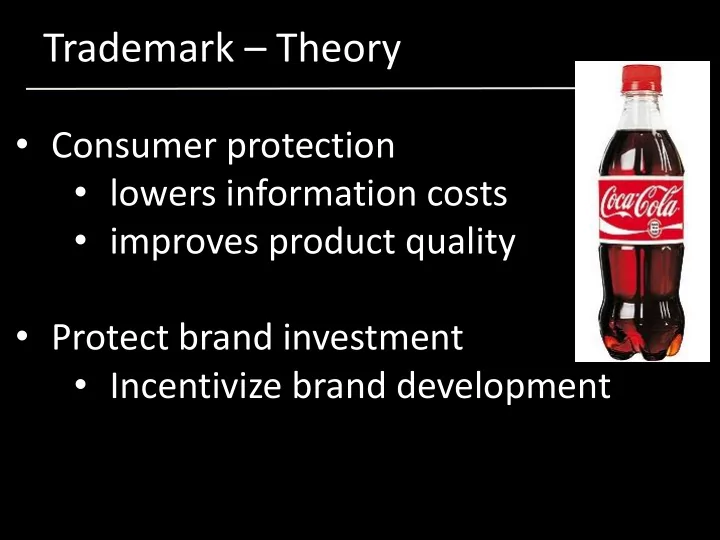
SLIDE 1 Trademark – Theory
- Consumer protection
- lowers information costs
- improves product quality
- Protect brand investment
- Incentivize brand development
SLIDE 2
Distinctiveness
Trademarkable
| |
Use in Commerce Priority
SLIDE 3 Trademark Subject Matter
- “The term “mark” includes any
trademark, service mark, collective mark, or certification mark.” Lanham Act § 45
SLIDE 4 Trademark Subject Matter
“the term “trademark” includes any word, name, symbol, or device, or any combination thereof— (1) used by a person, or (2) which a person has a bona fide intention to use in commerce and applies to register on the principal register established by this chapter, to identify and distinguish his or her goods, including a unique product, from those manufactured or sold by
- thers and to indicate the source of the goods, even if
that source is unknown.” Lanham Act § 45
SLIDE 5 Trademark Subject Matter
SLIDE 6 Trademark Subject Matter
“The term “service mark” means any word, name, symbol, or device, or any combination thereof— (1) used by a person, or (2) which a person has a bona fide intention to use in commerce and applies to register on the principal register established by this chapter, to identify and distinguish the services of one person, including a unique service, from the services of others and to indicate the source of the services, even if that source is unknown. . . . .” Lanham Act § 45
SLIDE 7 Trademark Subject Matter
SLIDE 8 Trademark Subject Matter
“The term “certification mark” means any word, name, symbol, or device, or any combination thereof (1) used by a person other than its owner, or (2) which its owner has a bona fide intention to permit a person other than the owner to use in commerce and files an application to register on the principal register established by this chapter, to certify regional or other origin, material, mode of manufacture, quality, accuracy, or other characteristics of such person’s goods or services or that the work or labor . . . performed by members of a union or other
- rganization.” Lanham Act § 45
SLIDE 9 Trademark Subject Matter
SLIDE 10 Trademark Subject Matter
“The term “collective mark” means a trademark or service mark— (1) used by the members of a cooperative, an association, or other collective group or organization,
- r (2) which such cooperative, association, or other
collective group or organization has a bona fide intention to use in commerce and applies to register
- n the principal register established by this chapter,
and includes marks indicating membership in a union, an association, or other organization.” Lanham Act § 45
SLIDE 11 Trademark Subject Matter
SLIDE 12 Trademark Subject Matter
- Qualitex v. Jacobson
- Can color be a trademark?
- “includes any word, name, symbol, or device, or any
combination thereof” Lanham Act § 45
- “source-distinguishing ability of a mark” (p. 746)
- needs “secondary meaning”
- protection attaches only after associated to
source by consumers
SLIDE 13 Trademark Subject Matter
- Qualitex v. Jacobson
- Do we care about color’s
utility/function?
- No protection if the color is “essential to the use or
purpose of the product or affect quality or cost of product” (p. 748-49)
- No protection if creates non-brand related
competitive advantage
- Protection of functional aspects for Patent Law
SLIDE 14 Trademark Subject Matter
SLIDE 15 Trademark Subject Matter
- What about?
- Product design (trade dress)?
- What about sound?
- Sound 1 Sound 2 Sound 3
- What about smell?
SLIDE 16 Trademark—Spectrum of Distinctiveness
Generic Descriptive Suggestive Arbitrary
Never Distinctive Can Acquire Distinctiveness (Secondary Meaning) Inherent Distinctiveness
Decreasing Distinctiveness
SLIDE 17 Trademark – Distinctiveness
- Zatarain’s v. Oak Grove
- Is Fish-Fri distinctive?
- Is it descriptive?
- dictionary
- imagination test
- barrier to competition test
- look at others use of term
- If descriptive, need secondary meaning?
- primary significance of mark is identify source
- advertising
- investment
- survey
SLIDE 18 Trademark – Distinctiveness
- Zatarain’s v. Oak Grove
- If Fish-Fri has secondary meaning?
- fair use defense
- can use to describe goods, not source
- What about Chick-Fri?
- descriptive
- no secondary meaning
- no protection
SLIDE 19 Trademark – Trade Dress
- Two Pesos v. Taco Cabana
- What is mark?
SLIDE 20 Trademark – Trade Dress
- Two Pesos v. Taco Cabana
- Can trade dress be source identifying?
- Jury finds inherently distinctive, but no
secondary meaning
- Can it be inherently distinctive?
- How do you resolve this with Qualitex?
- What is the Court’s concern?
SLIDE 21 Trademark – Trade Dress
- Wal-Mart v. Samara Bros.
- What is the mark?
- Does this change the
requirements for trade dress?
then descriptive at best
- Qualitex
- What if product packaging?
- What if both?
- What is the Court’s
concern?
SLIDE 22 Trademark – Trade Dress
SLIDE 23 Trademark – Use and Priority
- In common law, protection goes to first to “use in
commerce”
- Limited to geographic area of use
- Plus area of normal expansion of business
- And goods and services used on
- “The term ‘use in commerce’ means the bona fide
use of a mark in the ordinary course of trade, and not made merely to reserve a right in a mark.” Lanham Act § 45.
- Registration=de facto nationwide use
SLIDE 24
Trademark – Registration
“No trademark by which the goods of the applicant may be distinguished from the goods of others shall be refused registration on the principal register on account of its nature unless it— (a) Consists of or comprises immoral, deceptive, or scandalous matter . . . or a geographical indication which, when used on or in connection with wines or spirits, identifies a place other than the origin of the goods . . . (b) [flag of U.S., state, or foreign country] (c) [living person w/o consent or dead president while widow alive, w/o widow’s consent” Lanham Act § 2
SLIDE 25
Trademark – Registration
“(d) Consists of or comprises a mark which so resembles a mark . . . as to be likely, when used on or in connection with the goods of the applicant, to cause confusion (e) Consists of a mark which (1) when used on or in connection with the goods of the applicant is merely descriptive . . ., (2) when used on or in connection with the goods of the applicant is primarily geographically descriptive of them, except as indications of regional origin may be registrable under section 1054 of this title, (3) when used on or in connection with the goods of the applicant is primarily geographically deceptively misdescriptive of them,” Lanham Act § 2
SLIDE 26 Trademark – Registration
- In re Nantucket
- Mark is “Nantucket” for shirts not made in Nantucket,
MA
- § 2(e)(2) – geographically descriptive
- Primary significance of the mark is geographic
- Purchasers likely make a goods/place or services
place association
- Mark identifies the geographic origin of goods or
service
- Here, is it geographically descriptive?
- Notice could overcome with secondary meaning
- Idaho Potatoes, Virginia Ham, Virginia Peanuts
- If made in those locations
SLIDE 27 Trademark – Registration
- In re Nantucket
- § 2(e)(3) – geographically deceptively misdescriptive
- Primary significance of the mark is geographic
- Purchasers likely make a goods/place or services
place association
- Goods or service do not originate from place
identified
- Here, is it geographically deceptively misdescriptive?
- Notice cannot overcome with secondary meaning
- Cuban Cigar not from Cuba
SLIDE 28
Trademark – Registration
“(e) Consists of a mark which . . . (4) is primarily merely a surname, or (5) comprises any matter that, as a whole, is functional. (f) Except as expressly excluded in subsections (a), (b), (c), (d), (e)(3), and (e)(5) of this section, nothing in this chapter shall prevent the registration of a mark used by the applicant which has become distinctive of the applicant’s goods in commerce.” Lanham Act 2.
SLIDE 29
Trademark – Registration
SLIDE 30 Trademark – Likelihood of Confusion
“(1) Any person who shall, without the consent of the registrant— (a) use in commerce any reproduction, counterfeit, copy, or colorable imitation of a registered mark in connection with the sale, offering for sale, distribution, or advertising of any goods or services
- n or in connection with which such use is
, or to cause mistake, or to deceive . . . shall be liable in a civil action by the registrant for the remedies hereinafter provided.” Lanham Act § 32
SLIDE 31
Trademark – Likelihood of Confusion
“(a) Civil action (1) Any person who, on or in connection with any goods or services, or any container for goods, uses in commerce any word, term, name, symbol, or device, or any combination thereof, or any false designation of origin, false or misleading description of fact, or false or misleading representation of fact, which— (A) . . . shall be liable in a civil action by any person who believes that he or she is or is likely to be damaged by such act.” Lanham Act § 43
SLIDE 32 Trademark – Use Requirement?
- Rescuecom v. Google
- Mark is “Rescuecom” for on-site computer
services and sales
- Search for “rescuecom” results in ads from
competitors
SLIDE 33
Trademark – Use Requirement?
SLIDE 34 Trademark – Use Requirement?
- Rescuecom v. Google
- Both § 32 and § 43 require infringer to “use
in commerce”
- Is this a “use in commerce” of Rescuecom’s
Mark?
SLIDE 35
Trademark – Likelihood of Confusion
“(a) Civil action (1) Any person who, on or in connection with any goods or services, or any container for goods, uses in commerce any word, term, name, symbol, or device, or any combination thereof, or any false designation of origin, false or misleading description of fact, or false or misleading representation of fact, which— (A) . . . shall be liable in a civil action by any person who believes that he or she is or is likely to be damaged by such act.” Lanham Act § 43
SLIDE 36 Trademark – Likelihood of Confusion
SLIDE 37 Trademark – Likelihood of Confusion
SLIDE 38 Trademark – Likelihood of Confusion
- AMF v. Sleekcraft
- Gateway questions:
- compare goods/services at issue
- If compete for sales, just look at
similarity
- If related, but not competitive, look at
all factors
- If completely unrelated, no LOC
- Normally, in any case, look at all factors
SLIDE 39 Trademark – Likelihood of Confusion
- AMF v. Sleekcraft
- 1. Strength of Mark
- 2. Proximity of Goods
- 3. Similarity of Marks
- 4. Evidence of Actual Confusion
- 5. Marketing Channels Used
- 6. Type of Goods/Degree of Purchaser Care
- 7. Alleged Infringer’s Intent
- 8. Likelihood of Expansion
SLIDE 40 Trademark – Likelihood of Confusion
- Confusion as to Sponsorship
- Initial Interest Confusion
- Post-Sale Confusion
- Reverse Confusion
SLIDE 41
Trademark – Likelihood of Confusion
SLIDE 42 Trademark – Dilution
“(c) Dilution by blurring; dilution by tarnishment (1) Injunctive relief . . . the owner of a famous mark that is , shall be entitled to an injunction against another person who, at any time after the
, commences use
- f a mark or trade name in commerce that is
- f the famous mark, regardless of the
presence or absence of actual or likely confusion, of competition, or of actual economic injury.” § 43
SLIDE 43
Trademark – Dilution
SLIDE 44
Trademark – Dilution
SLIDE 45
Trademark – Dilution
SLIDE 46 Trademark – Dilution
- Louis Vuttion v. Haute Diggity Dog
- Likelihood of Confusion?
- Famous?
SLIDE 47
Trademark – Dilution
“(c) . . . (2) Definitions (A) . . . a mark is famous if it is widely recognized by the general consuming public of the United States as a designation of source of the goods or services of the mark’s owner. In determining whether a mark possesses the requisite degree of recognition, the court may consider all relevant factors. . . : (i) The duration, extent, and geographic reach of advertising and publicity of the mark . . . . (ii) The amount, volume, and geographic extent of sales of goods or services offered under the mark. (iii) The extent of actual recognition of the mark. (iv) Whether the mark was registered . . . .” Lanham Act § 43
SLIDE 48 Trademark – Dilution
- Louis Vuttion v. Haute Diggity Dog
- Likelihood of Confusion
- Famous?
- Blurring?
SLIDE 49 Trademark – Dilution
“(c) . . . (2) (B) . . . “dilution by blurring” is association arising from the similarity between a mark or trade name and a famous mark that impairs the distinctiveness of the famous
- mark. In determining whether a mark or trade name is likely
to cause dilution by blurring, the court may consider all relevant factors, including the following: (i) The degree of similarity . . . . (ii) The degree of inherent or acquired distinctiveness . . . . (iii) The extent to which the owner of the famous mark is engaging in substantially exclusive use of the mark. (iv) The degree of recognition of the famous mark. (v) [Intent] (vi) Any actual association . . . .” Lanham Act § 43
SLIDE 50 Trademark – Dilution
- Louis Vuttion v. Haute Diggity Dog
- Likelihood of Confusion
- Famous?
- Blurring?
- Tarnishment?
SLIDE 51
Trademark – Dilution
“(c) . . . (2) (C) For purposes of paragraph (1), “dilution by tarnishment” is association arising from the similarity between a mark or trade name and a famous mark that harms the reputation of the famous mark.” Lanham Act § 43
SLIDE 52 Trademark – Dilution
- Louis Vuttion v. Haute Diggity Dog
- Likelihood of Confusion
- Famous?
- Blurring?
- Tarnishment?
- Exclusions?
SLIDE 53
Trademark – Dilution
“(c) . . . (3) Exclusions The following shall not be actionable as dilution . . . : (A) Any fair use, including a nominative or descriptive fair use, . . . other than as a designation of source for the person’s own goods or services, including use in connection with— (i) advertising or promotion that permits consumers to compare goods or services; or (ii) identifying and parodying, criticizing, or commenting upon the famous mark owner or the goods or services of the famous mark owner. (B) All forms of news reporting and news commentary. (C) Any noncommercial use of a mark.” Lanham Act § 43
SLIDE 54
Trademark – Dilution
SLIDE 55
Trademark – Dilution
SLIDE 56
Trademark – Dilution
SLIDE 57
Trademark – Dilution
SLIDE 58 Trademark – Genericness
- Never distinctive
- Car for automobiles
- Bed for mattress
- Becomes generic
- Genericide
- Starts distinctive
- usually arbitrary or fanciful
- Becomes generic
SLIDE 59 Trademark – Genericness
- Murphy Door Bed v. Interior Sleep
- Starts suggestive, at least for wall bed
- Had patent
SLIDE 60 Trademark – Genericness
- Murphy Door Bed v. Interior Sleep
- Defendants have distribution agreement
- once PTO rejects registration, defendants
form corp. named Murphy Bed
- Burden on defendants became generic
- “commercial protection a developer of
innovation deserves” (p. 796)
- Determine became generic:
- dictionary use
- use by media—as adjective or noun
- policing efforts
SLIDE 61 Trademark – Functionality
- Three types:
- Utilitarian Functionality – trade
dress/product configuration (TrafFix)
- Aesthetic Functionality – trade
dress/product appearance (Qualitex)
- Linguistic Functionality -- genericness
(Murphy Bed)
- Looking for when protection creates barrier to
entry that outweighs any reduction in consumer search costs
SLIDE 62
SLIDE 63 Trademark – Functionality
- TrafFix Devices v. Marketing Displays
- “essential to the use or purpose of the product or
affect its cost or quality” (p. 820)
- If patent claims trade dress at issue, then
presumed functional
SLIDE 64
SLIDE 65 Trademark – Functionality
- TrafFix Devices v. Marketing Displays
- “essential to the use or purpose of the product or
affect its cost or quality” (p. 820)
- If patent claims trade dress at issue, then
presumed functional
- Evidence dual spring helped function
- and impacted costs
- Court not appear concerned with whether there
were alternatives
- Looking for a “significant non-reputation-related
disadvantage”
SLIDE 66 Trademark – Abandonment
“A mark shall be deemed to be “abandoned” if either of the following occurs: (1) Intent not to resume may be inferred from circumstances. Nonuse for 3 consecutive years shall be prima facie evidence of abandonment. “Use” of a mark means the bona fide use of such mark made in the
- rdinary course of trade, and not made merely to
reserve a right in a mark.” Lanham § 45
SLIDE 67
Trademark – Abandonment
“A mark shall be deemed to be “abandoned” if either of the following occurs: . . . (2) When any course of conduct of the owner, including acts of omission as well as commission, causes the mark to become the for the goods or services on or in connection with which it is used or otherwise to lose its significance as a mark. Purchaser motivation shall not be a test for determining abandonment under this paragraph.” Lanham § 45
SLIDE 68 Trademark – Abandonment
- MLB v. Sed Non Olet Denarius
- 1958 – Brooklyn Dodgers leave Brooklyn
for L.A. – become L.A. Dodgers
- Non-use of “Brooklyn Dodgers” for
baseball team from 1958 forward, resumes in 1981
SLIDE 69 Trademark – Abandonment
- MLB v. Sed Non Olet Denarius
- Abandonment?
- Court focuses on non-use as team
- And presume no intent to resume after
23 years of non-use
- Court not enjoin use at restaurant started
in 1988
- What if restaurant started selling shirts?
- Does this protect consumers?
- What about protection of brand investment?
SLIDE 70 Trademark – Fair Use
- KP Permanent Make-up, Inc. v. Lasting
Impression
SLIDE 71 Trademark – Fair Use
- KP Permanent Make-up, Inc. v. Lasting
Impression
- Fair use by KP Permanent Make-up
- used to merely described goods, not
identify source
- Like Zatarains
- What if there is still confusion as to source?
- No burden on alleged infringer to prove
no confusion
- Allow some degree of confusion (“mere
confusion”)
SLIDE 72 Trademark – Nominative Use
- Mattel v. MCA
- “Barbie” as mark
- Title of song
- Protectable?
- LOC?
- Nominative
Use?
SLIDE 73
Trademark – Dilution
“(c) . . . (3) Exclusions The following shall not be actionable as dilution . . . : (A) Any fair use, including a nominative or descriptive fair use, . . . other than as a designation of source for the person’s own goods or services, including use in connection with— (i) advertising or promotion that permits consumers to compare goods or services; or (ii) identifying and parodying, criticizing, or commenting upon the famous mark owner or the goods or services of the famous mark owner. (B) All forms of news reporting and news commentary. (C) Any noncommercial use of a mark.” Lanham Act § 43
SLIDE 74
Trademark – Injunction
“(a) Jurisdiction; service The several courts vested with jurisdiction of civil actions arising under this chapter shall have power to grant , according to the principles of equity and upon such terms as the court may deem reasonable, to prevent the violation of any right of the registrant of a mark registered in the Patent and Trademark Office or to prevent a violation under subsection (a), (c), or (d) of section 1125 of this title.” Lanham § 34
SLIDE 75
Trademark – Damages
“(a) Profits; damages and costs; attorney fees When a violation of any right of the registrant of a mark registered in the Patent and Trademark Office, a violation under section 1125 (a) or (d) of this title, or a willful violation under section 1125 (c) of this title . . . the plaintiff shall be entitled, . . . to recover (1) defendant’s profits, (2) any damages sustained by the plaintiff, and (3) the costs of the action.” Lanham § 35
SLIDE 76 Trademark – Damages
- Lindy Pen v. Bic Pen
- “Auditor” as mark for pen
- Initial Interest and Reverse
Confusion
- Lost Profits
- Very tough in reverse
confusion
- Some circuits allow you to
use infringer’s profits as proxy
SLIDE 77 Trademark – Damages
Goodyear
mark for tire
Confusion
advertising
Big O’s profits