Tracking Oil Tanker Movements in British Columbia: Comparisons and - - PowerPoint PPT Presentation

tracking oil tanker movements in british columbia
SMART_READER_LITE
LIVE PREVIEW

Tracking Oil Tanker Movements in British Columbia: Comparisons and - - PowerPoint PPT Presentation

Tracking Oil Tanker Movements in British Columbia: Comparisons and Context PRESENTED BY STEWART MUIR, M.A. Executive Director, Resource Works Society www.resourceworks.com/c48hearing SENATE COMMITTEE ON TRANSPORTATION AND COMMUNICATIONS


slide-1
SLIDE 1

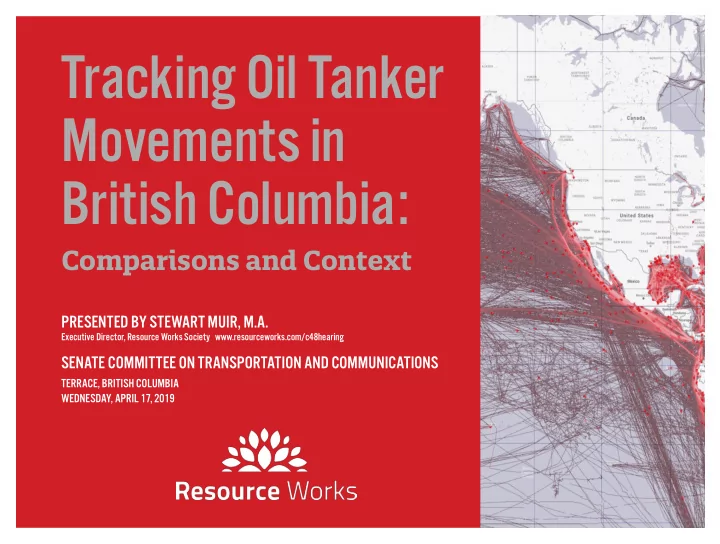
Tracking Oil Tanker Movements in British Columbia:

Comparisons and Context

PRESENTED BY STEWART MUIR, M.A.

Executive Director, Resource Works Society www.resourceworks.com/c48hearing

SENATE COMMITTEE ON TRANSPORTATION AND COMMUNICATIONS

TERRACE, BRITISH COLUMBIA WEDNESDAY, APRIL 17, 2019

slide-2
SLIDE 2

Tanker maps and satellite images by Marine Traffjc Cartes de pétroliers et images satellites de Marine Traffjc

A WORLD-CLASS SAFETY SYSTEM UN SYSTÈME DE SÉCURITÉ DE CLASSE MONDIALE

“Canadians can be assured that our coastline will ben- efjt from a world-class ma- rine safety system thanks to the implementation of the Oceans Protection Plan. This work is being done with scientists, Indigenous and coastal communities, experts and industry. Our Government has enhanced marine safety and reduced the risk of spills to address gaps that have existed for far too long.”

— Statement April 26, 2018 by Hon-

  • urable Marc Garneau, Minister of

Transport, the Honourable Jim Carr, Minister of Natural Resources, the Honourable Catherine McKenna, Minister of Environment and Climate Change, and the Honourable Dominic LeBlanc, Minister of Fisheries, Oceans and the Canadian Coast Guard issued the following statement

« Les Canadiens peuvent être assurés que notre lit- toral bénéfjciera d’un sys- tème de sécurité maritime de calibre mondial grâce à la mise en œuvre du Plan de protection des océans. Ce travail est effectué avec des scientifjques, des com- munautés autochtones et côtières, des experts et l’industrie. Notre gouver- nement a renforcé la sécu- rité maritime et réduit le risque de déversement afjn de remédier aux lacunes qui existent depuis trop

  • longtemps. »
  • Déclaration le 26 avril 2018 de l’hon-
  • rable Marc Garneau, ministre des

Transports, de l’honorable Jim Carr, ministre des Ressources naturelles, de l’honorable Catherine McKenna, ministre de l’Environnement et du Changement climatique, et de l’hon-

  • rable Dominic LeBlanc, ministre des

Pêches, des Océans et du La Garde côtière canadienne a publié la décla- ration suivante

Oil tanker “Erik Spirit” passes the Second Narrows in the Port of Vancouver, escorted by three tug boats. Destination: Qingdao, China. Date: April 4, 2019. 2 3

slide-3
SLIDE 3

STRONG RECORD, EVEN BETTER RECORD FORT, ENCORE MIEUX

Pilotage statistics show ship- ping safety rates, already very high, improved further between 2009 and 2017. The Pacifjc Pilot- age Authority, for example, rose from 99.95% to 99.97% incident free. Liquid bulk vessels of all types (including tankers) accounted for 10 incidents between 2013 and 2017 or 3.0% of vessels. While the absolute number of commercial shipping accidents is very low it is nevertheless important to analyze the type of marine accidents that do arise. Les statistiques de pilotage montrent que les taux de sécurité des transports, déjà très élevés, se sont encore améliorés entre 2009 et 2017. L’Administration de pilotage du Pacifjque Canada, par exemple, est passée de 99,95% à 99,97% sans incident. Les vracs liquides de tous types (y compris les pétroliers) ont représenté 10 incidents entre 2013 et 2017, soit 3,0% des navi- res. Bien que le nombre absolu d’ac- cidents de la navigation com- merciale soit très faible, il est néanmoins important d’analy- ser le type d’accident maritime survenant.

Pacifjc Pilotage Authority Administration de pilotage du Pacifjque Canada incident-free rate from 13,397 assignments including 804 tanker assignments. taux sans incident de 13 397 affectations, dont 804 affec- tations de pétroliers.

99.97%

Great Lakes Pilotage Authority Administration de pilotage des Grands Lacs incident-free rate from 7,636 assignments. taux sans incident de 7 636 affectations.

99.8%

Atlantic Pilotage Authority Administration de pilotage de l’Atlantique incident-free rate from 8,809 assignments including 3,338 tanker assignments. taux sans incident de 8 809 affectations, dont 3 338 af- fectations de pétroliers.

99.94%

Laurentian Pilotage Authority Administration de pilotage des Laurentides incident-free rate from 22,732 assignments, includ- ing 1,875 tanker assign- ments. taux sans incident de 22 732 affectations, dont 1 875 affec- tations de pétroliers.

99.93%

Pilotage safety record, 2017 Bilan de sécurité de pilotage, 2017

Sources: Data sources are the annual reports of the respective Pilotage Authorities complied by Wave Point Consulting Ltd. Note: Great Lakes Pilotage region handles some tanker and petroleum vessel traffjc but due to structure of pilotage charges the reporting of traffjc by vessel type is not the identical to the other pi- lotage regions and the identifjcation of type of vessel is not available from the information contained in the annual report. Data source for marine occurrences: Transportation Safety Board of Canada based on a request for data from Wave Point Consulting Ltd. Data from the Canadian Transportation Accident Investiga- tion and Safety Board Act provides insights into the type, frequency and distribution of maritime incidents that involved the transport of crude petroleum in Canada.

Average Number of Marine Occurrences by Region

(2000 to 2009) Newfound- land Maritime Laurentian Central Western Tankers 0.6 1.0 5.3 3.1 0.1 All vessels 62.4 100.2 72.5 56.6 130.7

4 5
slide-4
SLIDE 4

THE DOUBLE STANDARD: EAST COAST TANKERS LE DOUBLE STANDARD: TANKERS DE LA COTE EST

The Gulf of St. Lawrence is one of Cana- da’s most productive marine ecosystems and is home to large numbers of marine mammals and seabirds. Huge amounts of persistent oil are routinely moved around in this region by water. Le golfe du Saint-Laurent est l’un des écosystèmes marins les plus productifs du Canada et abrite un grand nombre de mammifères marins et d’oiseaux marins. D’énormes quantités d’huile persistante sont régulièrement transportées dans cette région par l’eau.

Right: Environmental Sensitivity Index (ESI) per sub-sector in Sector 3 (Estuary and Gulf of St. Lawrence), by Genivar. A REVIEW OF CANADA’S SHIP-SOURCE OIL SPILL PRE- PAREDNESS AND RESPONSE REGIME: Setting the Course for the Future. Tanker Safety Panel Secretariat, for Transport

  • Canada. 2013. Page 12.

À droite: Indice de sensibilité environnementale (ESI) par sous-secteur du secteur 3 (estu- aire et golfe du Saint-Laurent), par Genivar. EXAMEN DU RÉGIME DE PRÉPARATIF ET DE RÉPONSE EN CAS DE DÉVERSEMENT DE PÉTROLE À PARTIR DE NAVIRES DU CANADA: Fixer la voie de l’avenir. Secrétariat du groupe spécial sur la sécurité des navires-citernes, pour Trans- ports Canada. 2013. Page 12.

NEW BRUNSWICK NFLD QUEBEC

East Coast tanker traffjc

Persistent oils, and other hydrocarbon products, are stock in trade for Atlantic Canada shipping.

Trafjc pétrolier de la côte est

Les huiles persistantes, ainsi que d’autres produits à base d’hydrocarbures, font l’objet d’un commerce pour la navigation au Canada atlantique.

Right: Marine Traffjc map shows actual tanker traffjc on April 6,

  • 2019. The shapes are

moving or stationary

  • vessels. The lines de-

pict all tanker voyagers tracked in 2017.

6 7

slide-5
SLIDE 5

PERSISTENT OIL IN QUEBEC HUILE PERSISTANTE AU QUÉBEC

On a recent day, the Marine Traffjc map tool indicated the presence of fjve tanker ships at the north end of the Island of

  • Montreal. This is a typical sight.

The Parc National des Îles-de- Boucherville (a provincial park) is located a short distance away

  • n an island in the St. Lawrence

River. Port Montréal statistics show that the port saw over 5 million tons of crude, i.e., “persistent”

  • il, shipped through it in 2018.

Bill C-48 seems to say that these substances are only risky in north west British Columbia. Récemment, la carte de la cir- culation maritime a indiqué la présence de cinq navires-cit- ernes à l’extrémité nord de l’île de Montréal. Le parc national des Îles-de-Boucherville (un parc provincial) est situé à une courte distance sur une île du fmeuve Saint-Laurent. Les statistiques de Port Mon- tréal montrent que plus de 5 millions de tonnes de pétrole brut ont été acheminées par ce port en 2018. Le projet de loi C-48 semble indiquer que ces substances ne présentent un risque que dans le nord-ouest de la Colombie-Britannique.

Montréal: Port pétrolier Montreal: Oil tanker port

PARC NATIONAL DES ÎLES-DE-BOUCHERVILLE

1 2 3 4 5

On this day, 5 tankers likely including persistent

  • ils, were in the St. Lawrence River.

En ce jour, 5 transporteurs de pétrole persistants dans le fmeuve Saint-Laurent en même temps.

Sources: Port Montréal statistics; Marine Traffjc

Port Montréal: Persistent oils and other fuels

8 9

slide-6
SLIDE 6

GULF OF MEXICO: >430 TANKERS GOLFE DU MEXIQUE: > 430 TANKERS

The map here is a snapshot of tankers from Marine Traffjc, tak- en on April 14, 2019. It depicts more than 430 tanker ships (marked in red) that were either in motion or stationary. Major oil ports are located around the gulf, in Texas, Loui- siana, and the Mexican state of Veracruz. This situation is tolerable be- cause of exponential improve- ments in tankers safety since the 1970s.

Sources: Marine Traffjc; International Tanker Owners Pollution Federation (ITOPF)

La carte ici est un instantané des pétroliers du trafjc mari- time, prise le 14 avril 2019. Elle représente plus de 430 navi- res-citernes (marqués en rouge) en mouvement ou à l’arrêt. Les principaux ports pétroliers sont situés autour du golfe, au Texas, en Louisiane et dans l’État mexicain de Veracruz. Cette situation est supportable en raison des améliorations exponentielles apportées à la sécurité des navires-citernes depuis les années 1970.

Oil tankers in the Gulf of Mexico Pétroliers dans le golfe du Mexique

April 14, 2019 14 avril 2019

10 11

slide-7
SLIDE 7

IS HEAVY OIL TOO DANGEROUS? L’HUILE LOURDE EST-ELLE TROP DANGEREUSE?

Venezuela produces and exports heavy oil that has both charac- teristics and uses that are simi- lar to Canadian bitumen. Yet, somehow, the mass mari- time export of this “persistent” substance is not deemed to be a cause for concern for Venezue- la. The map at right shows oil tank- ers in position at Venezuela’s principal oil port on the Carib- bean, on April 12, 2019. The red lines depict all tanker trips made during 2017. In the month of March 2019, a total of 27.8 million barrels of oil where shipped from Venezuela to nine countries. The largest recipients were India and China, which combined received 61 per cent of shipments. Le Venezuela produit et exporte du pétrole lourd qui présente à la fois des caractéristiques et des utilisations similaires à celles du bitume canadien. Pourtant, l’exportation mar- itime massive de cette sub- stance «persistante» n’est pas considérée comme une source de préoccupation pour le Vene- zuela. La carte à droite montre les pétroliers en position dans le principal port pétrolier vénézuélien dans les Caraïbes, le 12 avril 2019. Les lignes rouges représentent tous les voyages de pétroliers effectués en 2017. En mars 2019, 27,8 millions de barils de pétrole ont été ex- pédiés du Venezuela vers neuf

  • pays. Les principaux destina-

taires ont été l’Inde et la Chine, qui ont reçu ensemble 61% des envois.

Venezuela

A persistent threat to the Caribbean Sea? Une menace persistante pour la mer des Caraïbes?

Sources: Marine Traffjc; TankerTrackers.com; earthsendangered.com Some endangered species of the Caribbean. Quelques espèces en voie de disparition des Caraïbes.

12 13

slide-8
SLIDE 8

PERSISTENT OIL IN EUROPE HUILE PERSISTANTE EN EUROPE

Europeans are working together to ensure high volumes of tank- er traffjc reach their destina- tions successfully. The map here from Marine Traffjc is a snapshot of tankers, taken on April 14, 2019. It depicts hundreds of persistent

  • il and other petroleum product

tanker ships either underway or stationary at that time. Canada possesses the potential to craft a unique community and coastal-based approach to marine risk response, so that necessary tanker movements are understood in context re- sulting in public confjdence. La carte ici est un instantané des pétroliers du trafjc mari- time, prise le 14 avril 2019. Elle représente plus de 430 navi- res-citernes (marqués en rouge) en mouvement ou à l’arrêt. Les principaux ports pétroliers sont situés autour du golfe, au Texas, en Louisiane et dans l’État mexicain de Veracruz. Cette situation est supportable en raison des améliorations exponentielles apportées à la sécurité des navires-citernes depuis les années 1970.

Oil tankers in the Gulf of Mexico Pétroliers dans le golfe du Mexique

April 14, 2019 14 avril 2019

English Channel North Sea

14 15

slide-9
SLIDE 9

THE PACIFIC CENTURY LE PACIFIQUE SIÈCLE

Statista reports 7,388 crude oil tankers worldwide as at Jan- uary 2018. Many of them pass through Asian waters. In 2018, there were 3 large spills and 3 medium spills, reported ITOPF (International Tanker Owners Pollution Federation Limited). En janvier 2018, Statista sig- nalait que 7 388 pétroliers étaient livrés dans le monde

  • entier. Beaucoup d’entre eux

transitent par les eaux asiat- iques. En 2018, il y a eu 3 déverse- ments importants et 3 déverse- ments moyens, a rapporté ITOPF (International Tanker Owners Pollution Federation Limited).

Change in daily use

  • f oil, 2017 to 2040

Sources: BP Outlook 2019; Marine Traffjc.

ADOBE STOCK

MILLIONS OF BARRELS PER DAY

Changement dans l’utilisation quoti- dienne du pétrole, 2017 à 2040

Right: Snapshot of April 14, 2019 tanker traffjc. Lines are tanker journeys of 2017. Droite: Instantané du trafjc de pétroliers du 14 avril

  • 2019. Les lignes sont des voyages

de pétroliers de 2017.

Région de croissance des pétroliers: Asie du Sud et du Sud-Est Tanker growth region: South and South East Asia

Singapore Singapour Singapore Singapour

16 17

slide-10
SLIDE 10

SNAPSHOT OF B.C. NORTH WEST INSTANTANÉ DE AVANT C-B NORD OUEST

Some large ships bound to and from the ports of Prince Rupert and Stewart at 10:15 am Pacifjc

  • n April 12, 2019:
  • 1. Medi Norfolk - bulk carrier
  • 2. Shoryu - bulk carrier
  • 3. Navig8 Spark - tanker
  • 4. Oyster Bay - bulk carrier
  • 5. Majorca - bulk carrier

These ships are not crude oil tankers but they do carry petro- leum in liquid form as fuel. The fjve here have combined fuel capacity of 9.8 million litres

  • f fuel oil.

The greatest fuel capacity is the 3.8 million litres of marine die- sel in the bulk carrier Shoryu. Quelques grands navires à des- tination et en provenance des ports de Prince Rupert et de Stewart à 10 h 15 le 12 avril 2019, dans la région de Pacifjc:

  • 1. Medi Norfolk
  • 2. Shoryu
  • 3. Navig8 Spark
  • 4. Oyster Bay
  • 5. Majorque

Ces navires ne sont pas des pétroliers mais ils transportent du pétrole sous forme liquide comme carburant. Les cinq pays ont une capacité de carburant combinée de 9,8 millions de litres de fuel. Les 3,8 millions de litres de diesel marin transportés par le vraquier Shoryu constituent la plus grande capacité en carbu- rant.

Maps by Marine Traffjc Cartes par Marine Traffjc

Cargo ships at and near Prince Rupert

10:15 a.m., April 12, 2019

One year of tanker traffjc through Dixon Entrance

1 3 2 4 5

18 19

Navires cargo à Prince Rupert et à proximité

slide-11
SLIDE 11

MEASURING ACTUAL RISK MESURE RISQUE RÉEL

DE NOMBREUX PETROLIERS. RAREMENT LES ACCIDENTS

Exxon Valdez Alaska group Consider ways to be creative en français... Shapes represent oil and chem- ical tankers moving and sta- tionary, around the world, on April 4, 2019. The actual number of tankers is far greater than shown. The red markers represent tanker ships underway, with the red circles representing tankers that are not moving. The red lines represent all of the 2017 voyages by tankers that were tracked using AIS systems. Statista reports 7388 crude oil tankers worldwide as at Janu- ary 2018.

Snapshot of commercial vessels

  • n the Pacifjc coast

Instantané de navires commerciaux sur la côte pacifjque

April 15, 2019

Transport Canada studied oil spill risk on the west coast of Canada. A northern cor- ridor, as some have proposed for tanker traffjc, is the least risky option. So why is the north coast the one excep- tion to area-based risk management? Transports Canada a étudié le risque de déverse- ment d’hydrocarbures sur la côte ouest du Cana-

  • da. Un corridor nord-ouest, comme certains l’ont

proposé pour le trafjc de pétroliers, est l’option la moins risquée. Alors, pourquoi la côte nord est-elle l’exception de la gestion des risques par zone?

Map by Genivar, from A REVIEW OF CANADA’S SHIP-SOURCE OIL SPILL PREPAREDNESS AND RESPONSE REGIME: Setting the Course for the

  • Future. Tanker Safety Panel Secretariat,

for Transport Canada. 2013. Page 13. Carte de Genivar, tirée de REVUE DU RÉGIME DE PRÉPARATIF ET DE RÉPONSE EN MATIÈRE DE DÉVERSEMENT DE PÉTROLE AU CANADA: Des plans pour l’avenir Secrétariat du groupe spécial sur la sécurité des navires-citernes, pour Transports Canada. 2013. Page 13. Marine Traffjc map

20 21

15 avril 2019

slide-12
SLIDE 12

22

Snapshot of global tanker traffjc Un instantané du trafjc mondial de pétroliers

Les balises rouges sont des pétroliers en mer ou amar- rés à cette date. Les pistes représentent tous les voyages enregis- trés en 2017. April 6, 2019 6 avril 2019 Red markers are tankers at sea or moored on this date. Tracks represent all record- ed 2017 tanker trips. r

Economic power is shifting from west to east, changing global trade fmows. Trade between emerging econ-

  • mies has doubled as a share of

global trade. Trade relationships have become more complex and fragmented—with Asia quick- ly becoming the world’s largest trade region. The Barton Report urged Canada to position itself as a global trad- ing hub by strengthening links to large and fast-growing Asian economies and and investing in trade infrastructure. Le pouvoir économique se dé- place d’ouest en est, modifjant les fmux commerciaux mondiaux. Le commerce entre les écono- mies émergentes a doublé en pourcentage du commerce mon-

  • dial. Les relations commerciales

sont devenues plus complexes et fragmentées, l’Asie devenant rapidement la plus grande région commerciale du monde. Le rapport Barton exhortait le Canada à se positionner comme une plaque tournante du com- merce mondial en renforçant les liens avec les grandes économies asiatiques à croissance rapide et en investissant dans l’infrastruc- ture commerciale.

Sources: Advisory Council on Economic Growth (“Barton Report”), 2017; Marine Traffjc

Nearly two thirds of Canadian GDP comes from trade. Only three tenths of American GDP is trade-based. Près des deux tiers du PIB canadien proviennent du com-

  • merce. Seulement trois dixièmes du PIB américain sont

basés sur le commerce. 23

slide-13
SLIDE 13

Suivi des mouvements des pétroliers en Colombie-Britannique

Comparaisons et contexte

PRESENTEE PAR STEWART MUIR, M.A.

Directeur exécutif, Resource Works Society www.resourceworks.com/c48hearing

SENATE COMMITTEE ON TRANSPORTATION AND COMMUNICATIONS

TERRACE, COLOMBIE-BRITANNIQUE MERCREDI 17 AVRIL 2019