
SLIDE 1
- Dr. S. Kevin Zhou, Chinese Academy of Sciences
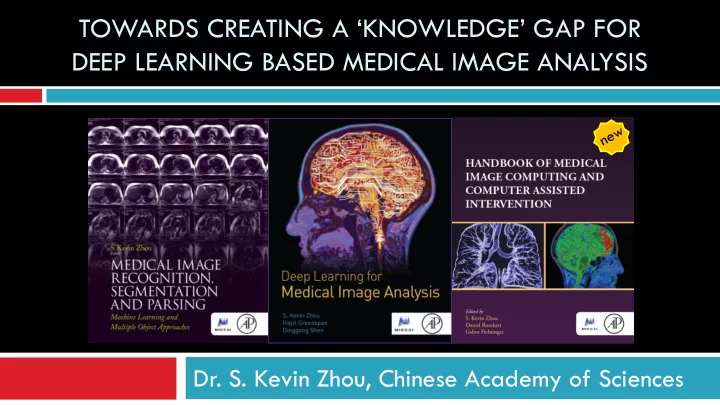
TOWARDS CREATING A KNOWLEDGE GAP FOR DEEP LEARNING BASED MEDICAL - - PowerPoint PPT Presentation
TOWARDS CREATING A KNOWLEDGE GAP FOR DEEP LEARNING BASED MEDICAL IMAGE ANALYSIS Dr. S. Kevin Zhou, Chinese Academy of Sciences Deep learning Input Algorithm: Output image variable Deep network X Y Y = f(X; W) Learning: arg min W S
Input image X Output variable Y
Algorithm: Deep network Y = f(X; W)
“state-of-the-art
[Zhang et al. ICLR2017]
“AlphaGo consumed ~50,000x more energy than Lee Sedol.”
20 ~ 1 M human brain AlphaGo v.s. in terms of watts
It is possible to
(50x less weights) MobileNet, ShuffleNet
StyleGAN, CVPR’19 Explaining and Harnessing Adversarial Examples, arxiv 1412.6572
Learning/fitting seems
from ‘easy’ to ‘difficult’ or from ‘smooth’ to ‘noisy’
Early stop
Deep image prior (arxiv 1711.10925)
“Learning is robust to an
arxiv 1705.10694
Increasing data Increasing model capacity Repeat the above
Input image
Output variable
Algorithm: Deep network Y = f(X; W)
▪ Input ▪ Output ▪ Algorithm
▪ Multi-modal inputs (RGBD, MR T1+T2, etc.) ▪ Synthesized inputs ▪ Other inputs
Input image
Output variable Y
Algorithm: Deep network Y = f(X; W)
Input image
Output variable Y
Algorithm: Deep network Y = f(X,X’; W)
Image to image X’
DNN
State-of-the-art accuracy in predicting 11 out of 14 common lung diseases based
Li et al., Encoding CT Anatomy Knowledge for Unpaired Chest X-ray Image Decomposition, MICCAI 2019. (patent pending)
Reading based on
(i) the original & bone free images (ii) only the original image
Diagnosis accuracy
Reading time
Joint work with Peking Union Medical College.
Cross-domain image synthesis Location-sensitive deep network (LSDN) The importance of spatial info.
Whole image Small region 10^3 voxels
Accurate result
Nguyen, et al. Cross-Domain Synthesis of Medical Images Using Efficient Location-Sensitive Deep Network, MICCAI 2015. Vemulapalli, et al. Unsupervised Cross-modal Synthesis of Subject-specific Scans, ICCV 2015.
▪ Multitask learning ▪ New representation ▪ More priors
Input image
Output variable
Algorithm: Deep network Y = f(X; W)
Input image
Output variable
Algorithm: Deep network Y = f(X; W)
Output variable
View classification
MTL: 85.29%, STL: 81.22%,
Human: 78.87% Measurement
Xu et al., Less is More: Simultaneous View Classification and Landmark Detection for Abdominal Ultrasound Images, MICCAI 2018.
… …
Sparse representation Dense representation Dense representation
Cross-modal Appearance 3D Geometry
Two 3D tasks: Image completion + segmentation 2D segmentation
Liao et al. More knowledge is better: Cross-domain volume completion and 3D+2D segmentation for intracardiac echocardiography contouring, MICCAI 2018.
Representation Training Testing
Xu et al., Supervised Action Classifier: Approaching Landmark Detection as Image Partitioning, MICCAI 2017.
Xu et al., Supervised Action Classifier: Approaching Landmark Detection as Image Partitioning, MICCAI 2017.
Representation Training Testing
[MICCAI’2017]
Using image2image network and
adversarial shape prior
Liver segmentation: 34% error
reduction when using 1000 CT data sets
Yang et al., Automatic Liver Segmentation Using an Adversarial Image-to-Image Network, MICCAI 2017
▪ Network design ▪ Leveraging the imaging physics, geometry
Input image
Output variable
Algorithm: Deep network Y = f(X; W)
U2-Net Adapter
* Huang et al., 3D U2-Net: A 3D Universal U-Net for Multi-Domain Medical Image Segmentation, MICCAI 2019. (patent pending)
Self-inverse Must be one2one
https://arxiv.org/abs/1909.04104 https://arxiv.org/abs/1909.04110
Lin et al., DuDoNet: Dual Domain Network for CT Metal Artifact Reduction, CVPR2019. (patent pending)
PSNR: 3dB better than state-of-the-art DL method.
Preoperative CT Intraoperative X-Ray
* Liao et al., Multiview 2D/3D Rigid Registration via a Point-Of-Interest Network for Tracking and Triangulation (POINT2), CVPR2019. (patent pending)
mTRE (mm) 50th mTRE (mm) 95th GFR (>10mm) Time (s) Initial 20.4 29.7 92.9% N/A Opt. 0.62 57.8 40.0% 23.5s DRL + opt. 1.06 24.6 15.6% 3.21s Our + opt. 0.55 5.67 2.7% 2.25s
constraint
Liao et al., Artifact Disentanglement Network for Unsupervised Metal Artifact Reduction, MICCAI 2019.
PSNR(dB) SSIM ADN 33.6 .924 CycleGAN 30.8 .729 Deep Image Prior 26.4 .759 MUNIT 14.9 .750 DRIT 25.6 .797
Artifact Disentanglement Network
思路 Idea Examples 四两拨千金 Exploiting known information rather than brute force learning ICE auto contouring, DuDoNet, disentanglement 升维思考 Making the pattern ‘more’ uniquely defined more inputs/synthesized input 降维打击 Prior or regularization multiview 2d/3d registration 梯度为王 Making problems more learnable self-inverse learning, distributed landmark representation 量变产生质变 Allowing to see more examples multitask learning, U2Net
Colleagues and students at
Colleagues and students at
Colleagues at Z2Sky Clinical collaborators at
Support from CAS,
Joining or visiting Collaborating with
Funding or investing in
zhoushaohua@ict.ac.cn 智在天下 Z2Sky
Editors: S. Kevin, Daniel Rueckert, Gabor Fichtinger Hardcover ISBN: 9780128161760 Imprint: Academic Press Published Date: 1st October 2019 Page Count: 1080
https://www.elsevier.com/books/handbook-of-medical-image-computing-and-computer-assisted-intervention/zhou/978-0-12-816176-0
Pre-order 15% off