
SLIDE 1
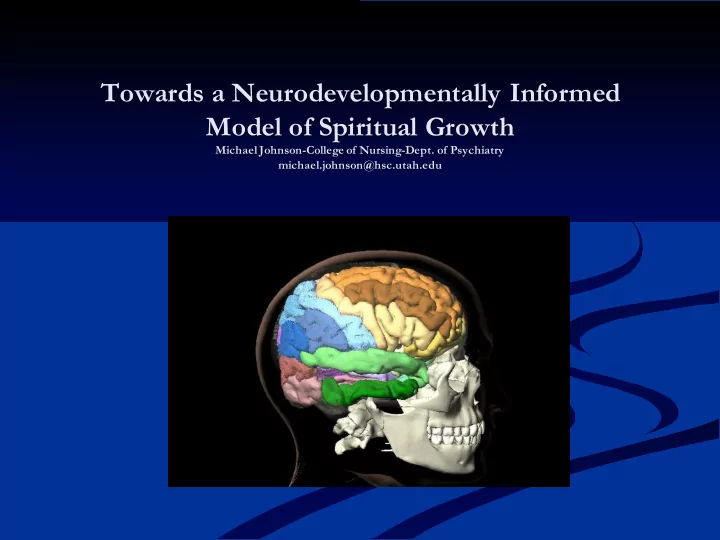
Towards a Neurodevelopmentally Informed Model of Spiritual Growth
Michael Johnson-College of Nursing-Dept. of Psychiatry michael.johnson@hsc.utah.edu
Towards a Neurodevelopmentally Informed Model of Spiritual Growth - - PowerPoint PPT Presentation
Towards a Neurodevelopmentally Informed Model of Spiritual Growth Michael Johnson-College of Nursing-Dept. of Psychiatry michael.johnson@hsc.utah.edu How do we define spirituality? n Spirituality a personal affirmation of the
Michael Johnson-College of Nursing-Dept. of Psychiatry michael.johnson@hsc.utah.edu
n Spirituality “a personal affirmation of the
26).
n “Spirituality is the sum total of the highest levels
n “Spiritual perfection means compassion and
NORMAL EGO FUNCTIONING (Western Psychology)
Moral conduct, simplifying life, slowing down, etc NONDUAL
(Beyond words, or rational thought)
UNITY MODES
(Self-object dichotomy gone,
people)
CONTEMPLATION WITH INTNERNAL REFLECTION-CALM REALATIVE REALITY DUALITY TRANSCENDENTAL/TRANSPERSONAL/ MYSTICAL
https://en.wikipedia.org/wiki/Charles_Manson
Zaehner, R. C. (1974). Our savage god. Collins.
NORMAL EGO FUNCTIONING (Western Psychology)
Preliminaries: Moral conduct, simplifying life, slowing down, etc NONDUAL
(Beyond words, or rational thought)
UNITY MODES
(Self-object dichotomy gone,
people)
MINDFULNESS & CALM REALATIVE REALITY DUALITY TRANSCENDENTAL/TRANSPERSONAL
No compassion COMPASSION
http://www.motherteresa.org/
http://www.motherteresa.org/
n To find spirit or the One within each-dedicated
Horton hears a who / everyone's hero [Motion picture]. (2012). S.l.: 20th Century Fox . Geisel, T. S., & Richardson, M. (2004). Horton Hears a Who!. HarperCollins Children's Books.
n Kabat Zinn “Perhaps the most “spiritual” thing
n Dala Lama “..Buddhahood is achieved through
Kabat-Zinn, J. (2009). Wherever you go, there you are: Mindfulness meditation in everyday life. Hachette Books . Dalai Lama. (2003). Stages of meditation. Random House.
COGNITIVE-EMOTIONAL (CULTURAL)
POSITIVE PSYCHOLOGY (VIRTUES & STRENGTHS)
Creativity Curiosity Learning Authenticity Bravery Persistence Prudence Modesty Self-Regulation- Insight Gratitude Hope Humor Religiousness
TRANSCENDENT
Sacred Mystical Beyond Words Ultimate Concern Nondual Reality Unknowable God Brahman-Atman Emptiness
COMPASSION
Love Empathy Morality Altruism Selfless Compassion
Weeks Years
Decades
16 2 4 6 10 12 18 8 14 20 13 32 26 30 28 36 24 22 2 3 4 1 6 7 5 20 12 17 9 11 30 40 10 16 50 8 60 70 80 14 15 18 90 100
CONCEPTION DEATH
Neuronal Activity
BIRTH
n Neurogenesis: production and migration of
n Synaptogenesis: creation of axons (signal cables)
n Pruning and Myelination: creation of memory
http://www.babycenter.com/6_your-pregnancy-3-weeks_1049.bc
Carlson, N. R. (1986). Physiology of behavior . Allyn & Bacon.
Weeks Years
Decades
16 2 4 6 10 12 18 8 14 20 13 32 26 30 28 36 24 22 2 3 4 1 6 7 5 20 12 17 9 11 30 40 10 16 50 8 60 70 80 14 15 18 90 100
CONCEPTION DEATH
NEUROGENESIS
Neuronal Activity
http://www.pregnology.com/faralong.php
Weeks Years
Decades
16 2 4 6 10 12 18 8 14 20 13 32 26 30 28 36 24 22 2 3 4 1 6 7 5 20 12 17 9 11 30 40 10 16 50 8 60 70 80 14 15 18 90 100
CONCEPTION DEATH
NEUROGENESIS
SYNAPTOGENESIS
http://www.neuroscience.cam.ac.uk/directory/profile.php?jf108, James Fawcett , 2016
23
By the time of birth there are 87 billion neurons (27 billion in the neocortex alone): Half excitatory and half inhibitory: Reverberating back and forth over can you guess how many miles of axonal wiring?
24
n A densely packed CONTINUOUS layer of
n 2-3 mm thick n 256 sq inches sheet
25
DENDRITES
AXONS
Weeks Years
Decades
16 2 4 6 10 12 18 8 14 20 13 32 26 30 28 36 24 22 2 3 4 1 6 7 5 20 12 17 9 11 30 40 10 16 50 8 60 70 80 14 15 18 90 100
CONCEPTION DEATH
NEUROGENESIS
SYNAPTOGENESIS MYELINATION & PRUNING
n “Neurons that fire together wire together” n Neuronal “Fingerprints” of Conscious
Hebb, D. O. (1949). The organization of behavior: A neuropsychological approach. John Wiley & Sons.
Complex pruning begins BOTH innately from genetic timing/propensities, and from environmental interaction leading to only certain connections (vast networks) being left in place
This can quantified through MRI images of the brain since by recording thickness of the neocortex-as you cut synapses and add white matter your neocortex gets thinner and you go from the magic of childhood to a specialized adults with an identity, job, role, etc.
THINNER NEOCORTEX=SPECIALIZATION OF FUNCTION
Gogtay, N., Giedd, J. N., Lusk, L., Hayashi, K. M., Greenstein, D., Vaituzis, A. C., ... & Rapoport, J. L. (2004). Dynamic mapping of human cortical development during childhood through early adulthood. Proceedings of the National Academy of sciences of the United States of America, 101(21), 8174-8179.
Gogtay, N., Giedd, J. N., Lusk, L., Hayashi, K. M., Greenstein, D., Vaituzis, A. C., ... & Rapoport, J. L. (2004). Dynamic mapping of human cortical development during childhood through early adulthood. Proceedings of the National Academy of sciences of the United States of America, 101(21), 8174-8179.
Sowell, E. R., Thompson, P. M., Leonard, C. M., Welcome, S. E., Kan, E., & Toga, A. W. (2004). Longitudinal mapping of cortical thickness and brain growth in normal children. The Journal of neuroscience, 24(38), 8223-8231.
Sowell, E. R., Peterson, B. S., Thompson, P. M., Welcome, S. E., Henkenius, A. L., & Toga, A. W. (2003). Mapping cortical change across the human life span. Nature neuroscience, 6(3), 309-315.
Schurz, M., Radua, J., Aichhorn, M., Richlan, F., & Perner, J. (2014). Fractionating theory of mind: A meta-analysis of functional brain imaging studies.Neuroscience & BiobehavioralReviews,42, 9-34.
Sowell, E. R., Peterson, B. S., Thompson, P. M., Welcome, S. E., Henkenius, A. L., & Toga, A. W. (2003). Mapping cortical change across the human life span. Nature neuroscience, 6(3), 309-315.
n Mother nature creates potentialities of human
n WE MUST TAKE ADVANTAGE OF THESE
Regional Pruning Corresponds to Known Brain Networks for Functions Predicting Developmental Stages
Weeks Years
Decades
16 2 4 6 10 12 18 8 14 20 13 32 26 30 28 36 24 22 2 3 4 1 6 7 5 20 12 17 9 11 30 40 10 16 50 8 60 70 80 14 15 18 90 100
CONCEPTION DEATH
MYELINATION & PRUNING
Piaget-Sensory-Motor > Piaget-Formal Operational > Piaget-Concrete Operational> Erickson-Intimacy vs. Isolation > Piaget-Preoperational> Erickson-Trust vs. Mistrust > Erickson-Autonomy vs. shame > Erickson-Industry vs. Inferiority > Erickson-Identity vs. Confusion >
Mahler & Bowlby-attachment & separation >
n Because of both cultural and economic factors the American
family is experiencing less time to nurture their developmental stages, particularly those related to emotional and contemplative skills.
n There is nearly a complete lack of mental health screening and
emotional/contemplative education in the school systems
n
The needs of the middle age person whose brain is undergoing a huge developmental change is equally important to earlier stages
>Just as we must address strengthening peoples abilities to improve or protect for well being/spirituality, we must also address innate pathological structures that arise during development >The old dogma of psychopharmacology being the explanatory model of psychiatry (i.e. to much/to little dopamine, serotonin, etc.) is now viewed as much more limited. Serious questions are being raised about the long term efficacy and hazards of psychiatric drugs especially in pediatrics.
Weeks Years
Decades
16 2 4 6 10 12 18 8 14 20 13 32 26 30 28 36 24 22 2 3 4 1 6 7 5 20 12 17 9 11 30 40 10 16 50 8 60 70 80 14 15 18 90 100
CONCEPTION DEATH
MYELINATION & PRUNING
Attachment/Personality Disorders > Autism > Tourette’s Disorder > Attachment/Personality Disorders > Poor maternal care/nutrition >
Because we can now see most psychiatric disorders as arising from complicated, hugely interconnected slabs of neocortex, involving many neurotransmitters, and we do not have an exact drug that changes the pathological underpinnings of such vast neurodevelopmental pathology-we must remind our selves of the earlier equation.
Cortical-Behavioral Functioning=Innate genetically controlled neuronal activity events (critical windows) +Innately determined talents or deficits (temperamental/ability traits) + Environment (local/global culture, nutrition, etc.)
Kinderman, P., Schwannauer, M., Pontin, E., & Tai, S. (2013). Psychological processes mediate the impact of familial risk, social circumstances and life events on mental
Each spiritual domain and level likely has it’s own unique neuronal fingerprint
n Future studies should look at the evolution of
n Operational definitions must be created based
Highly Recommended General Neurodevelopment Papers and Website for Movie
Core Papers: Sowell, Elizabeth R., et al. "Longitudinal mapping of cortical thickness and brain growth in normal children." The Journal of neuroscience 24.38 (2004): 8223-8231. Toga, Arthur W., Paul M. Thompson, and Elizabeth R. Sowell. "Mapping brain maturation." Focus (2006). Gogtay, Nitin, et al. "Dynamic mapping of human cortical development during childhood through early adulthood." Proceedings of the National Academy of Sciences of the United States of America 101.21 (2004): 8174-8179. Movie: http://users.loni.usc.edu/~thompson/DEVEL/dynamic.html