Towards a formal proof of the Jesse Han independence of the - - PowerPoint PPT Presentation

towards a formal proof of the
SMART_READER_LITE
LIVE PREVIEW

Towards a formal proof of the Jesse Han independence of the - - PowerPoint PPT Presentation

Towards a formal proof of the independence of the continuum hypothesis Towards a formal proof of the Jesse Han independence of the continuum The Flypitch project The path to a hypothesis proof Whats done A deep embedding of


slide-1
SLIDE 1

Towards a formal proof of the independence of the continuum hypothesis Jesse Han The Flypitch project The path to a proof What’s done

A deep embedding of first-order logic G¨

  • del’s completeness

theorem But wait, there’s more!

The way forward

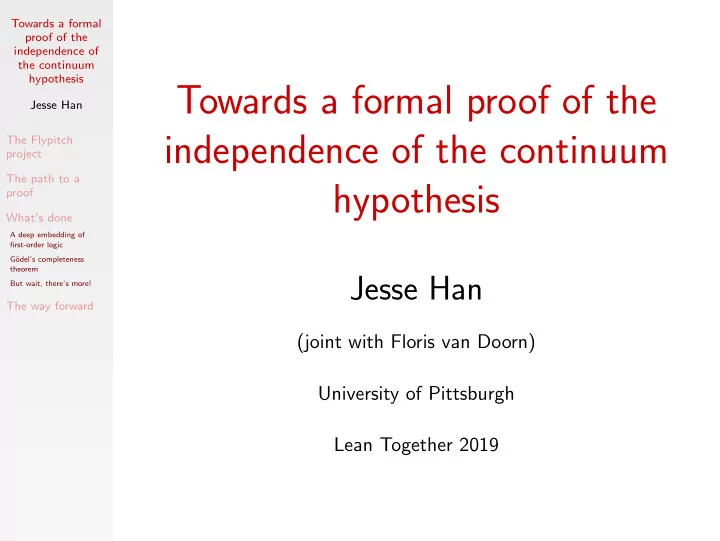
Towards a formal proof of the independence of the continuum hypothesis

Jesse Han

(joint with Floris van Doorn) University of Pittsburgh Lean Together 2019

slide-2
SLIDE 2

Towards a formal proof of the independence of the continuum hypothesis Jesse Han The Flypitch project The path to a proof What’s done

A deep embedding of first-order logic G¨

  • del’s completeness

theorem But wait, there’s more!

The way forward

The Flypitch project The path to a proof What’s done The way forward

slide-3
SLIDE 3

Towards a formal proof of the independence of the continuum hypothesis Jesse Han The Flypitch project The path to a proof What’s done

A deep embedding of first-order logic G¨

  • del’s completeness

theorem But wait, there’s more!

The way forward

What is CH?

§ The continuum hypothesis (CH) states that there are no sets whose size is strictly larger than the countable natural numbers and strictly smaller than the uncountable real numbers, i.e. @X, |X| ą ℵ0 ù ñ |X| ě 2ℵ0. § It was introduced by Cantor in 1878 and was the very first problem on Hilbert’s list of twenty-three

  • utstanding problems in mathematics.
slide-4
SLIDE 4

Towards a formal proof of the independence of the continuum hypothesis Jesse Han The Flypitch project The path to a proof What’s done

A deep embedding of first-order logic G¨

  • del’s completeness

theorem But wait, there’s more!

The way forward

What is CH?

§ G¨

  • del proved in 1938 that CH was consistent with ZFC

(i.e. not disprovable from ZFC), and later conjectured that CH was independent of ZFC, i.e. neither provable nor disprovable from the ZFC axioms. § In 1963, Paul Cohen developed forcing, which allowed him to prove the consistency of CH with ZFC, and therefore complete the independence proof. For this work, he was awarded a Fields medal—the only one to ever be awarded for a work in mathematical logic.

slide-5
SLIDE 5

Towards a formal proof of the independence of the continuum hypothesis Jesse Han The Flypitch project The path to a proof What’s done

A deep embedding of first-order logic G¨

  • del’s completeness

theorem But wait, there’s more!

The way forward

What is the Flypitch project?

The Flypitch project aims to produce a formal proof of the independence of CH.

slide-6
SLIDE 6

Towards a formal proof of the independence of the continuum hypothesis Jesse Han The Flypitch project The path to a proof What’s done

A deep embedding of first-order logic G¨

  • del’s completeness

theorem But wait, there’s more!

The way forward

The Flypitch project The path to a proof What’s done The way forward

slide-7
SLIDE 7

Towards a formal proof of the independence of the continuum hypothesis Jesse Han The Flypitch project The path to a proof What’s done

A deep embedding of first-order logic G¨

  • del’s completeness

theorem But wait, there’s more!

The way forward

The path to a proof

The proof can be broken down into three steps:

  • 1. G¨
  • del’s completeness theorem reduces “T does not

prove ψ” to “there exists a model M | ù T such that ψ in M”, and therefore the reduces problem to finding a model of ZFC where CH is true and a model of ZFC where CH is false.

  • 2. G¨
  • del’s 1938 result produces a model of ZFC where CH

is true.

  • 3. Cohen’s forcing argument produces a model of ZFC

where CH is false.

slide-8
SLIDE 8

Towards a formal proof of the independence of the continuum hypothesis Jesse Han The Flypitch project The path to a proof What’s done

A deep embedding of first-order logic G¨

  • del’s completeness

theorem But wait, there’s more!

The way forward

The path to a proof

Before we can even formally state the problem, we need to formalize: § Syntax of FOL § A proof system § Semantics of FOL § Axioms of ZFC.

slide-9
SLIDE 9

Towards a formal proof of the independence of the continuum hypothesis Jesse Han The Flypitch project The path to a proof What’s done

A deep embedding of first-order logic G¨

  • del’s completeness

theorem But wait, there’s more!

The way forward

Related existing formalizations

§ Harrison’s formalization of first-order logic and basic model theory in HOL Light; also in the Handbook of Practical Logic and Automated Reasoning § Lawrence Paulson’s formalization of consistency of the axiom of choice (in Isabelle/ZF) § Margetson, also Schlichtkrull: formalizations of first-order logic for verified provers (in Isabelle/HOL) § Russell O’Connor’s formal proof of G¨

  • del

incompleteness theorems (in Coq) § Gunther et al: formalization of some axiomatic forcing (in Isabelle/ZF)

slide-10
SLIDE 10

Towards a formal proof of the independence of the continuum hypothesis Jesse Han The Flypitch project The path to a proof What’s done

A deep embedding of first-order logic G¨

  • del’s completeness

theorem But wait, there’s more!

The way forward

The Flypitch project The path to a proof What’s done The way forward

slide-11
SLIDE 11

Towards a formal proof of the independence of the continuum hypothesis Jesse Han The Flypitch project The path to a proof What’s done

A deep embedding of first-order logic G¨

  • del’s completeness

theorem But wait, there’s more!

The way forward

Overview

Code located at: https://github.com/flypitch/flypitch. § Work on current codebase started in October 2018. § Now at ą 7500 lines of code. § Finished: formalization of first-order logic and G¨

  • del’s

completeness theorem. § Also: compactness theorem, Peano arithmetic, Presburger arithmetic, ZFC. Informal but detailed notes written with Lean’s type-theoretic foundations, located at https://github.com/flypitch/flypitch-notes.

slide-12
SLIDE 12

Towards a formal proof of the independence of the continuum hypothesis Jesse Han The Flypitch project The path to a proof What’s done

A deep embedding of first-order logic G¨

  • del’s completeness

theorem But wait, there’s more!

The way forward

Desiderata for a deep embedding of FOL

Syntax: § Proof system should mirror Prop: natural deduction, intro/elim rules. § Reflection-friendly: should be able to reify terms, formulas, proofs by structural induction; soundness should just match all deeply-embedded logical

  • perations to their Prop counterparts.

Semantics: § Given a model M, any term with k free variables should be interpreted as a k-ary function Mk Ñ M. § Given a model M, any formula with k free variables should be interpreted as a k-ary function Mk Ñ Prop

slide-13
SLIDE 13

Towards a formal proof of the independence of the continuum hypothesis Jesse Han The Flypitch project The path to a proof What’s done

A deep embedding of first-order logic G¨

  • del’s completeness

theorem But wait, there’s more!

The way forward

Languages

Function and relation symbols are types indexed by arity:

structure Language : Type (u+1) := (functions : N Ñ Type u) (relations : N Ñ Type u) variable L : Language /- The language of abelian groups -/ inductive abel_functions : N Ñ Type | zero : abel_functions 0 | plus : abel_functions 2 def L_abel : Language := xabel_functions, λn, emptyy

slide-14
SLIDE 14

Towards a formal proof of the independence of the continuum hypothesis Jesse Han The Flypitch project The path to a proof What’s done

A deep embedding of first-order logic G¨

  • del’s completeness

theorem But wait, there’s more!

The way forward

Terms

inductive preterm : N Ñ Type u | var {} : @ (k : N), preterm 0 | func : @ {l : N} (f : L.functions l), preterm l | app : @ {l : N} (t : preterm (l + 1)) (s : preterm 0), preterm l @[reducible] def term := preterm L 0

§ preterm L n is a partially applied term. If applied to n terms, it becomes a term. § Every element of preterm L 0 is a well-formed term. § We use this encoding to avoid mutual or nested inductive types, since those are not too convenient to work with in Lean.

slide-15
SLIDE 15

Towards a formal proof of the independence of the continuum hypothesis Jesse Han The Flypitch project The path to a proof What’s done

A deep embedding of first-order logic G¨

  • del’s completeness

theorem But wait, there’s more!

The way forward

Formulas

Formulas are defined analogously:

inductive preformula : N Ñ Type u | falsum {} : preformula 0 | equal (t1 t2 : term L) : preformula 0 | rel {l : N} (R : L.relations l) : preformula l | apprel {l : N} (f : preformula (l + 1)) (t : term L) : preformula l | imp (f1 f2 : preformula 0) : preformula 0 | all (f : preformula 0) : preformula 0 @[reducible] def formula := preformula L 0

A preterm (resp. preformula) of level l induces an l-ary function from terms to terms (resp. terms to formulas).

slide-16
SLIDE 16

Towards a formal proof of the independence of the continuum hypothesis Jesse Han The Flypitch project The path to a proof What’s done

A deep embedding of first-order logic G¨

  • del’s completeness

theorem But wait, there’s more!

The way forward

de Bruijn variables

Get used to using de Bruijn indices. (They are really not that bad.) —Jeremy Avigad § One of the reasons why the above syntax is so nice is because quantification is handled with de Bruijn variables: in a formula, the variable &k is bound by the kth outmost quantifier which has &k in scope. § Variable shadowing does not happen with de Bruijn variables. § Example: @x, @y, x “ y ù ñ p@z, z “ x ù ñ z “ yq becomes

@1 @1 &1 » &0 ù ñ @1 (&0 » &2 ù ñ &0 » &1)

slide-17
SLIDE 17

Towards a formal proof of the independence of the continuum hypothesis Jesse Han The Flypitch project The path to a proof What’s done

A deep embedding of first-order logic G¨

  • del’s completeness

theorem But wait, there’s more!

The way forward

Proof system

inductive prf : set (formula L) Ñ formula L Ñ Type u | axm {Γ A} (h : A P Γ) : prf Γ A | impI {Γ : set (formula L)} {A B} (h : prf (insert A Γ ) B) : prf Γ (A ù ñ B) | impE {Γ} (A) {B} (h1 : prf Γ (A ù ñ B)) (h2 : prf Γ A) : prf Γ B | falsumE {Γ : set (formula L)} {A} (h : prf (insert „A Γ ) K) : prf Γ A | allI {Γ A} (h : prf (lift_formula1 11 Γ) A) : prf Γ (@1 A) | allE2 {Γ} A t (h : prf Γ (@1 A)) : prf Γ (A[t // 0]) | ref (Γ t) : prf Γ (t » t) | subst2 {Γ} (s t f) (h1 : prf Γ (s » t)) (h2 : prf Γ (f[s // 0])) : prf Γ (f[t // 0])

slide-18
SLIDE 18

Towards a formal proof of the independence of the continuum hypothesis Jesse Han The Flypitch project The path to a proof What’s done

A deep embedding of first-order logic G¨

  • del’s completeness

theorem But wait, there’s more!

The way forward

Sentences

To define sentences, need a way to rule out free variables. Since we use de Bruijn variables, suffices to ensure index of largest variable never exceeds quantifier depth. To make it easy to structurally induct, we define bounded_preterm and bounded_preformula:

inductive bounded_preterm (n : N) : N Ñ Type u | bd_var {} : @ (k : fin n), bounded_preterm 0 | bd_func {} : @ {l : N} (f : L.functions l), bounded_preterm l | bd_app : @ {l : N} (t : bounded_preterm (l + 1)) (s : bounded_preterm 0), bounded_preterm l def bounded_term (n) := bounded_preterm L n 0 def closed_preterm (l) := bounded_preterm L 0 l def closed_term := closed_preterm L 0

slide-19
SLIDE 19

Towards a formal proof of the independence of the continuum hypothesis Jesse Han The Flypitch project The path to a proof What’s done

A deep embedding of first-order logic G¨

  • del’s completeness

theorem But wait, there’s more!

The way forward

Sentences

inductive bounded_preformula : N Ñ N Ñ Type u | bd_falsum {} {n} : bounded_preformula n 0 | bd_equal {n} (t1 t2 : bounded_term L n) : bounded_preformula n 0 | bd_rel {n l : N} (R : L.relations l) : bounded_preformula n l | bd_apprel {n l} (f : bounded_preformula n (l + 1)) (t : bounded_term L n) : bounded_preformula n l | bd_imp {n} (f1 f2 : bounded_preformula n 0) : bounded_preformula n 0 | bd_all {n} (f : bounded_preformula (n+1) 0) : bounded_preformula n 0 def sentence : bounded_preformula 0 0

slide-20
SLIDE 20

Towards a formal proof of the independence of the continuum hypothesis Jesse Han The Flypitch project The path to a proof What’s done

A deep embedding of first-order logic G¨

  • del’s completeness

theorem But wait, there’s more!

The way forward

Semantics

Without a bound, cannot instantiate a formula without knowing what to assign to every &k, k : N. With a bound, we can use vectors of elements instead.

inductive dvector (α : Type u) : N Ñ Type u | nil {} : dvector 0 | cons : @{n} (x : α) (xs : dvector n), dvector (n+1)

slide-21
SLIDE 21

Towards a formal proof of the independence of the continuum hypothesis Jesse Han The Flypitch project The path to a proof What’s done

A deep embedding of first-order logic G¨

  • del’s completeness

theorem But wait, there’s more!

The way forward

Semantics

@[simp] def realize_bounded_term {S : Structure L} {n} (v : dvector S n) : @{l} (t : bounded_preterm L n l) (xs : dvector S l), S.carrier | _ &k xs := v.nth k.1 k.2 | _ (bd_func f) xs := S.fun_map f xs | _ (bd_app t1 t2) xs := realize_bounded_term t1 (realize_bounded_term t2 ([])::xs)

slide-22
SLIDE 22

Towards a formal proof of the independence of the continuum hypothesis Jesse Han The Flypitch project The path to a proof What’s done

A deep embedding of first-order logic G¨

  • del’s completeness

theorem But wait, there’s more!

The way forward

Semantics

@[simp] def realize_bounded_formula : @{n l} (v : dvector S n) (f : bounded_preformula L n l) (xs : dvector S l), Prop | _ _ v bd_falsum xs := false | _ _ v (t1 » t2) xs := realize_bounded_term v t1 xs = realize_bounded_term v t2 xs | _ _ v (bd_rel R) xs := S.rel_map R xs | _ _ v (bd_apprel f t) xs := realize_bounded_formula v f (realize_bounded_term v t ([])::xs) | _ _ v (f1 ù ñ f2) xs := realize_bounded_formula v f1 xs Ñ realize_bounded_formula v f2 xs | _ _ v (@1 f) xs := @(x : S), realize_bounded_formula (x::v) f xs

slide-23
SLIDE 23

Towards a formal proof of the independence of the continuum hypothesis Jesse Han The Flypitch project The path to a proof What’s done

A deep embedding of first-order logic G¨

  • del’s completeness

theorem But wait, there’s more!

The way forward

Completeness: statement and proof sketch

Let T be a theory and ψ a sentence. G¨

  • del’s completeness

theorem states that the following are equivalent:

  • 1. T proves ψ.
  • 2. ψ is satisfied in every model of T.

Proof sketch:

  • 1. 1 ñ 2 is the soundness theorem, which follows from a

structural induction on proofs.

  • 2. Conversely, if pT $ ψq, then T Y ψ is consistent.

Any model of this is a model of T. Obtain a model by the Henkin construction which satisfies ψ, which gives the contrapositive of 2 ñ 1.

slide-24
SLIDE 24

Towards a formal proof of the independence of the continuum hypothesis Jesse Han The Flypitch project The path to a proof What’s done

A deep embedding of first-order logic G¨

  • del’s completeness

theorem But wait, there’s more!

The way forward

Completions of theories

§ The Henkin argument requires completions of theories. § Applied Johannes’ implementation of Zorn’s lemma. § Could have interpreted theories as filters on the poset of formulas, but needed to define filter machinery for posets instead of just set (set α) § To apply Zorn’s lemma, needed to bundle and work with the poset structure on the subtype of consistent extensions of a fixed theory T.

slide-25
SLIDE 25

Towards a formal proof of the independence of the continuum hypothesis Jesse Han The Flypitch project The path to a proof What’s done

A deep embedding of first-order logic G¨

  • del’s completeness

theorem But wait, there’s more!

The way forward

Term models

§ The Henkin construction produces a model of T using terms of the language (provided the language has enough constants to witness all existential statements proved by T). § First serious test of both syntax and semantics § Proof hinges on proving completeness for term models

  • f complete Henkinized theories and then reducing to

this case § This is an example of where straightforward structural induction doesn’t work; needed to induct on quantifier depth instead and then structurally induct on quantifier-free sentences.

slide-26
SLIDE 26

Towards a formal proof of the independence of the continuum hypothesis Jesse Han The Flypitch project The path to a proof What’s done

A deep embedding of first-order logic G¨

  • del’s completeness

theorem But wait, there’s more!

The way forward

Language morphisms

Henkinization requires the construction of an infinite chain

  • f languages and taking the union. Since we’re working with

types, we need to work with injective maps between Languages instead: L “ L0 Ñ L1 Ñ ¨ ¨ ¨ Ñ Ln Ñ . . . ; L8 “ lim

Ý Ñ Li

structure Lhom (L L1 : Language) := (on_function : @{n}, L.functions n Ñ L1.functions n) (on_relation : @{n}, L.relations n Ñ L1.relations n)

slide-27
SLIDE 27

Towards a formal proof of the independence of the continuum hypothesis Jesse Han The Flypitch project The path to a proof What’s done

A deep embedding of first-order logic G¨

  • del’s completeness

theorem But wait, there’s more!

The way forward

Lifting proofs along language morphisms

A nontrivial and crucial but overlooked (in nearly every source we found) step in the Henkin argument: let L1 Ñ L2 be an injective language morphism. Let Γ be a set of L1-formulas and let f be an L1-formula. If there is a proof Γ $ ψ in the language L2, there exists a proof Γ $ ψ in the

  • riginal language L1.

/- here F is an Lhom, F : L Ñ L1 -/ noncomputable def reflect_prf {Γ : set (formula L)} {f : formula L} (hF : F.is_injective) (h : F.on_formula 11 Γ $ F.on_formula f) : Γ $ f

slide-28
SLIDE 28

Towards a formal proof of the independence of the continuum hypothesis Jesse Han The Flypitch project The path to a proof What’s done

A deep embedding of first-order logic G¨

  • del’s completeness

theorem But wait, there’s more!

The way forward

Colimits and Henkinization

To perform the Henkin construction, need to take colimits of

  • languages. We rolled our own (filtered) colimits

(src/colimit.lean). To show “obvious” (but painful to prove) things like “the Henkinization of T is a Henkin theory”, need to: § Construct the induced colimits on preterms, terms, preformulas, formulas § Show the universal comparison maps are bijective (e.g. lim

Ý Ñ preterm L_n l » preterm L_infty l)

§ Take each T_n : Theory L_n, push it into Theory L_infty, and work with the resulting (literal) chain of sets (e.g. showing it’s a chain).

slide-29
SLIDE 29

Towards a formal proof of the independence of the continuum hypothesis Jesse Han The Flypitch project The path to a proof What’s done

A deep embedding of first-order logic G¨

  • del’s completeness

theorem But wait, there’s more!

The way forward

Putting it all together

theorem model_existence {L : Language} (T : Theory L) : is_consistent T Ø (D M : Structure L, (nonempty M) ^ M ( T) theorem completeness {L : Language} (T : Theory L) (ψ : sentence L) : T $1 ψ Ø T ( ψ theorem compactness {L : Language} {T : Theory L} {f : sentence L} : T ( f Ø D fs : finset (sentence L), (Òfs : Theory L) ( (f : sentence L) ^ Òfs Ď T

slide-30
SLIDE 30

Towards a formal proof of the independence of the continuum hypothesis Jesse Han The Flypitch project The path to a proof What’s done

A deep embedding of first-order logic G¨

  • del’s completeness

theorem But wait, there’s more!

The way forward

Pros and cons of our implementation

Pros: § Well-formedness is type-correctness § Many proofs become straightforward structural inductions easily handled with the equation compiler or induction on x; simp˚ § Can write examples of bounded_formula with the same notation as formula without requiring separate proofs of boundedness (“the notation is the proof of boundedness”) § Well-behaved semantics. Soundness is straightforward, as it should be. Statements like

Z1 ( @1@1(&1 +1 (&0 +1 &0) » &0 +1 (&0 +1 &1)) Ø @ (x y : Z), x + (y + y) = y + (y + x)

hold by refl.

slide-31
SLIDE 31

Towards a formal proof of the independence of the continuum hypothesis Jesse Han The Flypitch project The path to a proof What’s done

A deep embedding of first-order logic G¨

  • del’s completeness

theorem But wait, there’s more!

The way forward

Pros and cons of our implementation

Cons: § We often need casts to ensure statements involving bounded_terms type-check, usually induced by n ď m

  • r equalities like n ` 2 “ 1 ` n ` 1, e.g. “the

realizations of a closed term at any vector of any length are all the same”, or “substituting at the first open variable after taking forall is the same as taking forall after substituting at the second open variable”:

((@1f)[t.cast (by simp) /0] : bounded_formula L n) = @1((f[t.cast (by {simp} : 0 ď n) // 1 // (by {simp} : 1 + n + 1 = n + 2)]).cast_eq (by simp))

§ (This is actually a “by tidy” one-liner, but related statements are often not.)

slide-32
SLIDE 32

Towards a formal proof of the independence of the continuum hypothesis Jesse Han The Flypitch project The path to a proof What’s done

A deep embedding of first-order logic G¨

  • del’s completeness

theorem But wait, there’s more!

The way forward

Pros and cons of our implementation

Cons: § de Bruijn variables are easy for computers to read, not so much for humans as quantifier depth increases and substitutions/lifts show up:

slide-33
SLIDE 33

Towards a formal proof of the independence of the continuum hypothesis Jesse Han The Flypitch project The path to a proof What’s done

A deep embedding of first-order logic G¨

  • del’s completeness

theorem But wait, there’s more!

The way forward

Peano arithmetic

Example of the sentence notation at work:

inductive peano_functions : N Ñ Type | zero : peano_functions 0 | succ : peano_functions 1 | plus : peano_functions 2 | mult : peano_functions 2 def L_peano : Language := xpeano_functions, λ n, emptyy def p_induction_schema {n : N} (ψ : bounded_formula L_peano (n+1)) : sentence L_peano := bd_alls n (ψ[zero/0] [ @1 (ψ ù ñ (ψ Ò1 1 # 1)[succ &0/0]) ù ñ @1 ψ)

slide-34
SLIDE 34

Towards a formal proof of the independence of the continuum hypothesis Jesse Han The Flypitch project The path to a proof What’s done

A deep embedding of first-order logic G¨

  • del’s completeness

theorem But wait, there’s more!

The way forward

ZFC

Can either define abbreviations like Ď or tx, yu externally (extensions of language) or internally. Current development is bona fide ZFC with just the symbol tPu. Over the weekend, Andrew Tindall completed the formal statement of ZFC:

def axiom_of_choice : sentence L_ZFC := @1@1(fn_domain ù ñ D1@1(&0 P1 &2 ù ñ @1(fn_app Ò1 1 # 2 Ò1 1 # 2 ù ñ (@1(fn_app Ò1 1 # 1 Ò1 1 # 4 Ò1 1 # 4 [ D

1(&0 P1 &2)) ù

ñ &0 P1 &1)))) def ZF : Theory L_ZFC := {axiom_of_extensionality, axiom_of_union, axiom_of_powerset, axiom_of_infinity} Y (λ(c : bounded_formula L_ZFC 2), axiom_of_replacement c) 11 set.univ def ZFC : Theory L_ZFC := ZF Y {axiom_of_choice}

slide-35
SLIDE 35

Towards a formal proof of the independence of the continuum hypothesis Jesse Han The Flypitch project The path to a proof What’s done

A deep embedding of first-order logic G¨

  • del’s completeness

theorem But wait, there’s more!

The way forward

Statement of CH

...and also a statement of CH! def continuum_hypothesis : sentence L_ZFC := @1 @1 ((D1((is_first_infinite_ordinal Ò1 1 # 1 Ò1 1 # 1) [ (is_powerset Ò1 1 # 2)) [ (is_first_uncountable_ordinal Ò1 1 #0)) ù ñ zfc_equiv)

  • - TODO

theorem independence_of_CH : ( ZFC $1 continuum_hypothesis) ^ ( ZFC $1 „ continuum_hypothesis) := sorry

slide-36
SLIDE 36

Towards a formal proof of the independence of the continuum hypothesis Jesse Han The Flypitch project The path to a proof What’s done

A deep embedding of first-order logic G¨

  • del’s completeness

theorem But wait, there’s more!

The way forward

From a Math.SE thread about formally writing out the continuum hypothesis:

slide-37
SLIDE 37

Towards a formal proof of the independence of the continuum hypothesis Jesse Han The Flypitch project The path to a proof What’s done

A deep embedding of first-order logic G¨

  • del’s completeness

theorem But wait, there’s more!

The way forward

Formula pretty-printer

Disclaimer: code under construction!

slide-38
SLIDE 38

Towards a formal proof of the independence of the continuum hypothesis Jesse Han The Flypitch project The path to a proof What’s done

A deep embedding of first-order logic G¨

  • del’s completeness

theorem But wait, there’s more!

The way forward

The Flypitch project The path to a proof What’s done The way forward

slide-39
SLIDE 39

Towards a formal proof of the independence of the continuum hypothesis Jesse Han The Flypitch project The path to a proof What’s done

A deep embedding of first-order logic G¨

  • del’s completeness

theorem But wait, there’s more!

The way forward

To-do list

(or: La longue marche ´ a travers la th` eorie des ensembles): § Lowenheim-Skolem theorems § show ZFC is consistent (by e.g. showing Mario’s “model of ZFC” is a model of ZFC) § Formalize the constructible universe L § Extract a countable model for forcing § Formalize axiomatic presentation of forcing (without reference to countable transitive models of set theory)

slide-40
SLIDE 40

Towards a formal proof of the independence of the continuum hypothesis Jesse Han The Flypitch project The path to a proof What’s done

A deep embedding of first-order logic G¨

  • del’s completeness

theorem But wait, there’s more!

The way forward

To-do list

Long march aside, other useful things would be: § Custom tactics/automation for tedious work (like proving deeply-embedded tautologies or parsing de Bruijn indices). § Verified reflection procedure for first-order typeclasses § Extensive documentation (coming soon: flypitch-doc) to reduce activation energy for future

  • contributions. Also integration with the Formal

Abstracts project.

slide-41
SLIDE 41

Towards a formal proof of the independence of the continuum hypothesis Jesse Han The Flypitch project The path to a proof What’s done

A deep embedding of first-order logic G¨

  • del’s completeness

theorem But wait, there’s more!

The way forward

Wishlist

Maybe: § Construct Qalg as the term model of the Henkinization

  • f ACF0?

§ Go another level down and embed first-order logic inside a model of ZFC? § Categorical logic and sheaf-theoretic forcing?

slide-42
SLIDE 42

Towards a formal proof of the independence of the continuum hypothesis Jesse Han The Flypitch project The path to a proof What’s done

A deep embedding of first-order logic G¨

  • del’s completeness

theorem But wait, there’s more!

The way forward

Final remarks

§ Contributions and PRs are always welcome (see open issues at Github page) § de Bruijn indices really aren’t that bad § Lean is fun! § A big thank you to Floris for being an excellent mentor!

slide-43
SLIDE 43

Towards a formal proof of the independence of the continuum hypothesis Jesse Han The Flypitch project The path to a proof What’s done

A deep embedding of first-order logic G¨

  • del’s completeness

theorem But wait, there’s more!

The way forward

Thank you!