Tool-Supported Refinement of High- Level Requirements and - - PowerPoint PPT Presentation

tool supported refinement of high level requirements and
SMART_READER_LITE
LIVE PREVIEW

Tool-Supported Refinement of High- Level Requirements and - - PowerPoint PPT Presentation

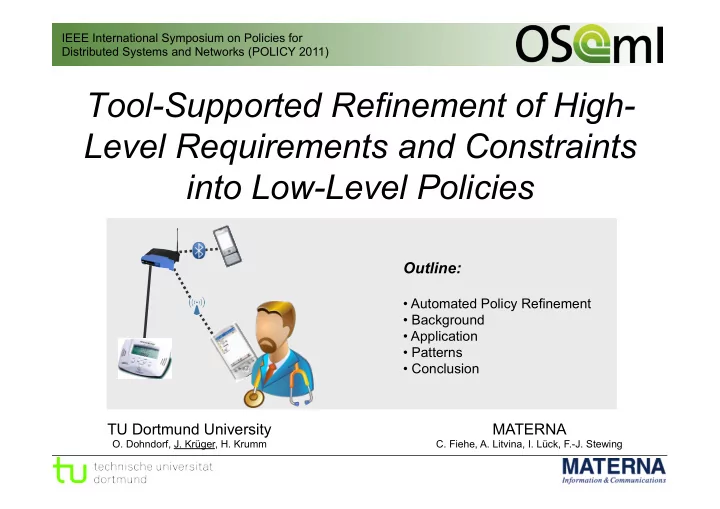
IEEE International Symposium on Policies for Distributed Systems and Networks (POLICY 2011) Tool-Supported Refinement of High- Level Requirements and Constraints into Low-Level Policies Outline: Automated Policy Refinement Background


slide-1
SLIDE 1

Tool-Supported Refinement of High- Level Requirements and Constraints into Low-Level Policies

TU Dortmund University

  • O. Dohndorf, J. Krüger, H. Krumm

MATERNA

  • C. Fiehe, A. Litvina, I. Lück, F.-J. Stewing

Outline:

  • Automated Policy Refinement
  • Background
  • Application
  • Patterns
  • Conclusion

IEEE International Symposium on Policies for Distributed Systems and Networks (POLICY 2011)

slide-2
SLIDE 2

2

  • Principle:

Abstract Policies: Constraints Detailed Policies: Executable ECA-Rules

automated refinement

Automated policy refinement

Details from System Model Guidance by Patterns

slide-3
SLIDE 3

3

  • Tool MoBaSeC
  • Model-Based Management (MBM)

– supported by MoBaSeC

  • Project OSAmI

– AAL domain – not necessarily technicians – resource-constraint devices

Layer 1 Layer 2 Layer 3

layered system model

Background

slide-4
SLIDE 4

4

  • Basis: the 3 layer system model
  • Modeled by means of UML-like object diagram
  • Model consists of

– Model nodes representing the system elements – Management variables being assigned to the nodes – Associations between model nodes

  • Policy refinement process

– exploits model structure; is governed by general and domain- specific pattern instances

  • Pattern types: refinement, evaluation, control

Layer 2 Layer 3

Condition ECA-Rules

Policy refinement

slide-5
SLIDE 5

5

  • Used to generate policies for the use in the OSAmI

project

  • Scenario:
  • Policies to control the system, especially to

– keep it stable & running – ensure the safety of the patient

(max, min) Thresholds ALARM Monitoring & Control

Data Transfer

Field of application

slide-6
SLIDE 6

6

Application: Resulting model (simplified)

slide-7
SLIDE 7

7

  • Specify refinement relations between model

elements of adjacent layers

  • RPs between system elements illustrate

implementation strategies

  • RPs between management variables of adjacent

layers depict the mappings between the abstract and the more concrete variables

Refinement Patterns: Purpose

slide-8
SLIDE 8

8

Refinement pattern links services (layer 2) with the software components providing these services (layer 3) Refinement pattern links a use case function (layer 1) with an application realizing this function (layer 2) Refinement pattern links an abstract status variable (”Distance Distance”) with the concrete low-level status variable in the MIB

  • f a software component (“./DEV/ERGOMETER/

“./DEV/ERGOMETER/ STATUS/CURRENT_SESSION/DISTANCE” STATUS/CURRENT_SESSION/DISTANCE”)

Refinement Patterns: Example

slide-9
SLIDE 9

9

  • Introducing abstract status variables (ASV)
  • ASVs allow to define domain-specific quantities
  • ASVs aggregate the values of a set of status

variables according to a specific point of view

  • EPs define the corresponding (arithmetic)

expressions

Evaluation Patterns: Purpose

slide-10
SLIDE 10

10

Evaluation pattern introducing the abstract status variable (ASV) “Stability” “Stability”. This system is regarded to be stable if the pedaled “Distance” “Distance” continuously increases, the “Battery Charge” “Battery Charge”

  • f the ECG does not fall below a certain threshold,

and the “Artifacts” “Artifacts” counted in the ECG are below a defined border.

Evaluation Patterns: Example

slide-11
SLIDE 11

11

  • Specify how higher-level policies are to be enforced

by lower-level ones

  • CPs specify the detailed measures to be applied by

– mapping of declarative abstract requirements to sets of more concrete conditions and objectives – the definition of the behavior of control components by relating declarative objectives with imperative enforcement mechanism

Control Patterns: Purpose

slide-12
SLIDE 12

12

Control pattern “Periodic State “Periodic State Monitor” Monitor” to indicate that the service- level objective “HIGH” “HIGH” shall be monitored Control pattern “Emergency Stop Emergency Stop” to indicate the strategy of lead in a safe training phase if the watchdog pattern detects a violation of the service-level objective high

Finally refined ECA rule which implements the strategy defined by the patterns

Control Patterns: Example

slide-13
SLIDE 13

13

  • Automated policy refinement

– from abstract policy constraints to executable ECA rules – detail enrichment from model, guidance by patterns

  • Pattern types: refinement, evaluation,

control

  • Tool-support for modeling & refinement

– Tool MoBaSeC

  • Application within the project OSAmI

– AAL domain – Challenge: resource-restricted devices – Challenge: not necessarily technicians for planning

Conclusion

slide-14
SLIDE 14

14

Thanks for the attention!

Questions?

IEEE International Symposium on Policies for Distributed Systems and Networks (POLICY 2011)

slide-15
SLIDE 15

15

– For example, the relation between a service and a software component providing it – For example, a service level parameter is mapped to the variable in the MIB of the providing component

Refinement Patterns: Example

slide-16
SLIDE 16

16

… ab hier: ausgeblendete Folien!

slide-17
SLIDE 17

17

Control System Policy

Control System Policy

slide-18
SLIDE 18

18

Motivation

  • Use-case context: mobile devices

in healthcare application scenarios

– Resource restrictions of used devices – Spontaneously changing conditions – Sometimes critical exceptions

  • Furthermore: users (health professionals)

typically not familiar with technical system management

slide-19
SLIDE 19

19

Basics of our work

  • Model-based management
  • Layered System Model
  • Model-based, automated policy refinement
  • Policy refinement supported by patterns:

– Refinement patterns – Evaluation patterns – Control patterns

  • Tool Support (MoBaSeC)
  • Low-level management rules by means of ECA
slide-20
SLIDE 20

20

Model-based management

  • Combination of management policies and policy

hierarchies with a layered system model

  • Management policies:

– Additional control level above the programming code – Used for configuration, adaptation, correction

  • Management phases:

– Design phase:

  • System to be managed is modeled
  • Abstract high-level polices are defined manually
  • The refinement into technical low-level policies is performed

automatically (supported by a tool)

– Runtime phase:

  • The refined low-level policies are efficiently enforced

Model- ing Refine- ment Runtime Management

slide-21
SLIDE 21

21

Layered System Model

  • System is modeled on 3 layers of different abstraction
  • Each layer is self-contained & independent à 3 models
  • f the same system, differing in the degree of abstraction
  • Layers:

– Use Cases & Aspects (U&A): barely technical details, instead e.g. non-functional requirements & quality criteria are modeled – Services & Domains (S&D):service-oriented point of view; clients, services and dependency relations are modeled and assigned to domains – Components & Devices (C&D): elements existing at runtime (e.g., software components and hardware devices) are modeled

  • Refinement relations to connect

adjacent layers of the model

Control System Policy U&A S&D C&D

slide-22
SLIDE 22

22

Tool „MoBaSeC“

  • “Model Based Service Configuration”
  • Java-based; Metamodels also

programmable by means of Java

  • Supports user in the design phase by

– providing a graphical frontend which allows to model a system (by easy-to-use drag’n’drop functions) – providing backend functions to automatically traverse & evaluate a model, and to refine the low-level policies based on this

  • Generated low-level policies are

– automatically compiled into efficient executable Java bytecode – automatically distributed to the policy storages where they are required

Policy tool „MoBaSeC“

slide-23
SLIDE 23

23

Example

  • ToDo
  • Not sure if

an example does make sense in this presentation?