TOK II Presentation Due Dates Dec. 8 th Presentation Workshop - - PDF document

tok ii presentation
SMART_READER_LITE
LIVE PREVIEW

TOK II Presentation Due Dates Dec. 8 th Presentation Workshop - - PDF document

TOK II Presentation Due Dates Dec. 8 th Presentation Workshop (Rough Draft) Dec. 16 th In-Class Presentations Jan. 28 th Senior Projects General instructions Students must make one or more individual and/or small group presentations to


slide-1
SLIDE 1

TOK II Presentation

Due Dates

  • Dec. 8th

– Presentation Workshop (Rough Draft)

  • Dec. 16th

– In-Class Presentations

  • Jan. 28th

– Senior Projects

General instructions

Students must make one or more individual and/or small group presentations to the class during the course. Presentations must be delivered in a language accessible to all members of the class (if the school has been notified to submit presentation recordings, those presentations must be given in the language for which the students have been, or will be, registered). The maximum group size is three. If a student makes more than one presentation, the teacher should choose the best one (or the best group presentation in which the student participated) for the purposes of assessment. Students are not permitted to offer presentations on the same specific subject matter more than once. This refers to either the same knowledge question, or the same real-life situation. It is advised that the presentation should take place towards the end

  • f the course, as otherwise students may not have had chance to develop skills such as formulating

knowledge questions which are key to this task. The TOK presentation requires students to identify and explore a knowledge question raised by a substantive real-life situation that is of interest to them. The selected real-life situation may arise from a local domain of personal, school, or community relevance, or from a wider one of national, international or global scope. Whatever situation is chosen, it must lend itself naturally to a question about knowledge.

slide-2
SLIDE 2

The student is required to extract and explore a knowledge question from a substantive real-life

  • situation. For this reason, it is wise that students avoid real-life situations that need a great deal of

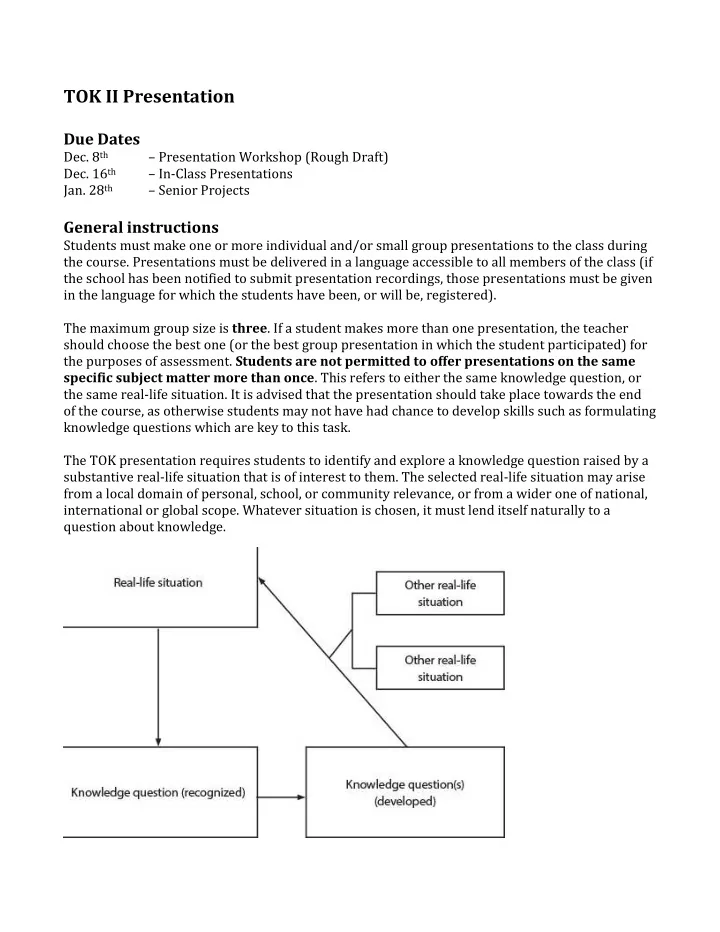
explanation from outside sources before the extracted knowledge question can be understood in context. The diagram indicates that a successful presentation will have several dimensions.

  • The two levels in the diagram represent the students’ experiences in the TOK course (lower

level) and in the world beyond it (upper level). The connections between the levels demonstrate the relevance of TOK to life beyond the TOK classroom.

  • At the “real-world” level, there is the real-life situation from which a knowledge question must

be extracted.

  • This knowledge question, residing in the “TOK world”, must be developed using ideas and

concepts from the TOK course, and in this progression it is likely that other related knowledge questions will be identified and will play a part in taking the argument forward.

  • The product of this reflection can be applied back (during and/or after the development) to the

real-life situation at the “real-world” level.

  • In addition, the presentation should ideally aim to show how the process of application extends

beyond the original situation to others, thus demonstrating why the presentation is important and relevant in a wider sense. Presentations may take many forms, such as lectures, interviews or debates. Students may use multimedia, costumes, or props to support their presentations. However, under no circumstances should the presentation be simply an essay read aloud to the class. While pre- recorded inserts within a presentation are permissible, the presentation itself must be a live experience and not a recording of the presentation. If students incorporate the thoughts and ideas of others into the presentation, this must be acknowledged. Before the presentation, the individual or group must give the teacher a copy of the presentation planning document. This is part of the assessment procedure (see below). The document is not to be handed out to the audience.

The role of the teacher

In relation to the presentation, the teacher has three principal responsibilities:

  • to encourage and support the student(s) in the preparation of the presentation
  • to provide guidance on presentation skills
  • to assess the presentation using the presentation assessment instrument.

These responsibilities should be met through the following interactions.

slide-3
SLIDE 3
  • The student(s) should bring to an initial meeting with the teacher ideas for the selection of a

real-life situation and the formulation of a knowledge question. The teacher should advise, but the final decisions belong with the student(s). The eventual success of this process will depend on a consideration of how the presentation will develop, so a second planning meeting is permitted, if required. Often a variety of appropriate knowledge questions can be identified in the kind of real-life situations most students will want to discuss. Teachers should help them concentrate their efforts on a clearly formulated one.

  • A final meeting between student(s) and teacher can take place several days before the

presentation, in which the final structure of the presentation can be discussed. The presentation is intended as a positive learning experience for the audience, and therefore it is important that the quality of the product is monitored at this stage. Each real-life situation and knowledge question should be treated only once in a particular teaching group. In summary, the teacher should give the presenter(s) every opportunity to construct a presentation that will advance the aims of the TOK course for the class as a whole. The teacher may support students by guiding them towards suitable approaches but should not do their work for them. The date when each presentation is to take place should be given to students well in advance, to allow sufficient time for preparation of material.

Presentation duration

Approximately 10 minutes per presenter should be allowed, up to a maximum of approximately 30 minutes per group. Presentations should be scheduled to allow time for class discussion afterwards. Interaction and audience participation are allowed during the presentation, not just in follow-up discussion, but there must be an identifiable substantial input from the presenter(s) that is assessable.

Internal assessment documentation

Presentation planning document (TK/PPD)

Each student must complete and submit a presentation planning document (TK/PPD). The procedure is as follows.

  • The student will complete the student sections of the TK/PPD form.
  • The student will provide a hard copy to the teacher for reference during the presentation.
  • The student will subsequently give the presentation.
  • The teacher will authenticate each student’s form and add comments on the presentation.

The section to be completed by the student requires responses to the following.

slide-4
SLIDE 4
  • 1. Describe your real-life situation.
  • 2. State your central knowledge question.
  • 3. Explain the connection between your real-life situation and your knowledge question.
  • 4. Outline how you intend to develop your presentation, with respect to perspectives, subsidiary

knowledge questions and arguments.

  • 5. Show how your conclusions have significance for your real-life situation and beyond.

This should be presented in skeleton or bullet point form, typed in standard 12 font and not exceed 500 words. It is acceptable to include diagrams, as long as they are clearly related to the

  • text. It is not permitted to exceed the two sides of the TK/PPD form.

Participants in a group presentation must be given the same marks. In a group presentation, not every student need speak for the same amount of time, but it is the presenters’ responsibility to ensure that all members of the group participate actively and make comparable contributions. Moderation of internal assessment The procedure for uploading the TK/PPD form can be found in the Handbook of procedures for the Diploma Programme. Marks awarded by teachers for the presentation will be subject to moderation procedures through sampling of the associated TK/PPD forms that have been uploaded. The objective of this process is to judge whether the contents of the TK/PPD form justify the marks given by the teacher for the presentation. In addition, some schools in each session may be required to record some or all of their

  • presentations. These schools may be chosen:
  • at random, in order to examine the relationships between plans and performance
  • because students are producing excellent presentations which could be used for professional

development purposes

  • because an anomaly has been identified, for example, in the correlation between the marks for

the presentations and the essays of students. It is not necessary for schools to record presentations unless they are asked to do so, although it can be a useful exercise in order to standardize internal marking, where more than one teacher is involved.

slide-5
SLIDE 5

Assessment

Using global impression marking The method of assessing the essay on a prescribed title and the presentation in TOK judges each piece of work in relation to written descriptions of performance and not in relation to the work of

  • ther students.

The assessment of both tasks is envisaged as a process of holistic or global judgment rather than an analytical process of totalling the assessment of separate criteria. Although in the essay the assessment is presented as two aspects, they are integrated into five described levels of performance, allowing for variation in student performance across different parts of the overall

  • assessment. Because of the requirement for a reasonable mark range along which to differentiate

student performance, each markband level descriptor corresponds to a range of two different marks. Assessment judgments should in the first instance be made with reference to the level descriptors for typical characteristics. The possible characteristics underneath are intended as starting prompts for discussion and development of a shared vocabulary among examiners, moderators, teachers and students as to how work at each level might be described. The possible characteristics corresponding to a level of performance should not be thought of as a checklist of attributes; they are intended to function only as tentative descriptions, some of which may seem appropriate to apply to work at that level. The achievement level descriptors concentrate on positive achievement, although for the lower levels (zero is the lowest level of achievement) failure to achieve is included in the description. These level descriptors are designed to be used as a whole, and operate at a global level. It is to be understood that:

  • the described levels are not a checklist or necessary minimum
  • the different levels of performance are not discrete, and differences of degree are involved
  • different levels suggest typical performance, and there are always exceptions requiring

individual or case by case judgments

  • the performance of students can be uneven across different aspects, but it is the overall

impression that is most important. Examiners and moderators will use the levels of performance as the terms on which they make a judgment that draws on their knowledge of what students at this level can do with tasks of this

  • kind. How examiners and moderators will make a judgement about the level of performance

attained in a particular student response will vary. Essay examiners may make a decision in the course of reading the piece, and then review it and make a final judgment after completing a reading. Or they may register the comments and arguments of a student, read the essay as a whole and make a decision in retrospect. In either case

slide-6
SLIDE 6

the described levels are to be seen as global and holistic rather than a checklist of necessary

  • characteristics. Examiners will make judgments about individual pieces of work by taking into

account and evaluating the distinctive characteristics of a particular script. Presentation moderators will similarly endeavour to reach a holistic judgment based on the responses of the student(s) and teacher on the TK/PPD form. The markbands for each assessment task in effect represent a single holistic criterion applied to the piece of work, which is judged as a whole. The highest descriptor levels do not imply faultless performance and examiners and teachers should not hesitate to use the extremes if they are appropriate descriptions of the work being assessed.

Part 2: Presentation

The following diagram shows the question underpinning a global impression judgment of the TOK presentation.

slide-7
SLIDE 7

Presentation Rubric (IB)

Does the presenter succeed in showing how TOK concepts can have practical application?

Level 5 Excellent 9–10 Level 4 Very good 7–8 Level 3 Satisfactory 5–6 Level 2 Basic 3–4 Level 1 Elementary 1–2 Irrelevant The presentation is focused on a well- formulated knowledge question that is clearly connected to a specified real-life

  • situation. The

knowledge question is effectively explored in the context of the real-life situation, using convincing arguments, with investigation of different

  • perspectives. The
  • utcomes of the

analysis are shown to be significant to the chosen real-life situation and to

  • thers.

The presentation is focused on a knowledge question that is connected to a specified real-life

  • situation. The

knowledge question is explored in the context of the real-life situation, using clear arguments, with acknowledgement

  • f different

perspectives. The outcomes of the analysis are shown to be significant to the real-life situation. The presentation identifies a knowledge question that has some connection to a specified real- life situation. The knowledge question is explored in the context of the real-life situation, using some adequate arguments. There is some awareness of the significance of the outcomes of the analysis. The presentation identifies a knowledge question and a real-life situation, although the connection between them may not be convincing. There is some attempt to explore the knowledge

  • question. There

is limited awareness of the significance of the outcomes of the analysis. The presentation describes a real- life situation without reference to any knowledge question, or treats an abstract knowledge question without connecting it to any specific real- life situation. The presentation does not reach the standard described by levels 1–5 Some possible characteristics Sophisticated Discerning Insightful Compelling Lucid Credible Analytical Organized Pertinent Coherent Relevant Adequate Acceptable Predictable Underdeveloped Basic Unbalanced Superficial Derivative Rudimentary Ineffective Unconnected Incoherent Formless